

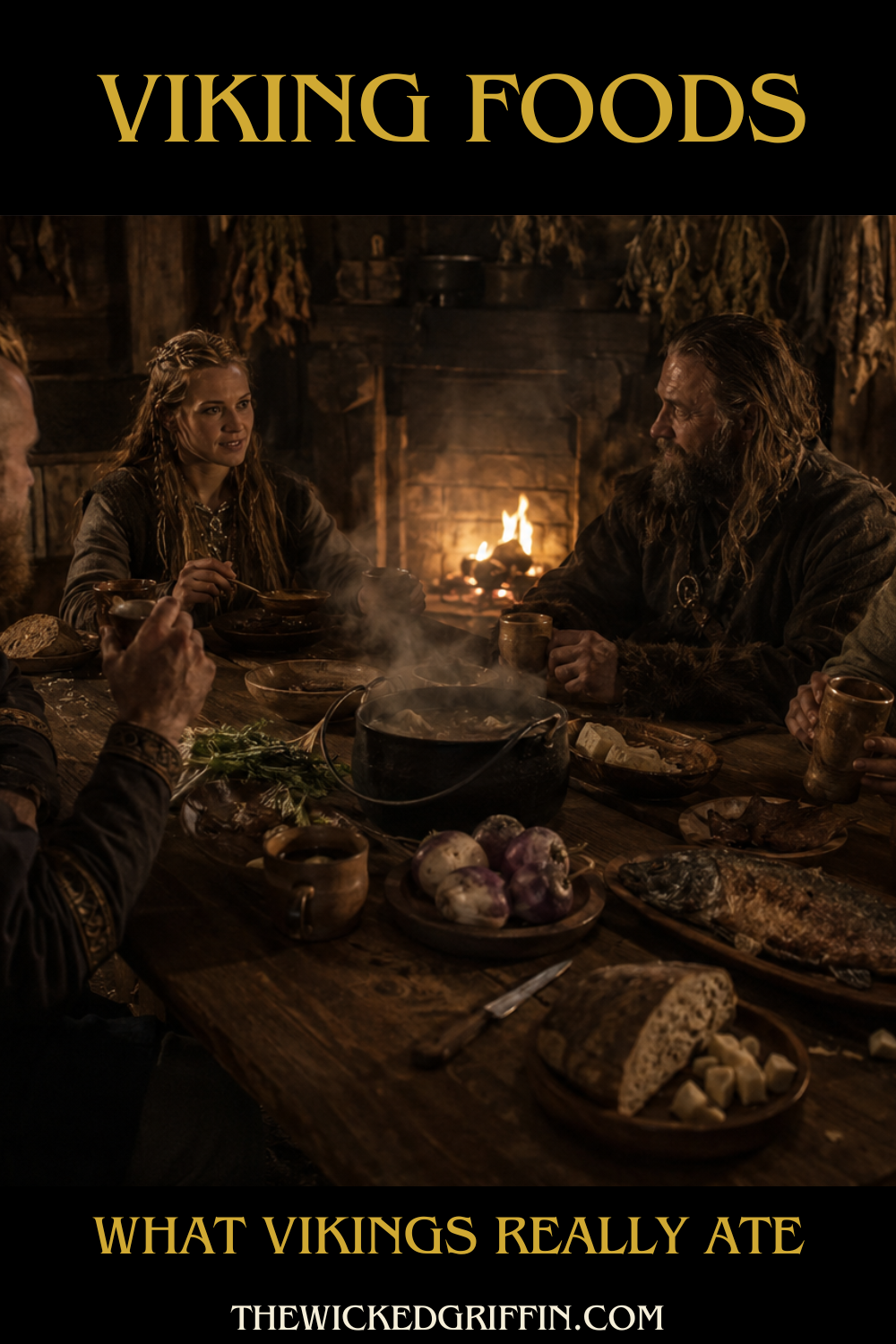
Viking Foods: What Vikings Really Ate in the Viking Age
Introduction To Viking Foods
Midsummer is here and we of course think of a rich Scandinavian table full of foods and dishes.
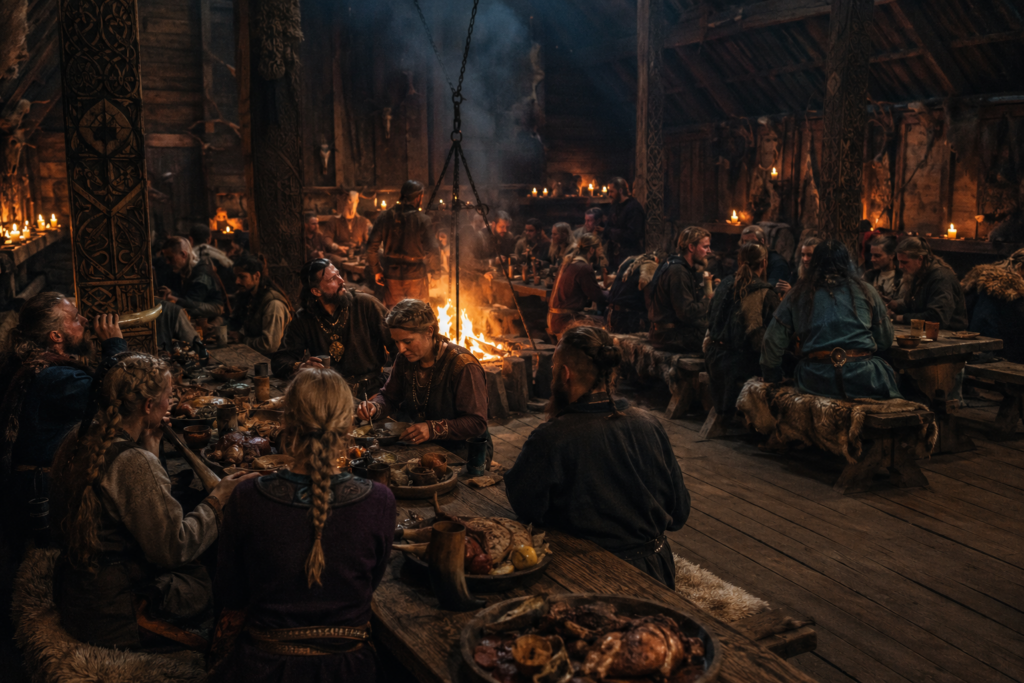
Drinking horns, roaring halls, roasted animals, and endless feasts. However, the real picture is quieter and, to my mind, more interesting.
People in the Viking Age ate from a working farm economy, from fishing, from gathered plants, and from stored winter supplies.
They did feast, and the sagas remember ale, cooked flesh, butter, cheese, porridge, and fish. Yet the safest way to talk about their diet is not to promise exact recipes.
It is better to speak about foods that can be traced through archaeology, plant remains, animal bones, preserved bread, and cautious reading of later medieval texts.
What Vikings Really Ate
The quality of the evidence matters here. A saga may name butter or horse meat, but a saga was usually written down after the period it describes.
A charred grain, a fish bone, or a loaf from a grave is less poetic, but it often gives us firmer ground. So this article treats Viking food as a set of attested ingredients and meal types, not as a kind of modern cookbook.
When a text and archaeology point in the same direction, confidence rises. When only a late story gives us a dish, we stay careful.
That means bread, porridge, ale, dairy, domestic animal products, fish, legumes, apples, berries, and nuts are strong candidates, but exact stews, sauces, and seasonings are harder to prove.
Food storage, quality and freshness
The everyday issue was not luxury, but survival across the year.
Modern shoppers can buy nearly anything in any season, but a household in Scandinavia had to plan around harvest time, slaughter time, milk production, fishing seasons, and winter storage.
The National Museum of Denmark describes a self supporting farm world where cereals, vegetables, milk products, fish, and animal products all mattered, and where preservation was a serious part of household work.
Fresh milk, berries, or fish would have been welcome when available, but quality and freshness were tied to timing. Drying, salting, souring, and storing were not rustic decoration. They were practical skills.
Bread and flatbread
Bread is one of the most reliable foods to include in our search for authentic and real Viking foods.
The National Museum of Denmark names rye and barley as the most important cereals, with oats, millet, and wheat cultivated too.
The same source notes that cereals were used not only for bread, but for porridge and beer.
Flatbreads are a safe public claim too, since the museum describes small breads made from flour, eggs, and water, baked in a pan or grilled over fire.
This gives us a useful picture of ordinary meals. However, bread was not always the soft loaf we imagine today. It could be coarse, dense, quick to cook, and shaped by the grain available in a given household.
Grain porridge
Porridge deserves its own place, since it is both practical and textually visible.
In the poem Hárbarðsljóð, Thor says he ate “herrings and porridge” before leaving home (Bellows, 1936, p. 123). This is not a household account book, of course.
It is mythic poetry, preserved in a medieval manuscript. Yet the food itself fits the wider evidence very well. Barley, oats, millet, and other grains could be boiled into a filling meal.
The National Museum of Denmark states that porridge could be made from barley, oats, buckwheat, or millet, and that berries and apples could be added for sweetness.
For a working person, porridge was plain, warm, and efficient.
Ale and mead
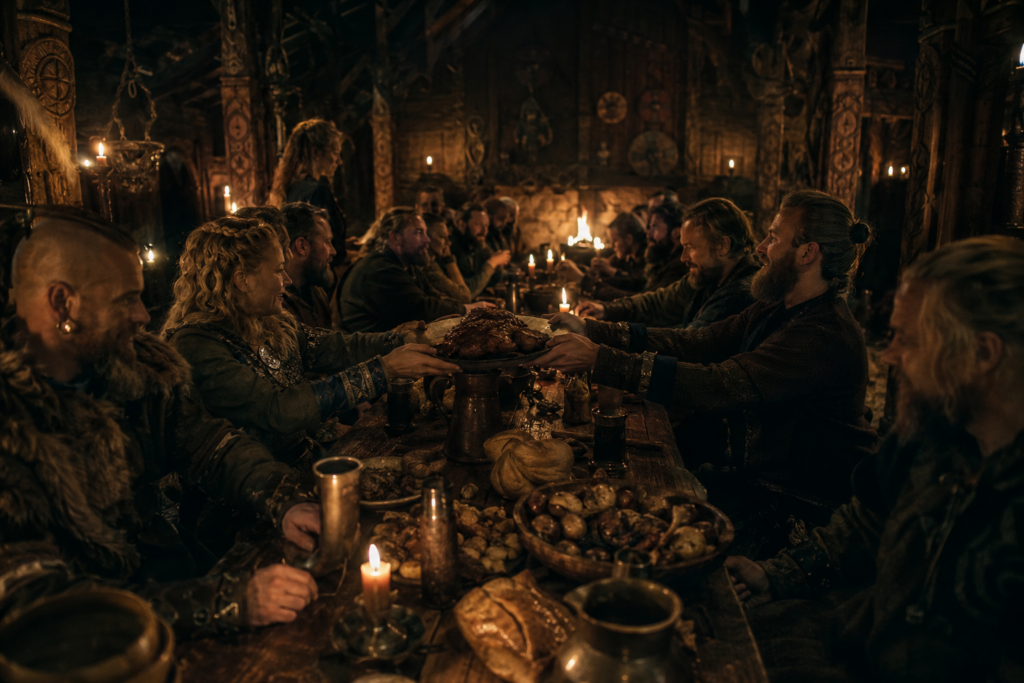
Ale is one of the strongest drink claims for the historical period of the Viking Age.
The National Museum of Denmark says beer was made from barley and consumed in both weak and strong forms, with strong beer served at festive occasions along with mead.
Snorri Sturluson’s Heimskringla gives a famous legal and ritual context when it says that every man should brew malt into ale for Yule (Snorri Sturluson, 1844, Hákonar saga góða, ch. 15).
Mead, made from honey, water, and spices, belongs in the discussion too, but barley ale is the safer everyday drink. Wine was known, but the museum treats it as an imported luxury for wealthier people .
Butter and cheese
Dairy was not a side detail. Milk from cows, goats, and sheep could be consumed, but it was especially valuable when preserved as butter and cheese.
The National Museum of Denmark says these products were important sources of fat during long winters, and that butter could be heavily salted for longer keeping.
Njáls saga gives a useful literary witness when Hallgerda orders stolen supplies and names butter and cheese among the goods, then the story describes cheese and butter appearing on the household table (Dasent, 1861, ch. 48).
The saga is later than the events it describes, but the items are ordinary enough to trust as part of the broader food culture.
Beef
Cattle had several lives before they became dinner.
They could work, produce milk, and then be slaughtered. To give a plain example: if an old cow was worn out, it was obvious what the household menu would contain in the following days.
The Heimskringla describes sacrificial feasts where cattle and horses were slaughtered and the flesh boiled for those present (Snorri Sturluson, 1844, Hákonar saga góða, ch. 16).
In other words, the consumption of beef was certainly real but not equally available to every person every day.
More importantly, cattle also represented wealth, work, milk, hide, horn, bone, and finally a large amount of edible meat.
Sheep, goats, and pork
Sheep and goats fit the same practical household pattern.
They gave milk, wool, skins, and eventually edible meat.
Pigs are different in one useful way. The National Museum of Denmark states that pigs were the only domestic animals kept solely for their meat.
That makes pork a strong item for the list. The same page names cattle, horses, pigs, sheep, goats, hens, geese, and ducks in a typical farming household.
The Viking Age table was not all roast boar and royal feasting. Much of it came from careful use of domestic animals across their whole lives.
Horse Meat
Horse meat is one of the more sensitive and culturally loaded items.
However, It should not be presented as an ordinary sandwich filling or as a fun novelty recipe. It appears most clearly in ritual and feast settings.
The National Museum of Denmark says horse meat was eaten on festive occasions and points to Hákonar saga góða, where horse flesh is linked with soup.
For instance, in the Heimskringla we find that King Hakon is pressed to eat horse flesh, drink soup, or at least taste gravy, and later he takes bits of horse liver at a Yule feast (Snorri Sturluson, 1844, Hákonar saga góða, chs. 18–19).
This is strong evidence for the food, but not proof of daily habit.
Herring
Herring is one of the safest fish foods to include in our discovery of authentic Viking foods.
The Hárbarðsljóð passage already gives us “herrings and porridge” as a memorable meal image (Bellows, 1936, p. 123).
The National Museum of Denmark says the inhabitants of Hedeby had fish as a major source of nourishment according to al Tartushi, and that herring was probably preserved in brine (National Museum of Denmark, n.d.-d, para. 5).
This matters for readers who imagine only smoked flesh and feast halls.
Coastal and trading communities could rely heavily on fish. A Herring was small, oily, abundant in many waters, and well suited to preservation. It belongs near the center of any careful discussion of Viking Age eating.
Dried cod and other preserved fish
Cod and related fish belong beside herring, especially in the North Atlantic and in long distance supply.
The National Museum of Denmark notes that fish and animal products were dried and salted for long keeping, and it lists fish bones, nets, metal hooks, and eel spears among the archaeological signs of fishing.
Ancient DNA research has strengthened the case for movement of preserved cod products in the period.
Star and colleagues traced Viking Age cod remains from Haithabu in Germany to Arctic origins, which points toward a northern fish supply moving into trading networks (Star et al., 2017, pp. 9152–9157).
This does not mean every household ate imported cod. It means preserved marine fish was historically real.
Peas and broad beans
Peas and broad beans may sound less dramatic than a drinking hall, but they matter and are just equally as important.
Archaeobotanical work on southern Scandinavian garden plants places legumes among the attested plant foods of the Viking Age, including pea and broad bean finds across several sites (Sloth et al., 2012).
Legumes could add substance to meals and could work with grain foods.
They may have appeared in boiled dishes, in mixed grain foods, or in flour mixtures. We should not pretend to know one standard recipe.
The safer claim is simpler and stronger: pulses were part of the cultivated plant base, and they deserve a place on the table.
Cabbage, onions, and garden greens
Cabbage and onions are best handled more carefully.
They are attested, but plant remains do not survive equally well, and some garden crops leave a thinner archaeological signal than grains, nuts, or bones.
Sloth, Hansen, and Karg treat cabbage and onion as part of the Viking Age garden plant evidence from southern Scandinavia, yet the exact place of these plants in everyday cooking is harder to reconstruct than bread or fish (Sloth et al., 2012).
This makes them useful, but not a place for overconfident recipes. A plain boiled meal, a pottage, or a cooked mixture with greens is plausible. A named “authentic Viking stew” is not secure.
Apples, berries, and hazelnuts
Sweetness did not always come from sugar.
The National Museum of Denmark names raspberries, bilberries, plums, wild apples, hazelnuts, and some walnuts as foods available from woods and local surroundings.
Apples and berries could sweeten porridge, and nuts offered fat and energy.
Sloth and colleagues place apples, hazelnuts, and several gathered fruits within the archaeobotanical picture of southern Scandinavia (Sloth et al., 2012).
These foods are useful for readers interested in lore and myth too, since apples carry mythic meaning through Iðunn.
The historical point remains simpler: people gathered and ate fruits, berries, and nuts when the season allowed, then dried or stored what they could.
What not to claim too confidently
We have discussed the consumption of bread, porridge, ale, dairy, domestic animal products, fish, legumes, alliums, apples, berries, and nuts with good confidence.
However, we should be more careful with exact recipes, fancy named dishes, and modern reconstructions.
A dish can be inspired by the Viking Age without being directly attested. That distinction is important and necessary since the real evidence shows a practical, seasonal, skilled household culture rather than a theme party menu.
Viking foods should mean the foods we can trace with fair evidence, not every rustic Nordic dish that feels old.
The clearest picture is built from grains, bread, porridge, barley ale, preserved dairy, cattle, sheep, goats, pigs, ritual horse flesh, herring, cod, peas, beans, garden plants, apples, berries, and hazelnuts. Some of these foods were everyday staples.
Some belonged more to feasts, trade, or seasonal work.
All of them remind us that the Viking Age was not just raiding and myth. It was farming, fishing, storing, brewing, sharing, and making the most of what the land and sea could give.
References
Bellows, H. A. (Trans.). (1936). The Poetic Edda. American Scandinavian Foundation.
Dasent, G. W. (Trans.). (1861). The story of Burnt Njal: From the Icelandic of the Njáls saga. Edmonston and Douglas.
National Museum of Denmark. (n.d.-a). Viking food. National Museum of Denmark.
National Museum of Denmark. (n.d.-b). Bread and porridge in the Viking Age. National Museum of Denmark.
National Museum of Denmark. (n.d.-c). Beer and mead in the Viking period. National Museum of Denmark.
National Museum of Denmark. (n.d.-d). Meat and fish in the Viking Age. National Museum of Denmark.
National Museum of Denmark. (n.d.-e). Fruit and berries in the Viking Age. National Museum of Denmark.
Sloth, P. R., Hansen, U. L., & Karg, S. (2012). Viking Age garden plants from southern Scandinavia: Diversity, taphonomy and cultural aspects. Danish Journal of Archaeology, 1(1), 27–38.
Snorri Sturluson. (1844). Heimskringla; or, the chronicle of the kings of Norway (S. Laing, Trans.). Longman, Brown, Green, and Longmans. Original work composed ca. 1230.
Star, B., Boessenkool, S., Gondek, A. T., Nikulina, E. A., Hufthammer, A. K., Pampoulie, C., Knutsen, H., André, C., Nistelberger, H. M., Dierking, J., Petereit, C., Heinrich, D., Jakobsen, K. S., Stenseth, N. C., & Barrett, J. H. (2017). Ancient DNA reveals the Arctic origin of Viking Age cod from Haithabu, Germany. Proceedings of the National Academy of Sciences, 114(34), 9152–9157. doi:10.1073/pnas.1710186114.