
The Sun in Mythology: Ancient Solar Deities of Prehistoric Europe
The Sun in Mythology:
It is easy to imagine one shining sun god seated above the clouds, ruling the day with a golden face and a blazing crown.
The older Indo-European material gives us something stranger, richer, and more moving.
The Sun could be a deity, a goddess, a wheel, a chariot, a ship-borne power, a watched-over treasure, and a presence whose return mattered to the order of the world (West, 2007, pp. 198, 201, 207; Kristiansen, 2012, p. 69).
For Bronze Age northern Europe, we must begin with care, since we do not have written myths from the people who carved ships, wheels, animals, and solar signs into stone.
Our strongest prehistoric evidence is visual and archaeological, and our fuller stories come much later, often through medieval Christian manuscripts, so the safest path is to study repeated motifs rather than pretend we can recover one perfect Bronze Age tale word for word (Etheridge, 2012, pp. 119–121; Kristiansen, 2012, p. 69).
This article follows a narrow but beautiful thread through Indo-European and northern European mythology.
We will examine ideas such as the all-seeing Sun, the solar wheel and sun chariot, the Bronze Age voyage of the sun, the Sun Maiden and Divine Twins, the solar animals, the sun stag, and the later Norse figures of Sól and Máni.
By the Viking Age, many of the old solar patterns still glimmer, but they have changed shape after centuries of religious and social transformation (Kristiansen & Larsson, 2005, p. 365; Etheridge, 2012, pp. 123–125).
Table of Contents
The Sun in Indo-European Mythology
The Sun as an All-Seeing Deity
One of the strongest Indo-European patterns is the idea that the Sun sees everything, not in a vague poetic sense, but as a divine witness to human action and cosmic order.
West describes the Sun as a being associated with omniscience, watching conduct and functioning as a kind of divine eye over the world (West, 2007, p. 198).
That detail matters, since it keeps the Sun from becoming a simple decoration in the sky or a flat symbol of warmth.
In this older mythical thinking, the personification of the sun could stand close to judgment, truth, order, and moral visibility, which means the Sun was not only bright but aware (West, 2007, p. 198).
For a reader used to later gods and goddesses with names, temples, and tidy family trees, this may feel less familiar than a single god of the sun in a fixed pantheon.
Yet in the older Indo-European frame, the Sun often appears through roles and images: the watcher, the traveler, the returning light, the celestial power who binds the day together (West, 2007, pp. 198, 201).
Wheel, Chariot, Boat, and the Motion of the Sun
Solar myth has to answer a simple question with deep roots: how does the Sun move across the sky and return after nightfall?
West shows that Indo-European traditions preserve several answers at once, including the Sun as a wheel, the Sun carried by a wheel, the Sun drawn by horses, the Sun set in a chariot, and the Sun borne by a boat (West, 2007, p. 201).
This cluster of images is one reason Bronze Age European art can feel so alive, even when no written caption survives beside it.
Wheels, discs, horses, ships, and shining signs are not random ornaments when they appear around solar imagery; they belong to a mythic vocabulary for movement, return, danger, and renewal (West, 2007, pp. 201, 207).
The solar boat is especially useful for northern Europe, since West points to Bronze Age Scandinavian art where ships are joined with solar wheels or discs.
This does not mean every ship carving is automatically a solar myth, but it does mean that the ship could serve as a serious representation of the sun in motion, especially in the northern Bronze Age visual world (West, 2007, p. 207).
The Sun’s Family: Daughters, Marriage, and Twin Helpers
The Sun in Indo-European mythology is not only a light in the heavens; it can belong to a family story, with daughters, marriages, twin figures, and ritual meanings.
West connects songs of the Sun’s daughter with Baltic and wider Indo-European tradition, noting that such songs were sung at weddings and that celestial marriage could serve as a cosmic model for human marriage (West, 2007, pp. 229, 234–235).
This is where the older material begins to feel like a fireside story rather than a chart of symbols.
The Daughter of the Sun may enter the chariot of twin brothers, and the whole pattern draws together beauty, desire, seasonal rhythm, marriage, and renewal (West, 2007, pp. 234–235).
For our purposes, the Sun’s daughter is one of the gentlest bridges between comparative Indo-European evidence and Bronze Age northern Europe.
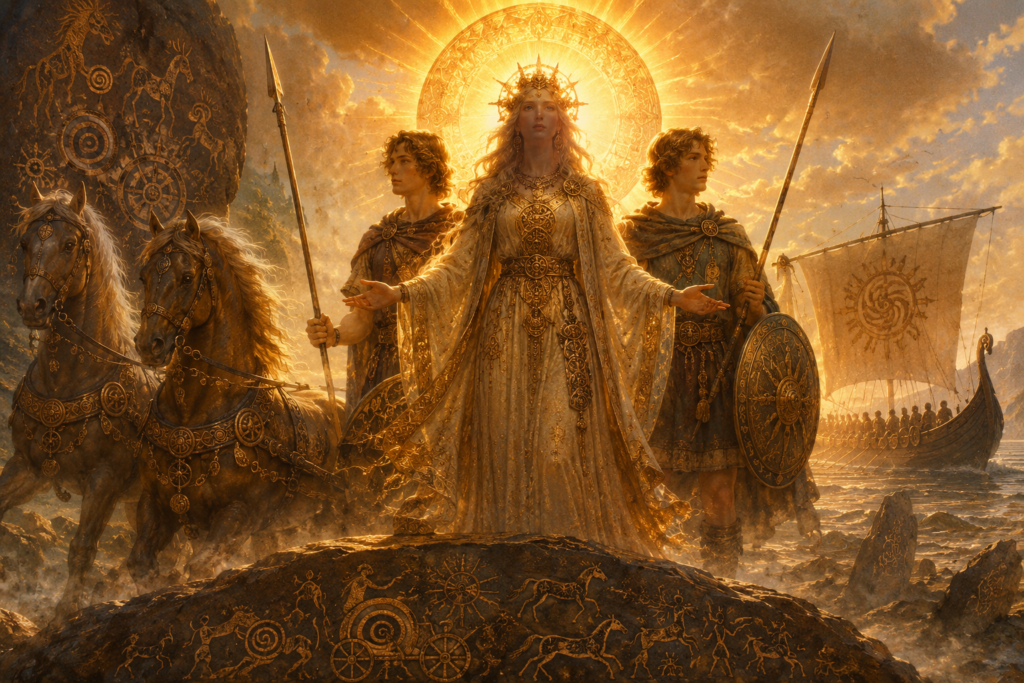
She helps us understand why later scholars speak of a Sun Maiden, twin helpers, horses, ships, and cosmic rescue as parts of one older solar complex, rather than as isolated pieces with no shared story behind them (West, 2007, pp. 234–235; Kristiansen, 2012, p. 69).
Bronze Age Scandinavia and the Sun Journey
Reading Rock Art Without Pretending It Is a Written Text
Bronze Age rock art in South Scandinavia gives us some of the most powerful solar imagery in prehistoric Europe, but it must be read with patience.
Kristiansen argues that these carvings preserve scenes from a wider Indo-European myth about the Sun Maiden, her twin brothers, and her helpers, who come to her aid in forms such as ships and horses so that the Sun can rise again (Kristiansen, 2012, p. 69).
That claim is vivid, but it is still an interpretation of images, not a direct translation of a lost poem.
A careful reader can accept the pattern without pretending that every carved ship, horse, or disc gives us a complete mythic sentence from the Bronze Age (Kristiansen, 2012, p. 69; Etheridge, 2012, pp. 119–121).
This is a better way to approach prehistoric sun worship than imagining a simple crowd praying to one golden object in the sky.
The images suggest a moving sacred drama, where the Sun needs helpers, vehicles, protection, and passage through dangerous thresholds between night and day (Kristiansen, 2012, pp. 69, 72–73).
The Helpers of the Rising Sun
Kristiansen’s reading becomes especially useful when he discusses the Sun’s helpers in Bronze Age imagery.
Drawing on Kaul’s work with the razor corpus, he identifies horse, bird, fish, and snake as beings connected with the solar cycle, not merely as decorative animals placed around the Sun by chance (Kristiansen, 2012, pp. 72–73).
This gives us a wonderfully textured picture of Bronze Age solar myth.
The rising sun is not simply pulled by one horse forever; instead, the Sun’s passage may involve different animal helpers, different vehicles, and different moments in the cycle from dawn to night and back again (Kristiansen, 2012, pp. 72–73).
Such imagery lets us feel the old story without overclaiming it.
The Sun moves through a world of horses, birds, fish, snakes, ships, and signs, and each helper may belong to a particular stage in the daily and nightly journey (Kristiansen, 2012, pp. 72–73).
The Trundholm Sun Chariot
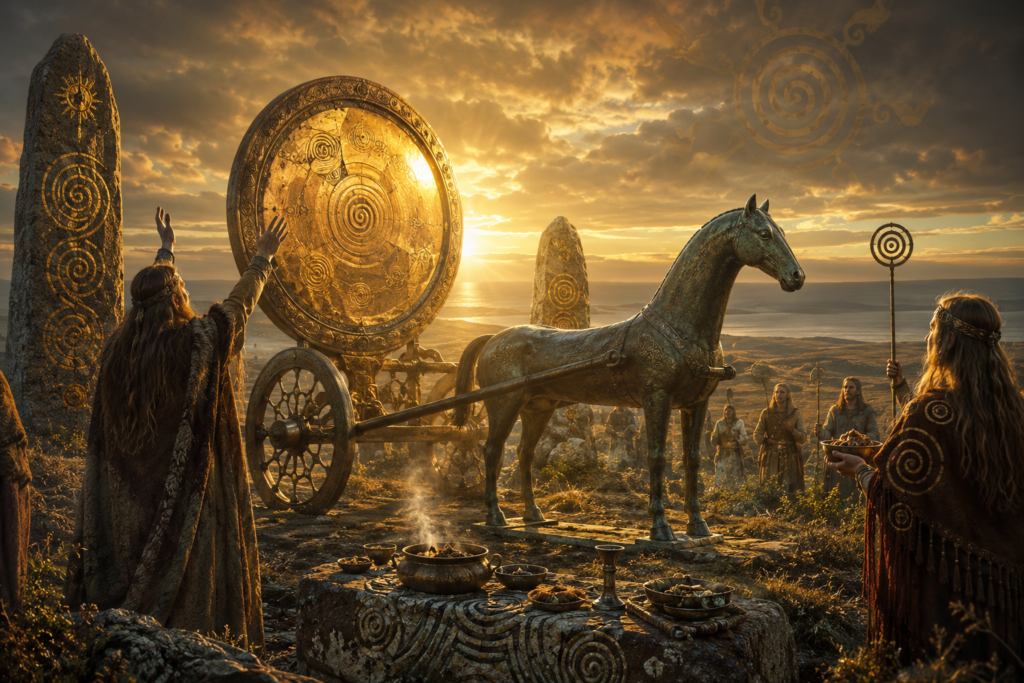
The Trundholm Sun Chariot is one of the clearest and most haunting objects in this whole subject.
Etheridge dates it to roughly 1400 BCE and describes it as a horse drawing a solar disc, with one bright side and one dark side that suit a mythic reading of day, night, and cyclical passage (Etheridge, 2012, p. 123).
For a modern reader, this object can feel like a small bronze doorway into the old mythic imagination.
It gives physical form to the chariot of the sun, the horse-drawn movement of the solar disk, and the idea that the Sun’s daily journey had a visible bright side and a hidden dark side (Etheridge, 2012, p. 123; West, 2007, p. 201).
The Trundholm object does not prove every detail of a Bronze Age story, but it does anchor the larger pattern in material form.
When West’s Indo-European solar wheel and horse-drawn chariot are placed beside Etheridge’s discussion of the Trundholm Sun Chariot, the Bronze Age evidence begins to look less like scattered fragments and more like a coherent symbolic language (West, 2007, p. 201; Etheridge, 2012, p. 123).
The Death-Sun and the Blessed Dead
The Sun as More Than a Giver of Life
It is a widespread belief to think of the Sun as a giver of life, and that association is certainly easy to understand in any farming world.
Yet Valent, Jelínek, and Lábaj argue that Bronze Age Central and Northern Europe may also have linked the Sun with death, blessed souls, and a destination reached during the Sun deity’s night journey (Valent et al., 2021, pp. 5–6).
Their study proposes that some Bronze Age communities imagined the souls of the blessed dead as “going to the Sun,” probably to an island connected with the deity’s nocturnal course.
This makes the Sun more than a source of warmth or health and energy; it becomes a power connected with the fate of the dead and the hope of passage beyond ordinary life (Valent et al., 2021, pp. 5–6).
This interpretation should be presented as a current scholarly proposal, not as settled fact for every Bronze Age community.
Its value is that it opens the solar myth to dusk, burial, memory, and the quiet road after death, not only to daylight and growth (Valent et al., 2021, pp. 5–6).
A Feminine Solar Deity in Bronze Age Europe
Valent, Jelínek, and Lábaj also argue that Bronze Age Central and Northern Europe knew a feminine, anthropomorphic solar deity.
Their reading matters for anyone who assumes that every major solar figure must be a male sun god, since the evidence they discuss points instead toward a sun goddess or feminine deity of the sun in parts of Bronze Age Europe (Valent et al., 2021, pp. 5–6).
This connects beautifully with the later northern figure of Sól, a female Sun in medieval Old Norse material, though the relationship between Bronze Age and Viking Age ideas should not be flattened into a simple line of direct survival.
The better claim is that feminine solar figures appear in both Bronze Age scholarly reconstruction and later northern tradition, with much transformation between them (Valent et al., 2021, pp. 5–6; Etheridge, 2012, pp. 123–125).
For readers who love the mystical side of mythology, this is one of the loveliest parts of the topic.
The Sun may be imagined not only as a blazing lord or abstract force, but as a goddess of the sun, a traveling figure, and perhaps a guide whose path crosses the borders of life, night, and death (Valent et al., 2021, pp. 5–6).
The Divine Twins and the Sun Maiden
Twin Rescuers in a Solar Drama
The Divine Twins are one of the clearest examples of how comparative mythology can help us read northern European material without pretending that Scandinavia and India were identical.
Kristiansen and Larsson argue that a Vedic-style Divine Twin myth can be used to interpret Scandinavian Bronze Age imagery, especially in structured contexts such as the Sagaholm barrow (Kristiansen & Larsson, 2005, pp. 329–330).
They summarize a Vedic myth involving the mare-formed wife of the Sun and the birth of the twins, then suggest that ships, horses, mating scenes, and twin imagery in Scandinavian Bronze Age contexts fit into a related Indo-European pattern.
In their reading, two ships can symbolize the twins’ role as rescuers of ships and sailors, which places solar myth close to travel, danger, and deliverance (Kristiansen & Larsson, 2005, pp. 329–330).
This does not mean a Bronze Age Scandinavian storyteller would have recited the Vedic version we know from India.
It means that related Indo-European motifs may help explain why northern rock art and burial imagery often feels narrative, with repeated pairings, vehicles, animals, and solar signs arranged as though something is happening (Kristiansen & Larsson, 2005, pp. 329–330; Kristiansen, 2012, p. 69).
The Sun Maiden and the Marriage of Worlds
West’s discussion of the Daughter of the Sun gives the Sun Maiden complex a wider Indo-European setting.
He connects the figure with wedding songs, seasonal celebration, twin brothers, and celestial marriage, where the drama of the heavens becomes a model for human ritual life (West, 2007, pp. 229, 234–235).
The Sun is no longer only the great light above the fields, but part of a family drama involving a daughter, a wedding, horses, and renewal at the level of both cosmos and community (West, 2007, pp. 229, 234–235).
For the reader, the Sun Maiden is best understood as a motif rather than a single fixed character with one fixed biography.
She belongs to a recurring mythic pattern in which the Sun’s power is imagined through kinship, beauty, movement, seasonal ritual, and the help of twin figures (West, 2007, pp. 229, 234–235; Kristiansen, 2012, p. 69).
Why the Bronze Age Does Not Look Exactly Like the Viking Age
Kristiansen and Larsson make a bold historical point: the Divine Twins and Sun Maiden appear weak and marginal in later Nordic mythology, which suggests heavy transformation during the Iron Age.
They even argue that Nordic Bronze Age religion stands much closer to Vedic religion than to the later Nordic religion recorded in medieval sources (Kristiansen & Larsson, 2005, p. 365).
That claim helps us avoid a common mistake. Bronze Age Scandinavian solar religion may feel “Norse-adjacent” to modern readers, but it should not be treated as a simple early draft of Viking Age Norse mythology (Kristiansen & Larsson, 2005, p. 365).
A good way to picture the change is to imagine old solar themes passing through many generations of new rituals, new elites, new stories, and new religious priorities.
By the time we reach the medieval records of Germanic mythology, the old Bronze Age solar drama has not disappeared, but it has been compressed, rearranged, and partly overshadowed by later mythic systems (Kristiansen & Larsson, 2005, p. 365; Etheridge, 2012, pp. 123–125).
Solar Animals in Northern Europe
Horses, Birds, Fish, and Snakes
The horse is the easiest solar animal to notice, especially once we have the Trundholm Sun Chariot in mind.
Yet Kristiansen’s reading of Bronze Age imagery places the horse alongside bird, fish, and snake as helpers within the solar cycle.
Consequently, this makes the mythic world more fluid and more alive than a single horse pulling a single cart forever (Kristiansen, 2012, pp. 72–73; Etheridge, 2012, p. 123).
Each animal seems to make sense within a world where the Sun must pass through different zones.
A bird can belong to the upper air, a fish to the watery deep, a snake to the dark or liminal passage, and a horse to the visible, powerful movement of the day, though the exact narrative details remain matters of interpretation (Kristiansen, 2012, pp. 72–73).
This is one of the strongest places to feel the “mythic grammar” of Bronze Age northern Europe.
The Sun’s course is not only astronomy; it is a story of helpers, thresholds, creatures, and return (Kristiansen, 2012, pp. 72–73).
The Sun Stag and the Hunted Light
The sun stag material belongs to a later and more text-based northern discussion, and it needs careful phrasing.
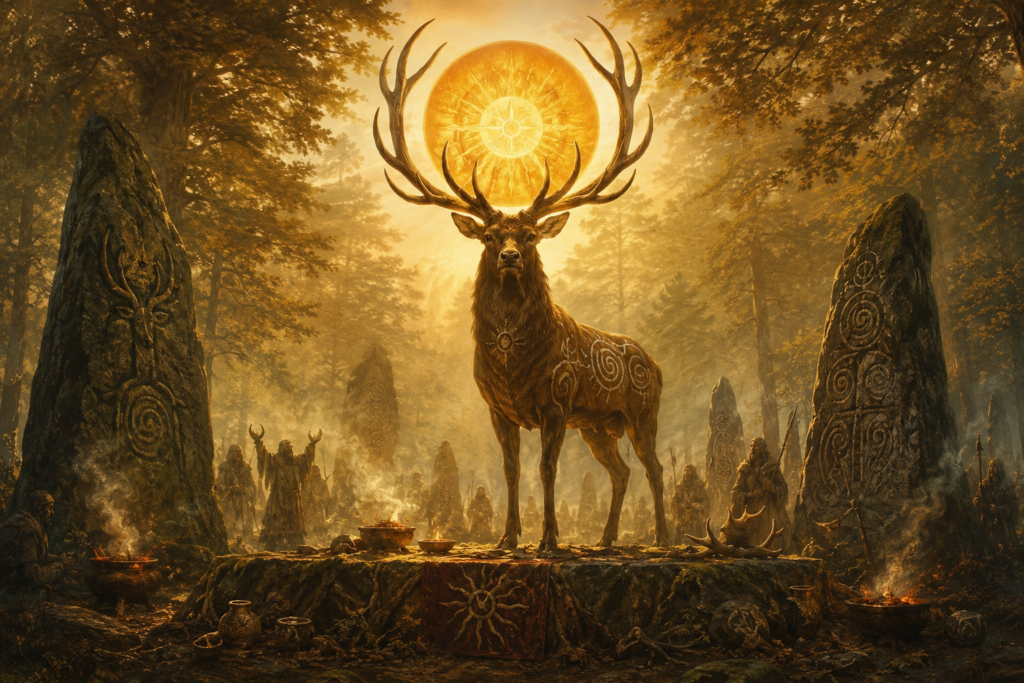
Pettit argues that Freyr’s solar aspect informs his association with the stag and that this connection extends to Hroðgar through Heorot, the “Hart” hall, placing solar stag imagery beside northern myths of wolf-like beings hunting the Sun (Pettit, 2020a, p. 235).
This reading is not something every scholar would state in exactly the same way, so it is best presented as Pettit’s interpretation rather than a universal rule of northern mythology.
Still, it gives the reader a powerful image: the Sun as radiant, horned, animal-linked, and hunted by forces that threaten cosmic light (Pettit, 2020a, pp. 235, 251–255).
Pettit’s later chapter on Sólarljóð deepens the pattern by reading two stanzas as referring to a buried, probably solar antler, and he notes the poem’s phrase sólar hjört, “the sun’s stag” or “a stag of the sun.”
He then interprets the hjartarhorn, the hart’s horn brought from a burial mound, as a solar symbol of unusual depth within the poem (Pettit, 2020b, pp. 315–317).
Wolves, Pursuit, and the Danger Around the Sun
The northern solar imagination does not present the Sun only as peaceful warmth.
Pettit’s chapter links solar stag imagery with the hunt for the Sun and with figures such as Skǫll, Hati, and Mánagarmr, which places the solar theme inside a dramatic world of pursuit and threat (Pettit, 2020a, pp. 235, 251–255).
Etheridge gives the later Old Norse version of this danger in a more astronomical-mythic frame.
In the Eddic material he surveys, Sun and Moon move through the heavens in chariots, and wolves pursue them until the apocalypse (Etheridge, 2012, pp. 123–125).
That image gives the old solar journey a darker edge.
The Sun travels, but it is not safe; it shines, but it is chased; it returns, but its return belongs to a cosmic order that can be threatened (Etheridge, 2012, pp. 123–125; Pettit, 2020a, pp. 251–255).
From European Prehistory to the Viking Age
Sól, Máni, and the Sun and Moon
By the Viking Age, the old solar vocabulary had changed, but it had not vanished.
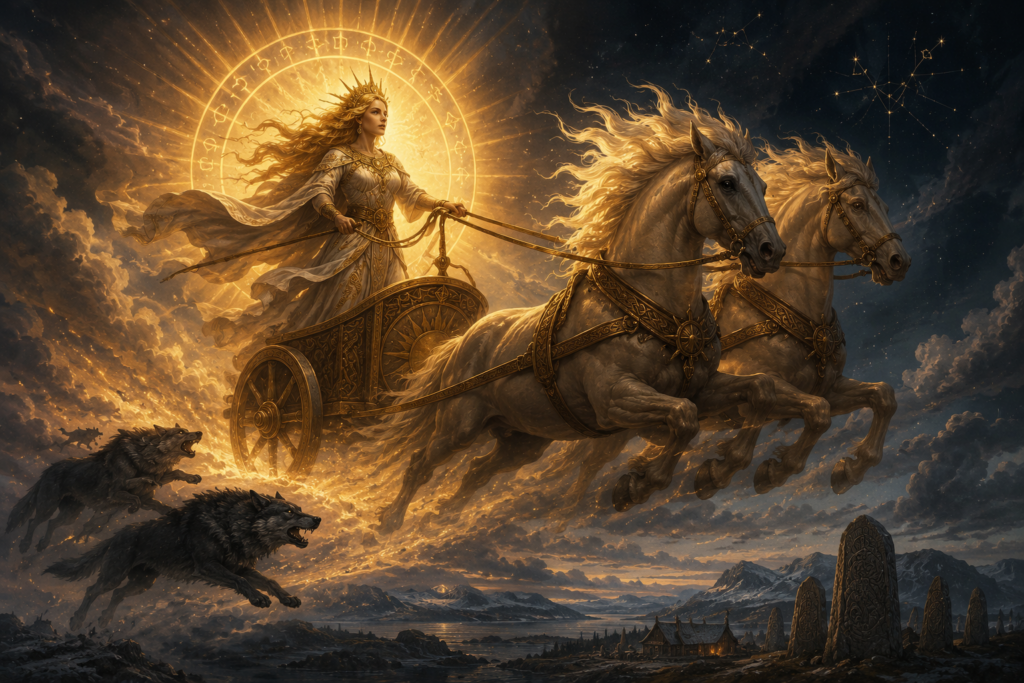
Etheridge notes that the surviving Old Norse material preserves a female Sun, Sól, and a male Moon, Máni, each set in motion through the heavens in chariots (Etheridge, 2012, pp. 123–125).
This is a striking reversal for readers who expect the Sun to be male and the Moon to be female.
In this northern material, the sun and moon are personified differently: the Sun is female, and the Moon is male, so a simple global formula of “sun god and moon goddess” does not fit the Old Norse evidence (Etheridge, 2012, pp. 123–125).
Etheridge also notes that Sól’s chariot is drawn by two horses and that wolves pursue both the Sun and the Moon until the end-time drama.
The same source places this later mythic picture beside the much older Trundholm Sun Chariot, giving us a long-lived pattern of horse-drawn solar movement in Scandinavian tradition (Etheridge, 2012, pp. 123–125).
A Female Sun in Norse Mythology
The female Sun of the Old Norse sources gives the blog reader a valuable correction to the habit of assuming every solar deity must be male.
Sól is not presented as a generic light-symbol, but as a named female figure whose movement through the heavens belongs to a mythic system of chariots, horses, wolves, and cosmic time (Etheridge, 2012, pp. 123–125).
This does not mean that Sól is simply the same sun goddess reconstructed for Bronze Age Europe.
It means that feminine solar imagery appears in both the Bronze Age scholarly proposal discussed by Valent, Jelínek, and Lábaj and the later Old Norse material discussed by Etheridge, with long transformation between them (Valent et al., 2021, pp. 5–6; Etheridge, 2012, pp. 123–125).
The result is more interesting than a single unbroken tradition.
We can speak of continuity in motifs, such as a feminine Sun, horses, chariots, movement, and danger, but we should speak more carefully about continuity in theology, ritual, and story (Kristiansen & Larsson, 2005, p. 365; Etheridge, 2012, pp. 123–125).
What Survived, and What Changed
The strongest continuity from the Bronze Age to the Viking Age lies in images and roles.
The Sun moves, the Sun is carried, the Sun can be feminine, the Sun is linked with horses, and the Sun belongs to a cosmic drama of danger, order, and return (West, 2007, pp. 201, 207; Etheridge, 2012, pp. 123–125).
The strongest change lies in the larger religious system.
Kristiansen and Larsson argue that the Sun Maiden and Divine Twins became weak and marginal in later Nordic mytholog.
This strongly suggests that the Bronze Age solar complex was not preserved whole into the medieval Norse texts (Kristiansen & Larsson, 2005, p. 365).
This gives us a grounded way to speak about European prehistoric cultures without turning them into fantasy.
The Viking Age inherited some old solar motifs, but the Bronze Age world of ships, twins, Sun Maiden, animal helpers, and solar rescue had already passed through many centuries of change (Kristiansen & Larsson, 2005, p. 365; Kristiansen, 2012, pp. 69, 72–73).
What We Can Say Carefully
Stronger Points in the Evidence
The Indo-European Sun is often an all-seeing deity tied to moral and cosmic order; solar movement is imagined through wheels, horses, chariots, and boats; and Bronze Age Scandinavian imagery strongly favors a mobile solar world of discs, ships, horses, and animal helpers (West, 2007, pp. 198, 201, 207; Kristiansen, 2012, pp. 69, 72–73).
It is also safe to say that later Old Norse material preserves a female Sun, a male Moon, chariots, horses, and wolves pursuing the heavenly lights.
Etheridge’s study gives us this later frame, and it lets us compare Viking Age material with older Scandinavian solar imagery without pretending that they are identical (Etheridge, 2012, pp. 123–125).
The sun stag and solar antler material can be used with care, especially when presented as Pettit’s text-rich interpretation.
Pettit connects Freyr, Heorot, solar stag imagery, the hunted Sun, and the Sólarljóð solar antler complex, but these readings should be introduced as scholarly arguments rather than plain facts agreed upon by every specialist (Pettit, 2020a, pp. 235, 251–255; Pettit, 2020b, pp. 315–317).
This carefulness does not make the story less magical.
It makes the wonder more honest, since the true beauty of prehistoric solar myth lies in the meeting place between stone, bronze, later poetry, comparative philology, and the patient work of reading what the past has left behind (Etheridge, 2012, pp. 119–121; Kristiansen, 2012, p. 69; West, 2007, pp. 198, 201, 207).
The Old Sun and the Mythic North
The old Sun of Indo-European and northern European myth was never only a lamp in the sky.
It could be all-seeing witness, feminine deity, sacred traveler, chariot-rider, ship-borne power, animal-guarded force, deathly guide, and endangered light pursued through the heavens (West, 2007, pp. 198, 201, 207; Valent et al., 2021, pp. 5–6; Etheridge, 2012, pp. 123–125).
That is why the Bronze Age material feels so powerful for anyone drawn to folklore and myth.
The carvings and objects do not hand us a neat storybook, but they do show a world where the Sun’s return was meaningful enough to be carved, cast, carried, buried, remembered, and reimagined (Kristiansen, 2012, pp. 69, 72–73; Etheridge, 2012, p. 123).
By the time we reach Sól and Máni in later northern tradition, the ancient solar drama has changed, but the glow remains.
The Sun still travels, still needs a path, still belongs to cosmic order, and still carries that deep human feeling that morning itself is a kind of rescue (Etheridge, 2012, pp. 123–125; Kristiansen & Larsson, 2005, p. 365).
References
Etheridge, C. (2012). A systematic re-evaluation of the sources of Old Norse astronomy. Culture and Cosmos, 16(1–2), 119–130.
Kristiansen, K. (2012). Rock art and religion: The sun journey in Indo-European mythology and Bronze Age rock art. Adoranten, 69–86.
Kristiansen, K., & Larsson, T. B. (2005). The rise of Bronze Age society: Travels, transmissions and transformations. Cambridge University Press.
Pettit, E. (2020a). Freyr, Heorot and the hunt for the solar stag. In The waning sword: Conversion imagery and celestial myth in Beowulf (pp. 235–286). Open Book Publishers.
Pettit, E. (2020b). The solar antler in Sólarljóð. In The waning sword: Conversion imagery and celestial myth in Beowulf(pp. 315–338). Open Book Publishers.
Valent, D., Jelínek, P., & Lábaj, I. (2021). The death-sun and the misidentified bird-barge: A reappraisal of Bronze Age solar iconography and Indo-European mythology. Zborník Slovenského Národného Múzea, 115(Archeológia 31), 5–43.
West, M. L. (2007). Indo-European poetry and myth. Oxford University Press.