

Viking Crafts and Craftsmanship: What Vikings Really Made, Wore, Traded, and Repaired
Viking Crafts: What Archaeology Really Shows They Made
When many people imagine Viking crafts, they picture a smoky hall, a hammer, a blade, and perhaps a carved dragon curling along the side of a ship.
That image is not completely wrong, but it is far too narrow for what archaeology has actually documented.
The Viking world was full of makers.
Farms, market towns, burial sites, ship finds, and wet urban deposits have given archaeologists a rich record of molds, crucibles, antler offcuts, loom weights, spindle whorls, leather scraps, repaired objects, and unfinished goods (Hilberg, 2009, pp. 93–94; McGraw & Mjærum, 2024, pp. 223–224).
This matters for a simple reason.
If we only imagine Vikings as raiders with weapons, we miss the hands that spun thread, shaped combs, cast ornaments, stitched shoes, split planks, mixed glass, and turned raw material into the lived texture of daily life.
Table of Contents

What Counts as a Viking Craft?
The safest way to define a Viking craft is to begin with the material evidence.
In this context Viking crafts means the skilled making, repairing, finishing, and decorating practices that can be traced through Viking Age archaeology, especially from the late eighth through the mid eleventh century.
That record is uneven.
Wood, leather, fur, and cloth survive best in waterlogged deposits, mounds, ship burials, and special preservation conditions, so some kinds of work are much easier to see than others (Mould et al., 2003, pp. 3185–3187; National Museum of Denmark, 2023, pp. 4–5).
The research matters here.
Archaeology lets us move beyond the romantic idea of a lone craftsman and ask better questions about tools, debris, raw materials, workshop floors, trade routes, and the difference between household labor and specialized production.

How Archaeologists Recognize Making
The Viking period grew out of the northern Iron Age, and the material record is full of continuity, experiment, and local variation.
A useful question is not simply, “Did they make this,” but “what trace would making leave behind?”
For metal, that trace might be slag, molds, crucibles, droplets, weights, and unfinished pieces.
For cloth, it might be loom weights, spindle whorls, needles, preserved fragments, and the slow work of reconstruction that tests how a fabric could have been made (National Museum of Denmark, 2023, pp. 4–5, 8–9).
For bone, antler, and leather, the waste can be as revealing as the finished object.
Offcuts, shoe parts, hide residues, comb plates, and species analysis help researchers see production in motion rather than only finished goods in a display case (Mould et al., 2003, pp. 3248–3257; Muñoz-Rodriguez et al., 2023, pp. 1, 11).
Household Work and Workshop Skill
One of the strongest patterns is that making happened on a spectrum.
Some work belonged to households, such as spinning, sewing, mending, and routine repair, but towns such as Ribe, Hedeby, and Kaupang show much denser evidence for specialist production (McGraw & Mjærum, 2024, pp. 223–224; National Museum of Denmark, 2023, pp. 8–9).
That distinction helps us avoid two bad extremes.
Viking society was not made of people who made absolutely everything at home, and it was not made only of professional urban specialists.
The better picture is more human.
Ordinary families repaired and produced what they could, and trained craftspeople in trade centers handled more demanding work such as casting, beadmaking, comb production, and complex metal objects.
Metalwork, Jewelry, and Exchange
Iron, Bronze, Silver, and Skill
Metalworking is one of the clearest craft categories in the archaeological record.
At Kaupang, McGraw and Mjærum studied evidence for both iron and non ferrous metalworking, including forging, casting, and composite objects, which suggests shared or flexible workshop practice rather than a simple one person, one material model (McGraw & Mjærum, 2024, pp. 210–211, 223–224).
Hedeby strengthens that evidence.
Hilberg describes houses and workshops near the shoreline, with areas tied to metal casting and glass production, and with molds for recognizably Scandinavian goods (Hilberg, 2009, pp. 89–94).
Hedeby’s 9th century evidence is valuable since it shows production, trade, and authority sitting close together.
Coin striking, copied dirhams, standardized weights, and casting evidence turn the town into more than a marketplace; it becomes a place where making and measuring value met (Hilberg, 2009, pp. 91–93).
This is where a brooch, a clasp, a fitting, or a weight becomes more than a pretty object.
A piece made from precious metal could be a sign of wealth, and gold or silver could move through exchange as a form of currency as much as ornament (Hilberg, 2009, pp. 91–93).

Ornaments, Belief, and Status
The famous Thor hammer pendant belongs to a larger world of ornament, identity, and belief.
A symbol tied to the god of thunder could be worn on the body, but the archaeological question is always more grounded: what metal was used, how was it cast, who had access to it, and where was it traded?
This is where viking art enters the conversation.
To the modern reader, we may know art styles such as oseberg style, borre style, jelling style, ringerike style, and urnes style, or may recognize a gripping beast, a gripping beast motif, and animal and plant motifs on decorated objects.
Borre and Jelling can guide the eye toward ornament, but those art styles do not replace evidence for production.
A mold, crucible, rivet, repair mark, or casting flaw tells us something different: it lets us see the maker’s problem, the maker’s technique, and the hands behind the design.
That difference matters for readers who love mythology and visual symbolism.
The decorated surface can tell us what a community found beautiful, but the workshop trace tells us how beauty was made.
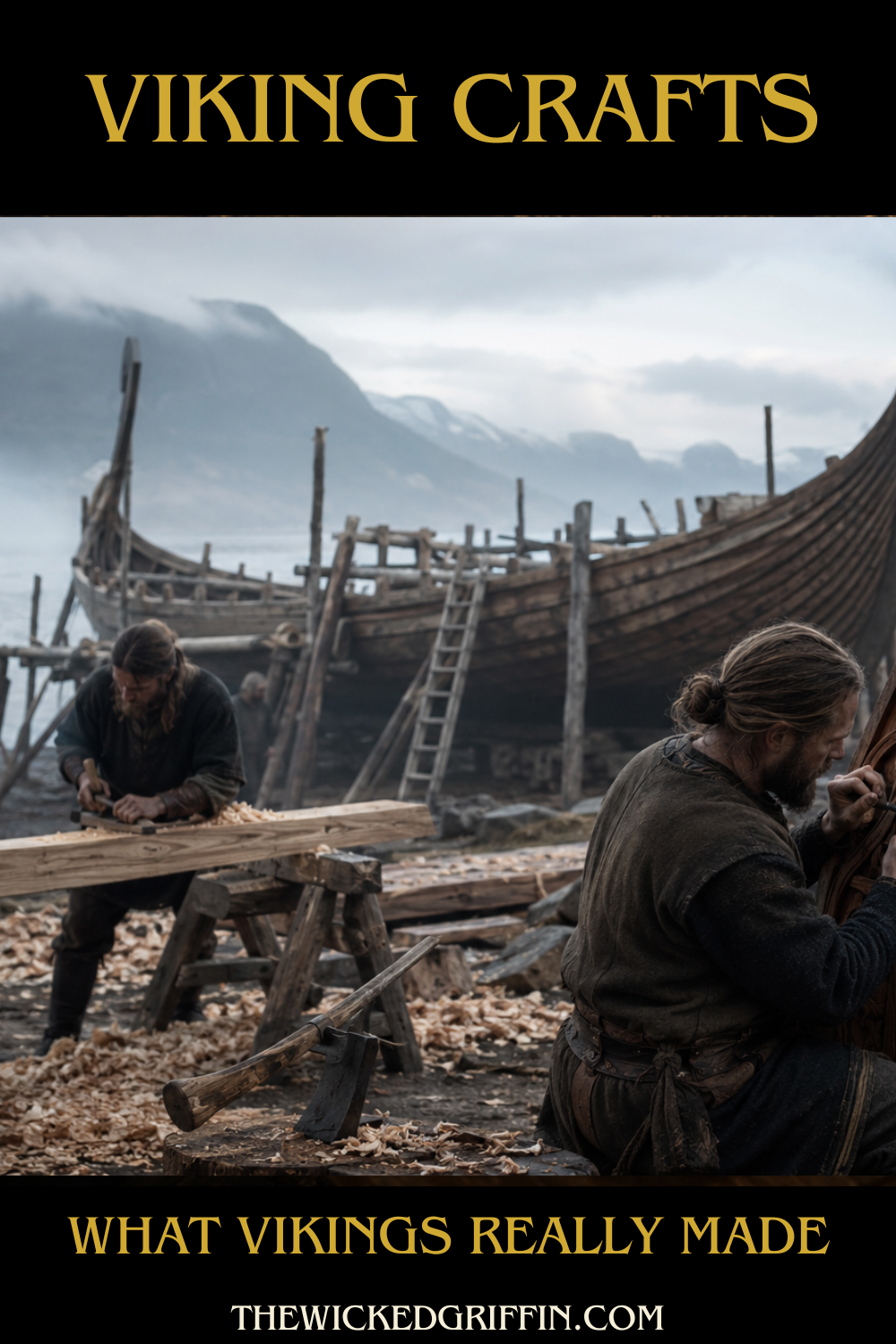
Woodworking and Clinker Shipbuilding
Woodworking was central, but it does not always survive well.
The best preserved technical evidence comes from ships, especially from timber orientation, splitting patterns, tool marks, repairs, and reconstruction studies (Crumlin-Pedersen, 1986, pp. 217–225).
Crumlin-Pedersen’s work on the Skuldelev ships showed that shipbuilders selected timber carefully, used grain and natural form, and often relied on radially split oak planks rather than ordinary boards.
That makes the viking ship a piece of technology, not just a dramatic image on the horizon (Crumlin-Pedersen, 1986, pp. 217–218).
Experimental archaeology adds another layer. Rebuilding ships forced researchers to test how planks could be split, how timbers could be shaped, and how tools could leave marks similar to the original finds (Crumlin-Pedersen, 1986, pp. 218–225).
This does not mean that woodwork was only about ships.
Hedeby also gives evidence for wood production, and the wider evidence for carved wood surfaces reminds us that beauty, utility, and technical control could meet in the same material world (Hilberg, 2009, p. 94).
Cloth, Dye, Embroidery, and Leather
The Labor Behind Cloth
Textile production deserves a central place in any honest account of Viking crafts.
The National Museum of Denmark’s reconstruction project matters because it tied surviving fragments to experimental reconstruction, showing how fiber sorting, spinning, weaving, tool choice, and skill shaped the finished textile (National Museum of Denmark, 2023, pp. 4–5).
This research also challenges the idea that early medieval cloth was crude or simple.
The reconstructed toolkit included spinning, weaving, tablet weaving, sewing, patterning, dyeing, embroidery, braiding, needle binding, and work with skin and fur (National Museum of Denmark, 2023, pp. 8–9).
The Gokstad burial gives a more elite view of this same world.
For instance, Chemical analysis found madder type dye in tent cloth and silk embroidery threads, which means faded fragments can still preserve traces of red color, patterning, and high skill (Łucejko et al., 2021, pp. 2278–2286).
Shoes, Skins, and Daily Wear
Leatherworking is less glamorous than a sword or ship, but it belongs close to daily life.
The York leather report records large quantities of leather objects and production waste in an Anglo Scandinavian urban context, including evidence for hide processing, residues, and large scale shoemaking (Mould et al., 2003, pp. 3248–3257).
The turnshoe remained a dominant shoe construction method from the later ninth century through long periods of change.
That kind of continuity is easy to overlook, but it shows that a practical tradition can be technically refined without looking spectacular (Mould et al., 2003, p. 3534).
Bone, Antler, and the Humble Comb
Bone and antler carving may sound small, but it opens a large window into trade and daily care.
Composite combs required cutting, fitting, riveting, decorating, and polishing, which makes them skilled objects rather than simple scraps of animal material.
At Hedeby, biomolecular research by Muñoz-Rodriguez and colleagues showed that many analyzed combs were made from reindeer antler, even though much of the local production waste came from red deer antler.
That matters since it points toward finished combs or raw material moving through northern exchange routes (Muñoz-Rodriguez et al., 2023, pp. 1, 11).
This is one of the loveliest things about the archaeology of ordinary objects.
A comb can tell us about grooming, trade, species identification, workshop organization, and the quiet pride someone took in a well made daily tool.
Glass, Pottery, and Color
Glass beads are one of the clearest examples of technical control in early Viking material culture.
At Ribe, Barfod, Feveile, and Sindbæk showed that beadmakers worked with recycled Roman and Late Antique glass, including mosaic tesserae, and manipulated color and opacity in small crucible batches (Barfod et al., 2022, pp. 2, 21–22).
Their research matters because it changes the story from simple recycling to skilled transformation.
Earlier Ribe workshops focused heavily on white and blue beads, and later eighth century workshops expanded into colors such as black, red, green, and yellow (Barfod et al., 2022, pp. 21–22).
Pottery looks quieter than beadmaking, but it still belongs in the larger story.
At Hedeby, local pottery stood beside imported wheel thrown Rhenish ceramics, which shows that everyday containers and trade goods both moved through the same busy places (Hilberg, 2009, pp. 92–94).
Trade, Raw Materials, and Expansion
Craft cannot be separated from movement.
Hedeby received soapstone and schist from Norway, iron from Sweden, brass probably from the Rhineland, walrus ivory, furs, leather, quernstone from the Mayen region, and large numbers of Islamic dirhams in the late ninth and tenth centuries (Hilberg, 2009, pp. 91–94).
That evidence matters for how we talk about viking expansion.
Movement did not only mean raiding or conquest; it also meant raw material streams, technical ideas, imported goods, copied objects, weights, and markets.
The same pattern appears in beadmaking and comb production.
Ribe beadmakers drew on older Roman glass, and Hedeby combs point toward northern antler supply, so the craft economy was tied into a wide network of materials and exchange (Barfod et al., 2022, pp. 2, 21–22; Muñoz-Rodriguez et al., 2023, p. 11).

What We Really Know, and What We Do Not
The clearest evidence supports metalworking, shipbuilding, cloth production, leatherworking, bone and antler carving, beadmaking, pottery, coin use, weighing, and repair.
This period was not a stage set of warriors with a few decorative hobbies.
At the same time, the evidence is not equal for every material.
Organic goods vanish more easily than metal or fired clay, so an archaeologist must read the record with care and resist pretending that absence always means nonexistence (Mould et al., 2003, pp. 3185–3187; National Museum of Denmark, 2023, pp. 4–5).
The late Viking Age probably held many forms of work that survive only in hints.
The strongest approach is to stay close to what the finds can support: workshop debris, production waste, chemical analysis, tool marks, preserved fragments, and experimental reconstructions.
This is why the source base matters so much.
Hilberg gives us the town and trade setting, McGraw and Mjærum give us workshop behavior, Crumlin-Pedersen gives us ships through tools and timbers, and the scientific studies on dyes, glass, combs, and leather let tiny traces speak with surprising force.
Why Viking Crafts Still Matter
Viking crafts matter because they put human labor back into history.
They remind us that the Norse past was not only about kings, raids, sagas, and battlefields, but also about repair, patience, repetition, training, and material knowledge.
They also make the past feel more intimate.
A shoe sole, a comb tooth, a bead, a wool thread, a plank scar, or a casting mold can bring us closer to daily life than a heroic story ever could.
That is the power of viking craft as a subject.
It shows us people making a world with their hands, whether they were shaping tools and weapons, sewing cloth, carving antler, casting ornaments, or building ships that could cross cold northern water.
The most authentic answer is not that Vikings made one kind of thing, or that they were all smiths, or that every farmstead produced every object it needed.
The evidence points to a mixed craft culture, with household labor on one end and organized workshop production on the other.
Ribe, Hedeby, Kaupang, York, Gokstad, and the Skuldelev ships show a society where making was practical, skilled, beautiful, and tied to trade. S
ome objects were plain and useful, some were richly decorated, and some crossed the line between tool, ornament, wealth, and belief.
That is why the archaeological record is so valuable.
It strips away the costume version of the Viking past and leaves us with something better: skilled people, real materials, worn tools, repaired objects, and a deeply human record of making.
References
Barfod, G. H., Feveile, C., & Sindbæk, S. M. (2022). Splinters to splendours: From upcycled glass to Viking beads at Ribe, Denmark. Archaeological and Anthropological Sciences, 14, Article 180. https://doi.org/10.1007/s12520-022-01646-8
Crumlin-Pedersen, O. (1986). Aspects of Viking-age shipbuilding from Roskilde Fjord. Journal of Danish Archaeology, 5, 210–228.
Hilberg, V. (2009). Hedeby in Wulfstan’s days: A Danish emporium of the Viking Age between East and West. In A. Englert & A. Trakadas (Eds.), Wulfstan’s voyage: The Baltic Sea region in the early Viking Age as seen from shipboard (pp. 79–102). Viking Ship Museum.
Łucejko, J. J., Vedeler, M., & Degano, I. (2021). Textile dyes from Gokstad Viking Ship’s Grave. Heritage, 4(3), 2278–2286. https://doi.org/10.3390/heritage4030129
McGraw, T. E., & Mjærum, A. (2024). Tools of different trades? Merging skill sets in metalworking at Viking-Age Kaupang. European Journal of Archaeology, 27(2), 210–230. https://doi.org/10.1017/eaa.2023.42
Mould, Q., Carlisle, I., & Cameron, E. (2003). Craft, industry and everyday life: Leather and leatherworking in Anglo-Scandinavian and medieval York. The Archaeology of York, 17/16. Council for British Archaeology for the York Archaeological Trust.
Muñoz-Rodriguez, M., Presslee, S., McGrath, K., Hausmann, N., Hilberg, V., Kalmring, S., Holmquist, L., Hendy, J., & Ashby, S. P. (2023). In the footsteps of Ohthere: Biomolecular analysis of early Viking Age hair combs from Hedeby (Haithabu). Antiquity, 97(395), 1233–1248. https://doi.org/10.15184/aqy.2023.118
National Museum of Denmark. (2023). Fashioning the Viking Age: Final project report. National Museum of Denmark.