
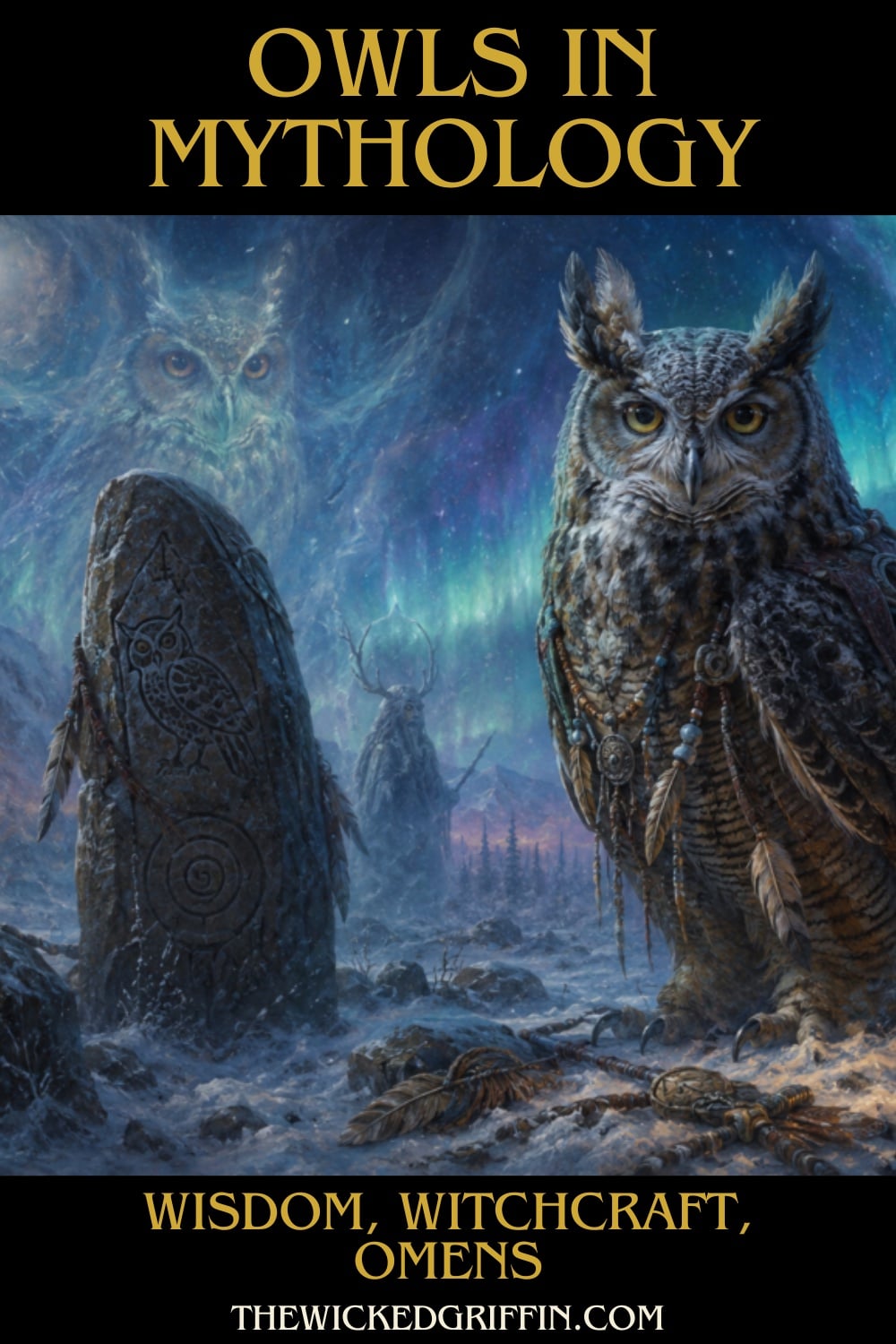
Owls in Mythology: Wisdom, Witchcraft, Death & Omens
Owls Across Different Mythologies
The owl is one of those creatures that seems to arrive already carrying a story.
Before we even open a book of folklore, we notice the owl eyes, the large eyes, the night vision, the silent flight, the curved beak, the gripping talon, and the low hoot that makes the darkness feel alive.
That is why the owl so easily enters stories about knowledge, death, magic, thresholds, and hidden power.
Owls are nocturnal, they can see in the dark, and they move through dawn and dusk with an ability to fly that feels almost ceremonia.
As though a single flap of the wing could cross the border between the human world and the unseen one.
But if we are going to talk about owls in a serious way, we have to begin with the sources rather than with a vague feeling.
The academic sources discussed here show that the owl does not mean one thing everywhere:
Instead, the owl changes its function from culture to culture, moving from sacred emblem to witchcraft creature, from ritual figure to animal-person, from symbol of wisdom to frightening omen.
Table of Contents

Why the Owl Feels Magical in Mythology and Folklore
The owl is a bird of prey, but it is not only its hunting that made people tell stories about it.
Its face looks strangely human, its gaze feels direct, and the hoot of an owl can make a familiar place feel like a borderland between the living and something older.
Across many cultures, people have noticed that owls are associated with night, hidden sight, and strange crossings between worlds.
A reader might say that owls represent wisdom, but the sources show that wisdom is only one part of the owl’s story.
The richer pattern is that the owl appears at thresholds.
It belongs near the edge of the house, the grave, the city, the forest, the nursery, the sacred stone, the shamanic journey, and the animal world that behaves like a human one.
Owls in Greek Mythology: Ancient Greece and the Sacred Bird
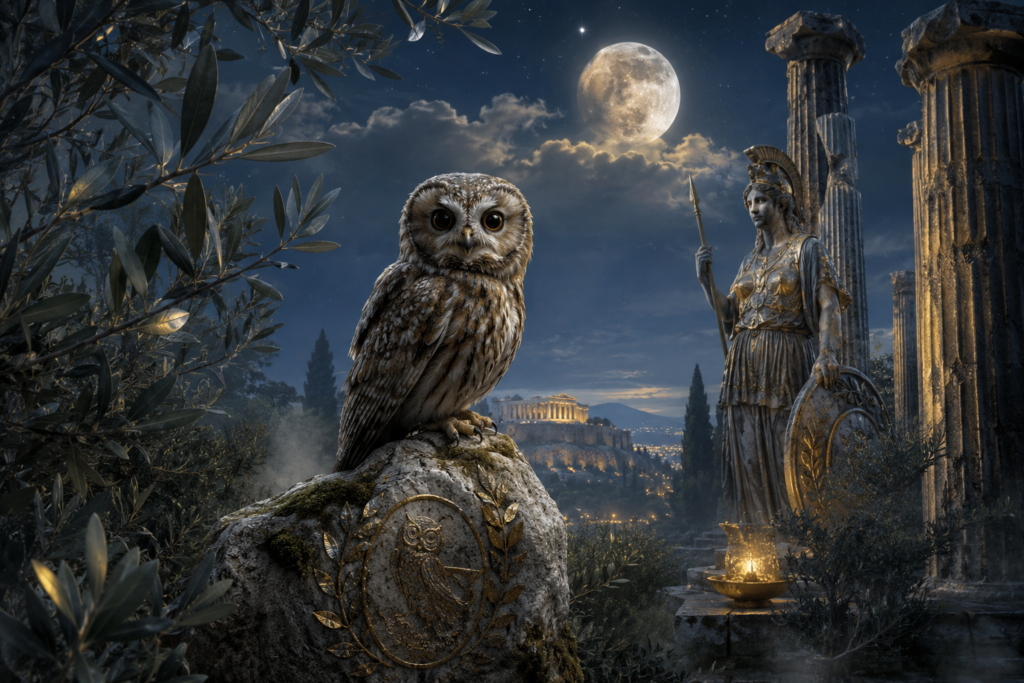
The best-known classical owl is the Greek owl, especially the small bird connected with the goddess of Athens.
In Greek civilization, the owl became a powerful sacred and civic image, but the scholarship shows that this meaning developed over time rather than appearing fully formed from the beginning.
Bontzorlos et al. explain that Greek owl symbolism changed across long periods, with earlier funerary and eerie associations giving way, in Archaic, Classical, and Hellenistic contexts, to meanings such as wisdom, power, justice, and divinity (Bontzorlos et al., 2023, pp. 691–692).
That shift and context is highly important since it reminds us that Greek mythology did not freeze the owl into one simple meaning or mythical context.
The Owl of Athena and the Goddess of Wisdom
The owl of Athena is the image most readers know first.
This is the clean, famous symbol: goddess Athena, the Greek goddess of wisdom, had a bird that became one of the most recognizable sacred animals of ancient Greece.
Bontzorlos et al. show that the owl appeared in material culture with the goddess, including prize amphoras, statues, owl-shaped cups, and the famous Athenian coinage that placed the goddess on one side and the owl on the other (Bontzorlos et al., 2023, pp. 699–700).
This makes the owl not just a pretty emblem, but a public sign of divine presence, civic pride, and Athenian identity.
When a student says that owls represent wisdom, this Greek evidence gives that idea a real historical foundation.
Yet the source does not reduce the owl to wisdom alone; the same bird became a symbol of Athena, a sign of the patron goddess, and a visual marker of the city’s sacred and political self-image (Bontzorlos et al., 2023, pp. 699–700).
The Little Owl matters here as more than a generic bird in a painting.
The Little Owl became bound to the public image of Athens, and Athena’s city used the bird so widely that the owl could speak visually for wealth, protection, and identity without needing a written explanation (Bontzorlos et al., 2023, pp. 699–700).
The Older, Darker Greek Owl: Tombs, Dance, and Chthonic Force
The Greek owl was not always only a symbol of wisdom.
Bontzorlos et al. argue that earlier Greek material, including Mycenaean contexts, could connect the owl with fear, respect, and funerary settings before its later association with wisdom and civic divinity became so dominant (Bontzorlos et al., 2023, pp. 691–692).
Lawler’s article deepens this darker side by examining the owl dance.
She argues that the oldest owl dances were probably Mycenaean, mimetic, and chthonic in origin, with possible links to tomb cult and hero cult rather than to the later civic image of the goddess (Lawler, 1939, pp. 482–485, 490).
This is where the owl becomes especially useful for readers interested in prehistory, ritual, and old religious ideas.
Calling the bird a simple symbol of death would flatten the evidence, but the funerary and chthonic associations do show that the Greek owl could stand near the grave, near the underworld, and near the serious ritual memory of the dead (Bontzorlos et al., 2023, pp. 691–692; Lawler, 1939, pp. 482–485).
Lawler is careful about the Athena connection, and that care makes her source especially valuable.
She stresses that the owl was not necessarily the goddess’s bird from the beginning, and she finds the evidence for an owl dance in honor of Athena too weak to treat as secure (Lawler, 1939, pp. 493–495).
That is the kind of source we should love as students of folklore. It gives us a more mysterious owl, but it refuses to make the mystery larger than the evidence.
Roman Owl Folklore: The Strix, Witchcraft, and the Threat at the Window
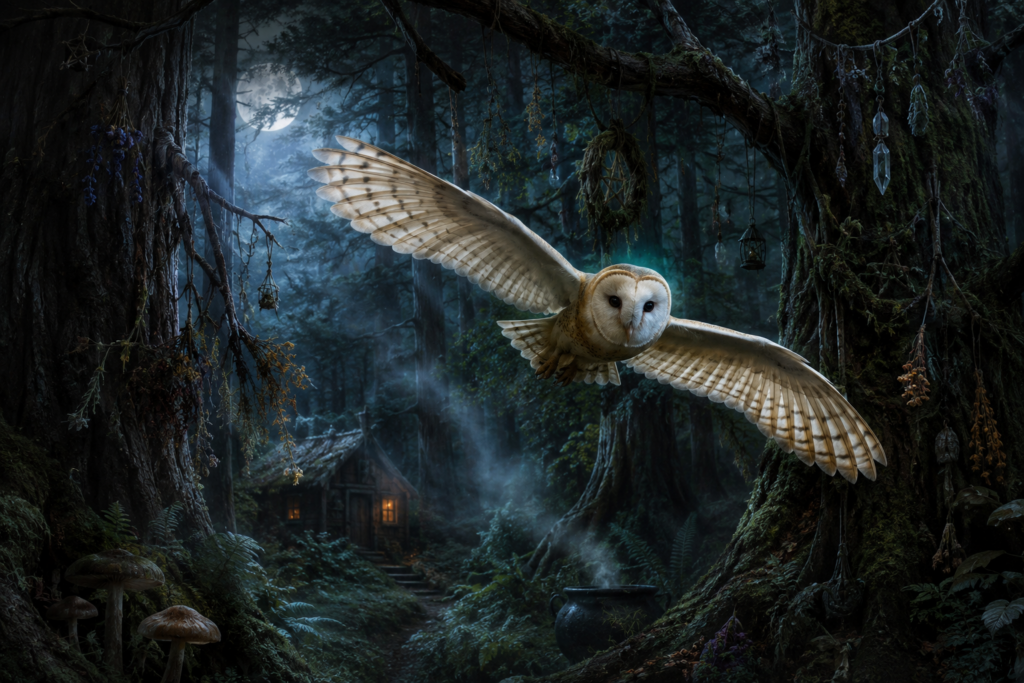
Roman material gives us a sharper, darker figure: the strix.
In McDonough’s study of Ovid’s Fasti, the striges are owl-like beings that enter the nursery of the infant Proca and attack him when he is only five days old (McDonough, 1997, pp. 315–316).
This is not the graceful owl as a symbol of wisdom.
This is the owl-form as a night visitor, as superstition, as witchcraft creature, and as an omen that something has gone wrong at the boundary of the household.
McDonough explains that Carna protects the infant by guarding the thresholds and windows, then leaving pig viscera outside for the creatures (McDonough, 1997, pp. 315–316).
The ritual logic is very clear for a classroom reader: the danger came through the opening, so the protection must restore the boundary.
This Roman owl-like being helps us understand why owls are considered frightening in some folklore traditions.
The strix is not merely a large owl or a strange bird; it is a night-flying danger that crosses into the human home and threatens the child inside (McDonough, 1997, pp. 315–316, 342).
McDonough’s interpretation is especially strong when he describes the strix as an inverted being that attacks children instead of caring for them, and he reads Carna’s rite as a way of restoring the boundary between inside and outside (McDonough, 1997, p. 342).
In that sense, the Roman owl-form does not only frighten people; it teaches a lesson about doors, windows, and the fragile safety of the household.
The Roman material also gives us a useful contrast with the Greek owl.
Greek artists and civic life associated owls with the goddess and the city, but Roman folklore could turn the owl-form into something that had to be driven away to ward off evil.
Hungarian Owl Folklore: The Táltos Bird and the Fragile Evidence
The Hungarian material is fascinating, but it needs careful treatment.
Pócs discusses the Hungarian táltos and the question of old Hungarian shamanistic belief, and within that discussion the owl appears as a possible helping spirit in older reconstructions (Pócs, 2018, p. 153).
This does not mean that we can declare a grand Hungarian owl cult.
Professor Eva Pócs who is well known for her research on Witchcraft Studies, is much more cautious than that, and her caution protects us from making the source say more than it says.
The owl appears again in scattered evidence for bird spirits connected with divination, where it is placed near other birds such as eagle, rooster, and crane (Pócs, 2018, p. 159).
In this kind of material, owls are regarded less as a single central deity and more as possible magical or spiritual helpers within a wider bird complex.
Pócs later discusses belief in the owl as a “táltos bird” and mentions the Conquest-era owl-headed staff, but she treats the evidence as fragmentary and uneven (Pócs, 2018, pp. 177–178).
That is a valuable lesson for students of mythology: a haunting detail can be real without proving a complete system.
The Hungarian owl gives us a misty but source-grounded image.
The bird may appear as a helper, a magical marker, or a shamanic sign, yet the evidence remains too scattered to make the owl the center of Hungarian mythology.
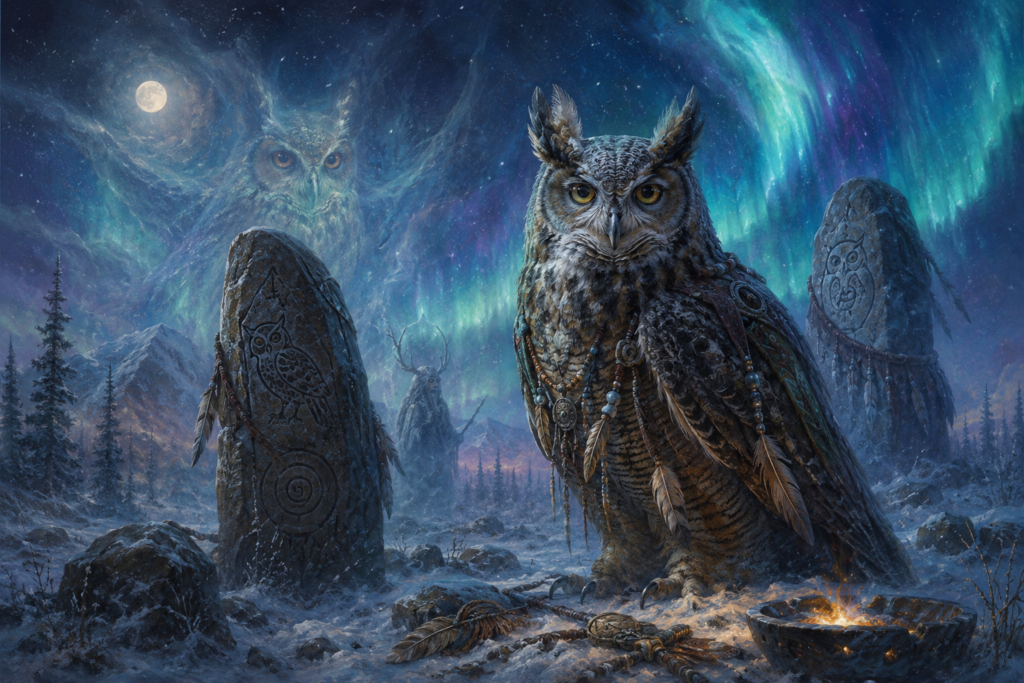
Sámi Sacred Bird Traditions: The Owl Inside a Wider Spiritual Pattern
The Sámi source by Joy, Armstrand, and Helander is not an owl-only study, and that is exactly why we should use it with care.
Their article discusses the spiritual significance of birds in Sámi tradition, especially birds connected with the noaidi, the Sámi religious specialist, and with sacred imagery on drums (Joy et al., 2024, pp. 50, 55, 58).
In this material, the owl is not isolated as the single great sacred bird. Instead, the owl appears inside a wider pattern in which birds can act as assistants, protectors, guardians, and figures connected with soul travel, metamorphosis, and the sáivo otherworld (Joy et al., 2024, pp. 50, 55, 58).
The most direct owl passage comes when the authors discuss missionary evidence for bird-shaped sacred stones, or seites/sieidi, which could be understood as birds such as eagle, owl, goose, and ptarmigan (Joy et al., 2024, pp. 70–71).
That places the owl within sacred geography, ritual imagination, and the spiritual power of bird forms.
This is a different kind of owl than the Athenian civic emblem or the Roman strix.
In the Sámi comparison, owls are seen as part of a sacred bird world, where the boundary between human, animal, spirit, and place can become charged with meaning.
Siberian Owl Folklore: The Owl as Animal-Person
Bogoras gives us one of the strangest and most vivid owl examples in this source set.
In his study of northeastern Asian folklore, especially among the Native Siberian Chukchi and related material, animals live in a world that mirrors human society, and the owl can appear as a social actor rather than as a simple symbol (Bogoras, 1902, p. 661).
Bogoras writes that owls hunt lemmings, skin and carve them, store the best hams, and break the larger bones for marrow (Bogoras, 1902, p. 661).
That is an extraordinary image, since the owl is not merely flying above the story; the owl is living inside an animal society with work, food, storage, and domestic action.
In another Chukchi tale, the Owl steals and swallows the Mouse-boy, then Raven defeats Owl, the swallowed bones come out, and those bones help repopulate the world with game animals (Bogoras, 1902, p. 655).
Here the owl becomes predatory, dangerous, and strangely tied to the return of life through death.
This is not the same as saying the Siberian owl is a universal symbol of death or that it represents the spirits of the dead in a simple formula.
The better reading is that the owl belongs to an animal-person world, where hunting, swallowing, bones, release, and restored life belong to the structure of the tale (Bogoras, 1902, pp. 655, 661).
The Siberian owl gives the post one of its most powerful images.
The bird is not only a watcher in the dark; it is a being who acts, eats, stores, harms, and becomes part of a story about how life returns to the world.
What These Owl Myths Actually Show
The most grounded lesson from these sources is that the owl changes its role depending on the culture and genre.
The owl as a symbol in Athens is not the same as the strix in Rome, and neither one is the same as the Sámi sacred bird complex or the Chukchi animal-person owl.
That is why broad claims about owls can become misleading very quickly.
Across many cultures, it is tempting to say that the owl is always wise, or always evil, or always one of the harbingers of death, but the sources do not support that kind of single answer.
The Greek material gives us sacred knowledge, civic power, funerary force, and ritual dance (Bontzorlos et al., 2023, pp. 691–692, 699–700; Lawler, 1939, pp. 482–485, 493–495).
The Roman material gives us the owl-form as nursery threat, witchcraft creature, and boundary-breaker (McDonough, 1997, pp. 315–316, 342).
The Hungarian and Sámi material gives us the owl as part of spirit-helper, sacred-bird, and shamanic or religious specialist traditions, but in cautious and fragmentary ways (Pócs, 2018, pp. 153, 159, 177–178; Joy et al., 2024, pp. 50, 58, 70–71).
The Siberian material gives us the owl as animal-person, hunter, swallower, and participant in a mythic cycle of death and renewal (Bogoras, 1902, pp. 655, 661).
Clearly, the owl often appears where human beings imagine the border between ordinary life and hidden power.
The Owl as a Symbol of the Threshold
The owl as a symbol works so well in folklore because it belongs to the hour when certainty weakens.
In Greek sources, the owl can sit beside the goddess and speak for a city. In Roman folklore, the owl-like strix can cross the window and threaten the nursery.
In Hungarian and Sámi materials, the owl moves through a more delicate field of spirit helpers, sacred birds, and uncertain traces. I
In northeastern Siberian folklore, the owl becomes a being in its own right, with appetite, action, and power inside an animal society.
That is why owl myths remain so compelling for readers of folklore, mythology, prehistory, and ethnography.
The owl does not merely decorate the dark; it gives the dark a face, a gaze, and a story.
References
Bogoras, W. (1902). The folklore of northeastern Asia, as compared with that of northwestern America. American Anthropologist, 4(4), 577–683. Available via JSTOR.
Bontzorlos, V. A., Johnson, D. H., Poirazidis, K., & Roulin, A. (2023). Owl symbolism in Greek civilization over the last 5000 years: Social perceptions and implications for conservation. The European Zoological Journal, 90(2), 691–707. doi:10.1080/24750263.2023.2254823
Joy, F., Armstrand, P., & Helander, E.-M. (2024). The spiritual significance of birds in Sámi tradition. Journal of Ethnology and Folkloristics, 18(2), 49–74. doi:10.2478/jef-2024-0020
Lawler, L. B. (1939). The dance of the owl and its significance in the history of Greek religion and the drama. Transactions and Proceedings of the American Philological Association, 70, 482–502. Available via JSTOR.
McDonough, C. M. (1997). Carna, Proca and the strix on the Kalends of June. Transactions of the American Philological Association, 127, 315–344. Available via JSTOR.
Pócs, É. (2018). The Hungarian táltos and the shamanism of pagan Hungarians: Questions and hypotheses. Acta Ethnographica Hungarica, 63(1), 149–196. doi:10.1556/022.2018.63.1.9