
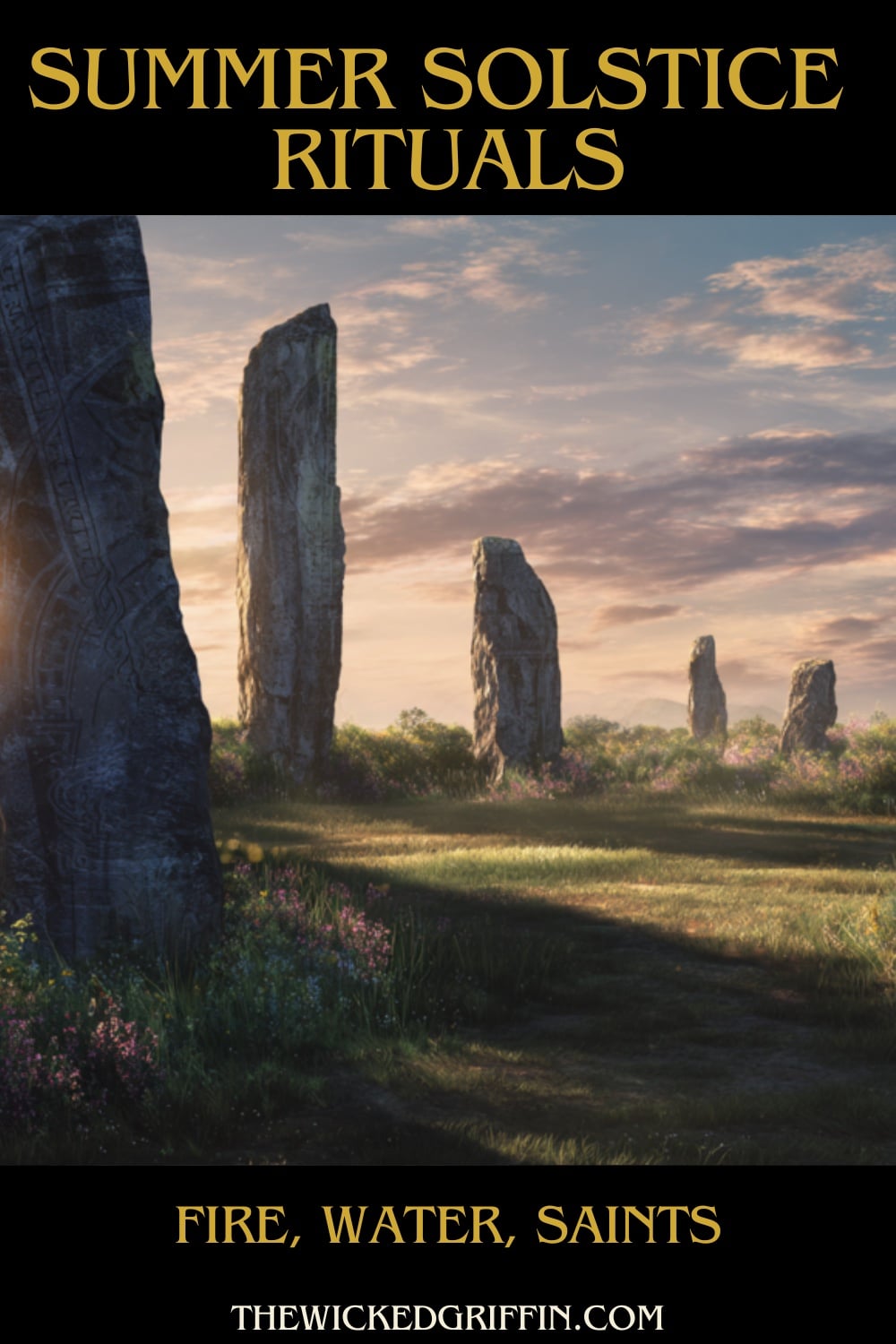
Summer Solstice Rituals: Fire, Water, Saints, and Stones in Academic Research
Summer solstice rituals are often imagined as one ancient and universal tradition, but the academic literature gives us something more precise and more interesting.
In the sources discussed here, the summer solstice appears through Irish bonfires, Italian St. John’s water rites, Greek solar calendars, modern Pagan gatherings at Stonehenge, and scholarly caution about how seasonal festivals are remembered and reinterpreted.
This article follows the research closely rather than trying to force every custom into one simple explanation.
The result is a richer look at how communities have marked midsummer, the longest day of the year, and the turning of seasonal time.
Table of Contents
What Do Academic Sources Actually Say About Summer Solstice Rituals?
When readers search for summer solstice rituals, they often expect a single set of ancient customs involving fire, stones, and sun worship.
The academic sources are more careful than that.
They do not describe one universal summer solstice ritual, but many different practices, symbols, calendars, and celebrations that were connected with midsummer or with the solstice in specific cultural settings.
That distinction matters because it keeps the discussion grounded in what the evidence actually shows.
Some of the sources in this article study recorded folk traditions from the nineteenth and twentieth centuries.
Patricia O’Hare’s article on County Kerry, for example, examines St. John’s Eve traditions from about 1850 to 1950, drawing heavily from Irish folklore collections (O’Hare, 2008, pp. 23-24).
Marco Fabbrini’s study of Civitella Roveto in Abruzzo likewise examines a local Italian festival of St. John through archival material, interviews, and fieldwork (Fabbrini, 2009, p. 157).
These studies are especially useful because they describe actual ceremonies, including bonfires, water rites, processions, prayer, dance, and the protection of crops and animals.
Other sources are useful in different ways.
Tomislav Bilić’s work on Apollo, Helios, and Greek calendars is not a description of villagers gathering for a midsummer festival.
It is a study of how solstitial timing, Apollo, Helios, and the structure of Athenian, Delphian, and Delian calendars intersect in ancient Greek evidence (Bilić, 2012, pp. 509-510).
Ronald Hutton and Eric Powell, meanwhile, help explain modern Pagan and Stonehenge related midsummer traditions without pretending that every modern practice is an unchanged survival from prehistory (Hutton, 2008, pp. 253-260; Powell, 2003, pp. 36-41).
Why Is Midsummer So Often Connected With St. John the Baptist?
One of the strongest patterns in the research is the connection between midsummer and the feast of St. John the Baptist.
O’Hare begins by noting that Irish midsummer ceremonies were generally celebrated on June 23, the eve of St. John the Baptist, even though they are connected with the summer solstice more broadly (O’Hare, 2008, p. 23).
This means that when we discuss summer solstice rituals in Christian Europe, we are often discussing St. John’s Eve rather than the astronomical solstice in a strict modern sense.
The calendar is important because it shows how seasonal time, saint devotion, and local custom could be woven together.
In County Kerry, the feast was known by several names, and some of those names reflected the importance of the bonfire itself (O’Hare, 2008, p. 26).
The celebration was not described simply as a private religious devotion.
It was a communal night involving neighbors, families, young people, older people, fields, animals, music, and fire.
O’Hare’s study is valuable because it shows how a Christian feast could also carry practical and seasonal concerns, such as protection, luck, harvest, milk production, and household well being.
Fabbrini’s Italian material gives another version of this midsummer pattern.
In Civitella Roveto, the Festival of St. John began on June 23 and included processions, local devotional structures, and rites involving water from the Liri River (Fabbrini, 2009, p. 159).
Fabbrini also notes that St. John was associated locally with water and the sun, including legends that the sun dances or changes color on June 24 (Fabbrini, 2009, p. 162).
The result is not a simple story of pagan custom replaced by Christianity, but a more layered picture of seasonal ritual under a Christian feast day.

How Were Bonfires Used in County Kerry?
O’Hare’s article gives some of the richest evidence for bonfires in the academic sources discussed here.
Communal fires were widely known in County Kerry, and in some areas people remembered hills being ablaze with bonfires on St. John’s Eve (O’Hare, 2008, p. 27).
These fires were often placed on high ground, hilltops, open fields, or crossroads, partly so that they could be seen from a distance (O’Hare, 2008, p. 28).
This visibility matters because the bonfire was not only a household act, but a public mark of community and place.
The preparation of the fire could involve many members of the community.
O’Hare records that boys were often prominent in collecting fuel, but men, women, girls, young people, and older people could also take part depending on the locality (O’Hare, 2008, p. 29).
The fuel included turf, furze, wood, coal, old hay, paper, rags, shoes, and other available materials (O’Hare, 2008, pp. 30-32).
Old bones were often included, and horse skulls were especially prized in some accounts (O’Hare, 2008, p. 31).
The fires were usually lit around twilight or sunset, after ordinary work and supper, because St. John’s Eve was not generally treated as a work holiday (O’Hare, 2008, p. 35).
In some places, the oldest person present lit the fire, sometimes with a special prayer or ceremonial action (O’Hare, 2008, p. 36).
Holy water might also be sprinkled on the fire or on the people gathered there (O’Hare, 2008, p. 34).
These details show why the bonfire should not be reduced to entertainment alone, even though amusement was also part of the night.
Carry the Midsummer Fire
Midsummer fires were lit for protection, purification, and the turning of the season. These pieces echo that old flame: bonfires, warding charms, and the bright force of the sun.

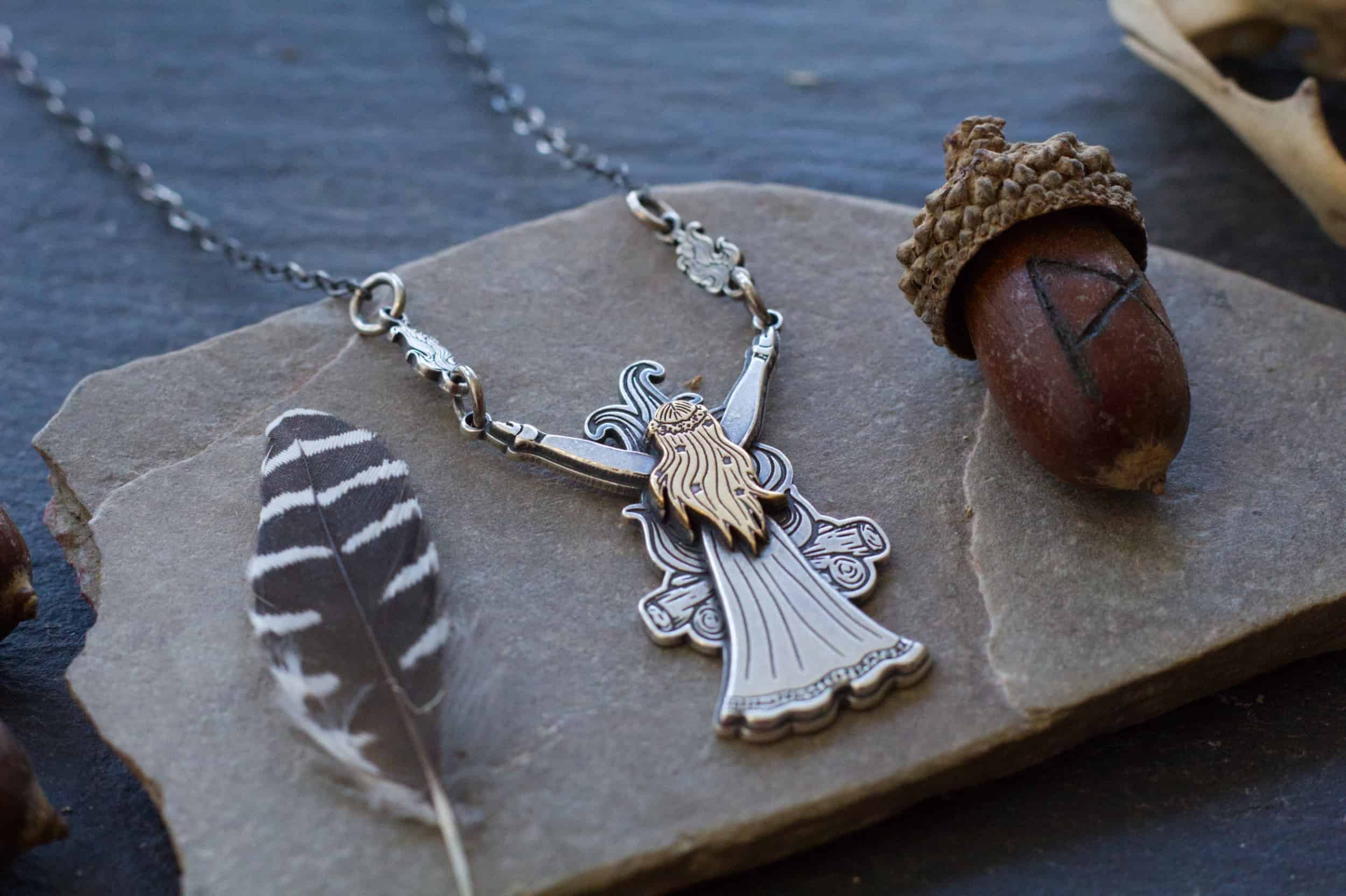

💡 These pieces carry the fire, protection, and threshold magic of midsummer. Browse all pagan jewelry →
What Happened Around the St. John’s Eve Fire?
The Kerry bonfire was a social and ritual center.
O’Hare records prayer, the Rosary, music, singing, storytelling, games, gossip, dancing, and food or drink in some places (O’Hare, 2008, pp. 44-53).
Dancing was especially prominent in the evidence, with jigs, reels, Kerry sets, and ring dancing mentioned in the collected material (O’Hare, 2008, pp. 50-53).
This gives the reader a vivid picture of St. John’s Eve as a night when religious observance, social pleasure, and seasonal ritual overlapped.
The fire was also associated with protection and luck.
O’Hare notes that the bonfires were lit in honor of St. John, but they were also connected with the longest day, the turning of the year, protection from spirits, and household safety (O’Hare, 2008, p. 44).
Jumping over the fire was reported especially in north and northwest Kerry.
In some accounts, jumping brought luck or protection from fairies, witches, and the evil eye, while young women might jump three times in connection with marriage divination (O’Hare, 2008, pp. 55-57).
The most striking evidence involves what happened after the fire was lit.
Burning brands, sods, bushes, torches, and embers could be carried away from the bonfire and brought into fields, gardens, or farmyards (O’Hare, 2008, pp. 58-62).
These actions were connected with crop luck, disease prevention, and the protection of potatoes and other produce.
O’Hare also records embers or lighted bushes being thrown toward cattle, especially milch cows, for blessing, protection, and milk supply (O’Hare, 2008, pp. 62-67).
How Did Italian St. John’s Rituals Use Water and Sun?
Fabbrini’s study of Civitella Roveto gives a different but equally important midsummer pattern.
In this Abruzzo community, the Festival of St. John included processions, saint devotion, and water rites connected with the Liri River (Fabbrini, 2009, p. 159).
At midnight, the river water was believed to become sacred, magical, and therapeutic.
People bathed in it, washed their faces, and crossed themselves with what was understood as St. John’s water (Fabbrini, 2009, p. 159).
The festival also included a dawn procession that carried the statue of St. John to the riverbank and back before sunrise (Fabbrini, 2009, p. 159).
Fabbrini notes that the statue had to avoid the sun, which gives the ritual a striking relationship to solar time.
He also places the festival within the local ritual year, where the June 24 procession divided the bright half of the year between pastoral and agricultural concerns (Fabbrini, 2009, p. 162).
This is a strong example of how a saint’s feast could organize seasonal life.
Fabbrini’s article also reminds us that traditions change.
The festival was not frozen in time, and the author discusses recatholicization, local identity, and modern transformation in the celebration (Fabbrini, 2009, pp. 165-170).
T
This matters because readers may imagine summer solstice ritual as something ancient and untouched.
The research instead shows living traditions that were adapted, emphasized, criticized, revived, or reshaped by communities over time.
What Does Apollo Tell Us About Solar Time in Greek Calendars?
Bilić’s article gives a very different kind of evidence.
It is not about bonfires, cattle, or local midsummer customs, but about Apollo, Helios, solstitial symbolism, and the timing of festivals in Greek calendars.
Bilić discusses Apollo’s northern journey and the Hyperboreans as a mythic expression of the sun’s annual motion and the solstices (Bilić, 2012, pp. 509-510).
He also notes that Plato associates Apollo, Helios, and the summer solstice in a calendrical context (Bilić, 2012, p. 513).
The Athenian calendar is especially important here.
Bilić explains that the Athenian New Year began with Hekatombaiôn 1, the first new moon after the summer solstice (Bilić, 2012, p. 514).
This does not prove a popular summer solstice ritual in the modern sense.
It does show that the solstice could matter in the ordering of sacred and civic time.
Bilić also discusses the Skira festival, noting that in 432 BCE the summer solstice fell on Skirophoriôn 13, while Skira took place on the previous day (Bilić, 2012, p. 516).
The festival involved priests and a priestess proceeding under a canopy, and Bilić considers the festival certainly related to the summer solstice (Bilić, 2012, p. 516).
This is the kind of evidence that needs careful wording.
It is useful for discussing solar and calendrical religion, but it should not be turned into a generic description of Greek folk solstice customs.

Was Stonehenge Always a Pagan Summer Solstice Ritual Site?
Stonehenge is almost unavoidable in an article about summer solstice rituals, but it needs careful handling.
Powell’s article describes a modern gathering at Stonehenge where about 30,000 people came hoping to see the summer solstice sunrise (Powell, 2003, p. 36).
He describes modern British Pagan groups, including druids, wiccans, and heathens, treating ancient sites as sacred ground and taking part in processions, circles, and ritual activity (Powell, 2003, p. 36).
This is useful evidence for modern practice.
Powell also notes the long history of watching the solstice sunrise over the Heel Stone, while being careful about the modern history of access, gatherings, and conflict at the site (Powell, 2003, pp. 37-39).
The twentieth century history includes modern druid orders, large public gatherings, restrictions, and the reopening of access around the turn of the twenty first century (Powell, 2003, pp. 37-38).
In 2003, Powell records 30,148 attendees, along with dancers, drummers, torchlight processions, and private druid rituals on the edges of the event (Powell, 2003, p. 39).
This gives a strong modern picture, but it should not be mistaken for direct evidence of Neolithic ritual behavior.
Hutton is especially important for placing this in context.
He explains that modern Paganism is united in part by an eight festival seasonal calendar, including the solstices and equinoxes (Hutton, 2008, pp. 251-253).
He also stresses that modern Druidic solar festival structures developed in modern history, particularly through figures such as Iolo Morganwg, rather than being simple survivals from ancient Druid practice (Hutton, 2008, pp. 253-254).
In other words, Stonehenge today is a major site of solstice meaning, but that meaning includes modern religious creativity as well as ancient monumentality.
How Do Modern Pagan and Wiccan Traditions Reinterpret the Solstice?
Modern readers may associate a summer solstice ritual with an altar, candle, incense, crystal, meditation, flower petals, herbal symbolism, or honoring a goddess or deity.
Those associations belong most naturally in the modern Pagan and Wiccan part of the discussion, not in the Irish or Italian folklore material unless the sources themselves make such connections.
Hutton’s study is useful because it explains the formation of the modern Pagan festival calendar without flattening it into ancient continuity.
He notes that the eight festival Wheel of the Year became established in 1958, when Gerald Gardner’s coven moved toward equal observance of the solar points and the quarter days (Hutton, 2008, p. 259).
Hutton also discusses the modern name “Litha” for midsummer.
He traces its connection to Bede’s Anglo Saxon seasonal vocabulary and possibly to Tolkien’s hobbit calendar (Hutton, 2008, p. 260).
This is a useful reminder that modern religious language can feel ancient while having a traceable modern history.
That does not make it meaningless.
It means that its history should be explained accurately.
Powell’s article gives the living atmosphere of modern midsummer at Stonehenge.
He reports that modern Pagans often do not claim to be reconstructing ancient rites exactly, but see their practices as evolving traditions rooted in ancient beliefs, including the power of the sun at midsummer (Powell, 2003, p. 41).
This is where terms like pagan customs, mysticism, mother earth, the energy of the sun, and the triumph of light can be used carefully as modern interpretive language.
The key is to make clear which vocabulary belongs to modern spiritual practice and which belongs to older folklore, archaeology, or calendar studies.
Sun, Fertility, and Sacred Growth
The summer solstice is tied to abundance, flowering, fertility, and the sun at its height. These pieces carry the symbols of light, seasonal cycles, nature, and the living world.



💡 Choose pieces connected with sun, seasonal cycles, nature, and sacred growth. Browse all pagan jewelry →

What Can Prehistoric Monuments Tell Us About Solstices and Equinoxes?
Barratt, Malone, McLaughlin, and Stoddart offer a Mediterranean archaeological comparison from prehistoric Malta.
Their article is not about Indo European religion, but it is useful for thinking about celebration, monumentality, celestial timing, and seasonal experience.
They discuss Maltese prehistoric monuments as places of celebration connected with time, seasonality, and alignments (Barratt et al., 2018, pp. 271-273).
Their discussion of the Brochtorff Xagħra Circle is especially relevant to the summer solstice.
The authors describe how entrance pillars cast a shadow corridor toward the underground complex at the summer solstice, guiding visitors toward an underworld space through darkness (Barratt et al., 2018, p. 279).
They contrast this with winter solstice illumination at Ġgantija, where sunlight entered and lit the inner apse shortly after sunrise during the solstitial season (Barratt et al., 2018, p. 279).
The comparison shows how light, shadow, architecture, and seasonal timing could be built into ritual experience.
This source should be used as a careful archaeological comparison rather than as proof of a universal solstice religion.
It helps explain how a monument can align with a celestial event and still leave many questions about what people did, believed, or said.
The word alignment is useful here, but it should not be used as if every alignment automatically explains a full ritual system.
The evidence is powerful, but the interpretation still depends on careful archaeological argument.
What Should Readers Remember About Summer Solstice Rituals?
The academic literature does not give us one single answer to the question of summer solstice rituals.
It gives us many carefully situated answers.
In County Kerry, O’Hare shows St. John’s Eve as a night of communal fire, prayer, dance, protection, crops, cattle, and household luck (O’Hare, 2008, pp. 44-70).
In Abruzzo, Fabbrini shows a festival where St. John, water, procession, sun symbolism, and seasonal transition shaped local religious life (Fabbrini, 2009, pp. 159-162).
In ancient Greek material, Bilić shows that Apollo, Helios, and the solstice could matter in calendar structure and sacred timing, even when the evidence is not the same kind of evidence as a recorded folk ceremony (Bilić, 2012, pp. 513-516).
In modern Britain, Powell and Hutton help explain Stonehenge, modern Pagan observance, Wiccan festival language, and the more recent history of the Wheel of the Year (Hutton, 2008, pp. 253-260; Powell, 2003, pp. 36-41).
In prehistoric Malta, Barratt and colleagues show how architecture, shadow, light, and seasonal timing could create powerful ritual settings (Barratt et al., 2018, p. 279).
The most important lesson is that midsummer traditions are not less interesting when we treat them carefully.
They become more interesting.
Fire, water, saints, stones, animals, crops, sunlight, darkness, abundance, fertility, warmth, radiance, and seasonal change all appear in the research, but not always in the same way or for the same reasons.
The best way to understand the traditions of the summer solstice is to let each source speak in its own context.
References
Barratt, R., Malone, C., McLaughlin, R., & Stoddart, S. (2018). Celebrations in prehistoric Malta. World Archaeology, 50(2), 271-284. https://doi.org/10.1080/00438243.2018.1489739
Bilić, T. (2012). Apollo, Helios, and the solstices in the Athenian, Delphian, and Delian calendars. Numen, 59(5/6), 509-532. https://doi.org/10.1163/15685276-12341237
Fabbrini, M. (2009). The Festival of St John: Norm and change in Civitella Roveto in Abruzzo, Italy. Folklore, 120(2), 157-175. https://doi.org/10.1080/00155870902969319
Hutton, R. (2008). Modern Pagan festivals: A study in the nature of tradition. Folklore, 119(3), 251-273. https://doi.org/10.1080/00155870802352178
O’Hare, P. (2008). St. John’s Eve traditions in County Kerry, c. 1850-1950. Béaloideas, 76, 23-88. https://www.jstor.org/stable/20520952
Powell, E. A. (2003). Solstice at the stones. Archaeology, 56(5), 36-41. https://www.jstor.org/stable/41658746