


Mars in Roman Mythology: Roman God of War and Agriculture
Mars The Roman God of War
Mars is usually introduced as the Roman god of war, but the academic literature gives us a richer and more careful picture.
In Roman mythology and religion, Mars was not only connected with battle.
Scholars also discuss him as a deity of agriculture, purification, protection, springtime, Roman identity, military ritual, frontier worship, and imperial vengeance.
This article follows the research closely, especially the work of Vincent Rosivach, Robert Hoerber, Gary Forsythe, L.
J.
F.
Keppie, Beverly J.
Arnold, J.
K.
Ingham, and Martin Beckmann.
Their work helps us understand why Mars mattered so deeply in ancient Rome, and why the phrase “Roman god of war” only begins the story.
Table of Contents

Who Was Mars in Roman Mythology?
Mars is one of the most important Roman deities, but we should be careful with the word mythology.
Forsythe notes that the Romans did not develop a mythology as colorful and narrative as that of the Greeks.
Instead, they often thought of their gods in practical terms, as powerful beings who could give benefits and avert harm (Forsythe, 2005, p. 126).
That is a useful starting point for Mars in Roman mythology, because Mars is not only a character in stories.
In later Roman tradition, Mars is usually remembered as the god of war.
Yet Forsythe stresses that his archaic nature was more complex, and that he may originally have had power over the wilderness beyond the farmstead, and therefore over both farmland and dangerous outer space (Forsythe, 2005, p. 127).
This makes Mars a god of boundaries, pressure, danger, and protection.
He belongs to the field, the frontier, and the battlefield.
Rosivach begins from a similar problem.
He observes that interpretations of Mars have often fallen into two camps: Mars as war god and Mars as nature deity (Rosivach, 1983, p. 509).
Rather than simply choosing one side, he asks what kind of war god Mars was supposed to be.
His answer is important for the whole article: Mars was deeply connected with lustration, purification, and protection (Rosivach, 1983, pp. 515-516).
Why Is Mars Called the Roman God of War?
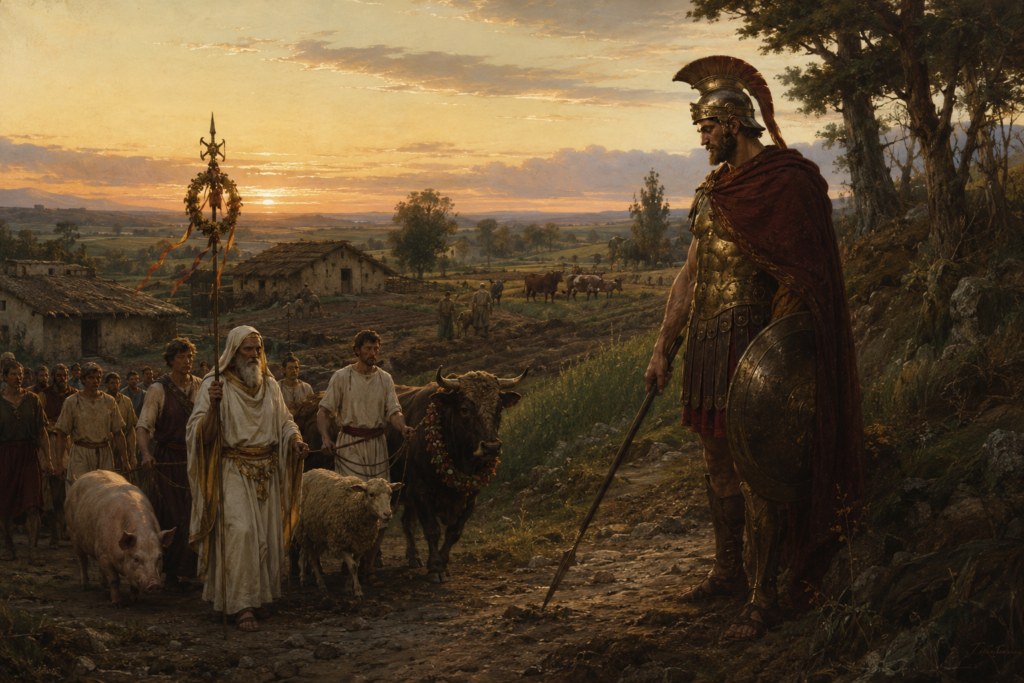
Mars is the Roman god of war because many of his public rites were military in character.
Rosivach discusses a series of festivals in March and October that Roman tradition associated with Mars: Equirria, Quinquatrus, Tubilustrium, the October Horse, and Armilustrium (Rosivach, 1983, pp. 509-510).
These were not abstract ideas about war.
They involved horses, shields, trumpets, arms, priests, and the ritual preparation or purification of military equipment.
Rosivach argues that the March rites looked forward to the coming campaign season, while the October rites marked the end of that season (Rosivach, 1983, p. 512).
In this reading, Mars is not simply a god of war and battle.
He is a god whose rites protect the instruments of war before danger begins and purify them after danger has passed.
This is a more precise and more interesting understanding of a god of war.
Hoerber gives a vivid introduction to the warrior priests of Mars, the Salii.
Drawing on Livy and Dionysius of Halicarnassus, he describes them as priests who carried the sacred shields, wore ceremonial clothing, danced through the city, sang hymns, and struck their shields with daggers (Hoerber, 1958, pp. 65-66).
This is where the worship of Mars becomes visible, noisy, rhythmic, and public.
The god mars is not merely believed in, but performed in the streets of Rome.
Was Mars Also the Roman God of War and Agriculture?
The phrase Roman god of war reflects a real scholarly problem.
Hoerber presents the older scholarly case that Mars was originally an agricultural deity, pointing especially to the Arval Brothers and Cato’s field prayer (Hoerber, 1958, pp. 66-67).
Forsythe also says that ancient prayers and rituals demonstrate Mars’s dual agricultural and warlike character (Forsythe, 2005, p. 127).
However, Cato’s prayer is really central here.
In the agricultural rite cited by Forsythe, Father Mars is asked to protect the farmer, household, land, crops, vineyards, shepherds, and flocks, while warding off sickness, barrenness, destruction, ruin, and harmful seasonal influence (Forsythe, 2005, p. 127).
Hoerber quotes the same prayer and emphasizes that Mars is asked to preserve harvests, grain, vineyards, shepherds, cattle, and the health of the household (Hoerber, 1958, pp. 66-67).
This is one of the clearest reasons scholars discuss Mars in connection with agriculture.
Rosivach helps us phrase this carefully.
He does not simply say that Mars was a vegetation god.
He argues that the agricultural evidence shows Mars acting as protector and averter of evil in the fields, just as he acts as protector in military contexts (Rosivach, 1983, pp. 517-518).
That distinction matters.
Mars was also agricultural, but not necessarily because he was a soft god of plants.
He guarded the conditions that allowed fields, animals, households, and Roman citizens to survive.
What Does Mars Pater Tell Us About Protection?
The title Mars Pater, or Father Mars, appears in the agricultural prayer from Cato.
It gives the god a protective, household-facing quality that can surprise modern readers who only know him as the Greek Ares equivalent.
In Cato’s prayer, Mars is addressed as a powerful divine father who can keep disease, bad weather, and disaster away from the farm (Hoerber, 1958, pp. 66-67).
The prayer is practical, anxious, and deeply rooted in rural life.
Rosivach interprets this kind of evidence through lustration.
A lustration was a purificatory and protective ritual, directed either toward removing past pollution or preventing future harm (Rosivach, 1983, p. 515).
In military settings, Mars protects weapons, shields, horses, and the assembled army.
In agricultural settings, he protects fields, flocks, crops, and the household.
This is where Mars becomes a protector of Rome in a broader sense.
Rosivach concludes that Mars’s role in both military and agricultural contexts points to a wider function as protector of his people against evils in general (Rosivach, 1983, p. 518).
That statement gives us a careful way to explain Mars without flattening him.
He is a war god, but his warlike power belongs to a larger pattern of guarding, cleansing, and defending.
Why Was March Sacred to Mars?
March was sacred to Mars because it opened the old Roman year and marked a crucial moment in both agriculture and warfare.
Hoerber notes that the Romans originally dedicated the first month of the year to Mars, and that surviving calendars record several March festivals in his honor (Hoerber, 1958, p. 65).
Forsythe adds that March took its name from Mars and marked the return of spring and plant life (Forsythe, 2005, p. 127).
The beginning of the year was not just a date.
It was a seasonal threshold.
Forsythe explains that the first four months of the old Roman calendar were connected with the growth and maturation of crops.
March belonged to Mars and vegetation, April to opening and blossoming, May to growth, and June to maturation before harvest (Forsythe, 2005, p. 130).
In that calendar, Mars stands at the beginning of the agricultural cycle.
The birthday of Mars, in this sense, belongs to the return of motion, risk, growth, and military readiness.
The Salii performed especially during this month.
Forsythe describes them as leaping priests who moved through Rome, beating spears on shields and singing an archaic hymn (Forsythe, 2005, p. 127).
Hoerber emphasizes the same dance and connects it with spring sowing and the hoped-for growth of grain (Hoerber, 1958, p. 66).
The result is not a neat division between war and farming, but a Roman world where spear, shield, crop, rhythm, and season meet.
Who Were the Salii in the Worship of Mars?
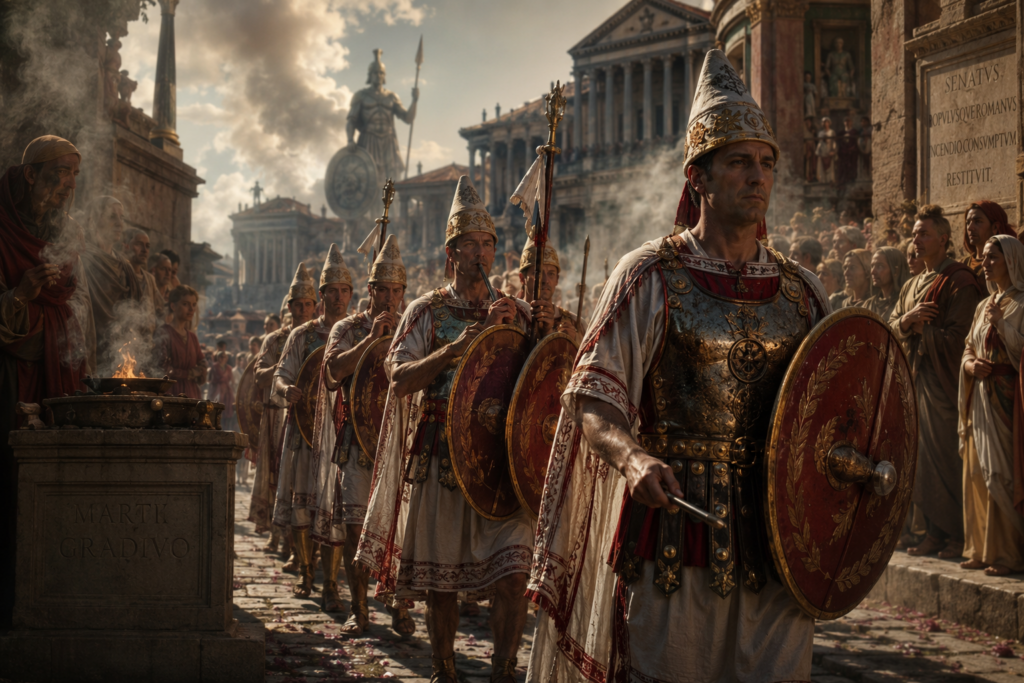
The Salii were among the most vivid figures in the cult of Mars.
Hoerber cites Livy’s statement that Numa appointed twelve Salii for Mars Gradivus and ordered them to carry the sacred shields, the ancilia, through the city while dancing and singing (Hoerber, 1958, p. 65).
Dionysius gives a fuller picture, describing their clothing, caps, swords, rods, shields, flute music, and shield-striking performance (Hoerber, 1958, pp. 65-66).
Their worship was embodied movement.
Rosivach is interested in the Salii because they fit the lustral pattern of Mars.
The Quinquatrus involved the lustration of the ancilia, and Rosivach notes that the Salii likely carried out this ritual, perhaps by dancing around the shields (Rosivach, 1983, p. 512).
The dance was not merely decorative.
It belonged to the religious handling of Rome’s sacred war equipment.
The Salii also help explain why Mars became such an important god in Roman public life.
Their rites took place in March, at the opening of the war season and the agricultural year.
Polybius even shows that the Salii’s obligations could affect military movement, since a general who was one of the Salii could not change residence during the thirty-day sacrificial period (Hoerber, 1958, p. 66).
Religion, calendar, war, and public duty were not separate boxes in ancient Rome.
How Did Mars Differ From Ares in Greek Mythology?
Mars is often described as the Roman equivalent of Ares, the Greek god of war, but that comparison can mislead if it is used too quickly.
Although, they both may have older shared Indo-European roots and origins.
Keppie, Arnold, and Ingham note that Mars became identified with the Greek warrior god Ares, and that his military role eventually overshadowed his agricultural one (Keppie et al., 1982, p. 73).
That is true for later Roman art and interpretation.
But it does not mean Mars and Ares were the same kind of deity.
Forsythe makes the larger difference clear when he says the Romans did not develop myth in the same manner as the Greeks (Forsythe, 2005, p. 126).
Greek mythology gives us a strong narrative figure in Ares, often defined by battle passion, conflict, and divine family drama.
Roman religion gives us Mars as a practical divine power who receives rites, protects fields, guards the army, and helps define the Roman state.
The Greek god of war and the Roman god of war overlap, but they are not identical in function or cultural meaning.
This is why “Greek and Roman” comparisons should be handled with care.
Mars was not merely Greek Ares wearing a Latin name.
In Roman culture, Mars could be linked to March, the Salii, Cato’s agricultural prayer, the Campus Martius, the Arval hymn, and imperial monuments.
The Greek counterpart helps readers orient themselves, but the Roman evidence gives Mars his own shape.
How Was Mars Linked With Romulus, Quirinus, and Early Rome?
Mars also belongs to Roman tradition about origins and identity.
Forsythe notes that later Romans associated Quirinus with the deified Romulus and considered him a war god similar to Mars (Forsythe, 2005, p. 137).
Rosivach goes further into the relationship between Mars and Quirinus, arguing that Mars may have been the protective deity, while Quirinus had a similar role for the Sabine settlement on the Quirinal (Rosivach, 1983, pp. 519-520).
This is not a simple myth tale, but a scholarly attempt to understand early Rome through cult and settlement history.
Rosivach also discusses Italic foundation myths involving animals sacred to Mars.
He mentions the Picentini guided by a woodpecker, the Samnites guided by a bull after a sacred spring vow to Mars, and the Hirpini guided by a wolf (Rosivach, 1983, p. 520).
He suggests that the woodpecker and the wolf in Roman foundation material may belong to a wider Italic pattern of Mars-connected origin stories (Rosivach, 1983, p. 520).
This gives a careful way to mention Romulus without too much speculation.
This is also where the phrase father of the Roman people can be used cautiously.
Mars the father is not only a biological father in Roman myth.
He is also a divine figure through whom Romans imagined protection, origin, expansion, and community.
Rosivach’s Mars is a tutelary power, watching over a specific people and eventually becoming the dominant protector of the whole Roman community (Rosivach, 1983, pp. 519-520).
What Did Mars Look Like in Roman Britain?
The Balmuildy statue gives us Mars in stone, not only in texts.
Keppie, Arnold, and Ingham describe fragments of a half life size statue of Mars found at Balmuildy Roman fort in Scotland during excavations in 1912 to 1914 (Keppie et al., 1982, p. 73).
This source is especially useful because it shows Mars in Roman Britain, on the military frontier, where Roman soldiers looked to divine powers for success, protection, and answered prayers.
It is a different kind of evidence from Cato or the Roman calendar.
The authors state that Mars was especially venerated in frontier provinces where the Roman army had garrison posts (Keppie et al., 1982, p. 73).
They also say shrines to Mars likely existed in or beside Roman forts, with altars, votive statues, and bronze statuettes expressing hopes for his favorable intervention (Keppie et al., 1982, p. 73).
This is the army’s Mars.
He belongs to forts, dedications, sacrifice, and the dangerous edges of empire.
The Balmuildy statue is shown in full military equipment.
Mars is depicted with a crested Corinthian helmet, muscle cuirass, cloak, sword, greaves, and probably spear and shield (Keppie et al., 1982, p. 75).
Yet the carving also shows Celtic influence in the face and hair, making the statue a Romano-British cultural amalgam (Keppie et al., 1982, p. 75).
The article also notes that in Celtic lands Mars was often assimilated to local deities such as Camulus, Belatucadros, and Ocelus (Keppie et al., 1982, p. 73).
That lets us mention a Celtic god context carefully, as a matter of provincial assimilation rather than vague folklore.
Who Was Mars Ultor, Mars the Avenger?
Mars Ultor means Mars the Avenger, and Beckmann’s article is essential for this imperial layer of the god.
Beckmann argues that modern commentators often emphasize Mars Ultor as avenger of Caesar, but that the evidence for actual invocations of Mars Ultor more strongly supports a role as avenger against foreign enemies, especially Parthia and later Persia (Beckmann, 2016, p. 124).
This is an important correction.
It keeps us from reducing Mars Ultor to one familiar explanation.
The earliest specific evidence for Mars Ultor, according to Beckmann, appears on coinage of 19 and 18 B.C. connected with the Roman military standards recovered from the Parthians (Beckmann, 2016, p. 132).
These coins showed standards either held by Mars or displayed in a temple, with legends referring to Mars Ultor or to the recovered standards (Beckmann, 2016, p. 132).
Beckmann argues that this publicized Mars Ultor across the empire as a god of vengeance against the Parthians (Beckmann, 2016, p. 132).
Beckmann also connects Mars Ultor with Trajan.
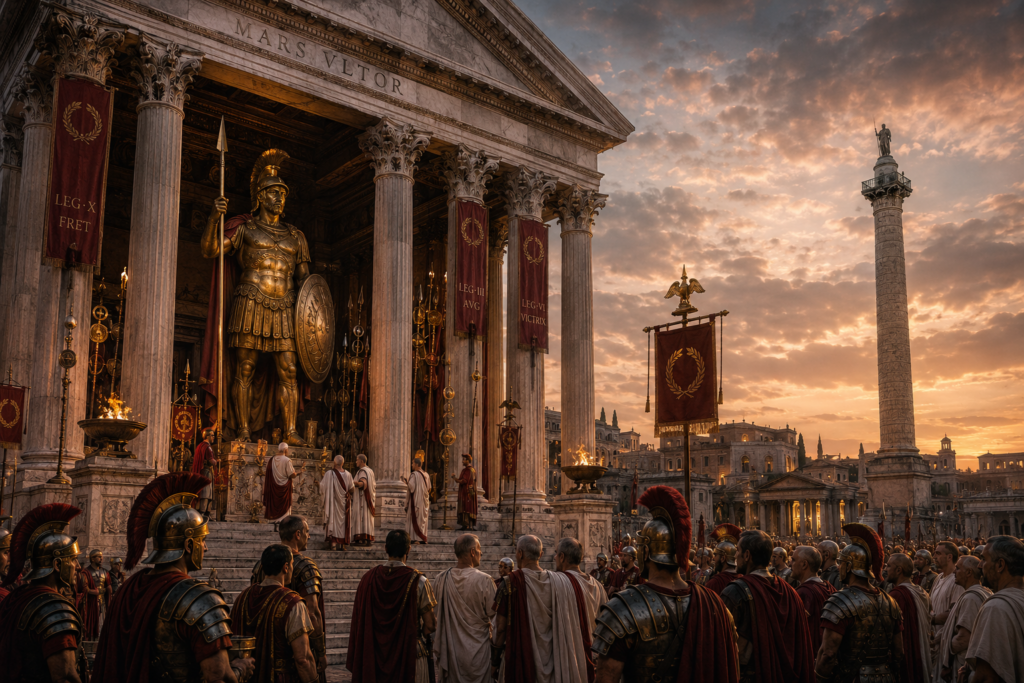
He argues that Trajan deliberately dedicated his Column on 12 May A.D. 113, the anniversary of the Temple of Mars Ultor, as part of the setting for a new war against Parthia (Beckmann, 2016, pp. 124-126).
He also explains that 12 May was the date of circus games for Mars Ultor, and that the Feriale Duranum records a bull sacrifice to Mars Pater Ultor on that date (Beckmann, 2016, p. 126).
In this imperial setting, Mars represented vengeance, recovered honor, Roman victory, and sacred state memory.
What Should Readers Remember About Mars?
Mars is the Roman god of war, but the research shows that this phrase is only the beginning.
Rosivach shows Mars as a lustral god, deeply involved in purification and protection (Rosivach, 1983, pp. 515-518).
Forsythe shows him as a complex archaic deity connected with farmland, wilderness, spring, March, and war beyond the borders of the state (Forsythe, 2005, p. 127).
Hoerber gives the older case for the agricultural Mars through the Salii, Arval Brothers, and Cato’s prayer (Hoerber, 1958, pp. 65-67).
Keppie, Arnold, and Ingham show Mars in the Roman army and on the frontier, standing in stone at Balmuildy with helmet, armor, spear, and shield (Keppie et al., 1982, pp. 73-75).
Beckmann shows Mars Ultor in imperial politics, coinage, temples, recovered standards, and wars against Dacia and Parthia (Beckmann, 2016, pp. 124-143).
Together, these sources make Mars an important god not because he fits a single simple definition, but because he stands at the meeting point of war, agriculture, protection, origin, empire, and ritual memory.
So when we say Mars is the Roman god, or the Roman god of war, we should hear the fuller scholarly conversation behind the phrase.
Mars belongs to the gods of ancient Rome, but he is not only a battlefield figure.
He is invoked over fields, seen in priestly dances, carved in frontier forts, linked with Roman beginnings, and remembered in imperial monuments.
The academic literature makes him larger, stranger, and more Roman than the familiar comparison with Ares alone.
References
Beckmann, M. (2016). Trajan’s Column and Mars Ultor. The Journal of Roman Studies, 106, 124-146. https://www.jstor.org/stable/26346753
Forsythe, G. (2005). Archaic Roman religion. In A critical history of early Rome: From prehistory to the First Punic War (pp. 125-146). University of California Press. https://www.jstor.org/stable/10.1525/j.ctt1ppxrv.12
Hoerber, R. G. (1958). The worship of Mars. The Classical Outlook, 35(6), 65-67. https://www.jstor.org/stable/43929232
Keppie, L. J. F., Arnold, B. J., & Ingham, J. K. (1982). A statue of Mars from Balmuildy. Glasgow Archaeological Journal, 9, 73-75. https://www.jstor.org/stable/44811149
Rosivach, V. J. (1983). Mars, the lustral god. Latomus, 42(3), 509-521. https://www.jstor.org/stable/41532888