

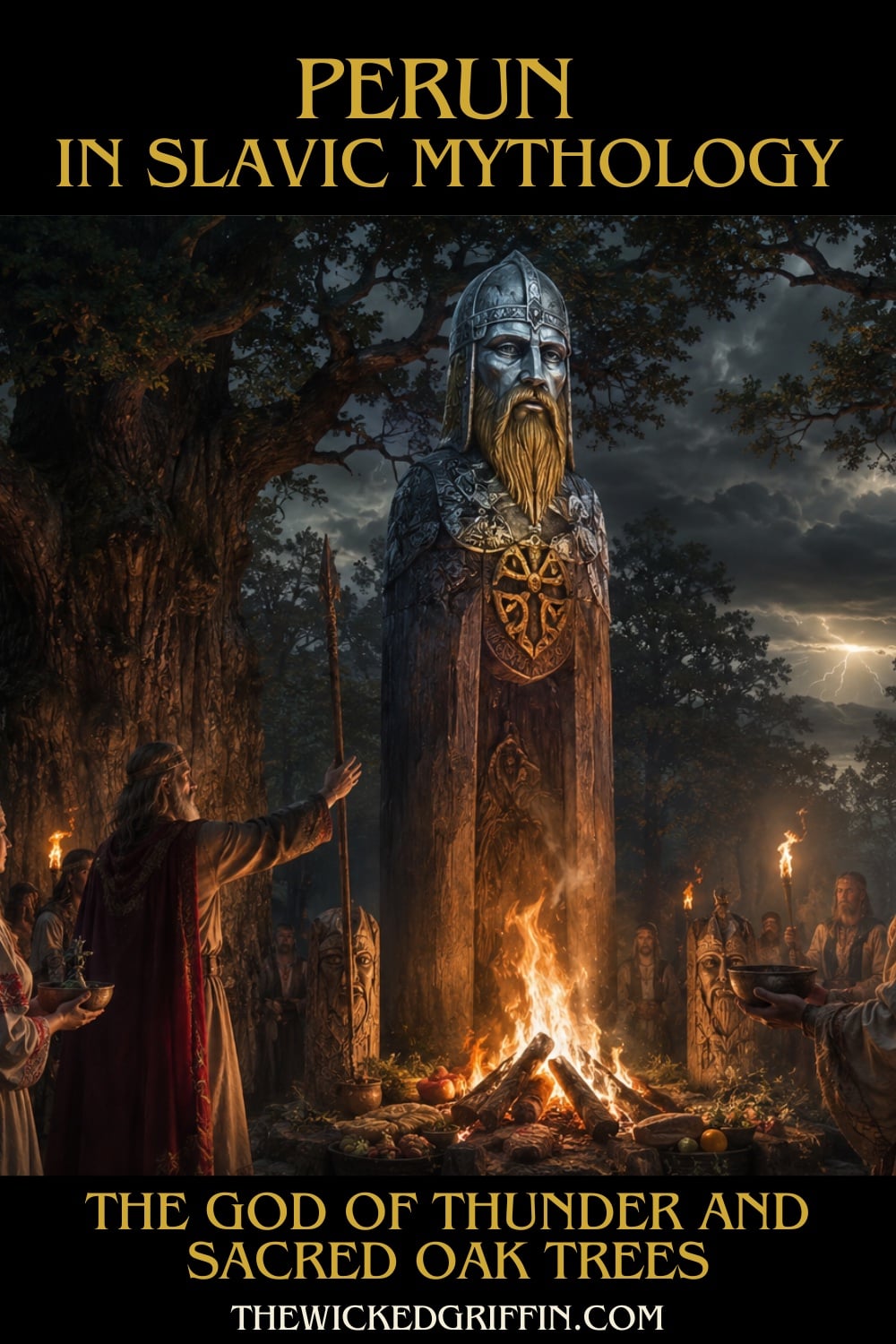
Perun in Slavic Mythology: The Slavic God of Thunder, Oak Trees, and Sacred Order Explained
Perun is one of the most powerful figures in Slavic mythology.
He is usually described as a Slavic god of thunder, lightning, storms, weapons, and sacred order, but the real story is more interesting than a simple label.
Perun belongs to a world of oaks, vows, storms, mountain tops, political power, and mythic conflict with Veles.
This article is worth reading because Perun was not just “the Slavic Thor.” He was part of a much older and more complicated religious world, and the sources need careful handling.
Who Was Perun in Slavic Mythology?
Perun was a major Slavic deity connected with thunder, storm power, weapons, and the protection of order.
In older scholarship and medieval source discussions, he often appears as the Slavic god of thunder, but we have to be careful. Slavic religion was not a single, tidy system with one neat list of gods and goddesses.
Dittrich warned that old Slavic religion should not be treated as a fully developed high culture polytheism, because it was made from several different layers of belief and practice (Dittrich, 1961, p. 481).
That matters because Perun’s role changed depending on time, place, and political setting. Among the Slavs, Perun could be imagined as a storm power, a god Perun with weapons, a witness to a treaty, and later a figure raised to special rank by rulers.
Urbańczyk notes that Perun was described by Gieysztor as “the highest Slavonic god, the lord of the thunders” and “the guarantor of the world’s order,” but Urbańczyk also cautions against assuming one uniform Slavic pantheon (Urbańczyk, 2003, p. 21).
Was Perun the Supreme God of the Slavs?
Perun is often called the supreme god of the Slavs, but that statement needs a giant footnote.
It is safer to say that Perun became one of the most prominent Slavic deities, especially in certain political settings.
In Kievan Rus, Vladimir elevated Perun before the Christianization of Rus in 988, and this seems to reflect political centralization as much as ancient religious tradition (Urbańczyk, 2003, pp. 21–22).
This is where modern readers can get misled. A late ruler raising Perun above other gods does not prove that every Slavic tribe, across every region, always saw Perun as king of the gods.
Urbańczyk argues that pagan pantheons often became more hierarchical when ambitious rulers needed religious support for their own power (Urbańczyk, 2003, p. 21).
Dittrich goes even further by warning that Perun should not simply be treated as the main god of a unified pantheon, since that would assume a system that the evidence itself does not clearly show (Dittrich, 1961, p. 499).
What Made Perun a God of Thunder and Lightning?
Perun’s strongest identity is tied to thunder and lightning. Chadwick points to Procopius, the 6th century historian Procopius, who wrote that the Slavs believed in “one god, the creator of the lightning,” whom they considered lord of all things (Chadwick, 1900, p. 27).
This does not give us a full biography of Perun, but it does show that a powerful lightning deity was already visible to outside observers in early Slavic religion.
The phrase god of thunder and lightning fits Perun well, but it should not be stretched into a comic book image of a sky warrior throwing lightning bolts every five minutes.
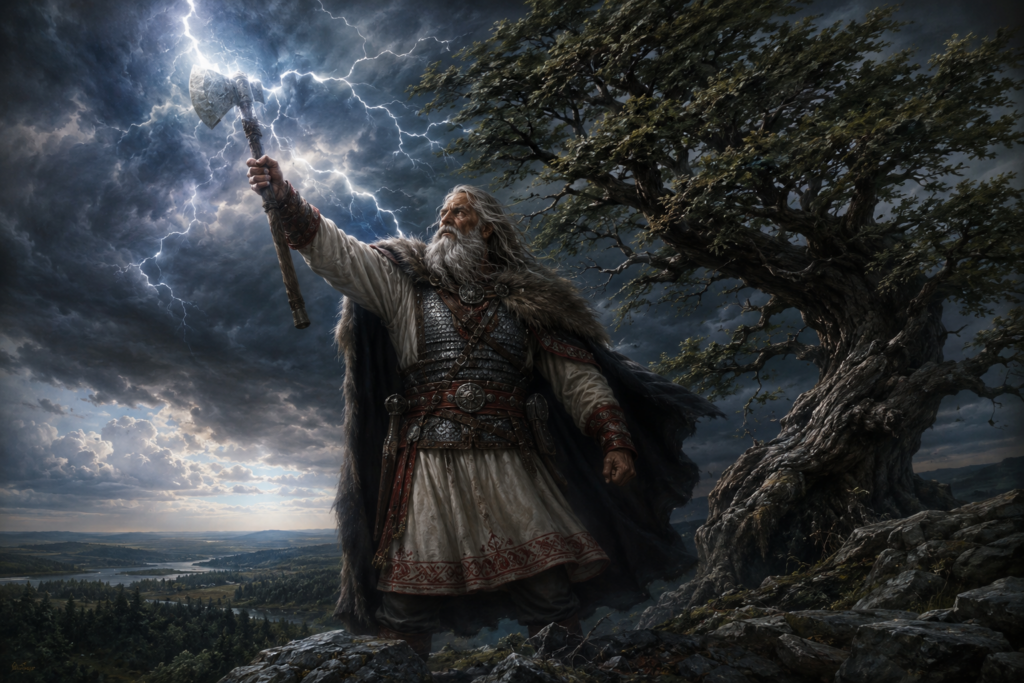
The older sources give us a more symbolic picture. Montelius says that the Slavonians pictured Perun with a stone ax in his hand, placing him in the wider European pattern where stone weapons, thunderbolts, and storm gods belonged together (Montelius, 1910, p. 67).
Perun’s thunder and lightning were signs of power, judgment, and cosmic force, not just dramatic weather.
Why Is the Oak Tree Associated with Perun?
The oak tree is one of the strongest symbols associated with Perun. Chadwick’s entire study focuses on the relationship between sacred oaks and thunder gods across Europe.
He argues that among Baltic peoples, reverence for the oak was closely tied to Perkuno or Perkunas, a thunder deity related to Perun in the wider Baltic Slavic comparison (Chadwick, 1900, pp. 34–35).
This is not just a pretty nature symbol.
The mighty oak stood for height, rootedness, strength, and contact with the storm.
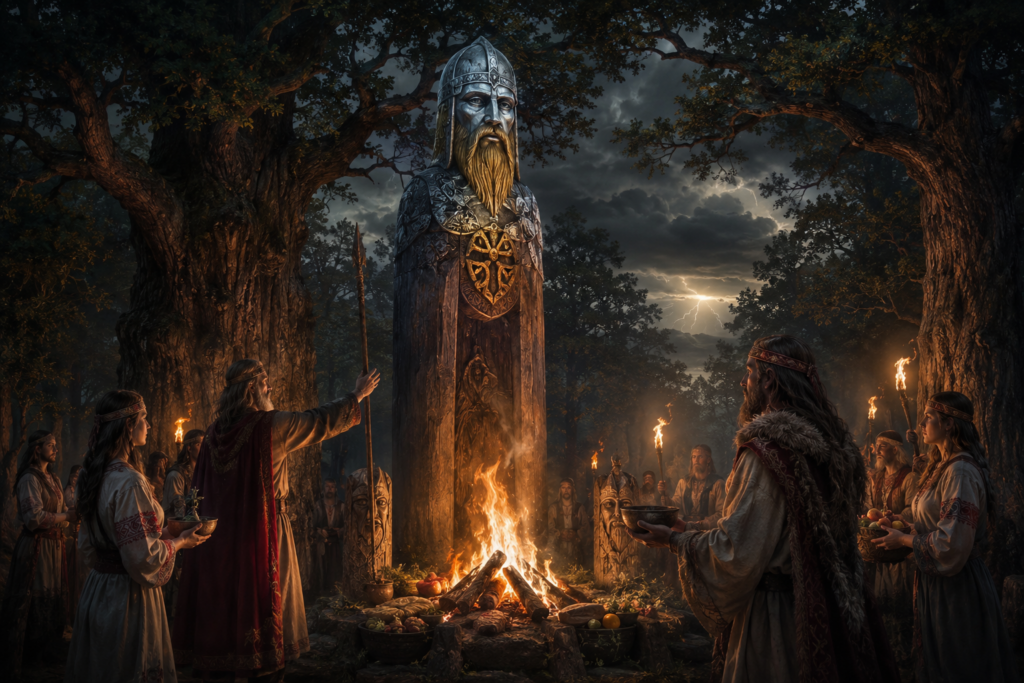
Chadwick describes the sacred oak at Romove, where Perkuno was believed to communicate with priests during thunderstorms, and where a perpetual fire was kept burning beneath the tree (Chadwick, 1900, p. 26).
Montelius gives a close Slavic parallel when he says that an oak log fire was kept burning day and night in honor of Perun (Montelius, 1910, p. 67).
What Were Perun’s Symbols and Weapons?
Perun’s symbols include the ax, stone, hammer, arrow, oak tree, storm, and sacred fire.
These are not random accessories. They belong to a wider pattern in which the thunder god strikes, splits, burns, and restores order.
Montelius connects stone axes with thunderbolts and says that people in different parts of Europe understood ancient stone implements as weapons of the thunder god (Montelius, 1910, p. 60).
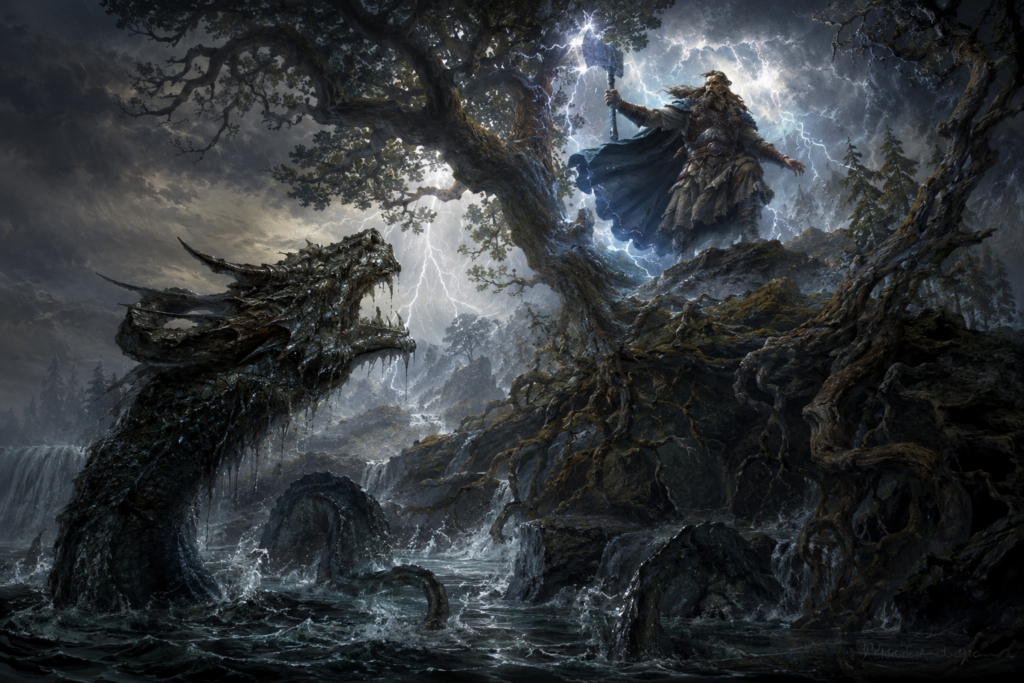
Rak’s discussion of Perun and Veles gives a clear list of Perun’s weapons in the mythic conflict. Perun defeats Veles using stone, hammer, lightning, thunder, and arrow, then releases the stolen waters or treasure (Rak, 2011, pp. 103–104).
This is where the old storm imagery becomes more than weather. Perun’s weapons are tools of justice and order, and they are aimed at restoring balance when the world has been disrupted.
Who Was Veles, and Why Does Perun Fight Him?
The conflict of Perun and Veles is one of the most important mythic patterns linked with Perun. Veles is often connected with the underworld, water, cattle, wealth, serpents, and the chthonic side of life.
Rak describes Veles or Volos as a serpent figure below in the water, the source of riches, while Perun belongs above the water and has a dry, stormy, sky connected sphere (Rak, 2011, p. 103).
In this mythic pattern, Veles rises into Perun’s realm and takes water or treasure. Perun then pursues and defeats him on the mountain, freeing rain and restoring order (Rak, 2011, pp. 103–104).
This is not a simple good guy and bad guy story. It is more like a battle between order and chaos, dry and wet, sky and earth, upper world and god of the underworld type imagery.
The balance between these powers mattered because life depended on rain, fertility, and the return of proper boundaries.
Was Perun Like Thor, Zeus, or Other Thunder Gods?
Perun is often compared with Thor, and that comparison can be useful if we do not push it too far.
Thor in Norse mythology carries a hammer, fights giants, protects the world of humans and gods, and is deeply tied to thunder.
Montelius compares Thor’s hammer with the older symbolism of lightning, stone, and sacred weapons, and he notes that Thor’s hammer was imagined as flying through the air and returning to his hand (Montelius, 1910, p. 71).
Perun also belongs to a wider Indo European thunderer pattern that includes Greek Zeus, Jupiter, Donar, Perkunas, and other storm figures.
Rak states that the oak was often dedicated to the highest thunder deity, naming Zeus, Jupiter, Donar, Perun, and Perkunas in that symbolic group (Rak, 2011, p. 105).
That does not mean Perun and Greek Zeus are the same god. It means that ancient European religions often connected storm power, sacred trees, kingship, and divine force in similar ways.
What Do We Know About the Worship of Perun?
The worship of Perun appears in several kinds of evidence.
Chadwick notes that in treaties mentioned by Nestor, the Varangians called Perun as a witness, and he suggests that Thor may have been identified with a native Slavic deity in some of those contexts (Chadwick, 1900, p. 27).
This treaty material is important because it shows Perun as a god invoked in serious public vows, not just a figure of story or folklore.
The Primary Chronicle tradition also matters for the famous idol of Perun under Prince Vladimir.
Pettazzoni mentions the wooden idol of Perun described in Nestor’s Chronicle with a silver head and golden moustaches, placed under the year 980 in the so called canon of Vladimir’s gods (Pettazzoni, 1946, p. 142).
Montelius gives a related version, saying that Vladimir’s statue of Perun in Kiev was made of wood and had a silver head and golden beard (Montelius, 1910, p. 67).
If you see “silver hair” or “golden mustache” online, the careful version is that the source tradition speaks of a silver head and gold facial hair, with wording that varies between beard and moustaches.
How Did Perun Fit Into Ancient Slavic Sacred Places?
Perun belongs naturally to mountains, oaks, fire, and high places.
In ancient Slavic sacred geography, the oak and the elevated place mattered because they gave the thunderer a place to stand in the world.
Rak discusses the place name Dubrava, from a root meaning oak, and explains that Katičić reads it as land religiously understood as a place where the thunderer is present, much like his mountain (Rak, 2011, p. 105).
Sacred groves and oak groves were not just pretty backgrounds.
They were places where a community could meet the divine. Chadwick describes Slavic holy groves and trees, including an oak at Stettin that Bishop Otto of Bamberg prepared to cut down in 1124.
The people begged him to spare it because they believed it was the dwelling place of a deity, and a spring stood beneath it (Chadwick, 1900, p. 33). This helps us understand why Perun’s oak was not “just a tree.” It was a living religious place.
What Happened to Perun After Christianization?
Christianization changed Perun’s world, but it did not erase it overnight.
Urbańczyk argues that conversion in North Central Europe was deeply political, because pagan elites often judged Christianity through its political and economic advantages (Urbańczyk, 2003, p. 15).
Once Christianity became tied to rulers, old gods could be condemned, transformed, or absorbed into new local traditions.
This is where figures like Elijah and Christian saints become important.
In many Slavic cultures, thunder imagery later attached itself to St. Elijah, while dragon slayer motifs could attach to saints such as St. Michael or St. George.
Rak discusses Christian dragon slayer figures replacing or transforming older mythic patterns in Croatian and South Slavic material (Rak, 2011, pp. 104–105). The old world did not vanish. It changed clothes.
How Does Perun Relate to Svarog, Lada, and Other Slavic Deities?
Perun is only one figure in a larger and messier religious field.
Names such as Svarog, Lada, goddess Lada, Dodola, and other gods and goddesses often appear in modern discussions of Slavic mythology, but each one needs careful source work.
Pettazzoni discusses Svarozic as “little Svarog” or the son of Svarog in connection with the Redarii and Slavic religious evidence (Pettazzoni, 1946, p. 147). That is helpful, but it does not mean every later internet list of Slavic deities is equally reliable.
Lada and Dodola are good examples of why accuracy matters.
They may belong in a wider article on Slavic folklore, fertility rites, rain rites, or goddess traditions, but they should not be forced into a Perun article unless the source base supports it.
Dittrich’s work reminds us that Slavic religion contained earth, water, ancestor, feminine, and chthonic layers that cannot be reduced to Perun alone (Dittrich, 1961, pp. 487–490). A good article should let Perun be powerful without pretending he explains everything.
Why Does Perun Still Matter?
Perun still matters because he gives us a window into how ancient Slavs imagined power.
He was not merely a storm character. He stood near the oak, above the waters, with the ax, hammer, arrow, and storm at his command.
He could be invoked in oath and treaty, placed at the center of political reform, and remembered in later folklore through thunder marks, saints, sacred trees, and stories of cosmic battle.
Perun in Slavic mythology teaches us that religion was not separate from land, law, family, weather, kingship, and survival. The thunder was not background noise. It was a voice of power.
The oak was not decoration. It was a sacred point in the world. The fight with Veles was not just monster slaying. It was a story about water, wealth, fertility, boundaries, and the fragile order that lets life continue.
References
Chadwick, H. M. (1900). The oak and the thunder-god. The Journal of the Anthropological Institute of Great Britain and Ireland, 30, 22–44. https://www.jstor.org/stable/2842615
Dittrich, Z. R. (1961). Zur religiösen Ur- und Frühgeschichte der Slaven. Jahrbücher für Geschichte Osteuropas, Neue Folge, 9(4), 481–510. https://www.jstor.org/stable/41041852
Montelius, O. (1910). The sun-god’s axe and Thor’s hammer. Folklore, 21(1), 60–78. https://www.jstor.org/stable/1253798
Pettazzoni, R. (1946). The pagan origins of the three-headed representation of the Christian Trinity. Journal of the Warburg and Courtauld Institutes, 9, 135–151. https://www.jstor.org/stable/750313
Rak, O. (2011). The vulva and the plough. In The rhyton from Danilo: Structure and symbolism of a Middle Neolithic cult-vessel (pp. 103–117). Oxbow Books. https://www.jstor.org/stable/j.ctt1cfr73m.14
Urbańczyk, P. (2003). The politics of conversion in North Central Europe. In M. Carver (Ed.), The Cross goes north: Processes of conversion in Northern Europe, AD 300–1300 (pp. 15–27). York Medieval Press/Boydell & Brewer. https://www.jstor.org/stable/j.ctv136bvsn.6