
Laufey in God of War vs. Norse Mythology: What the Game Gets Right (and What It Changes)
Sony's God of War: Laufey puts players in the role of Loki's mother for the first time. But who was Laufey in the original Norse sources? We compare the mythological Laufey from the Prose Edda with her reimagined counterpart in the God of War franchise — what the games preserve, what they transform, and why it matters.
If you have ever played God of War (2018) or God of War Ragnarök (2022), you know the name Laufey.
In the games, she is Faye — the warrior wife of Kratos, the mother of Atreus, and the woman whose death sets the entire Norse saga in motion.
But Laufey is not a character invented by Sony Santa Monica.
She is drawn from the Old Norse literary tradition, where she appears as the mother of one of mythology’s most complex figures: Loki.
With the June 2026 announcement of God of War: Laufey, the first entry in the series where players take on her role directly, millions of gamers are now asking: who was the real Laufey?
What did the game developers get right, and where did they take creative liberties?
This article examines the mythological Laufey alongside her video game counterpart, drawing on the primary medieval sources — the Prose Edda and the Poetic Edda — to separate historical Norse mythology from modern storytelling.

Who Is Laufey in Norse Mythology?
In the original sources, Laufey is a quiet presence.
She appears in the Prose Edda, composed by the Icelandic historian Snorri Sturluson around 1220, and in references scattered across the Poetic Edda, a collection of older poems preserved in 13th-century manuscripts.
What we know can be summarized simply: Laufey is the mother of Loki.
Her husband is Fárbauti, a jötunn (giant) whose name means “dangerous striker.”
She is also called Nál, meaning “needle,” which a later source (Sörla þáttr) explains by describing her as “slender and weak.”
Her primary name, Laufey, derives from the Old Norse lauf (leaf or foliage), leading some scholars to interpret her as a figure connected to trees or nature.
That is, frankly, the extent of what the medieval texts tell us.
There are no stories about Laufey, no tales of her deeds, no accounts of her personality.
She is defined almost entirely through her genealogical connection to Loki.
Yet one detail stands out: Loki is consistently called Laufeyjarson — “son of Laufey” — rather than Fárbautason (“son of Fárbauti”).
In a mythology that overwhelmingly identifies individuals through their fathers, this matronymic is remarkable.
It appears multiple times in the Prose Edda, including in Gylfaginning and Skáldskaparmál, as well as in the Poetic Edda.
Whatever Laufey’s story was, her connection to Loki was important enough to override the patrilineal naming convention.
For a deeper exploration of Laufey in the original sources, see our full article: Laufey in Norse Mythology: Loki’s Forgotten Mother.
One more detail matters for this comparison: Snorri lists Laufey among the ásynjar — the goddesses of the Æsir.
This is significant because it places her within the divine community, despite her husband being a giant.
It may also explain why Loki himself was accepted among the gods.
Laufey in God of War: The Character the Games Built
The God of War franchise took these sparse mythological fragments and built a fully realized character.
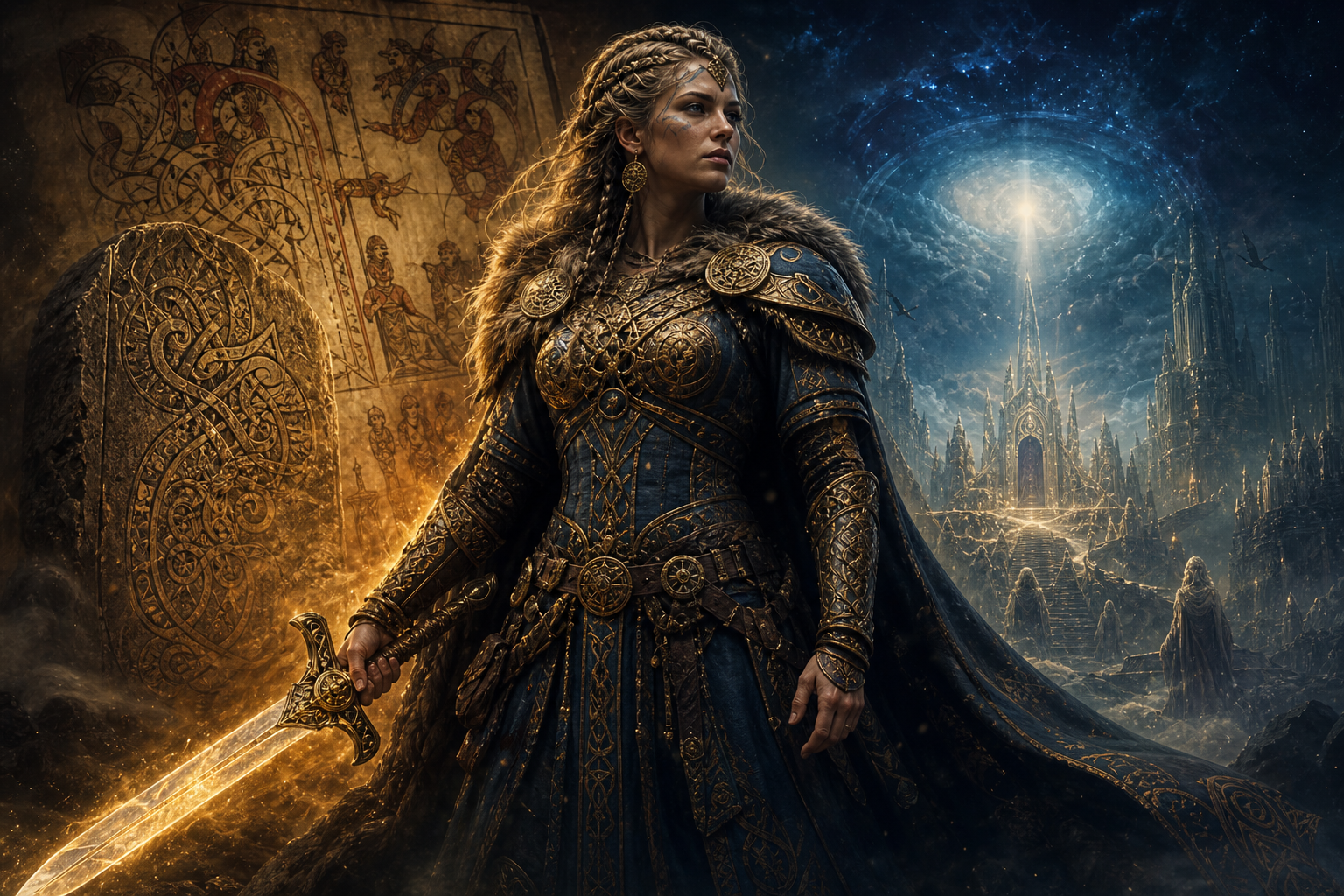
In the games, Laufey — known by her alias Faye — is a Jötunn warrior of Midgard, the last Guardian of the Jötnar, and a woman of extraordinary foresight and courage.
She never appears alive on screen in God of War (2018).
The game opens with her funeral pyre, and the entire journey — Kratos and Atreus carrying her ashes to the highest peak in the Nine Realms — is driven by her final wish.
Yet her presence pervades the story.
Faye is the one who marked the trees along the path.
She is the one who hid Atreus’s true nature.
She is the one who foresaw the journey before it began.
In God of War Ragnarök (2022), we learn more about her backstory.
Faye cooperated with Týr, the Norse god of war and justice, to hide the Realm Tower to Jötunheim, cutting herself off from her homeland to protect her people from Thor’s genocide of the giants.
She met Kratos during a search for her Leviathan Axe, and they fell in love — two warriors with world-weary pasts finding something to protect.
Most importantly, the games reveal that Atreus is Loki.
Faye named him Loki in the language of the giants, making her the mother of Loki — exactly as she is in the original mythology.
What God of War Gets Right About Norse Mythology
Despite being an action-adventure game, the God of War series handles several mythological details with surprising care.
Laufey as Loki’s Mother
The most fundamental connection is preserved: Laufey is the mother of Loki.
The games maintain this relationship as the central reveal of the 2018 entry, when murals in Jötunheim show that Atreus was always Loki.
Laufey as a Jötunn
In the games, Faye is a giant, which aligns with the mythological tradition.
While Snorri lists Laufey among the Ásynjar, her husband Fárbauti is explicitly a jötunn, and the boundaries between gods and giants are famously fluid in Norse mythology.
Many of the Æsir have giantess mothers or wives.
The game’s treatment of Faye as a giant who exists within and alongside the divine world reflects this complexity.
The Importance of Maternal Lineage
The game subtly honors the matronymic tradition.
Atreus is known as “Loki Laufeyson” in the giant prophecies, echoing the Poetic Edda and Prose Edda where Loki is called Laufeyjarson rather than by his father’s name.
The game positions Faye, not Kratos, as the parent through whom Atreus’s mythological destiny is defined.
The Broader Mythological Landscape
The games faithfully recreate many elements of Norse cosmology: the Nine Realms, the World Tree Yggdrasil, the Bifröst, the Norse afterlife and its multiple destinations, and the complex relationships between the Æsir and the Jötnar.
Characters like Odin, Thor, Freya, Mimir, and Týr all draw on (and sometimes deliberately subvert) their mythological counterparts.
What God of War Changes About Laufey
The mythological sources give us almost nothing about Laufey as a person.
The game developers had to invent nearly everything, and some of their choices diverge significantly from what the texts suggest.
A Warrior Heroine vs. a Genealogical Footnote
The biggest departure is obvious: in the mythology, Laufey is essentially a name in a family tree.
She is described only as “slender and weak” (via the epithet Nál) in a late source.
The game transforms her into Laufey the Just, a legendary warrior and the last Guardian of an entire race.
This is pure invention — magnificent invention, but invention nonetheless.
Fárbauti Replaced by Kratos
In Norse mythology, Laufey’s husband is Fárbauti, the “dangerous striker.”
In the games, her partner is Kratos, the Greek god of war from an entirely different mythological tradition.
The name Fárbauti does not appear in the games.
However, some fans have noted that “dangerous striker” could describe Kratos rather well.
Loki’s Siblings Are Missing
The Prose Edda names Býleistr and Helblindi as Loki’s brothers through Laufey and Fárbauti.
The games make Atreus an only child.
Similarly, Loki’s famous monstrous children — Fenrir, Jörmungandr, and Hel — exist in the game’s universe but arrive through different narrative paths.
The Ásynjar Connection Is Absent
Snorri’s placement of Laufey among the goddesses of the Æsir is not reflected in the games.
The game’s Faye is firmly a Jötunn, and the Æsir are largely antagonists.
The mythological suggestion that Laufey bridged the world of gods and giants — perhaps explaining Loki’s acceptance among the Æsir — is lost in this retelling.
The Name Symbolism
The names Laufey (“leafy one”) and Nál (“needle”) carry plant and tree symbolism that some scholars connect to a lost creation myth involving lightning (Fárbauti), leaves or pine needles (Laufey), and fire (Loki).
This poetic layer is absent from the games, which instead build Faye’s identity around warrior culture and prophecy.
God of War: Laufey — The New Game (2026)
On June 2, 2026, Sony Santa Monica revealed God of War: Laufey during the PlayStation State of Play showcase.
It is the first mainline God of War game where Kratos is not the protagonist.
The premise: after her death and funeral at the beginning of God of War (2018), Faye awakens in a place called the Everywhen — a divine afterlife where gods from multiple mythological traditions clash for power.
She must fight her way through this realm to protect the plans she set in motion for Kratos and Atreus.
Key details from the announcement:
- Deborah Ann Woll (Daredevil, True Blood) voices Faye
- Jack Quaid plays Phranque, a friendly talking cube companion
- Faye wields a magic sword named Rue alongside soul-related abilities
- The game blends the movement and fluidity of the Greek-era God of War games with the Norse era’s approach to world-building and character development
- No release date has been announced
From a mythological perspective, the concept of an afterlife journey is deeply rooted in Norse tradition.
The Norse understood multiple afterlife destinations — Valhalla, Hel, Fólkvangr, and more — and the idea of a warrior navigating the realm of the dead resonates with the mythology’s emphasis on death as transformation rather than ending.
The “Everywhen,” with its collision of gods from different traditions, extends this idea into new territory.
Why Laufey Matters — In Mythology and In Gaming
The story of Laufey is, in a sense, a story about what happens when mythology meets imagination.
The medieval sources give us a name, a family connection, and a handful of tantalizing clues.
That is enough for a genealogy but not enough for a narrative.
What the God of War series has done is fill that silence with a story that honors the spirit of the source material — a mother who defines her son’s identity, a figure who bridges worlds — while creating something entirely new.
Whether you came to Laufey through gaming, through Norse mythology, or through the wider world of Loki’s stories, her name carries weight.
The original Laufey may be a “forgotten mother,” but thanks to God of War, she is forgotten no more.
Sources and Further Reading
- Sturluson, Snorri. Prose Edda. Translated by Anthony Faulkes, Everyman, 1998.
- Larrington, Carolyne, trans. The Poetic Edda. Oxford University Press, 2014.
- Lindow, John. Norse Mythology: A Guide to the Gods, Heroes, Rituals, and Beliefs. Oxford University Press, 2001.
- PlayStation Blog. “First Look at God of War Laufey.” June 2, 2026.
- God of War Wiki. “Laufey.”
- The Wicked Griffin. “Laufey in Norse Mythology: Loki’s Forgotten Mother.”
Carry the Spirit of Norse Mythology With You
If the world of Laufey, Loki, and the Norse sagas resonates with you, explore our handcrafted Loki collection. Every piece is inspired by the Urnes style, Elder Futhark runes, and the rich traditions of the Viking age — handmade by an artisan silversmith.
→ Shop the Loki Collection ·
→ Browse All Norse & Viking Jewelry
Shop Handcrafted Norse & Viking Jewelry on Etsy
Love the world of Laufey, Loki, and the Norse sagas? These pieces are handcrafted and inspired by Elder Futhark runes, Viking symbolism, and the old ways.
- → Viking Ear Cuff – Custom Elder Futhark Runes
- → Huginn & Muninn Ear Cuff Set – Odin’s Ravens
- → Sterling Silver Rune Ring – Viking Jewelry
- → Vegvisir Ear Cuff – Norse Pagan Compass
- → Vegvisir + Labradorite Pendant – Viking Locket
Every purchase supports a small, independent artisan shop.