
Celtic Shamanism: Ancient Seers, Fairy Doctors, and the Dangerous Wisdom of the Otherworld

What Do We Mean by Celtic Shamanism?
Celtic shamanism is a phrase people search for when they are trying to find something older, stranger, and more rooted than modern spiritual language usually allows.
The difficulty is that the phrase itself is modern, while the older sources give us something more textured: poets, seers, fairy doctors, otherworld journeys, healing charms, dangerous spirits, animal wisdom, sacred plants, and people who stood at the edge of ordinary life.
That is where the subject becomes interesting.
The question is not simply, “Did the Celts have shamans?” A better question is, “Do Irish and Scottish sources preserve shamanic patterns, even if they did not use that exact word?” (DuBois, 2011, pp. 101–102).

Why We Have to Be Careful with the Word Shaman
A Word with a Complicated History
Scholars do not all agree on how widely the word shaman should be used.
Thomas A. DuBois explains that recent scholarship often speaks of “shamanisms” in the plural, because the term can flatten very different local traditions into one big category (DuBois, 2011, pp. 101–102).
That matters for Celtic material.
If we use the word too loosely, every strange burial, fairy encounter, or magical poem suddenly becomes “shamanism,” and that is not good research.
Shamanism, Reconstruction, and Modern Practice
Modern Western shamanism is often shaped by books, workshops, anthropology, personal experience, and nature spirituality (DuBois, 2011, p. 114).
DuBois even lists Celtic shamanism as an example of “ethno-neoshamanism,” meaning a modern attempt to recover or rebuild a past spiritual path through historical evidence (DuBois, 2011, p. 116).
That does not make it meaningless.
It means we have to separate the modern spiritual practice from the older Irish and Scottish evidence.

Ancient Celtic Evidence Is Not Simple
What We Can Say
The ancient Celtic world did include ritual specialists, poets, healers, seers, and religious figures.
But the sources in this post do not prove that there was a formal class called “Celtic shamans,” or that druids were simply the Celtic version of Siberian spirit-workers.
That kind of claim would be too neat.
What the sources do show is that Irish and Scottish traditions preserve powerful patterns of otherworld travel, supernatural danger, ritual healing, spirit contact, and special knowledge gained through ordeal (Nagy, 1981, pp. 302–306; Goodare, 2012, pp. 198–200).
Finn mac Cumaill as a Shamanic Hero
Hunter, Warrior, Poet, Seer
Joseph Falaky Nagy gives us one of the strongest pieces of evidence for this topic.
He argues that Finn mac Cumaill can be read as a shamanic figure because he is not only a hunter and warrior, but also a poet and seer who repeatedly enters supernatural realms (Nagy, 1981, p. 302).
Finn lives in the wilderness with the fian, outside ordinary settled society.
That matters because liminal figures often have the power to cross boundaries that settled people cannot cross (Nagy, 1981, pp. 302–304).
The Boundary Guard
Nagy describes the shaman as someone who can travel between worlds, protect society from dangerous outside forces, gain hidden knowledge, and survive contact with powers that might destroy an ordinary person (Nagy, 1981, p. 303).
Finn fits that pattern in a very Irish way.
He stands at the edge of the human world, facing what comes from beyond it (Nagy, 1981, pp. 303–304).
Healing and Protection
Finn is not only a fighter.
Nagy notes that Finn can drive away disease, that water held in his hands has healing power, and that Scottish folk tradition gives him a healing cup (Nagy, 1981, p. 304).
This is one place where the idea of the Celtic shaman becomes more grounded.
We are not talking about a vague mystical figure, but about a boundary-crossing healer whose power comes through contact with the otherworld.

The Salmon of Wisdom
Knowledge Through Injury
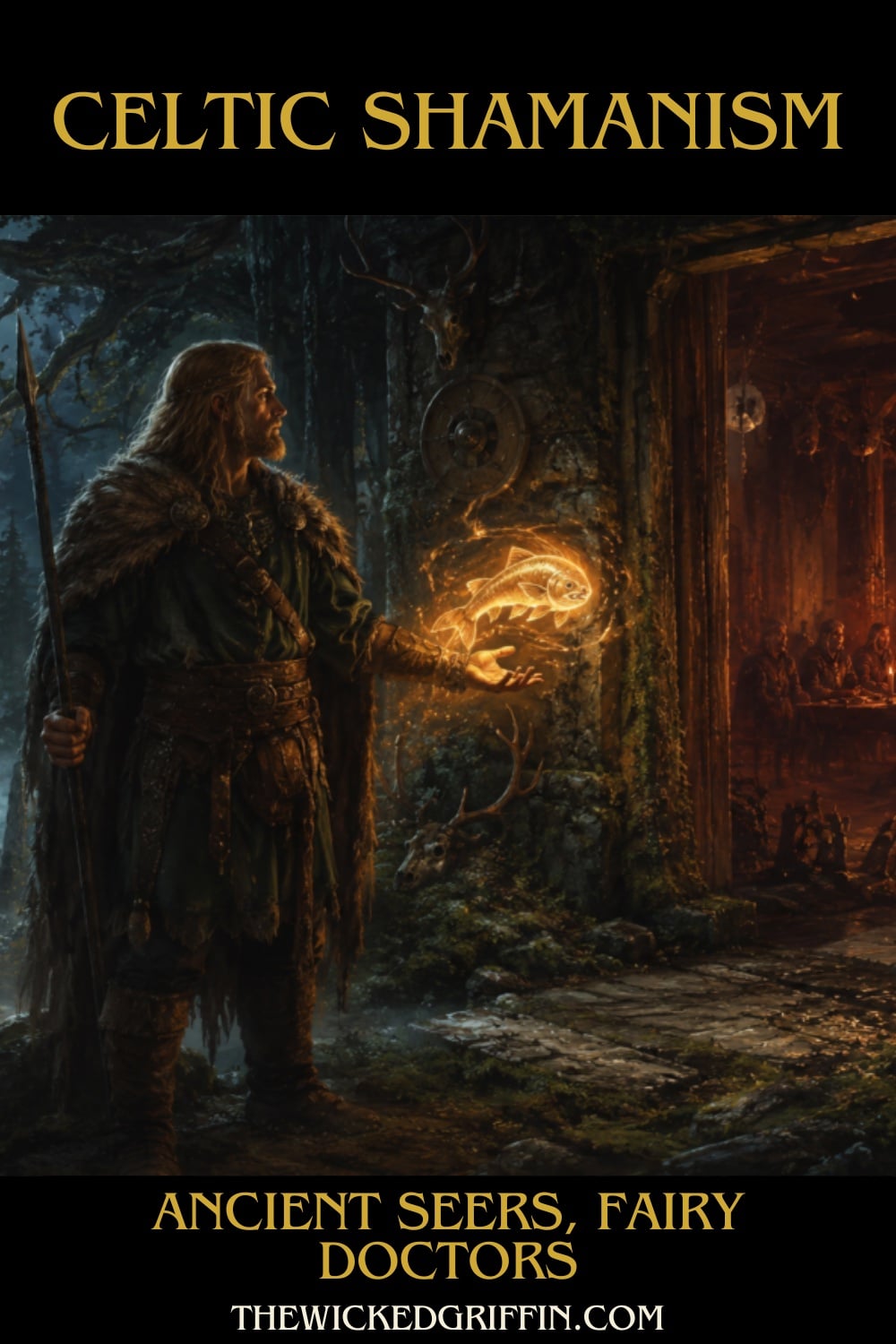
One of the most famous Finn stories tells how he gains wisdom through the salmon.
Finn burns his finger while cooking the supernatural fish, puts the finger into his mouth, and consumes the essence of knowledge that was in the salmon (Nagy, 1981, pp. 304–305).
After that, the gesture itself becomes divinatory.
When Finn places his finger in his mouth, he can access hidden knowledge (Nagy, 1981, p. 305).
Wisdom Is Not Soft in These Stories
This is not the kind of wisdom that arrives politely.
Nagy shows that Finn’s knowledge often comes through injury, humiliation, aging, fear, or death-like contact with the supernatural (Nagy, 1981, p. 305).
That is one of the oldest and most fascinating patterns in the literature.
The otherworld gives knowledge, but it does not give it gently.
The Bruidhean: When the Otherworld Invites You to Dinner
The Otherworld Hostel
A bruidhean is a hostel, but in Fenian stories it is not an ordinary inn.
Nagy explains that bruidhean dwellings are often otherworldly places where Finn and his men are invited to a feast that turns out to be a trap (Nagy, 1981, p. 306).
The shape of the story is simple.
Finn enters a house that looks like shelter, but it becomes a test.
Hospitality Turned Inside Out
In one early bruidhean tale, Finn and his companions enter a strange house after a horse race.
Inside, they meet grotesque supernatural figures, including a three-headed hag, a headless man with an eye in his chest, and a chorus of heads and trunks (Nagy, 1981, pp. 307–308).
The house has fire, food, and music, but all of them are wrong.
The fire suffocates, the food is raw or forbidden, and the music disturbs rather than welcomes (Nagy, 1981, pp. 308–309).
A Dangerous Lesson
That is what makes the bruidhean so powerful.
It is not just a haunted house story.
It is a story about what happens when human customs are mirrored back through the otherworld and made strange.
The Otherworld Takes You Apart
Horses, Cooking, and Return
In the Book of Leinster bruidhean tale, the horses that carry Finn and his men toward the otherworld are killed, cooked, nearly eaten, and then restored (Nagy, 1981, pp. 309–310).
Nagy reads the horses as both vehicles into the otherworld and substitutes for the travelers themselves (Nagy, 1981, p. 310).
That detail matters.
The journey is not sightseeing.
It is a symbolic ordeal.
The Cooked Body Motif
Nagy compares these stories with shamanic initiation motifs where supernatural beings cook, consume, or break down the traveler (Nagy, 1981, pp. 310–311).
In some bruidhean tales, Finn or his companions are threatened with being boiled, eaten, burned, or fed to dogs (Nagy, 1981, p. 310).
That sounds brutal, but the pattern is clear.
The person who returns from the otherworld is not exactly the same person who entered it.
The Seely Wights of Scotland
Blessed Beings, Magical Beings
Julian Goodare gives us another strong piece of evidence, this time from Scotland.
He studies the “seely wights,” a phrase he translates as something like “blessed beings” or “magical beings” (Goodare, 2012, p. 200).
Goodare argues that early modern Scottish evidence points to a shamanistic cult centered on these fairy-like nature spirits (Goodare, 2012, p. 198).
Trance and Spirit Flight
Goodare says members of this cult entered trances and reportedly flew out at night on swallows to join the seely wights (Goodare, 2012, p. 198).
That is one of the clearest source-backed examples in this whole topic.
Still, Goodare is careful.
He admits that the evidence is solid but not extensive, comparing the reconstruction to building a dinosaur skeleton from only a few bones (Goodare, 2012, p. 199).
Not Quite Fairies, Not Quite Something Else
Goodare argues that the seely wights were probably nature spirits similar to fairies, though not exactly fairies (Goodare, 2012, p. 202).
This gives us a fascinating Scottish parallel to the Irish otherworld material.
Here again, the key ideas are trance, travel, spirit beings, healing knowledge, and danger.
Fairy Doctors and Irish Healing Magic
Illness from the Good People
John Windele’s 1865 article is old and often dismissive in tone, but it preserves useful Irish folk-healing material.
He writes that many diseases of humans and animals were believed to come from the “good people,” meaning the fairies, and that charms and spells were used against fairy influence (Windele, 1865, p. 315).
This is not modern medicine.
It is a worldview in which illness can be physical, spiritual, social, and supernatural at the same time.
Fairy Stroke and Fairy Dart
Windele mentions the “fairy stroke or dart,” an affliction that could be treated by sacred water at Lough a dereert in Carbery, County Cork (Windele, 1865, p. 315).
He also says epilepsy was believed to come from fairies and that remedies included laurel, foxglove, known in Irish as fairy thimble, and polypody of the oak (Windele, 1865, p. 319).
People were trying to explain suffering, sickness, seizures, wasting, and misfortune with the language they had.
Charms, Prayers, and the Body
Healing Words
Windele gives an old Irish charm for a sprain that invokes Christ joining blood to blood, flesh to flesh, and bone to bone (Windele, 1865, p. 312).
That small charm tells us a lot.
Irish healing was not cleanly “pagan” or “Christian.”
It could blend biblical language, folk ritual, bodily repair, and inherited magical logic in one spoken formula.
The Healer as Mediator
Windele says early medicine was closely linked with religion, and that practitioners claimed special knowledge of the invisible world (Windele, 1865, p. 310).
That is why fairy doctors and charmers matter for a discussion of celtic shamanism.
They may not fit a strict definition of shamanic practitioner, but they worked at the boundary between body, spirit, land, and story.
Herbs That Belonged to the Otherworld
Plants with Guardians
Windele records beliefs that certain herbs were guarded by fairies or invisible powers, making them dangerous to gather (Windele, 1865, pp. 316–317).
The Treiri luibh, or “herb of power,” had to be pulled from the earth by tying it to a cat or dog, because humans were not supposed to remove it directly (Windele, 1865, p. 317).
That is a striking idea.
The plant is not just a plant.
It belongs partly to the unseen world.
Rowan, Thorn, and Protection
Windele says rowan or mountain ash was used against evil spirits, witchcraft, and fairies, and that rowan crosses were placed over doors in Ireland and Scotland (Windele, 1865, p. 320).
The fairy thorn was treated differently.
It was sacred to the fairies and not to be harmed by humans or animals (Windele, 1865, p. 320).
Stones, Amulets, and Healing Water
Objects That Hold Power
Windele gives a long list of protective materials used in Irish charm tradition, including herbs, trees, minerals, stone, wood, glass, hair, jet, amber, coral, and gems (Windele, 1865, p. 313).
He says amulets could be engraved with mystical, Runic, or Ogham inscriptions and worn to protect people, animals, houses, and places (Windele, 1865, p. 313).
For The Wicked Griffin reader, this is one of the most interesting bridges between folklore and jewelry.
A ring, bead, stone, or pendant was not always just decoration.
Water Made Holy by Contact
Windele also describes healing water made by immersing sacred objects such as stones, relics, manuscripts, coins, rings, or silver into water (Windele, 1865, pp. 321–322).
That is a deeply old magical logic.
Power can move from object to water, from water to body, and from body back into balance.
Animals and the Living World
Salmon, Swallows, Horses
The sources in this post are full of animals.
Finn gains wisdom through the salmon, Scottish practitioners reportedly fly on swallows, and the horses in the bruidhean tales carry travelers toward the otherworld (Nagy, 1981, pp. 304–310; Goodare, 2012, p. 198).
These are not casual animal details.
They mark movement between worlds.
Archaeology and Caution
Beebe Bahrami’s review of The Quest for the Shaman notes that some scholars interpret human-animal images, red ocher, bog bodies, and other ancient European materials as possible signs of shamanic religion (Bahrami, 2005, p. 50).
But she also points out the problem.
A material can suggest sacred use without proving shamanic status (Bahrami, 2005, p. 50).
That is the lesson we need to carry through the whole topic.
Modern Celtic Shamanism
Why the Modern Search Makes Sense
Kocku von Stuckrad argues that modern Western shamanism grew in the second half of the twentieth century as part of a broader nature-based spirituality (von Stuckrad, 2002, p. 771).
He connects this movement to the desire to restore sacred meaning to the natural world after modern culture separated matter from spirit (von Stuckrad, 2002, pp. 771–773).
That helps explain why people search for Celtic shamanism today.
They are often looking for a way to make the land feel alive again.
Celtic Language and Modern Reconstruction
Von Stuckrad notes that European practitioners have tried to connect modern shamanic practice to older Celtic language and imagery (von Stuckrad, 2002, p. 777).
This is where we need honesty.
Modern practice may deepen someone’s relationship with myth, land, and spirit, but that does not make every modern ritual ancient.
What We Can Honestly Say
Not a Simple Lost Religion
Celtic shamanism is not a neatly documented ancient religion with a manual, membership list, and fixed title.
It is better understood as a modern phrase used to gather older patterns from Irish and Scottish material: otherworld travel, fairy healing, charm work, seership, animal mediation, sacred plants, and healing knowledge.
A Better Way to Read the Evidence
The Irish material gives us Finn as a wilderness figure who crosses into supernatural realms, survives ordeals, heals, protects, and returns with knowledge (Nagy, 1981, pp. 302–306).
The Scottish material gives us seely wights, trance, spirit flight, magical practitioners, and fairy-like beings who could bless, harm, or teach (Goodare, 2012, pp. 198–204).
Irish medical folklore gives us fairy doctors, healing charms, ritual herbs, protective stones, and illnesses understood as attacks from unseen powers (Windele, 1865, pp. 310–323).
Modern scholarship reminds us to use the word carefully, to respect indigenous traditions, and to avoid pretending that every strange old story is proof of a universal shamanic ideas. (DuBois, 2011, pp. 101–102; von Stuckrad, 2002, pp. 771–777).
Final Thoughts
The real beauty of this topic is not that it gives us a simple answer.
It does something better.
It shows us a world where knowledge is not always found in books, where illness can come from beyond the hedge, where a salmon can carry wisdom, where a fairy thorn should not be cut, and where the person who crosses the boundary may come back changed.
That is why Celtic shamanism remains such a fascinating subject to think about.
People are not only looking for a label.
They are looking for the old edge of the world, where story, healing, danger, and spirit still meet.
References
Bahrami, B. (2005). Tracking the shaman across ancient Europe. Archaeology, 58(5), 50. https://www.jstor.org/stable/41781044
DuBois, T. A. (2011). Trends in contemporary research on shamanism. Numen, 58(1), 100–128. https://doi.org/10.1163/156852710X514339
Goodare, J. (2012). The cult of the seely wights in Scotland. Folklore, 123(2), 198–219. https://doi.org/10.1080/0015587X.2012.68248
Nagy, J. F. (1981). Shamanic aspects of the “Bruidhean” tale. History of Religions, 20(4), 302–322. https://www.jstor.org/stable/1062458
von Stuckrad, K. (2002). Reenchanting nature: Modern Western shamanism and nineteenth-century thought. Journal of the American Academy of Religion, 70(4), 771–799. https://www.jstor.org/stable/1466399
Windele, J. (1865). Irish medical superstition. The Journal of the Kilkenny and South-East of Ireland Archaeological Society, New Series, 5(2), 306–326. https://www.jstor.org/stable/25502666