
Hungarian Folk Tales: Fehérlófia, Dragons, Tricksters, Shamanic Beliefs and Old Magyar Magic
An Introduction To Hungarian Folklore
Hungarian folk tales are stranger, funnier, and more layered than a quick search result can or may show.
A reader looking for “Hungarian folk tales” might be trying to find a story to read, an English translation, a children’s tale, a book, or the animated Magyar népmesék series.
However, Hungarian folk tales have always moved between spoken storytelling, manuscript notes, printed collections, school readers, and later media.
The best way to understand them is to begin with the tales themselves, then look carefully at the collectors, editors, motifs, and older belief patterns behind them.
The Hungarian folkloric tradition includes wonder tales, animal tales, formula tales, humorous tales, legends, and historical stories about justice.
Some are short and child friendly, such as a little pig outwitting wolves or a little bird setting off a chain of appeals.
Others are vast wonder tales of dragon combat, underworld descent, animal ancestry, magical birds, and bodily sacrifice.
Hungarian folk tales became recognizable through nineteenth century collecting and publication, but they were also reshaped by editors, teachers, schoolbooks, and later readers (Gunda, 1950, pp. 74 to 80; Gulyás, 2020, pp. 51 to 52; Domokos, 2018, p. 639).
Table of Contents
What Are Hungarian Folk Tales?
Hungarian folk tales are traditional narratives connected with Hungarian oral and literary folklore.
They include fairy tales, animal tales, chain tales, trickster stories, supernatural legends, historical legends, and stories told for humor, teaching, wonder, or warning.
In nineteenth century Hungarian collecting, the categories were not always as strict as modern genre labels may suggest.
For instance, Gulyás explains that János Erdélyi’s Népdalok és mondák used the word monda broadly for prose folk tradition, including legend, historical legend, and tale (Gulyás, 2020, p. 54).
For example the tale of King Matthias, a story about a tiny hero, and a dragon slaying underworld journey can all belong to the larger world of Hungarian folk narrative.
Dömötör’s work is especially useful here, because she shows how Hungarian folk narratives often sit beside folk customs, magical actions, and also via Christian explanations, witches, saints, devils, and impersonal supernatural power (Dömötör, 1967, pp. 131 to 137).
These stories were never sealed away from everyday life.
They belonged to a culture where story, custom, belief, and explanation often touched one another.
Hungarian folk tales, fairy tales, and legends are not exactly the same
A Hungarian fairy tale is usually a wonder tale.
It may include dragons, enchanted maidens, magical objects, supernatural helpers, impossible tasks, underworld journeys, and miraculous transformations.
A folk tale is a wider category, since it can include fairy tales, animal tales, formula tales, humorous tales, and other orally shaped stories.
A legend usually claims some relationship to history, place, belief, or communal memory, even when it contains symbolic or supernatural material.
This is why Fehérlófia, with its horse born hero and underworld dragons, can sit beside King Matthias stories in a larger context about Hungarian folk tales.
The first belongs to the wonder tale world, while the second belongs more clearly to historical legend and social memory (Horváth, 1995, pp. 160 to 168; Szövérffy, 1968, pp. 71 to 76).
The older collectors and editors often worked with these materials together, and they did not always divide them as sharply as we might today (Gulyás, 2020, p. 54).
But this detail makes Hungarian folk tales so much richer.
They are not one genre, but a whole storytelling field in itself.
Why Hungarian folk tales are more than children’s stories
Many Hungarian folk tales are excellent children’s stories.
They can be short, repetitive, comic, and easy to remember.
Domokos shows that nineteenth century Hungarian school readers favored shorter animal tales and formula tales, especially the kinds of stories that could be taught to young readers (Domokos, 2018, pp. 647 to 648).
That is one reason tales like A kóró és a kis madár and A kis malac és a farkasok became so familiar.
Yet the same tradition includes far deeper material.
Dömötör argues that Hungarian folk narrative and custom often carry layered meanings, where magical force, Christian explanation, folk belief, saints, witches, and unnamed supernatural power can replace or overlap with each other (Dömötör, 1967, pp. 136 to 137).
A story may amuse a child and still preserve older symbolic structures.
That tension is part of the fascination.
Hungarian folk tales are readable as children’s stories, literary texts, cultural memory, and folklore evidence.
Seven Classic Hungarian Folk Tales to Know
This list is not meant to be the only possible list of Hungarian folk tales.
It is a carefully chosen starting point for readers who want stories that show the range of the tradition.
Some tales are great wonder tales filled with dragons and underworld journeys.
Others are comic animal tales or chain tales that became famous partly through schoolbook use (Domokos, 2018, pp. 647 to 648).
Together, they show why Hungarian folk tales cannot be reduced to one mood, one genre, or one kind of reader.
Fehérlófia, or Son of the White Horse
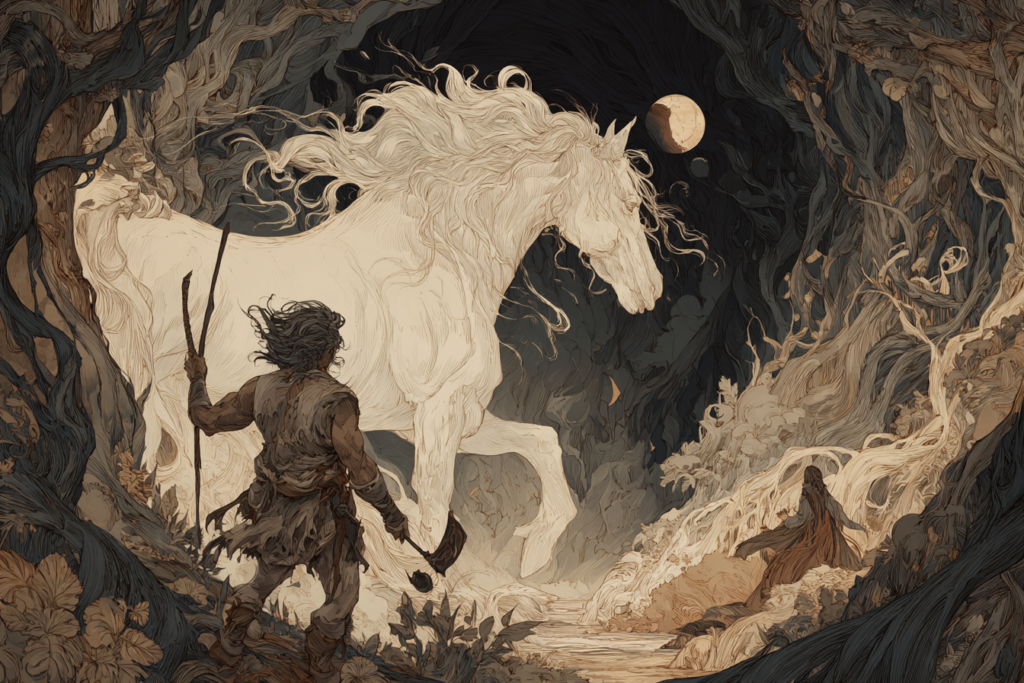
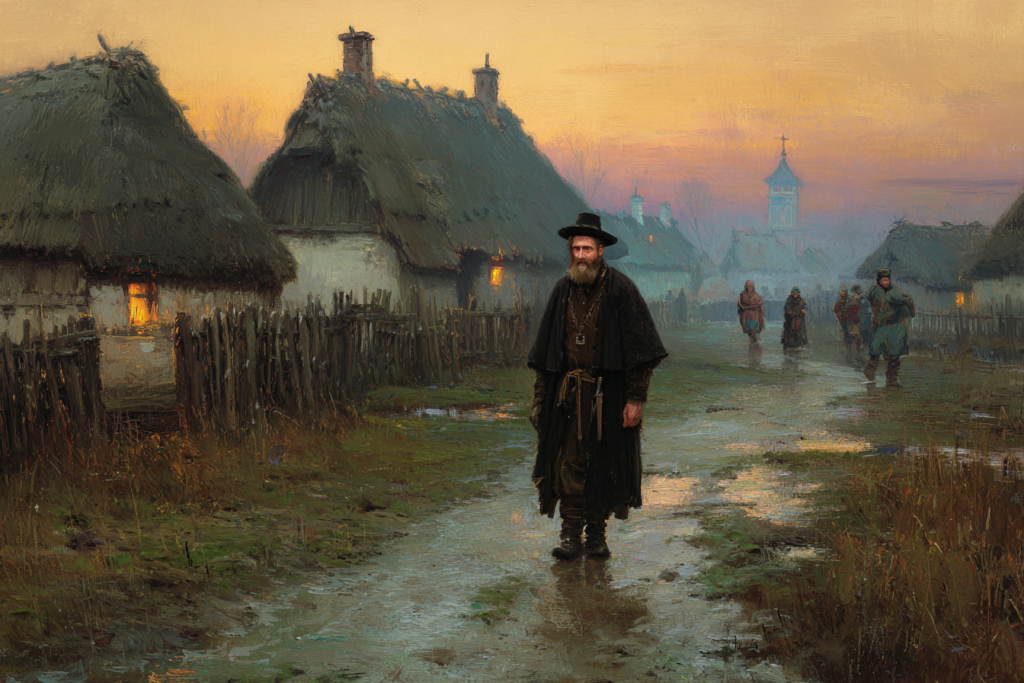
Fehérlófia, or Son of the White Horse, is one of the most powerful Hungarian wonder tales.
The hero is born from a white horse and grows into a figure of impossible strength.
He joins mighty companions, descends into the underworld, fights dragons, rescues captive princesses, is betrayed, and returns to the upper world with the help of a giant bird.
Horváth compares the Hungarian tale with Turkic parallels and identifies a shared structure involving animal origin, underworld descent, rescue, dragon combat, bird assisted return, self sacrifice, restoration, and kingship (Horváth, 1995, pp. 160 to 168).
This tale is one of the best answers to the question of what makes Hungarian folk tales distinctive.
It is not only a rescue story.
It has the shape of a world crossing ordeal.
Horváth reads its structure through shamanic motifs, especially descent, struggle, bodily sacrifice, and return with renewed power (Horváth, 1995, pp. 165 to 168).
The claim should be made carefully, since Horváth does not prove a simple one way origin from Turkic tradition into Hungarian tradition, but she does show that the tale belongs to a much wider comparative field (Horváth, 1995, p. 162).
A három királyfi, or The Three Princes
A három királyfi, or The Three Princes, appears in Gulyás’s discussion of the earliest Hungarian language collected folk tale material.
The tale includes a prince who defeats a seven headed dragon that has been killing maidens.
During the prince’s sleep, a treacherous red knight kills him, but his animal servants revive him with a life giving herb.
The story then moves into another cycle involving an old woman, petrification, and the rescue of the older brothers by the third brother (Gulyás, 2020, p. 54).
This tale is useful because it shows how dense early Hungarian wonder tales could be.
It brings together the dragon slayer, false hero, animal helpers, death and revival, magical plants, petrification, and sibling rescue.
Gulyás gives the tale type combination, which shows that the printed story joins several recognizable tale patterns (Gulyás, 2020, p. 54).
It is a good reminder that early Hungarian printed material did not preserve only simple children’s tales.
It also preserved long, layered, and sometimes darker wonder tales.
Three Reed Maidens and The Three Oranges
The Three Reed Maidens and Three Oranges cycle belongs to a widespread wonder tale pattern in which magical women emerge from reeds, fruits, or similar enchanted objects.
In the Hungarian branch, the hero’s success depends on timing, care, and recognition.
The true bride may be hidden, displaced, transformed, or replaced before the story restores the rightful marriage.
Gulyás notes that the Three Reed Maidens or Three Orange Maidens type appeared among the major tale types represented in early Hungarian printed folk tale material (Gulyás, 2020, p. 52).
This story type is valuable because it shows that Hungarian folk tales belong to broader European and Eurasian narrative patterns.
Curtin’s collection helps English readers approach related Magyar material and compare it with neighboring traditions (Curtin, 1890).
The tale is less immediately famous to casual English readers than Fehérlófia, but it is important for understanding bride substitution, enchantment, recognition, and magical timing.
It gives us a softer kind of wonder than dragon combat.
Here, the danger is not only a monster, but also the loss of a beloved one.
Babszem Jankó, or Bean Boy Jack
Babszem Jankó, or Bean Boy Jack, is a tiny hero story from Arany’s classic collection.
A child is born impossibly small, but the story does not treat smallness as weakness.
He eats, hides, tricks, escapes, and unsettles the adult world around him.
The humor comes from the contrast between his tiny body and his oversized appetite for action.
Domokos notes that Babszem Jankó was the only wonder tale from the Arany family collection that she found in nineteenth century school readers, and even there it was shortened, probably because of length (Domokos, 2018, p. 648).
That detail tells us a lot about how tales entered classrooms.
Teachers and editors preferred shorter, more manageable texts.
A tale could be beloved and still be trimmed to fit schoolbook needs.
Babszem Jankó survived because it is funny, compact, strange, and wonderfully easy to remember.
A kis malac és a farkasok, or The Little Pig and the Wolves
A kis malac és a farkasok, or The Little Pig and the Wolves, is a clever animal tale.
The little pig outwits a wolf, then faces a larger danger when more wolves arrive.
The wolves try to reach him, but their plan collapses through panic and confusion.
The story works beautifully because it gives the small and vulnerable character a sharp mind.
Domokos shows that this was one of the most frequently republished Arany family tales in nineteenth century Hungarian school readers, appearing in nine different readers (Domokos, 2018, p. 647).
Some editors even changed the pig hero into a human swineherd, which shows that printed transmission could actively reshape tale material (Domokos, 2018, p. 647).
This is a perfect example of how folk tales change when they enter educational print.
The story is still about the weak defeating the dangerous, but the printed versions show how culture, schooling, and editorial choice can alter details.
A kis gömböc, or The Little Dumpling
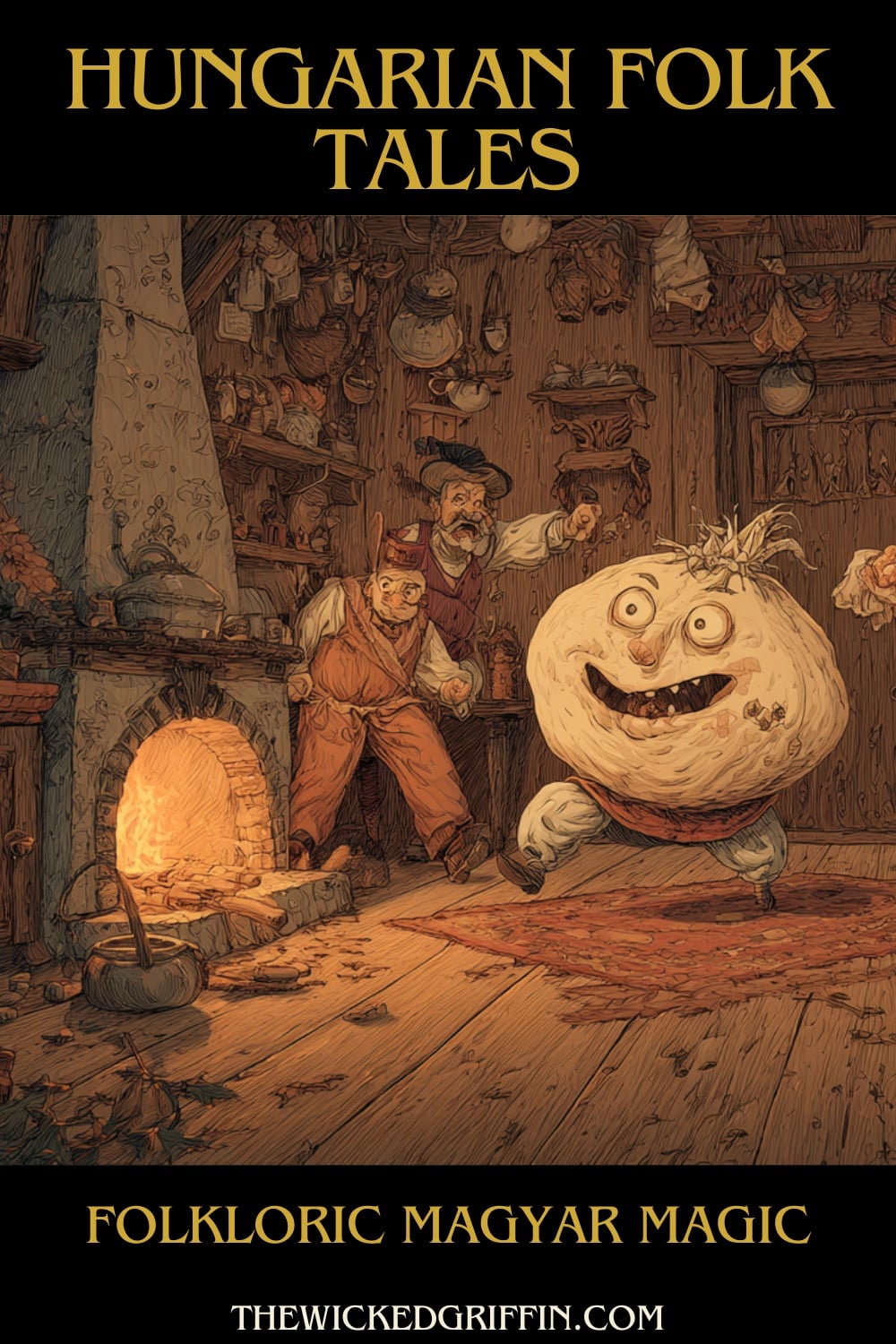
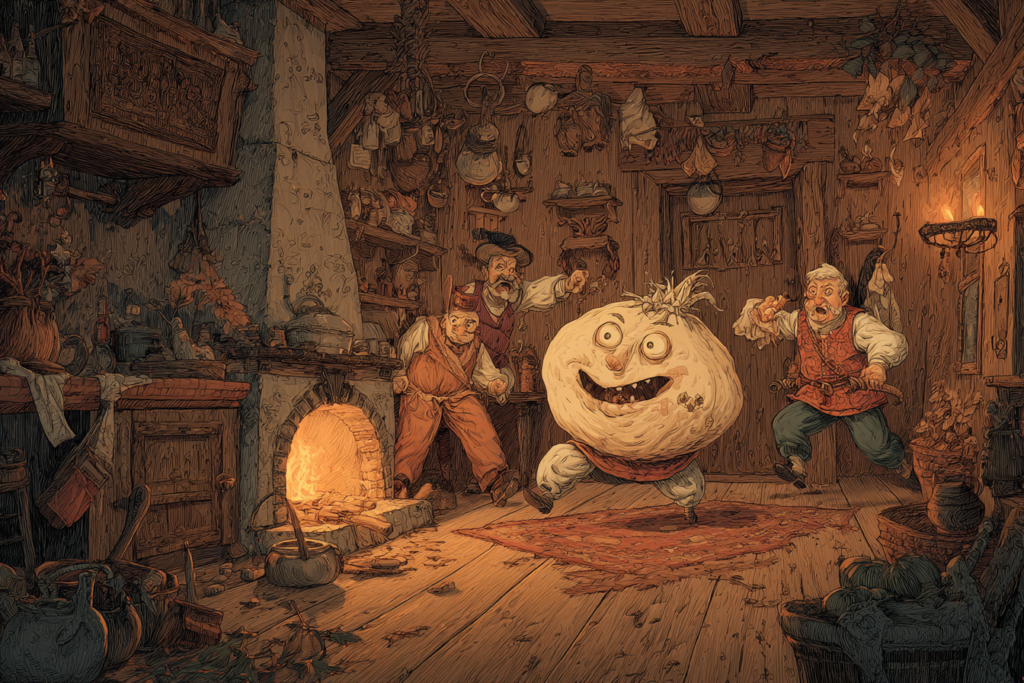
A kis gömböc, or The Little Dumpling, is one of the strangest and most memorable Hungarian cumulative tales.
A little food creature becomes a devouring monster and eats one person after another.
The tale grows through repetition, and that repetition makes the danger both comic and unsettling.
It is funny, but it is also a miniature nightmare about appetite without limit.
Domokos found that A kis gömböc appeared in two nineteenth century school readers, making it part of the printed educational afterlife of the Arany tales (Domokos, 2018, pp. 647 to 648).
The structure makes it especially easy to retell because each swallowed victim adds to the growing chain.
It is a good example of the formulaic pleasure of folk narrative.
The listener knows the pattern and enjoys watching it become more ridiculous with every step.
A kóró és a kis madár, or The Reed Stalk and the Little Bird
A kóró és a kis madár, or The Reed Stalk and the Little Bird, is a tale built on repetition and escalation.
A small grievance sends the bird from one figure to another, asking for help until the right force finally acts.
The story’s pleasure is not in psychological depth.
It is in rhythm, sequence, and the satisfaction of a tiny problem becoming a whole comic system.
This tale has a special place in the printed history of Hungarian folk tales.
Domokos explains that it appeared in the 1853 Gáspár and Kovácsi school reader before Arany’s 1862 Eredeti népmesék, attributed to “Arany Julcsa” (Domokos, 2018, pp. 639 to 640).
It later became one of the most frequently republished Arany family tales in nineteenth century school readers, appearing in ten different publications (Domokos, 2018, p. 647).
That means its fame came not only from oral tradition, but from repeated classroom use.
What Makes Hungarian Folk Tales So Fascinating?
Hungarian folk tales are fascinating because they move easily between the enormous and the tiny.
One tale sends a horse born hero under the earth to fight dragons.
Another sends a little bird from one helper to another because of a small grievance.
Another makes a dumpling into a devouring monster.
The tradition has room for mythic depth, comic danger, social justice, animal cleverness, and schoolroom repetition.
Animal born heroes, dragons, and underworld journeys
One of the most striking motifs in Hungarian wonder tales is the hero who crosses worlds.
Fehérlófia is the clearest example, because the hero is born from a white horse and descends below the earth to fight dragons and rescue captives.
Horváth’s comparative reading shows that this pattern has parallels in Turkic traditions and can be interpreted through shamanic motifs of descent, struggle, sacrifice, restoration, and return (Horváth, 1995, pp. 160 to 168).
Róheim’s study of the dragon and hero pattern gives another comparative frame for reading dragon combat as more than decorative danger, though Horváth remains the stronger source for the specifically Hungarian and Turkic comparison in Fehérlófia (Róheim, 1940, pp. 40 to 69; Horváth, 1995, pp. 160 to 168).
Dömötör’s caution keeps this interpretation honest.
She argues that Hungarian folk customs and narratives should not be reduced to simple remnants of one ancient system, because later explanations, such as Christian reinterpretations, magical belief systems, and poetic imagination all became layered together (Dömötör, 1967, pp. 131 to 137).
That makes the tales richer.
They are not fossils.
They are stories that kept surviving by changing.
Clever animals, small heroes, and comic danger
Hungarian folk tales are not all underworld journeys and dragon fights.
Some of the most memorable ones are small, sharp, comic, and almost rude in their energy.
The Little Pig and the Wolves, The Little Dumpling, and The Reed Stalk and the Little Bird work through repetition, reversal, escalation, and verbal patterning.
Domokos’s schoolbook research shows that these were exactly the kinds of stories that nineteenth century educators liked to reuse (Domokos, 2018, pp. 647 to 648).
This is fascinating because it shows how canon formation actually works.
The tales that became familiar were not always the grandest or most mythic.
They were often the tales that were teachable, memorable, and lively enough for young readers.
Arany’s edited folk like narrative style also became a model for later Hungarian folk tale publication (Domokos, 2018, p. 639).
The “classic” sound of Hungarian folk tales was shaped by storytelling, but it was also shaped by editors and classrooms.
Justice, kings, and social memory
Hungarian folk narrative also includes historical legends, and King Matthias Corvinus is an excellent example here.
Szövérffy shows that Hungarian and Slavic folklore remembered Matthias less as a military ruler and more as a social hero who brought justice.
The famous saying “King Matthias is dead; justice is gone” captures this folk image with painful clarity (Szövérffy, 1968, pp. 71 to 72).
In many legends, Matthias travels in disguise, sees how ordinary people are treated, and punishes arrogant nobles, rich men, or greedy priests (Szövérffy, 1968, pp. 73 to 76).
This belongs in a discussion of Hungarian folk tales because folk tradition is not only about monsters and magic.
It is also about what people wished the world could be.
The disguised just king is a fantasy of moral repair.
He sees what the powerful hide and fixes what ordinary people cannot fix alone.
That is why historical legend and fairy tale often feel closer than they look at first.
How Hungarian Folk Tales Were Collected and Became Classics
Hungarian folk tales became visible to modern readers through collecting, editing, publication, and reprinting.
Gunda shows that Hungarian folklore research developed through scholars, literary societies, museums, field collectors, and institutions that treated oral tradition as a serious cultural inheritance (Gunda, 1950, pp. 74 to 80).
Gulyás gives a closer picture of Erdélyi’s Népdalok és mondák, which published important prose folk material between 1846 and 1848 (Gulyás, 2020, pp. 51 to 52).
Domokos then shows what happened later, when Arany’s tales entered school readers and became part of the Hungarian educational canon (Domokos, 2018, pp. 639 to 648).
Erdélyi, Arany, and early printed tale collections
Erdélyi’s Népdalok és mondák was one of the key early points where Hungarian prose folk tradition entered print in a collected form.
Gulyás explains that the Mondák sections contained 35 prose texts, 33 of which can be classified as tales (Gulyás, 2020, p. 84).
She also shows that the collection was regionally and textually complex, with collectors such as Bartók Gábor, Eperjesy Ferenc, and Kürti Mihály contributing identifiable materials (Gulyás, 2020, p. 84).
This however was not a neat little fairy tale book.
It was a complicated record of oral tradition, manuscripts, collectors, and editorial decisions.
Arany László’s Eredeti népmesék then became a major classic after its publication in 1862.
Domokos emphasizes that the manuscript tale records behind the book were not identical to the printed versions (Domokos, 2018, p. 639).
Arany reshaped the tales into a folk like narrative style that later became a model for Hungarian folk tale publication (Domokos, 2018, p. 639).
This is one of the most important points for careful readers.
Printed folk tales are not untouched oral speech.
They are literary and folkloric artifacts at once.
Schoolbooks helped decide which tales became famous
Schoolbooks played a major role in deciding which Hungarian folk tales became widely familiar.
Domokos examined about 300 Hungarian school readers from 1867 to 1914 and found that Arany’s tales appeared most often in elementary readers (Domokos, 2018, pp. 646 to 647).
At least 34 different elementary publications included 11 of the tales from Arany’s 1862 collection (Domokos, 2018, p. 647).
The most frequently repeated tales were short animal and formula tales, especially A hólyag, szalmaszál és a tüzes üszök, A kóró és a kis madár, A kis malacz és a farkasok, and A farkas tanya (Domokos, 2018, p. 647).
This explains why some tales became “classic” while others remained less familiar.
A tale did not become famous only because it was ancient or universally loved in folkloric tradition.
It could become famous because teachers, editors, and textbook writers kept putting it in front of children.
Printed versions may even have influenced later oral storytelling, since Domokos notes Kovács’s argument that some twentieth century storytellers knew Arany’s versions (Domokos, 2018, p. 639).
The story did not travel in one direction only.
It moved from mouth to page, then from page back to mouth.
Where to read Hungarian folk tales in English
For English readers, The Folk Tales of the Magyars is one of the most useful older sources.
Jones and Kropf translated and edited the volume, drawing on tales collected by Kriza, Erdélyi, Pap, and others (Jones & Kropf, 1889).
Orczy’s Old Hungarian Fairy Tales is another accessible English source, though it should be treated as retelling rather than strict field transcription (Orczy, 1895).
Curtin’s Myths and Folk Tales of the Russians, Western Slavs, and Magyars is useful for readers who want Hungarian material set beside Slavic and neighboring traditions (Curtin, 1890).
For Hungarian text, Arany’s Eredeti népmesék is central.
It includes many of the tales discussed here, including Fehérlófia, Babszem Jankó, A kis gömböc, and A kóró és a kis madár (Arany, 1862).
Readers who can work with Hungarian will be closer to the sound and structure of the tales.
Readers who cannot can still use English collections to understand the main plots and motifs.
Hungarian folk tales are fascinating because they refuse to stay in one box.
They are children’s stories, but not only children’s stories.
They are fairy tales, but they also touch legend, custom, belief, schoolbook history, and modern animation.
They can give us a tiny boy with an enormous appetite, a pig who outsmarts wolves, a dumpling that eats everyone, a king who restores justice, and a horse born hero who climbs back from the underworld on the back of a giant bird.
The sources show that these tales became classic through many hands.
Storytellers told them, families preserved them, collectors wrote them down, editors reshaped them, scholars classified them, schoolbooks repeated them, and animation gave them another life.
That long journey is part of their meaning.
Hungarian folk tales are not frozen relics.
They are stories that kept finding new ways to be heard.
References
Arany, L. (1862). Eredeti népmesék. Heckenast.
Curtin, J. (1890). Myths and folk-tales of the Russians, Western Slavs, and Magyars. Little, Brown, and Company.
Domokos, M. (2018). Arany László népmeséi a 19. századi magyar olvasókönyvekben [The folktales of László Arany in Hungarian school textbooks in the 19th century]. Ethnographia, 129(4), 639–653.
Dömötör, T. (1967). Animistic concepts and supernatural power in Hungarian folk narratives and folk customs. Journal of the Folklore Institute, 4(1), 127–137.
Gulyás, J. (2020). Az Erdélyi János szerkesztette Népdalok és mondák meséi és mesegyűjtői [Folktales and collectors of the first collection of Hungarian folk poetry, 1846 to 1848]. In A. Szakál & E. Tekei (Eds.), “Tenger fenekéről gyöngyszemeket szednék”: Tanulmányok Olosz Katalin tiszteletére (pp. 51–100). Kriza János Néprajzi Társaság.
Gunda, B. (1950). Research in Hungarian folk culture: An ethnological and folkloristic survey. The Journal of American Folklore, 63(247), 72–84.
Horváth, I. (1995). A comparative study of the shamanistic motifs in Hungarian and Turkic folk tales. In T. Kim & M. Hoppál (Eds.), Shamanism in performing arts (pp. 159–170). Akadémiai Kiadó.
Jones, W. H., & Kropf, L. L. (Trans. & Eds.). (1889). The folk-tales of the Magyars: Collected by Kriza, Erdélyi, Pap, and others. Published for the Folk-Lore Society by Elliot Stock.
Orczy, E. (Trans. & Ed.). (1895). Old Hungarian fairy tales. Dean & Son; Wolf & Co.
Róheim, G. (1940). The dragon and the hero. American Imago, 1(2), 40–69.
Szövérffy, J. (1968). History and folk tradition in Eastern Europe: Matthias Corvinus in the mirror of Hungarian and Slavic folklore. Journal of the Folklore Institute, 5(1), 68–77.