No products in the cart.
April 1, 2026 8:06 pm

Free USA shipping on orders $35+
April 1, 2026 8:06 pm
The figure known in Old English as Woden and in Old Norse as Óðinn stands among the most complex and historically layered deities of northern European religion.
Among the Anglo-Saxons, Woden appears only in scattered fragments: royal genealogies, charms, and place-names.
Yet in the medieval Scandinavian tradition preserved in the Edda and other Old Norse sources, Odin emerges as the chief figure of the Norse pantheon, a wandering magician, war leader, and seeker of cosmic knowledge.
This discrepancy between sparse early evidence and rich later mythology raises a central historical question: who was Woden the god, and how did he develop into the Odin described in Norse mythology?
Reconstructing this figure requires the combined evidence of Old English texts, Roman ethnography, archaeological discoveries, and later Scandinavian literature.
Scholars have long debated whether Woden should be understood primarily as a war god, a master of magical knowledge, or perhaps as a figure whose mythology incorporates much older religious layers.
Modern scholarship increasingly emphasizes that early Germanic religion was not a unified system but a collection of regional traditions that evolved over time.
Rudolf Simek stresses that it is more accurate to speak of Germanic religions rather than a single coherent belief system (Simek, 2004, p. 74).
Within this dynamic religious landscape, the deity later known as Odin appears to have accumulated different roles across centuries, including associations with kingship, battle, magic, prophecy, and the world of the dead.
This article examines the historical evidence for Woden, the development of the god in Old Norse literature, and several scholarly debates concerning the deeper origins of the deity, including the influential theories that Odin preserves elements of shamanic traditions or earlier Bronze Age solar symbolism.
The earliest historical evidence for Woden appears in the traditions of the Anglo-Saxons, where the god was remembered primarily as a divine ancestor and supernatural protector of rulers.
One of the most striking forms of evidence comes from royal genealogies preserved in medieval historical texts.
Several Anglo-Saxon dynasties traced their lineage back to Woden, including the ruling houses of Wessex, Mercia, and Kent.
William Chaney notes that these genealogies illustrate the concept of sacral kingship, in which the authority of the ruler derived from divine ancestry (Chaney, 1960, p. 200).
In early Germanic society the king or chieftain acted not only as political leader but also as a ritual mediator between the community and the supernatural world.
Chaney emphasizes that rulers presided over sacrificial ceremonies intended to secure prosperity and military success (Chaney, 1960, p. 209). The presence of Woden at the beginning of royal genealogies therefore reflects the belief that kingship itself possessed a sacred origin.
Additional evidence comes from place-names across England that contain forms of the god’s name.
These locations may represent sites where Woden was worshiped, suggesting that certain hills or landscapes were associated with the cult of the god. J. S. Ryan argues that such place-names may preserve traces of earlier ritual practices dedicated to Woden (Ryan, 1963, p. 463).
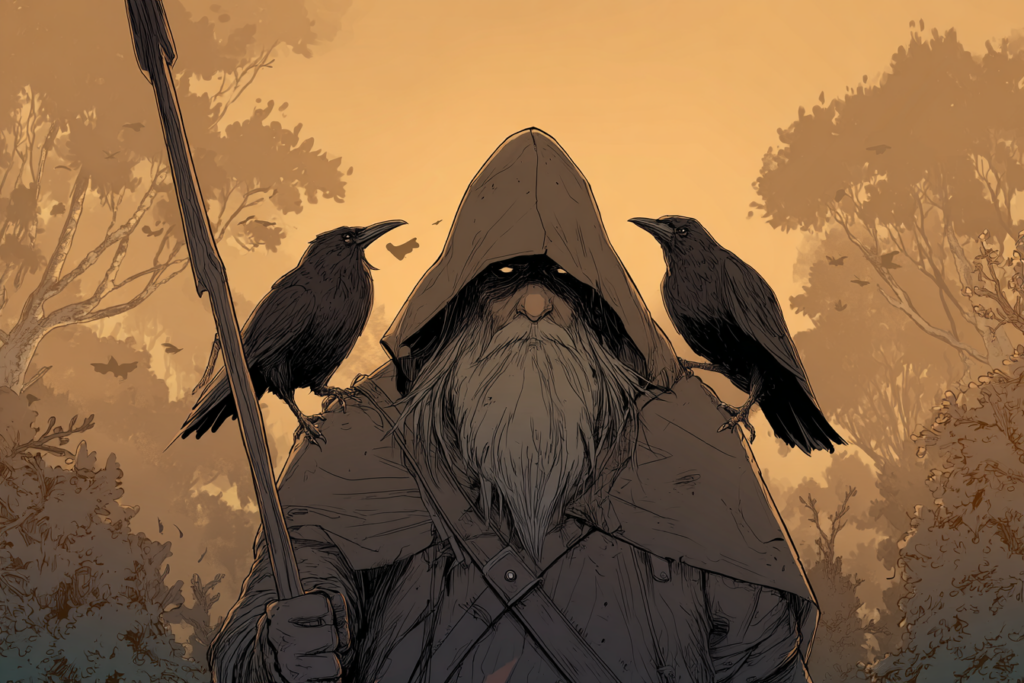
Although most surviving manuscripts were written by Christian scribes, several Old English texts preserve fragments of earlier pagan tradition.
One of the most important examples is the Nine Herbs Charm, a healing incantation preserved in an Anglo-Saxon medical manuscript.
In the charm Woden strikes a serpent with nine magical twigs, destroying the creature and curing the poison it had inflicted (Chaney, 1960, p. 202). This passage suggests that Woden was associated not only with warfare but also with healing and ritual knowledge.
Another possible reference appears in the poem Maxims I.
Leonard Neidorf argues that the line “Woden worhte weos” may preserve an early tradition in which Woden was remembered as a founder of pagan shrines or ritual sites (Neidorf, 2023, p. 82).
Such fragments demonstrate how memories of the old gods survived even after the conversion to Christianity.
These textual traces reveal that the Anglo-Saxon understanding of Woden already included elements that later became central to the mythology of Odin in Norse tradition: magical knowledge, ritual power, and connections to sacred places.
The earliest written descriptions of Germanic religion come from Roman authors such as Tacitus. In his ethnographic work Germania, Tacitus states that the Germans primarily worshipped a deity whom he identified as Mercury.
Modern scholars widely agree that Tacitus’ Roman god Mercury corresponds to the early Germanic Wodan (Simek, 2004, p. 81).
This comparison reflects the Roman practice known as interpretatio romana, in which foreign gods were interpreted through familiar Roman categories.
The association between Wodan and Mercury was based on perceived similarities.
Mercury functioned as the messenger of the gods, a figure associated with travel, knowledge, and magical skill. These characteristics correspond closely to the later mythological portrait of Odin as a wandering seeker of wisdom.
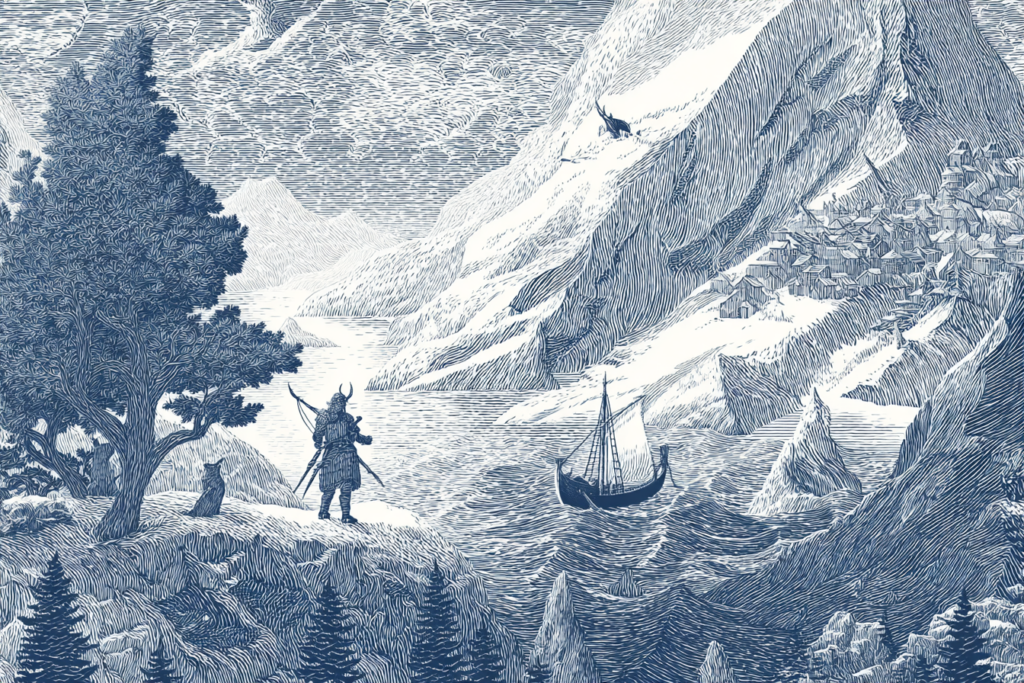
Animal symbolism forms an important part of the mythology associated with Odin. In Scandinavian tradition the god is accompanied by two ravens, Huginn and Muninn, who fly across the world gathering knowledge, and two wolves, Geri and Freki, who accompany him in battle.
The significance of such animals may have earlier roots in Anglo-Saxon warrior culture.
Ryan observes that Old English battle poetry frequently describes ravens and wolves gathering before combat, suggesting a symbolic connection between these animals and battlefield death (Ryan, 1963, p. 470).
Archaeological evidence reinforces this interpretation.
Aleks Pluskowski describes early Anglo-Saxon artistic traditions as fundamentally zoocentric, with animals appearing prominently in weapon decoration and elite symbolism (Pluskowski, 2010, p. 103).
Such imagery reflects the importance of predatory animals within the ideology of warrior elites.
Arnold Price likewise argues that early Germanic warrior bands formed distinct social groups with their own rituals and identities, often centered on warfare and heroic ideals (Price, 1968, p. 438).
Within this context, the mythology surrounding Odin may reflect the religious worldview of these warrior elites.
Hilda Ellis Davidson likewise emphasized that animals such as ravens, wolves, and eagles held powerful symbolic meaning within early northern European religion.
These creatures frequently appear in mythological narratives and heroic poetry associated with warfare and death, suggesting that they were understood as supernatural companions or manifestations of divine power (Davidson, 1989, p. 136).
The repeated presence of such animals in myth and literature may reflect older ritual beliefs in which predatory creatures served as intermediaries between the human world and the realm of the gods.
Within this symbolic framework, the ravens Huginn and Muninn and the wolves Geri and Frekiassociated with Odin can be understood not merely as mythological companions but as expressions of a broader religious tradition linking the war god with animals that feed upon the slain.
The richest descriptions of Odin appear in medieval Icelandic texts such as the Prose Edda and other works of Old Norse literature.
In these sources Odin emerges as the ruler of Valhalla, where fallen warriors gather after death. One of the most famous myths describes Odin sacrificing one of his eyes in exchange for wisdom at the well of Mimir.
This sacrifice reflects the god’s relentless pursuit of knowledge.
Odin also rides the eight-legged horse Sleipnir, wields the magical spear Gungnir, and travels across the worlds in disguise.
John Lindow describes Odin as a deity associated simultaneously with wisdom, prophecy, poetry, and magical knowledge (Lindow, 2002, p. 247).
These mythological narratives portray Odin as a ruler among the Æsir, but also as a restless seeker of hidden knowledge.
A defining feature of Odinic mythology is the god’s connection with sacred knowledge and the runes.
In one famous Old Norse poem, Odin describes how he hung upon the world tree Yggdrasil for nine nights in order to obtain the secrets of runic magic.
This myth portrays Odin as a god of knowledge who acquires wisdom through sacrifice. Simek describes Odin as a deity associated with prophecy, magical practice, and poetic inspiration (Simek, 2004, p. 89).
Such stories emphasize the intellectual and mystical dimension of the god’s character.
One of the most enduring debates in the study of Odin concerns whether the god should be interpreted as a shamanic figure.
Franz Rolf Schröder argued that Odin’s ordeal on Yggdrasil resembles initiation rituals associated with shamanic traditions (Schröder, 1958, p. 354).
François-Xavier Dillmann likewise explored possible connections between Odinic magic and shamanistic practices in his study of seiðr rituals (Dillmann, 1993, p. 28).
Åke Ohlmark suggested that certain aspects of Scandinavian magical traditions may have originated in northern Arctic religious environments, implying a possible link with circumpolar shamanism (Ohlmark, 1939, p. 171).
However, this interpretation has been strongly criticized.
Jere Fleck argued that the evidence for identifying Odin as a shaman is weak and that comparisons with Siberian traditions often rely on superficial similarities rather than historical connections (Fleck, 1971, p. 162).
The debate therefore remains unresolved.
While Odin clearly possesses traits associated with ecstatic magic and ritual knowledge, the extent to which these features reflect genuine shamanistic traditions remains controversial.
Another scholarly debate concerns the possibility that Odin incorporates elements of much older religious traditions connected with Bronze Age solar symbolism.
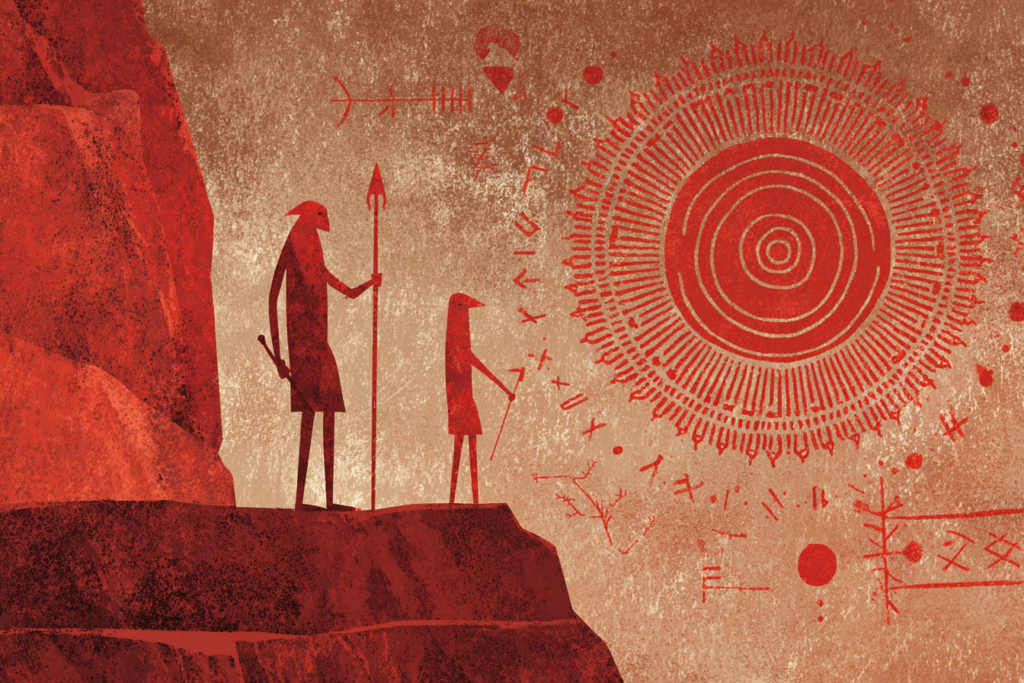
Archaeological discoveries from northern Europe reveal extensive solar imagery in Bronze Age rock art. Emilia Pasztor argues that these images reflect cosmological ideas centered on the movement of the sun across the sky (Pasztor & Roslund, 2007, p. 269).
Some Scandinavian rock carvings depict spear-bearing figures associated with solar symbols. Archaeologists have occasionally interpreted these figures as early prototypes of warrior deities (Uckelmann et al., 2018, p. 139).
The broader context for interpreting Bronze Age solar imagery comes from comparative studies of ancient European religion.
Lene Bredholt Christensen and her collaborators emphasize that religious traditions in prehistoric Europe frequently centered on cosmological symbolism expressed through ritual objects, rock art, and mythic narratives (Bredholt Christensen et al., 2014, p. 7).
Solar imagery in particular played a dominant role in many Bronze Age societies, where the daily journey of the sun across the sky was understood as a fundamental organizing principle of the cosmos.
These cosmological ideas were often expressed through visual symbols such as solar disks, wheels, ships, and radiant figures carved into rock surfaces or represented on ritual artifacts.
Although it would be misleading to assume a direct continuity between Bronze Age cosmology and later Norse mythology, scholars increasingly recognize that long-lived symbolic traditions can persist in transformed forms across centuries.
Bredholt Christensen and colleagues note that many religious motifs visible in prehistoric European archaeology continued to influence later mythological traditions even after major cultural transformations (Bredholt Christensen et al., 2014, p. 12).
From this perspective, the spear-bearing figures and solar imagery present in Scandinavian rock art may reflect an earlier cosmological framework within which later warrior deities developed.
While such interpretations remain speculative, they illustrate how archaeological evidence can contribute to discussions about the deeper historical background of figures such as Odin.
Archaeological research has increasingly emphasized that mythological ideas were often expressed through material culture in Iron Age Scandinavia.
Lotte Hedeager argues that elite artifacts, including weapons, jewelry, and decorative metalwork, frequently carried symbolic imagery connected with mythological narratives and supernatural power (Hedeager, 2011, p. 212).
Rather than representing simple ornamentation, such motifs may have functioned as visual expressions of cosmological beliefs and social identity.
In this context, the recurring imagery of predatory animals, warrior figures, and supernatural beings in Scandinavian art may reflect mythological themes that later appear in Old Norse literature, including traditions associated with Odin and the warrior ideology of the Norse pantheon.
Karl Simrock suggested that certain mythological horses connected with Odin may preserve solar symbolism, particularly in relation to the horse Grani and its association with radiant imagery (Simrock, 1869, p. 208).
These interpretations remain debated, but they raise the possibility that the later mythology of Odin incorporates elements from earlier cosmological traditions.
A further theory proposes that Odinic mythology developed partly through interaction with the Roman world during the Iron Age.
Anders Kaliff has suggested that contact between Germanic warriors and Roman soldiers may have facilitated the exchange of religious ideas during this period (Kaliff, 2006, p. 115).
The cult of Mithras, popular among Roman soldiers, has sometimes been compared with aspects of Odinic mythology.
However, Thomas Markey argues that the evidence for direct Mithraic influence on Germanic religion is extremely limited and that the theory remains speculative (Markey, 2015, p. 15).
The figure known as Woden in Anglo-Saxon England and Odin in Scandinavian mythology represents one of the most complex deities of early European religion.
Evidence from genealogies, charms, Roman accounts, archaeology, and mythological literature suggests that the god developed gradually across centuries.
Rather than representing a single original cult, Odin likely embodies multiple historical layers: early Germanic warrior traditions, Iron Age ritual practices, and the elaborate mythology preserved in Old Norse sources.
Understanding Woden therefore requires examining not only mythology but also history, archaeology, and the changing religious landscape of northern Europe.
Bredholt Christensen, L., Hammer, O., & Warburton, D. A. (2014). The handbook of religions in ancient Europe. Routledge.
Chaney, W. A. (1960). Paganism to Christianity in Anglo-Saxon England. Harvard Theological Review, 53(3), 197–217.
Davidson, H. E. (1989). Myths and symbols in religion and folklore. Folklore, 100(2), 131–142.
Davidson, H. R. E. (1993). The lost beliefs of Northern Europe. Barnes & Noble.
Dillmann, F.-X. (1993). Seiður og shamanismi í Íslendingasögum. Skáldskaparmál, 2, 20–33.
Fleck, J. (1971). The “knowledge-criterion” in Grímnismál: The case against “shamanism.” Arkiv för nordisk filologi, 86, 148–165.
Hedeager, L. (2011). Iron age myth and materiality: An archaeology of Scandinavia AD 400–1000. Routledge.
Kaliff, A. (2006). Odin and Mithras: Religious acculturation during the Roman Iron Age and the Migration Period. In A. Andrén, K. Jennbert, & C. Raudvere (Eds.), Old Norse religion in long-term perspectives: Origins, changes, and interactions (pp. 169–176). Nordic Academic Press.
Lindow, J. (2002). Norse mythology: A guide to gods, heroes, rituals, and beliefs. Oxford University Press.
Neidorf, L. (2023). Woden worhte weos: A crux in Maxims I. Traditio, 78, 81–100.
Ohlmark, Å. (1939). Arktischer Schamanismus und altnordischer Seiðr. Archiv für Religionswissenschaft, 36, 171–180.
Pasztor, E., & Roslund, C. (2007). An interpretation of the Nebra Disc. Antiquity, 81(312), 267–278.
Pluskowski, A. (2010). Animal magic. In M. Carver, A. Sanmark, & S. Semple (Eds.), Signals of belief in early England: Anglo-Saxon paganism revisited (pp. 103–124). Oxbow Books.
Price, A. H. (1968). Differentiated Germanic social structures. Vierteljahrschrift für Sozial- und Wirtschaftsgeschichte, 55(4), 433–448.
Ryan, J. S. (1963). Othin in England: Evidence from the poetry for a cult of Woden in Anglo-Saxon England. Folklore, 74(3), 460–480.
Schröder, F. R. (1958). Grímnismál. Beiträge zur Geschichte der deutschen Sprache und Literatur, 80, 341–378.
Simek, R. (2004). Germanic religion and the conversion to Christianity. In B. Murdoch & M. Read (Eds.), Early Germanic literature and culture (pp. 73–104). Camden House.
Simrock, K. (1869). Handbuch der deutschen Mythologie mit Einschluss der nordischen. Marcus.
Suhm, P. F. (1771). Om Odin og den hedniske gudelære og gudstjeneste udi Norden. Copenhagen.
Uckelmann, M., & Bertilsson, U. (2018). In Prehistoric warfare and violence: Quantitative and qualitative approaches (p. 139). Springer.

ᛉ 100% handcrafted artisan pagan , viking, witchcraft and shamanic inspired jewelry.
ᛉ Runes, Symbolism & European Folklore
Get 20% off👇🏻
Happy washing day 🙃
A few rings I’ve worked on the last couple days…
Freya’s cats rule and dogs drool?
Or was that the other way around? 🙃

Garm barely shows up in the old Norse stories.
Still… he leaves a mark.
A...
Leave a comment with your result ❤️
Bavarian Folklore says that you might just cross paths with a Wolpertinger in the alpine...

🐇🌲✨
He finally stepped out of the forest…
The Wolpertinger Pendant has arrived.
Inspired by...

I don’t often sell them, but love it when I do!
Vinca symbol bracelets ❤️...

Rooted in strength + guarded by ravens

The serpent waits 🖤
(Handcrafted Jörmungandr ring made to order in my shop)

Stay warm, everyone ❤️

😑😑😑🤮

I thought I had closed the book on the Alice in Wonderland rings…
But you...

Can this be over now, please?

In case you forgot 💜

Something I’ve been thinking about lately.
If there’s one thing I would’ve done differently early...

This year, we’re not buying things just to keep up.
If you need the reminder:...

My husband is from Bavaria (southern Germany) and I originally made this Krampus pendant for...

Some of the items I’m shipping out today ❤️
Please forgive my dirty nails 😂...

A few items shipping out today 🥰

This mornings rings shipping out ❤️

A few of the rjngs I’m shipping out this morning ❤️
How do you like...

Krampus is coming 🫶🏻

Getting ready to pack up these pretties and ship to their owners ❤️

Freya, cats and pentacles. Doesn’t get any better ❤️

You all got me going crazy making all these fairytale + storybook rings.
But I’ll...

Just launched these pretties ❤️
Size 9 amethyst ring + size 7.25 green kyanite

What would you trade to learn Baba Yaga’s secrets?

It *finally* looks, feels and smells like October!
And here are some items I’m packing...

This mornings pretties getting ready to ship :)

Getting ready to pack up these pretties and ship to their owners ❤️

You bet I’m hopping on this trend 😂
Thank you @shes_sinister for the prompt!

While I welcome the seasonal darkness…it sure is going to make my morning quick videos...

Finally finished the rings I’ve been working on in my stories ❤️
I think I...

Was going to post this update to my stories but it’s too long.

“How do you know I’m mad?” said Alice.
“You must be,” said the Cat, “or...

Some of this mornings orders getting ready to ship. Those little bats are so cute...

Here is the finished ring I was working on in my stories yesterday, along with...

A few of today’s orders shipping out this morning ❤️

The two silver raven rings I was working on in my stories yesterday.
…as well...

Eeeek! I’m so happy to add these to my shop ❤️
I’ve gotten so many...

I had 6 clamshells ready to ship this morning but I dropped and lost my...

Not the story you were told.
The girl didn’t run.
The wolf didn’t win.
This...

I love these raven rings so much 🖤
This mornings pretties shipping out.
All items...

Sleek + minimal Mjölnir ring ⚒️

Today’s orders getting ready to ship.
…And I finally got some time to work on...


About the author Jacqueline Fatica


