No products in the cart.
February 11, 2026 7:59 pm

Free USA shipping on orders $35+
February 11, 2026 7:59 pm
Norse mythology is often reduced to Vikings, longships, and thunder gods, yet its origins stretch far deeper than the Viking Age.
This guide to Norse mythology explains where Norse mythology comes from, how it developed long before the Vikings, and why Norse gods and myths belong to a much older cultural and religious tradition rooted in Germanic Europe.
By tracing Norse mythology from its Proto-Germanic background through Old Norse culture, this article offers a clear, historically grounded overview for readers who want more than surface-level myths and legends.
What follows is not just a list of Norse gods and goddesses, but an explanation of how Norse mythology formed, evolved, and survived the arrival of Christianity.
Norse mythology is the mythological system of the Norse people of Scandinavia, preserved primarily in Old Norse sources from medieval Iceland.
It includes myths about gods and goddesses, cosmology, the creation myth, and the fate of the world at Ragnarok.
Yet Norse mythology did not appear suddenly during the Viking Age. It emerged from a much older Germanic mythology that developed over centuries.
The Norse gods belong to a religious tradition that predates Vikings by hundreds of years.
Long before the Viking era, Germanic peoples across northern Europe shared a religious worldview with common deities, myths, and ritual practices.
Norse mythology represents the Scandinavian branch of that broader Germanic tradition, shaped by local conditions and preserved later than elsewhere.
Understanding Norse mythology means recognizing it as part of a long cultural process rather than a short Viking phenomenon.
Germanic mythology forms the foundation of Norse mythology.
Linguistic and archaeological evidence places Proto-Germanic culture in northern Europe by the late Iron Age, centuries before written Norse literature existed.
Germanic tribes occupied a wide area, extending from the North Sea to the Baltic and inland toward central Europe.
These Germanic peoples shared religious concepts, deities, and mythological themes.
Roman authors such as Tacitus recorded Germanic religious practices in the first century CE, identifying gods comparable to Odin, Thor, and Tyr.
This confirms that key Norse gods were already worshipped long before Scandinavia entered the Viking Age.
Norse mythology is therefore best understood as a regional development of Germanic mythology rather than an isolated system.
It developed in Scandinavia, yet belongs to an older set of beliefs, myths and deities.
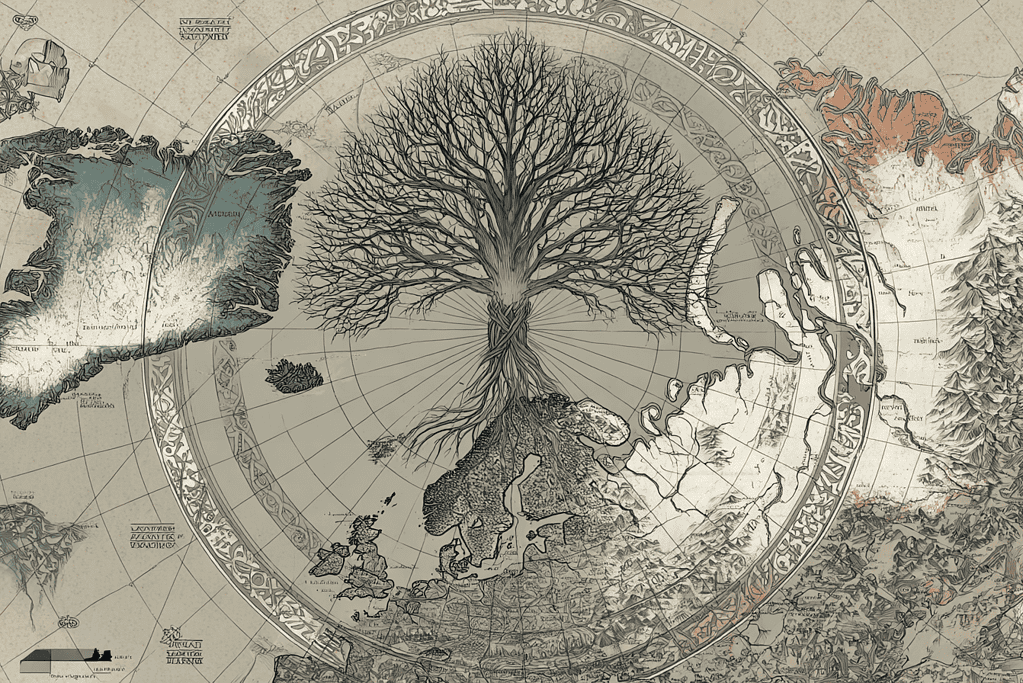
Proto-Norse culture developed as Germanic peoples settled and consolidated in Scandinavia during the Roman Iron Age and Migration Period.
From roughly the first centuries CE onward, Scandinavian communities spoke early North Germanic dialects and practiced a religion that would later become Norse paganism.
Archaeological finds such as bracteates, runestones, and weapon imagery show mythological symbols associated with Odin, Thor, and other Norse gods.
These materials demonstrate that Norse religion existed centuries before the Viking Age, embedded in Scandinavian society as a living belief system rather than a literary invention.
By the time Vikings began their raids and migrations, Norse mythology was already ancient.
The Norse gods belong to two divine groups: the Æsir and the Vanir.
The Æsir include Odin, Thor, Tyr, and Baldr, while the Vanir include Freyr, Freyja, and Njord. This division reflects older layers within Germanic mythology.
Odin is a central deity associated with wisdom, war, poetry, and death.
His role as a god of war and knowledge reflects earlier Germanic concepts recorded by Roman observers.
Thor, protector of Midgard and enemy of giants, preserves Indo-European storm-god traits shared across ancient mythological systems.
Freyja and Freyr, associated with fertility and prosperity, likely preserve older agricultural religious traditions within Norse religion.
Loki, a complex figure, embodies chaos and transformation within the Norse mythological framework.
Together, these gods and goddesses form a pantheon shaped by centuries of religious development.
Norse cosmology describes a structured universe centered on the world tree Yggdrasil, an ash tree connecting nine worlds.
These nine realms include Asgard, Midgard, Hel, Niflheim, and other mythological regions inhabited by gods, humans, elves, dwarves, and giants.
The creation myth begins with Ginnungagap, a primordial void between fire and ice.
From this space emerged Ymir, the first being, whose body became the material of the cosmos after Odin and his brothers killed Ymir.
This cosmology reflects a worldview rooted in cycles, balance, and inevitable destruction at Ragnarok.
Norse cosmology was not abstract philosophy but a lived understanding of reality within pre-Christian religion.
Death in Norse mythology was not uniform.
Warriors who died bravely could enter Valhalla, Odin’s hall in Asgard, where they prepared for Ragnarok.
Others might go to Hel, ruled by the goddess Hel, or to Freyja’s realm.
This system reflects a Norse religion deeply concerned with honor, fate, and community memory.
The afterlife was tied to how one lived, fought, and fulfilled social obligations.
Valhalla was not a universal paradise but one destination among many, shaped by mythological and cultural values rather than moral judgment.
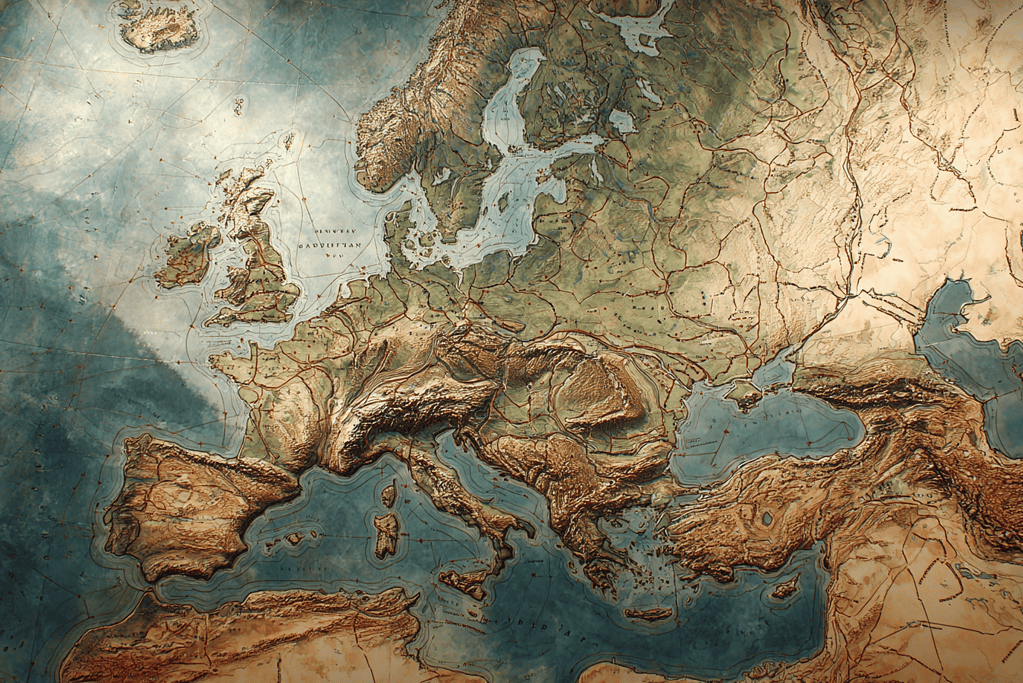
Most surviving Norse mythology comes from medieval Icelandic texts.
The Poetic Edda preserves mythological poems transmitted orally for generations, while the Prose Edda was written by Snorri Sturluson as a guide to skaldic poetry.
Snorri’s work systematized Norse mythology at a time when Scandinavia had already converted to Christianity.
Although written by a Christian author, the Prose Edda preserves valuable material from older oral traditions.
Iceland’s late conversion to Christianity allowed Norse mythology to survive longer there than in much of northern Europe.
The arrival of Christianity did not instantly replace Norse paganism.
Conversion was gradual, uneven, and often pragmatic. This has been well attested by several scholars. The same is true for the Germanic Pantheon, as written by the scholar Ramsay MacMullen.
Many heathen beliefs survived as folklore, saga traditions, and cultural memory.
Christian scribes preserved Norse mythology even as religious practices changed.
This paradox explains why Norse mythology is better documented than other Germanic mythologies, despite being one regional expression of a wider tradition.
The conversion to Christianity transformed religious practices, but myths and legends continued to shape Scandinavian folklore.
Norse mythology belongs to the broader Indo-European mythological family.
Shared themes such as a sky father, thunder god, world tree, and cosmic battle appear across Indo-European cultures. And these Indo-European cultures, too, had their own prehistory.
Thor’s conflict with the Midgard serpent, Fenrir’s role at Ragnarok, and Odin’s sacrificial quest for knowledge all reflect mythological patterns found far beyond Scandinavia and even into Eurasia.
Norse mythology preserves these ancient structures in a distinctly Nordic form, shaped by geography, history, and social organization.
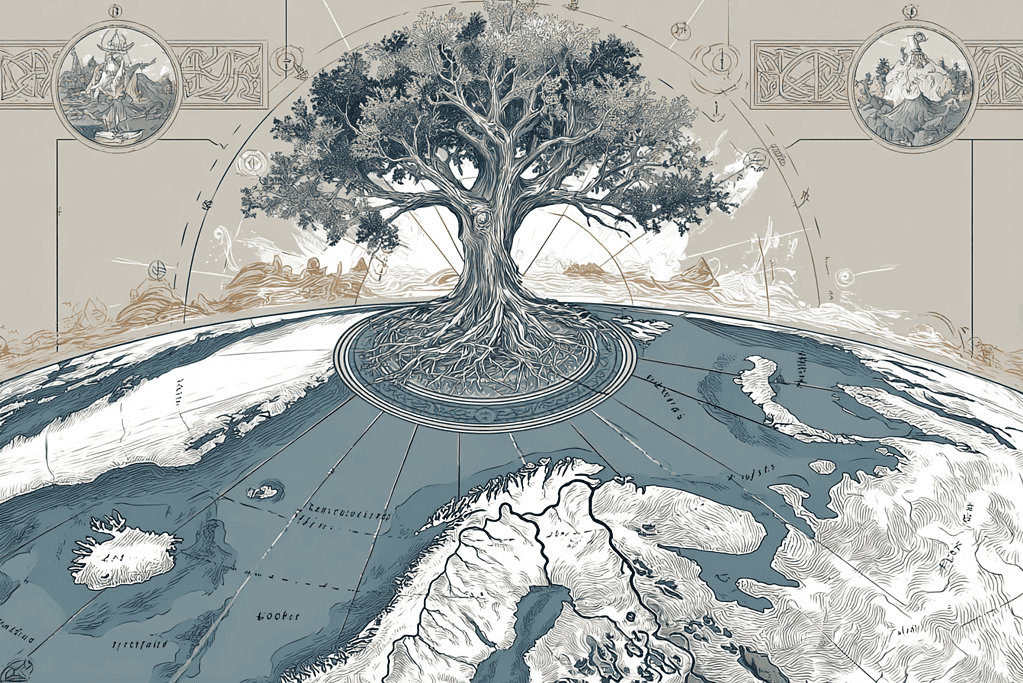
Norse mythology stands out for its emphasis on fate, cyclical destruction, and the acceptance of cosmic endings.
Unlike myth systems focused on eternal renewal, Norse myth acknowledges Ragnarök as unavoidable.
This worldview reflects the harsh realities of life in northern Europe and the values of Norse society.
The gods themselves are not immortal in the absolute sense; they face death alongside humanity.
Norse mythology is both heroic and tragic, shaped by deep historical memory.
Birley, A. R. (Trans.). (1999). Tacitus: Agricola and Germania. Oxford University Press. (Original work published c. 98 CE)
Ellis Davidson, H. R. (1964). Gods and myths of Northern Europe. Penguin Books.
Haselgrove, C., Rebay-Salisbury, K., & Wells, P. S. (Eds.). (2023). The Oxford handbook of the European Iron Age. Oxford University Press.
Lindow, J. (2020). Language: Religious vocabulary. In J. P. Schjødt, J. Lindow, & A. Andrén (Eds.), Pre-Christian religions of the North: History and structures (Vol. 1, pp. 113–130). Brepols.
Schjødt, J. P. (2013). Initiation, liminality, and the secular world in pre-Christian Scandinavian religion. Brepols.
Simek, R. (2007). Dictionary of Northern mythology (A. Hall, Trans.). D. S. Brewer.
Turville-Petre, E. O. G. (1964). Myth and religion of the North: The religion of ancient Scandinavia. Holt, Rinehart and Winston.
West, M. L. (2007). Indo-European poetry and myth. Oxford University Press.
Andrén, A. (2014). Tracing Old Norse cosmology: The world tree, Middle Earth, and the sun from archaeological perspectives. Nordic Academic Press.
Adam of Bremen. (2002). History of the archbishops of Hamburg-Bremen (F. J. Tschan, Trans.). Columbia University Press. (Original work written c. 1075)

ᛉ 100% handcrafted artisan pagan , viking, witchcraft and shamanic inspired jewelry.
ᛉ Runes, Symbolism & European Folklore
Get 20% off👇🏻
Happy washing day 🙃
A few rings I’ve worked on the last couple days…
Freya’s cats rule and dogs drool?
Or was that the other way around? 🙃

Garm barely shows up in the old Norse stories.
Still… he leaves a mark.
A...
Leave a comment with your result ❤️
Bavarian Folklore says that you might just cross paths with a Wolpertinger in the alpine...

🐇🌲✨
He finally stepped out of the forest…
The Wolpertinger Pendant has arrived.
Inspired by...

I don’t often sell them, but love it when I do!
Vinca symbol bracelets ❤️...

Rooted in strength + guarded by ravens

The serpent waits 🖤
(Handcrafted Jörmungandr ring made to order in my shop)

Stay warm, everyone ❤️

😑😑😑🤮

I thought I had closed the book on the Alice in Wonderland rings…
But you...

Can this be over now, please?

In case you forgot 💜

Something I’ve been thinking about lately.
If there’s one thing I would’ve done differently early...

This year, we’re not buying things just to keep up.
If you need the reminder:...

My husband is from Bavaria (southern Germany) and I originally made this Krampus pendant for...

Some of the items I’m shipping out today ❤️
Please forgive my dirty nails 😂...

A few items shipping out today 🥰

This mornings rings shipping out ❤️

A few of the rjngs I’m shipping out this morning ❤️
How do you like...

Krampus is coming 🫶🏻

Getting ready to pack up these pretties and ship to their owners ❤️

Freya, cats and pentacles. Doesn’t get any better ❤️

You all got me going crazy making all these fairytale + storybook rings.
But I’ll...

Just launched these pretties ❤️
Size 9 amethyst ring + size 7.25 green kyanite

What would you trade to learn Baba Yaga’s secrets?

It *finally* looks, feels and smells like October!
And here are some items I’m packing...

This mornings pretties getting ready to ship :)

Getting ready to pack up these pretties and ship to their owners ❤️

You bet I’m hopping on this trend 😂
Thank you @shes_sinister for the prompt!

While I welcome the seasonal darkness…it sure is going to make my morning quick videos...

Finally finished the rings I’ve been working on in my stories ❤️
I think I...

Was going to post this update to my stories but it’s too long.

“How do you know I’m mad?” said Alice.
“You must be,” said the Cat, “or...

Some of this mornings orders getting ready to ship. Those little bats are so cute...

Here is the finished ring I was working on in my stories yesterday, along with...

A few of today’s orders shipping out this morning ❤️

The two silver raven rings I was working on in my stories yesterday.
…as well...

Eeeek! I’m so happy to add these to my shop ❤️
I’ve gotten so many...

I had 6 clamshells ready to ship this morning but I dropped and lost my...

Not the story you were told.
The girl didn’t run.
The wolf didn’t win.
This...

I love these raven rings so much 🖤
This mornings pretties shipping out.
All items...

Sleek + minimal Mjölnir ring ⚒️

Today’s orders getting ready to ship.
…And I finally got some time to work on...


About the author Jacqueline Fatica


