No products in the cart.
November 20, 2025 9:43 am

Free USA shipping on orders $35+
November 20, 2025 9:43 am
Norse shamanism is one of the most captivating subjects in Norse studies because it connects myth, ritual, ecstasy, and magic into one powerful current.
If you’ve ever wondered how much of Odin’s legend comes from genuine shamanic tradition and/or how seiðr fit into Viking spiritual practice, this article lays it out clearly.
You’ll walk through the core scholarly debates, the trance-rites tied to the völva, and the shamanic traits embedded in sagas and Old Norse poetry.
Anyone exploring Norse shamanism will find this a grounded, academically supported guide worth reading.
Norse shamanism is usually described as a cluster of shamanic practices such as seiðr, trance, spirit-journey, galdr, divination, ritual ordeal rather than a neat institution like the better-documented forms of Siberian or Eurasian shamanism which are embedded in traditional subsistence such has as reindeer pastoralism or hunting and gathering.
The term connects Norse spiritual practice to broader patterns across northern Eurasia.
Because shamanism appears in many cultures, scholars stress the need to look at traits rather than labels.
In Norse society that means examining shamanic rituals, altered states, spirit helpers, and mythic ordeals that mirror practices recorded among circumpolar peoples.
When exploring Norse shamanism, the key question becomes: which Old Norse traits align with shamanic practice, and which belong purely to Norse tradition?
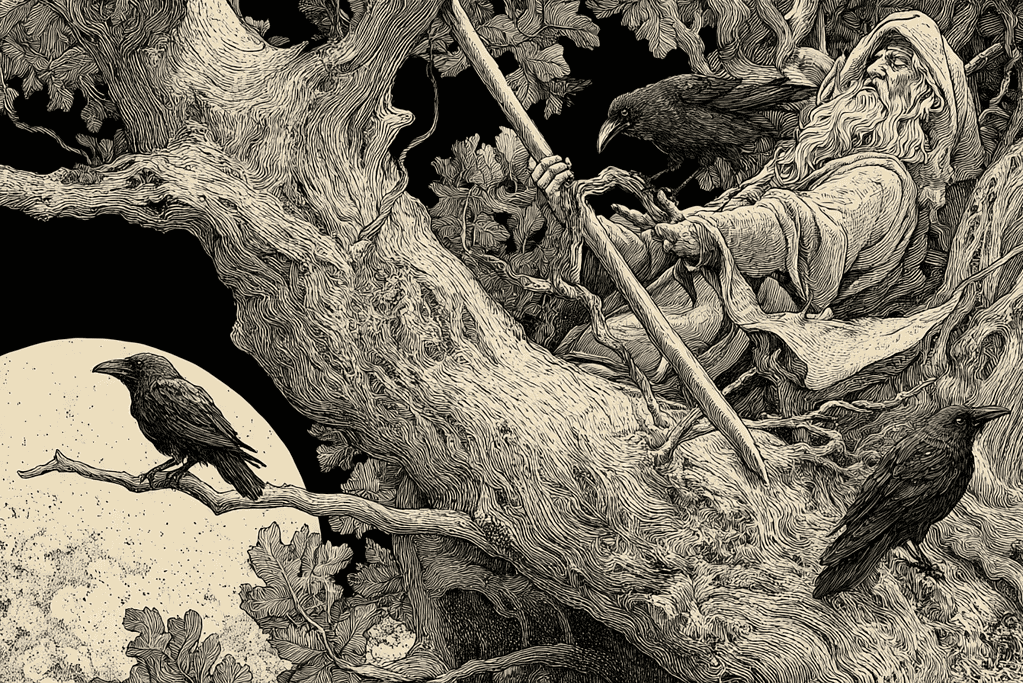
Odin stands at the center of the debate. His actions such as seeking wisdom through ordeal, practicing seiðr, engaging in trance, working galdr, using spirits, performing other acts of magic make him the clearest example of a Norse shamanic figure.
Mircea Eliade famously described Odin as “comparable to the great shamans” (1951, p. 390).
His interest in ecstasy and visionary power echoes shamanic practice across Eurasian shamanism. Yet Odin also stands apart: he is a deity, not a human practitioner.
This is why scholars argue over definition.
If shamanism must involve a social role like a Tungus shaman or a Sámi noaidi, then Odin does not fit.
But if the focus is on shamanic traits in Norse mythology, Odin is one of the richest examples in European shamanism.
The world tree is central in Norse cosmology and forms a natural setting for soul-flight, trance, and shamanic practice.
The image of the tree as a cosmic axis appears widely in Eurasian shamanism, where the shaman climbs or journeys along it.
Old Norse poems describe the world tree as the center of the supernatural world and the pathway linking the nine realms.
When Odin sacrifices himself upon the tree, he interacts directly with a mythic structure shared by many shamanic traditions.
Scholars view this not as coincidence, but as a Norse expression of a very old northern pattern.

Hávamál stanzas 138–141 present Odin hanging nine nights on the world tree, pierced by a spear, fasting, and undergoing symbolic death until he wins the rune.
This is the most frequently cited evidence in the entire study of Norse shamanism.
Rolf Pipping compared the nine nights to a nine-day initiation of Finnish shamans in the north (1928).
A. A. Jøn noted that this ordeal maps closely onto classic initiation experiences found in shamanic tradition (1999, p. 69).
This makes the ordeal of death, trance, illumination one of the strongest shamanic motifs in all Old Norse literature.
Yes. Snorri Sturluson describes Odin lying as if dead while his spirit traveled in the shape of a bird or beast. That motif is a textbook example of shamanic soul-flight.
Mircea Eliade singled out this episode as nearly identical to Siberian shamanic soul-journeys.
Clive Tolley argues for caution, noting that these motifs appear in myth rather than social practice, but he still affirms their shamanic nature (2009, vol. 1, p. 95).
This makes soul-flight part of Norse magical tradition even if it wasn’t practiced widely by Norse people.
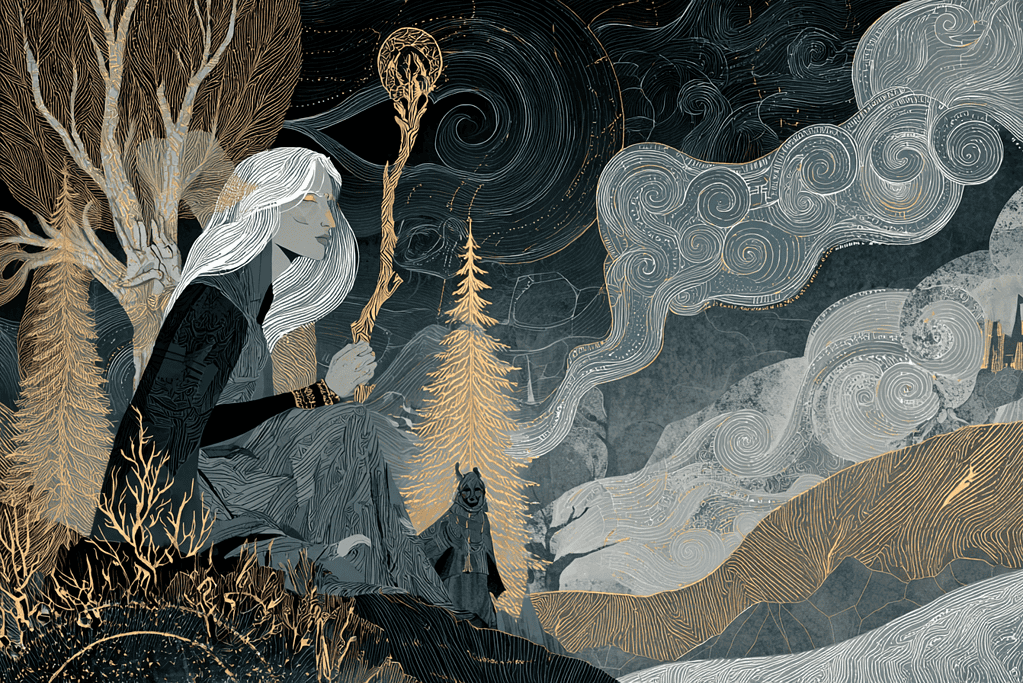
Huginn and Muninn behave like shamanic spirit helpers.
They fly across the world, gather knowledge, and return to their master which is parallel to helping spirits found throughout northern Europe and Asia.
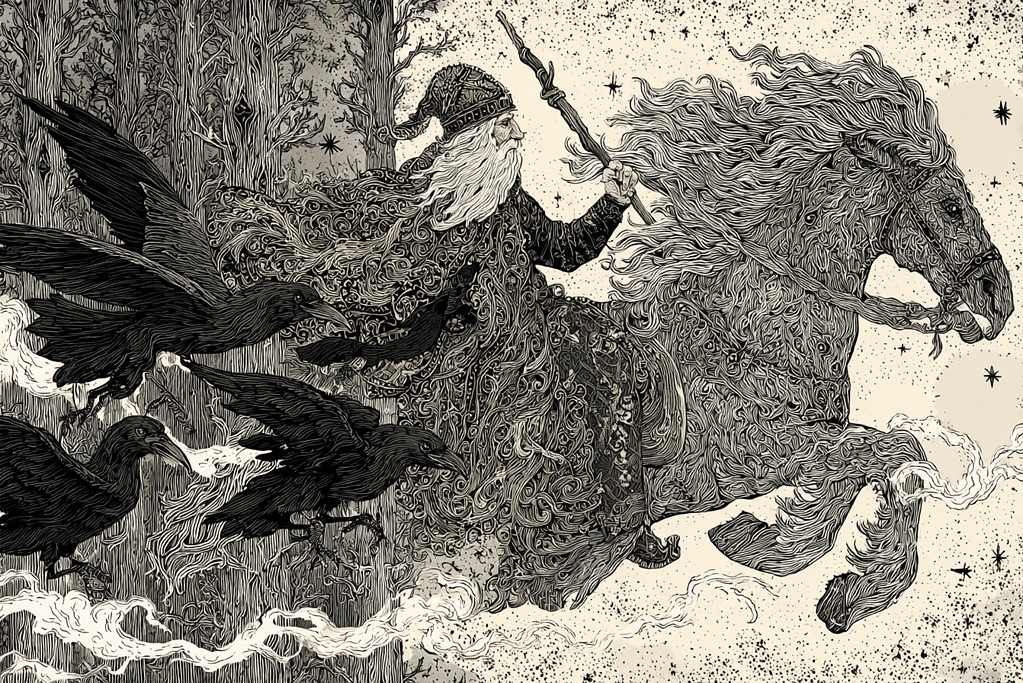
Odin’s eight-legged horse, Sleipnir, reinforces this pattern.
Many scholars treat Sleipnir as a symbolic “ritual horse” used in shamanic journeys, especially those that involve travel to the land of the dead.
These details place Odin within a shamanic tradition of animal spirits, guiding entities, and otherworldly travel.
Seiðr is the most controversial part of Norse shamanism.
It carries shamanic traits (trance, prophecy, ritual platform, chant, spirit interaction), but it also holds a cultural stigma.
Freyrja teaches seiðr to Odin, and saga accounts present it as a ritual involving trance, a high seat, chanting attendants, and spirit communication.
Dag Strömbäck argued that the practice shows strong influence from Sámi shamanic traditions, especially the ritual equipment and altered state used in trance (1935, pp. 45–52).
But seiðr was considered unmanly for a male practitioner. Loki mocks Odin for engaging in seiðr, using the charge of ergi.
This makes seiðr not just a form of magic, but a window into Norse society, and spirituality.
The völva is often treated as a Norse shaman because she engages directly in trance, prophecy, ritual performance, and the communication with the supernatural world.
Her staff, platform, chant, and ritual authority all resemble shamanic practitioners across circumpolar regions.
In Viking Age texts, the völva holds enormous authority. She interprets fate, delivers prophecy, and acts as the central practitioner of seiðr.
When exploring Norse shamanism, the völva becomes essential because she represents the clearest human link to ancient spiritual practices in Scandinavia.
Her ritual role makes her one of the most vivid examples of shamanic tradition embedded in Norse culture.
Sagas offer some of the best written evidence for Norse shamanism because they detail ritual scenes, seiðr rites, and magical performances.
The Saga of Erik the Red describes a völva entering trance while attendants chant a ritual song to open communication with other realms.
This mirrors shamanic rituals across northern Eurasia, where chanting enables altered states and spirit contact.
Galdr, the magical chant of Old Norse ritual, supports this link. It ties voice, rhythm, and supernatural intent into one act.
Sagas also depict the use of rune magic, curse magic, divination, and other ritual tools that interact with the supernatural world which is also a central requirement for shamanic practice.
These accounts do not present everyday Norse people practicing seiðr; instead they highlight specialized individuals trained in these ancient spiritual practices.
Scholarly views differ, but most agree on the presence of shamanic traits:
Argues that Norse magic belongs to a northern Eurasian context, sharing many patterns with circumpolar shamanism (2019).
Shows that Old Norse myth contains many shamanic rituals even if Norse society did not contain a distinct shamanic class (2009).
Sees seiðr as religious exchange—Sámi ritual adapted into Scandinavian cult (1999).
Interprets Odin as clearly shamanic, especially in his soul-journeys and ecstasy.
Rejects external borrowing and argues for indigenous ecstatic traditions.
Emphasize differences between seiðr and classic shamanism, suggesting the need for precision when defining shamanism.
These debates show that “Norse shamanism” is not a simple category, but a living discussion shaped by evidence, definitions, and comparative research.
DuBois, T. A. (1999). Nordic religions in the Viking Age. Philadelphia: University of Pennsylvania Press.
Eliade, M. (1951). Shamanism: Archaic techniques of ecstasy. Princeton: Princeton University Press.
Fleck, J. (1971). The riddle of Hávamál 138–145. Scandinavian Studies, 43(2), 112–126.
Jøn, A. A. (1999). Shamanism and the image of the Teutonic deity Óðinn. Folklore, 10, 68–76.
Polomé, E. C. (1992). Approaches to Germanic mythology. In E. C. Polomé (Ed.), Essays on Germanic religion (pp. 37–61). Washington, D.C.: Institute for the Study of Man.
Price, N. (2019). The Viking way: Magic and mind in late Iron Age Scandinavia (2nd ed.). Oxford: Oxbow Books.
Pipping, R. (1928). De nordiska gudasagorna och den finska folktron. Finsk-Ugrisk Förenings Tidskrift, 41, 1–50.
Schnurbein, S. von. (2003). Shamanism in the Old Norse tradition: A theory between ideological camps. History of Religions, 43(2), 116–138.
Strömbäck, D. (1935). Sejd: Textstudier i nordisk religionshistoria. Stockholm: Hugo Gebers Förlag.
Tolley, C. (2009). Shamanism in Norse myth and magic (Vols. 1–2). Helsinki: Suomalainen Tiedeakatemia.
Vries, J. de. (1956). Altgermanische Religionsgeschichte (2nd ed.). Berlin: Walter de Gruyter.

ᛉ 100% handcrafted artisan pagan , viking, witchcraft and shamanic inspired jewelry.
ᛉ Runes, Symbolism & European Folklore
Get 20% off👇🏻

Five witches dance around a blazing bonfire beneath a citrine cabochon in this Walpurgisnacht pendant....
Happy washing day 🙃
A few rings I’ve worked on the last couple days…
Freya’s cats rule and dogs drool?
Or was that the other way around? 🙃

Garm barely shows up in the old Norse stories.
Still… he leaves a mark.
A...
Leave a comment with your result ❤️
Bavarian Folklore says that you might just cross paths with a Wolpertinger in the alpine...

🐇🌲✨
He finally stepped out of the forest…
The Wolpertinger Pendant has arrived.
Inspired by...

I don’t often sell them, but love it when I do!
Vinca symbol bracelets ❤️...

Rooted in strength + guarded by ravens

The serpent waits 🖤
(Handcrafted Jörmungandr ring made to order in my shop)

Stay warm, everyone ❤️

😑😑😑🤮

I thought I had closed the book on the Alice in Wonderland rings…
But you...

Can this be over now, please?

In case you forgot 💜

Something I’ve been thinking about lately.
If there’s one thing I would’ve done differently early...

This year, we’re not buying things just to keep up.
If you need the reminder:...

My husband is from Bavaria (southern Germany) and I originally made this Krampus pendant for...

Some of the items I’m shipping out today ❤️
Please forgive my dirty nails 😂...

A few items shipping out today 🥰

This mornings rings shipping out ❤️

A few of the rjngs I’m shipping out this morning ❤️
How do you like...

Krampus is coming 🫶🏻

Getting ready to pack up these pretties and ship to their owners ❤️

Freya, cats and pentacles. Doesn’t get any better ❤️

You all got me going crazy making all these fairytale + storybook rings.
But I’ll...

Just launched these pretties ❤️
Size 9 amethyst ring + size 7.25 green kyanite

What would you trade to learn Baba Yaga’s secrets?

It *finally* looks, feels and smells like October!
And here are some items I’m packing...

This mornings pretties getting ready to ship :)

Getting ready to pack up these pretties and ship to their owners ❤️

You bet I’m hopping on this trend 😂
Thank you @shes_sinister for the prompt!

While I welcome the seasonal darkness…it sure is going to make my morning quick videos...

Finally finished the rings I’ve been working on in my stories ❤️
I think I...

Was going to post this update to my stories but it’s too long.

“How do you know I’m mad?” said Alice.
“You must be,” said the Cat, “or...

Some of this mornings orders getting ready to ship. Those little bats are so cute...

Here is the finished ring I was working on in my stories yesterday, along with...

A few of today’s orders shipping out this morning ❤️

The two silver raven rings I was working on in my stories yesterday.
…as well...

Eeeek! I’m so happy to add these to my shop ❤️
I’ve gotten so many...

I had 6 clamshells ready to ship this morning but I dropped and lost my...

Not the story you were told.
The girl didn’t run.
The wolf didn’t win.
This...

I love these raven rings so much 🖤
This mornings pretties shipping out.
All items...

Sleek + minimal Mjölnir ring ⚒️


About the author Jacqueline Fatica


