No products in the cart.
November 15, 2025 3:21 pm

Free USA shipping on orders $35+
November 15, 2025 3:21 pm
In Swedish folklore, few beings stand as firmly rooted in older belief as the tomte gnome.
Behind the cozy winter imagery and bright red hat, the original swedish tomte was an ancestral guardian tied to land, barn, and family history.
Historical descriptions portray the tomte as an ancestral spirit linked directly to the first person who cleared the land.
Eldar Heide explains that the founder of a farmstead was remembered as the rudkall or the tomten, the “house-foundation man,”.
In other words, a being who “lived on the farm or in a nearby (grave) mound, boulder, grove or other, occasionally in a local mountain” (Heide, 2022, p. 110).
This places the tomte within the world of the dead who remain near their descendants.
Heide also notes that this tradition is part of a much older northern pattern where ancestors stay close to the homestead, watching over its prosperity (Heide, 2022, pp. 94–96).
This connects the tomte not to myth invented in modern times, but to enduring scandinavian folklore around kinship, land, and continuity.
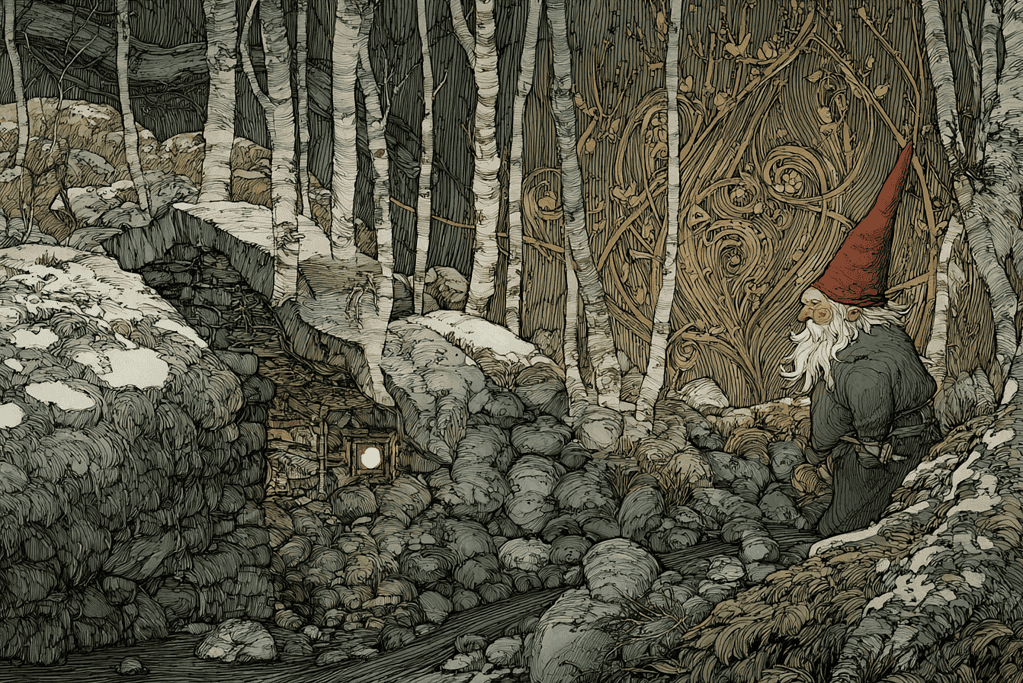
The origins of the swedish tomte make him far more than a gnome from winter postcards.
Older traditions describe him as a presence woven into the soil of the farmstead, tied to the early settlers who shaped the land.
This older understanding explains why the tomte later becomes central to julenisse and jultomte customs in sweden.
In these traditions, a nisse acts not as a toy-like plush figure, but as a protective household spirit whose watchfulness shapes each season’s celebration.
Because he is connected to the first ancestor, a tomte was approached with respect.
In the wider regions of norway and denmark, related beings appear in similar roles.
These parallels help readers see tomte not as a universal christmas elf, but as a deeply rooted spiritual figure with links to yule, winter rites, and older nordic perceptions of land and kin.
Modern tomte figurines often show a long beard, pointy posture, and a whimsical style, but these are echoes of a spirit once believed to bring either prosperity or misfortune depending on the behavior of the household.
This older context explains how the tomte eventually became a tomte gnome in winter stories while still retaining his character as a benevolent but demanding guardian.
Cyriax’s firsthand early 20th-century account offers one of the clearest depictions of the tomte’s role on a working farm.
On Christmas Eve, families placed porridge in the barn “for a small gnome who, when in a good humour, is believed to help with the farm work, but when offended, plays all sorts of pranks” (Cyriax, 1923, p. 316).
He describes this figure who are called Tomte-Nisse as a small old man in a red cap and grey clothes (Cyriax, 1923, p. 316).
The tomte protected livestock, aided in chores, and demanded proper treatment.
Heide’s analysis supports these details: the tomte “protects the farm and helps the people who live there with their work.
As long as they bring him sacrifices at certain times and observe taboos” such as avoiding noise or uncleanliness near his dwelling (Heide, 2022, p. 110).
When these expectations were unmet, the tomte could cause harm or withdraw help.
Within nordic folklore, this barn spirit stands apart from the gentle little gnomes often sold as christmas decorations.
The traditional tomte enforced boundaries.
A family who showed rudeness or failed to maintain the homestead properly risked a prank or worse. In such stories, the tomte could shift from benevolent helper to a force angered by neglect.
The practice of offering christmas porridge or porridge and milk reflects the belief that maintaining harmony required steady attention.
This spirit’s appearance later influenced scandinavian christmas imagery.
His red hat and compact posture helped distinguish him from the american santa claus and linked him more closely to older barn traditions.
The tomte’s bond with livestock and especially horses, cows, and goats extends into symbols like the julbock, the straw goat of jul.
Small figurine versions placed near mantels or windows today are a softened echo of the older spirit whose personality could shift quickly.
Whether carved, painted, or crafted as an ornament, these figures continue to represent the household guardian who offered help only when treated well.
Heide emphasizes that the tomte cannot be fully separated from the wider system of elf-like beings. He explains that the rudkall and the tomte “can only partially be distinguished” from huldrufolk, mound-people, vättar, and álfar (Heide, 2022, pp. 110–111).
This overlap places the tomte within a shared world of hidden beings connected to burial mounds, local landmarks, and ancestral memory.
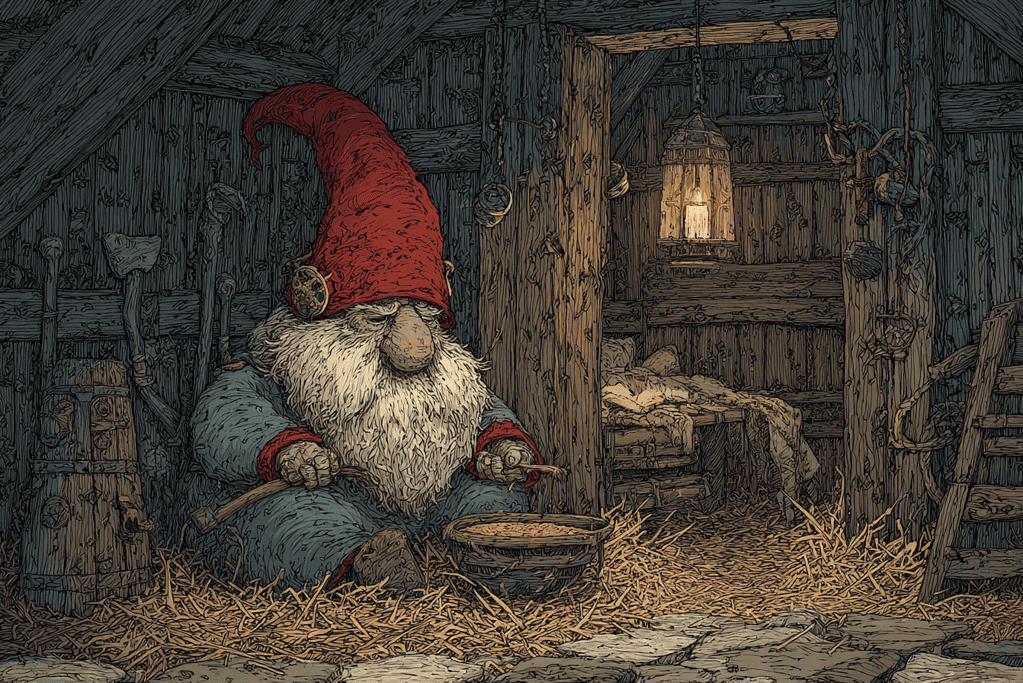
Cyriax’s description of the tomte as both helpful and temperamental fits this larger system, where spirits responded to human behavior and upheld older customs around respect for land and lineage.
This connection to ancestral spirits gives the tomte a character richer than any decor item.
In regions like norway, finland, and denmark, related traditions describe figures close to the tonttu and tomtar, beings who exist at the boundary between the living and the dead.
These beings appear especially vividly during the winter solstice, when older beliefs held that the veil between worlds thinned.
Because of these connections, many people place ornaments tomte or home décor featuring these figures around their homes during the darker months.
These modern objects help keep a sense of continuity with the older ideas that formed the ancestral memory of rural communities.
Although the modern tomte gnome is softened into a festive companion, fragments of the older worldview still linger in the way families speak of kindness, hard work, and the rewards given to good children.
Even softened into a plush toy or winter decoration, the tomte remains linked to his past as a guardian.
Contemporary understanding often calls him a christmas gnome, yet the older materials reveal a spirit shaped by land, graves, stones, and the work of the homestead.
Cyriax preserves one of the earliest full descriptions of how a tomte was honored specifically on christmas eve.
Families left porridge in the barn alongside extra feed for animals and grain-sheaves for birds (Cyriax, 1923, p. 316).
This placed the tomte within a broader winter pattern where humans, animals, and spirits were all given nourishment.
Heide notes that beings within this same complex, including those related to the tomte, were believed to appear or approach homes during the winter season, including at Christmas (Heide, 2022, p. 108).
This situates the tomte’s holiday visit within centuries of midwinter spiritual expectation.
Henderson offers a modern perspective: the tomten arriving on skis at night, carrying a sack of gifts, calling “Ho, ho, HO!” and leaving simple surprises behind (Henderson, 2005, pp. 48–49).
She emphasizes that this figure was once “a sprite that lived under barns to protect the livestock” before becoming a visitor on christmas night (Henderson, 2005, p. 48).
The shift from barn guardian to visitor helped create today’s scandinavian image of a charming but powerful spirit active during jul.
The tomte’s partnership with winter symbols like the reindeer or the straw goat (julbock) reflects how modern scandinavian christmas celebration keeps older threads alive.
Though softened, these stories still retain traces of the protective being who once patrolled the stable.
Decorative ornament sets or tomte figurines near windows and trees echo this presence.
While they serve as home décor today, their forms still hark back to the barefoot, bearded, mischievous figure described in early accounts.
Holiday markets across scandinavia often feature versions carved from wood or shaped as plush toys, keeping the line of tradition unbroken.
This blend of charm and older belief gives the tomte a role distinct from northern figures shaped by the north pole.
Though later holidays added the idea of bringing gifts, the foundation remains in rites around porridge, barns, and the winter visit of a spirit tied to land and lineage.

Henderson’s description shows that the tomte still appears in community memory. Her family’s tomte arrived after dark, knocked loudly, and delivered small gifts (Henderson, 2005, pp. 48–49).
She points out that the visitor could be a neighbor or a genuine sprite, an intentional ambiguity that preserves the spirit’s old liminal presence.
By identifying him as “Sweden’s magical, mythical, noncommercial Santa figure” (Henderson, 2005, p. 49), she highlights how the tomte remains distinct from later imports.
The tomte’s history as a barn spirit, ancestor, and guardian gives him a grounding in swedish culture absent from imported traditions.
This living tradition helps explain why the tomte appears widely across scandinavia during winter.
Many families keep small figurine sets on mantels or windowsills, evoking the way older tomtar were thought to watch over the homestead.
These figures help preserve memories that reach back long before the image of the north pole workshop.
In some regions, craft markets sell tomte figurines carved from wood, accented by woolen beards and pointed hats.
Their expressions shift between stern, cozy, or playful, reflecting the older spirit who could be helpful or sharply corrective.
Even as a softened decoration, the tomte retains echoes of a being bound to winter rites.
Across Scandinavia related beings appear in stories of the julenisse, tonttu, or tomtar.
Though their roles differ slightly from region to region, each holds the core identity of a winter guardian who responds directly to the conduct of the household.
These linked traditions help us understand why families still see tomte in their winter décor: he embodies a cultural memory carried into present-day celebrations.
Cyriax, A. K. (1923). Swedish Christmas Customs. Folklore, 34(4), 314–321.
Henderson, H. (2005). Swedish Holidays, Customs, and Celebrations. In The Swedish Table (pp. 47–50). University of Minnesota Press.
Heide, E. (2022). Old Icelandic and Sami Ancestor Mountains: A Comparison. In H. Rydving & K. Kaikkonen (Eds.), Religions around the Arctic: Source Criticism and Comparisons (pp. 89–116). Stockholm University Press.

ᛉ 100% handcrafted artisan pagan , viking, witchcraft and shamanic inspired jewelry.
ᛉ Runes, Symbolism & European Folklore
Get 20% off👇🏻

Five witches dance around a blazing bonfire beneath a citrine cabochon in this Walpurgisnacht pendant....
Happy washing day 🙃
A few rings I’ve worked on the last couple days…
Freya’s cats rule and dogs drool?
Or was that the other way around? 🙃

Garm barely shows up in the old Norse stories.
Still… he leaves a mark.
A...
Leave a comment with your result ❤️
Bavarian Folklore says that you might just cross paths with a Wolpertinger in the alpine...

🐇🌲✨
He finally stepped out of the forest…
The Wolpertinger Pendant has arrived.
Inspired by...

I don’t often sell them, but love it when I do!
Vinca symbol bracelets ❤️...

Rooted in strength + guarded by ravens

The serpent waits 🖤
(Handcrafted Jörmungandr ring made to order in my shop)

Stay warm, everyone ❤️

😑😑😑🤮

I thought I had closed the book on the Alice in Wonderland rings…
But you...

Can this be over now, please?

In case you forgot 💜

Something I’ve been thinking about lately.
If there’s one thing I would’ve done differently early...

This year, we’re not buying things just to keep up.
If you need the reminder:...

My husband is from Bavaria (southern Germany) and I originally made this Krampus pendant for...

Some of the items I’m shipping out today ❤️
Please forgive my dirty nails 😂...

A few items shipping out today 🥰

This mornings rings shipping out ❤️

A few of the rjngs I’m shipping out this morning ❤️
How do you like...

Krampus is coming 🫶🏻

Getting ready to pack up these pretties and ship to their owners ❤️

Freya, cats and pentacles. Doesn’t get any better ❤️

You all got me going crazy making all these fairytale + storybook rings.
But I’ll...

Just launched these pretties ❤️
Size 9 amethyst ring + size 7.25 green kyanite

What would you trade to learn Baba Yaga’s secrets?

It *finally* looks, feels and smells like October!
And here are some items I’m packing...

This mornings pretties getting ready to ship :)

Getting ready to pack up these pretties and ship to their owners ❤️

You bet I’m hopping on this trend 😂
Thank you @shes_sinister for the prompt!

While I welcome the seasonal darkness…it sure is going to make my morning quick videos...

Finally finished the rings I’ve been working on in my stories ❤️
I think I...

Was going to post this update to my stories but it’s too long.

“How do you know I’m mad?” said Alice.
“You must be,” said the Cat, “or...

Some of this mornings orders getting ready to ship. Those little bats are so cute...

Here is the finished ring I was working on in my stories yesterday, along with...

A few of today’s orders shipping out this morning ❤️

The two silver raven rings I was working on in my stories yesterday.
…as well...

Eeeek! I’m so happy to add these to my shop ❤️
I’ve gotten so many...

I had 6 clamshells ready to ship this morning but I dropped and lost my...

Not the story you were told.
The girl didn’t run.
The wolf didn’t win.
This...

I love these raven rings so much 🖤
This mornings pretties shipping out.
All items...

Sleek + minimal Mjölnir ring ⚒️


About the author Jacqueline Fatica


