No products in the cart.
February 12, 2026 3:06 pm

Free USA shipping on orders $35+
February 12, 2026 3:06 pm
European prehistory stretches across an almost unimaginable span of time, far longer than written history and far longer than the Viking Age most people are familiar with.
For tens of thousands of years, humans lived in Europe without writing, cities, or states.
They hunted animals, gathered wild plants, adapted to dramatic climate shifts, and slowly reshaped the continent through migration, technology, and settlement.
This article offers a clear, guided timeline of prehistory in Europe, explaining who lived here, how they survived, and why major changes such as farming and metalworking transformed human life forever.
This is not a catalogue of obscure terms or cultures. Instead, it is a story of how people lived, how that life changed, and why those changes mattered in the long history of Europe.
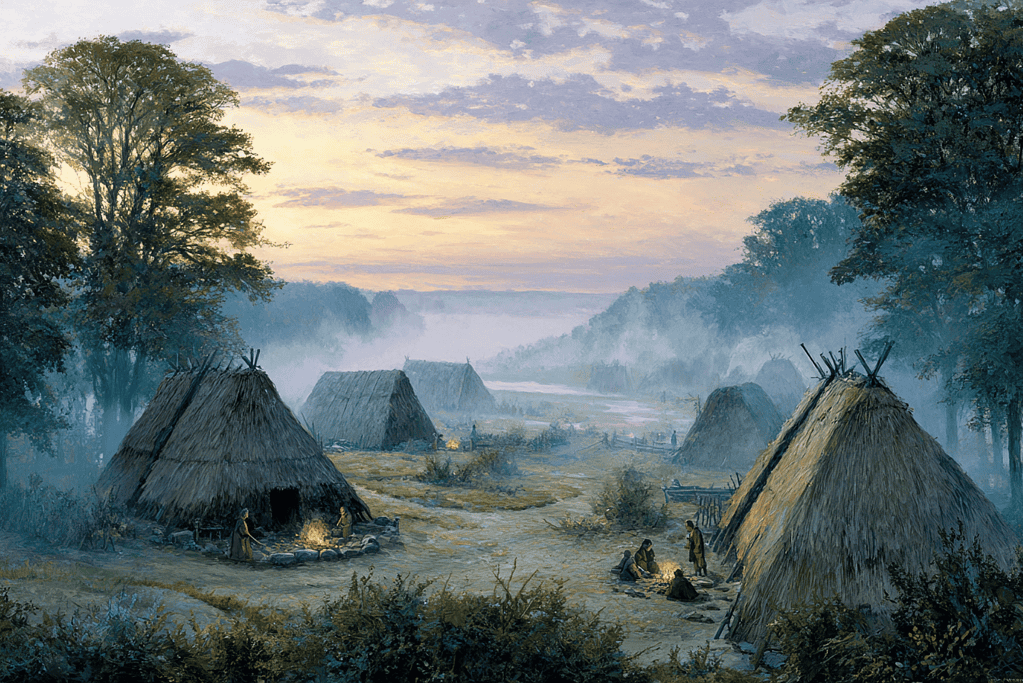
Before diving into dates or names, it helps to understand one basic idea. European prehistory is not defined by kings, empires, or written records.
It is defined by how people got their food, how they moved across the land, and how they organized their lives.
For most of prehistory, humans in Europe lived as hunters and gatherers. They followed animals, collected plants, and moved seasonally.
Much later, farming arrived from the Near East, bringing permanent villages, pottery, and population growth.
Only after thousands of years of farming did metalworking appear, first bronze and later iron, laying the groundwork for what we recognize as early civilization and, eventually, written history (Robb, 2013, p. 19).
Understanding this sequence makes everything else fall into place.
The earliest chapter of European prehistory belongs to the Palaeolithic, also called the Old Stone Age.
This period stretches back hundreds of thousands of years and covers the time when humans lived entirely by hunting animals and gathering wild resources.
Early humans, including Neanderthals, lived in Europe long before modern humans arrived. Neanderthals were skilled hunters who made stone tools, controlled fire, and adapted to harsh Ice Age environments (Stringer, 2012, p. 87).
They were not primitive but capable prehistoric humans who survived in Europe for hundreds of thousands of years.
Around 45,000 years ago, anatomically modern humans, known as Homo sapiens, entered Europe from earlier populations in Africa and the Near East. (Fu et al., 2014, p. 445).
From this point onward, the story of Europe becomes the story of modern human adaptation.
The Upper Palaeolithic refers to the later phase of the Old Stone Age, roughly between 45,000 and 11,700 years ago.
This was a time when modern humans fully established themselves across Europe, even in extremely cold Ice Age environments.
People lived as highly mobile hunter-gatherers, relying on animals such as mammoth, reindeer, horse, and bison.
They made sophisticated stone tools, bone implements, and clothing suited for cold climates.
Importantly, this period also saw the explosion of prehistoric art, including cave paintings, carved figurines, and engraved objects, showing symbolic thinking and shared cultural traditions (Clottes, 2008, p. 21).
During this time, different hunting groups lived in different parts of Europe. Archaeologists later gave these groups names based on their tools and art styles.
Two well-known examples are the Gravettian and Magdalenian traditions. These names do not describe ethnic groups or nations.
They describe ways of life, tool-making habits, and regional adaptations among Ice Age hunters (Bahn, 2010, p. 54).
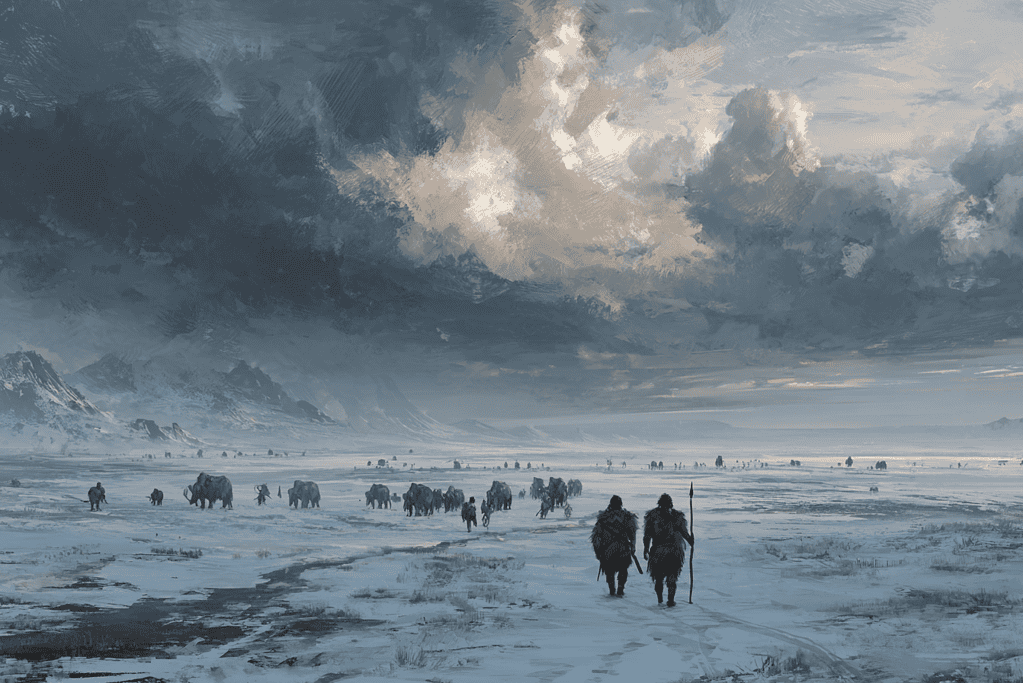
The Gravettian tradition, dating roughly between 30,000 and 22,000 years ago, represents groups of hunters who specialized in cold, open environments across much of western and central Europe.
These people hunted large animals and produced distinctive stone tools and famous small figurines, often interpreted as representations of the human body (Bahn, 2010, p. 88).
The Magdalenian tradition emerged later, after the coldest phase of the last Ice Age.
Magdalenian hunters, living roughly between 17,000 and 11,700 years ago, focused heavily on reindeer and produced some of the most elaborate cave art known in prehistoric Europe, especially in western Europe.
Their tools, art, and settlement patterns show a highly organized hunting economy tied closely to seasonal animal migrations (Clottes, 2008, p. 67).
What matters is not memorizing these names, but understanding that different hunter-gatherer groups adapted in different ways to changing climates and environments.
The end of the last Ice Age marked a major turning point.
As glaciers retreated and forests spread across much of Europe, human life changed again. This period is known as the Mesolithic, or Middle Stone Age.
Mesolithic hunter-gatherers still relied on wild resources, but their environments were warmer, wetter, and more forested.
Instead of following massive herds across open plains, people hunted smaller animals, fished rivers and coastlines, and gathered a wider range of foods.
In parts of northern Europe and Scandinavia, maritime resources became increasingly important. This was the time period when the Maglemosian and Ertebœlle hunter-fishers lived in Scandinavia (Price, 2015, p. 142).
This period shows remarkable regional diversity.
Mesolithic communities adapted locally, creating new settlement patterns and toolkits suited to forests, wetlands, and coastlines. These changes laid the groundwork for what came next.
The Neolithic marks the most profound transformation in European prehistory. The term refers to the period when farming and animal domestication first appeared.
Farming did not originate in Europe. It developed earlier in the ancient Near East, where people domesticated wheat, barley, sheep, and goats.
The Danube that spans along the Balkans into Hungary, Austria, Germany played a key role in the spread of Neolithic technology.
By 5500BC, the first farming technology reached Germany.
From there, farming spread slowly into southeastern Europe and eventually across Europe through migration and cultural exchange (Bocquet-Appel, 2011, p. 199).
Neolithic farmers lived very differently from hunter-gatherers.
They built permanent settlements, produced pottery, stored food, and relied on domesticated plants and animals.
This shift allowed population growth but also brought new challenges, including disease, inequality, and environmental pressure.
Archaeological and genetic evidence shows that early European farmers were not simply local hunters adopting agriculture.
In many regions, farming arrived with new populations migrating into Europe from the Near East (Haak et al., 2015, p. 209).
One well-known early farming culture is the Linear Pottery Culture, named after its distinctive pottery decoration.
These early farmers settled in central Europe, clearing forests and establishing longhouse villages.
Over time, farming spread into western Europe, southern Europe, and parts of northern Europe, interacting in complex ways with remaining hunter-gatherer groups.
This was not a single event but a long process that reshaped the population history of Europe. Some hunter-gatherers adopted pottery, and even livestock, such as the Ertebølle hunter-fishers of southern Scandinavia/Denmark.
Depending on the region, some may have learned to farm themselves, other areas may have replaced the older hunter communities. The picture overall is highly complex and it took a long time until all of Europe adopted agriculture.
The Bronze Age began when people learned to alloy copper with tin to produce bronze, a durable metal suitable for tools and weapons.
This technological shift transformed economic and social life across Europe.
Bronze Age societies developed long-distance trade networks, social hierarchies, and new forms of burial that emphasized status and ancestry.
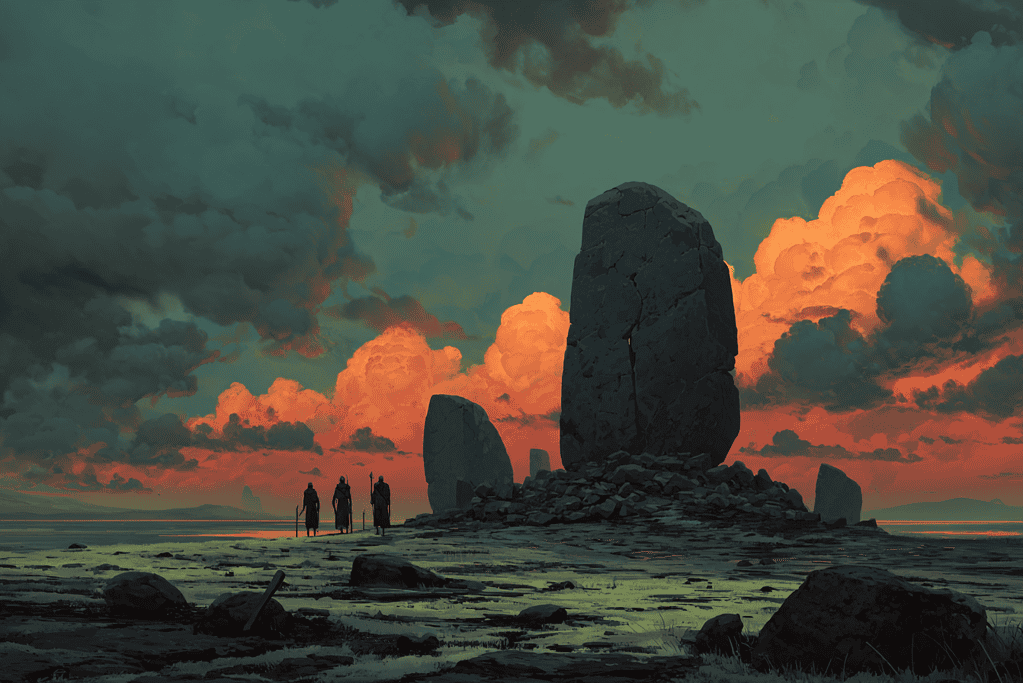
Monumental structures such as Stonehenge belong to this broader world of ritual, memory, and landscape organization (Parker Pearson, 2012, p. 312).
By the early Bronze Age, Europe was no longer a continent of small farming villages alone. It was a connected world of regional cultures linked by trade, migration, and shared ideas.
The Iron Age marked the final stage of European prehistory. Iron tools and weapons became widespread, allowing more intensive agriculture and warfare.
Settlements grew larger, and social complexity increased dramatically.
By the late Iron Age, particularly by the 1st century BC, many parts of Europe were on the brink of written history.
Contact with Mediterranean civilizations such as Greece and Rome introduced writing, coinage, and historical records, ending prehistory and beginning documented European history (Cunliffe, 2013, p. 401).

European prehistory explains how humans adapted to climate change, migration, and technological innovation over tens of thousands of years.
It shows that civilization did not appear suddenly but emerged through countless small changes in how people lived, worked, and understood their world.
For the reader of The Wicked Griffin blog, it is important to emphasize that every single culture, time period and tradition mentioned in this blog post, played a key role in the development of pre-Christian cosmologies, myths and traditions.
Paganism didn’t start in the Bronze Age or Viking Age.
The cosmological ideas and concepts were bound and shaped by subsistence (hunting, gathering, fishing, farming) over thousands of years and its roots go indeed back to the Old Stone Age.
Every shift in technological and livelihood also caused a shift and change in traditions, rituals and cosmologies. This is exactly what the archaeological record indicates.
Understanding this timeline gives context to later European history and reminds us that modern society rests on a deep and complex human past.
Bahn, P. (2010). Prehistoric art. Cambridge University Press.
Bocquet-Appel, J.-P. (2011). When the world’s population took off: The springboard of the Neolithic demographic transition. Science, 333(6042), 560–561.
Clottes, J. (2008). Cave art. Phaidon.
Cunliffe, B. (2013). Britain begins. Oxford University Press.
Fu, Q., et al. (2014). Genome sequence of a 45,000-year-old modern human from western Siberia. Nature, 514, 445–449.
Haak, W., et al. (2015). Massive migration from the steppe was a source for Indo-European languages in Europe. Nature, 522, 207–211.
Parker Pearson, M. (2012). Stonehenge: Exploring the greatest Stone Age mystery. Simon & Schuster.
Price, T. D. (2015). Europe’s first farmers. Cambridge University Press.
Robb, J. (2013). The early Mediterranean village. Cambridge University Press.
Stringer, C. (2012). Lone survivors: How we came to be the only humans on Earth. Times Books.

ᛉ 100% handcrafted artisan pagan , viking, witchcraft and shamanic inspired jewelry.
ᛉ Runes, Symbolism & European Folklore
Get 20% off👇🏻

Five witches dance around a blazing bonfire beneath a citrine cabochon in this Walpurgisnacht pendant....
Happy washing day 🙃
A few rings I’ve worked on the last couple days…
Freya’s cats rule and dogs drool?
Or was that the other way around? 🙃

Garm barely shows up in the old Norse stories.
Still… he leaves a mark.
A...
Leave a comment with your result ❤️
Bavarian Folklore says that you might just cross paths with a Wolpertinger in the alpine...

🐇🌲✨
He finally stepped out of the forest…
The Wolpertinger Pendant has arrived.
Inspired by...

I don’t often sell them, but love it when I do!
Vinca symbol bracelets ❤️...

Rooted in strength + guarded by ravens

The serpent waits 🖤
(Handcrafted Jörmungandr ring made to order in my shop)

Stay warm, everyone ❤️

😑😑😑🤮

I thought I had closed the book on the Alice in Wonderland rings…
But you...

Can this be over now, please?

In case you forgot 💜

Something I’ve been thinking about lately.
If there’s one thing I would’ve done differently early...

This year, we’re not buying things just to keep up.
If you need the reminder:...

My husband is from Bavaria (southern Germany) and I originally made this Krampus pendant for...

Some of the items I’m shipping out today ❤️
Please forgive my dirty nails 😂...

A few items shipping out today 🥰

This mornings rings shipping out ❤️

A few of the rjngs I’m shipping out this morning ❤️
How do you like...

Krampus is coming 🫶🏻

Getting ready to pack up these pretties and ship to their owners ❤️

Freya, cats and pentacles. Doesn’t get any better ❤️

You all got me going crazy making all these fairytale + storybook rings.
But I’ll...

Just launched these pretties ❤️
Size 9 amethyst ring + size 7.25 green kyanite

What would you trade to learn Baba Yaga’s secrets?

It *finally* looks, feels and smells like October!
And here are some items I’m packing...

This mornings pretties getting ready to ship :)

Getting ready to pack up these pretties and ship to their owners ❤️

You bet I’m hopping on this trend 😂
Thank you @shes_sinister for the prompt!

While I welcome the seasonal darkness…it sure is going to make my morning quick videos...

Finally finished the rings I’ve been working on in my stories ❤️
I think I...

Was going to post this update to my stories but it’s too long.

“How do you know I’m mad?” said Alice.
“You must be,” said the Cat, “or...

Some of this mornings orders getting ready to ship. Those little bats are so cute...

Here is the finished ring I was working on in my stories yesterday, along with...

A few of today’s orders shipping out this morning ❤️

The two silver raven rings I was working on in my stories yesterday.
…as well...

Eeeek! I’m so happy to add these to my shop ❤️
I’ve gotten so many...

I had 6 clamshells ready to ship this morning but I dropped and lost my...

Not the story you were told.
The girl didn’t run.
The wolf didn’t win.
This...

I love these raven rings so much 🖤
This mornings pretties shipping out.
All items...

Sleek + minimal Mjölnir ring ⚒️


About the author Jacqueline Fatica


