No products in the cart.
November 4, 2025 9:02 am

Free USA shipping on orders $35+
November 4, 2025 9:02 am
The Yule Goat is one of the most enduring winter traditions in Scandinavia. Long before the modern image of Santa Claus arrived in Sweden and Norway, this goat delivered gifts, caused mischief, and walked from door to door.
The Yule Goat is a Scandinavian winter visitor whose story reaches back into Norse mythology, pagan celebrations, and the oldest yule preparations.
This article is worth reading for anyone curious about the strange, wonderful, and ancient elements of Christmas time that survive in Northern Europe.
It explains how the goat became a bringer of gifts, why the goat appears in Christmas ornaments made of straw, and how the tradition grew into the modern Gävle Goat.
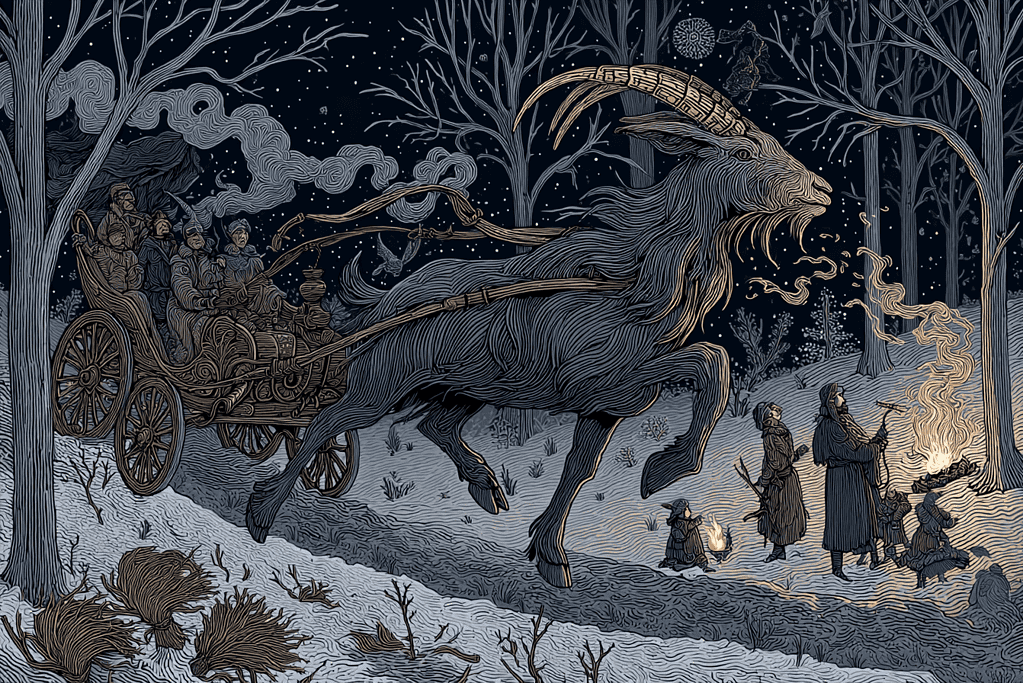
The Yule Goat, sometimes called the Christmas Goat, is a Scandinavian figure who once delivered gifts before Santa Claus became the dominant winter visitor.
In Sweden, the Yule Goat was known as the Yulbock, and in Norway the figure appears as the julebukk. The Yule Goat is a Scandinavian character who visited houses in disguise.
A man dressed in goatskin or carrying a goat-head effigy would bring gifts to sleeping children during Christmas time.
The goat is connected to yule celebrations that long predate Christianity in Scandinavia.
Folklorists point to surviving traditions where the last sheaf of grain was saved for the yule celebrations. This last sheaf was sometimes shaped into the form of a goat.
The idea that the harvest spirit lived in the last sheaf of grain helped connect the goat to fertility, good fortune, and the hope that the sun does at Yule.
The goat would bring strength through the darkest winter nights.
Norse mythology helps explain why the goat became a winter visitor. Thor’s goats are central to this story. The Norse god Thor rode across the sky in a chariot drawn by two goats.
Their names were Tanngrisnir and Tanngnjóstr.
These two goats pulled the chariot drawn across the heavens. In this myth the goats have the power to die and return to life.
Thor kills the goats to feed his companions, but when their bones are laid carefully together, the goats return to life.
The Yule Goat returned to life in the same symbolic spirit.
Later Christmas folklore remembered this idea, because many versions of the Yule Goat were symbolically killed but returned to life during midwinter performance.
The connection to a Norse god does not mean the Yule Goat was originally a religious figure.
It does suggest that Scandinavian history preserved animal traditions linked to pagan times. The goat remains an animal of great power in Norse mythology.
The Yule Goat appears as a winter echo of a very old mythic companion.
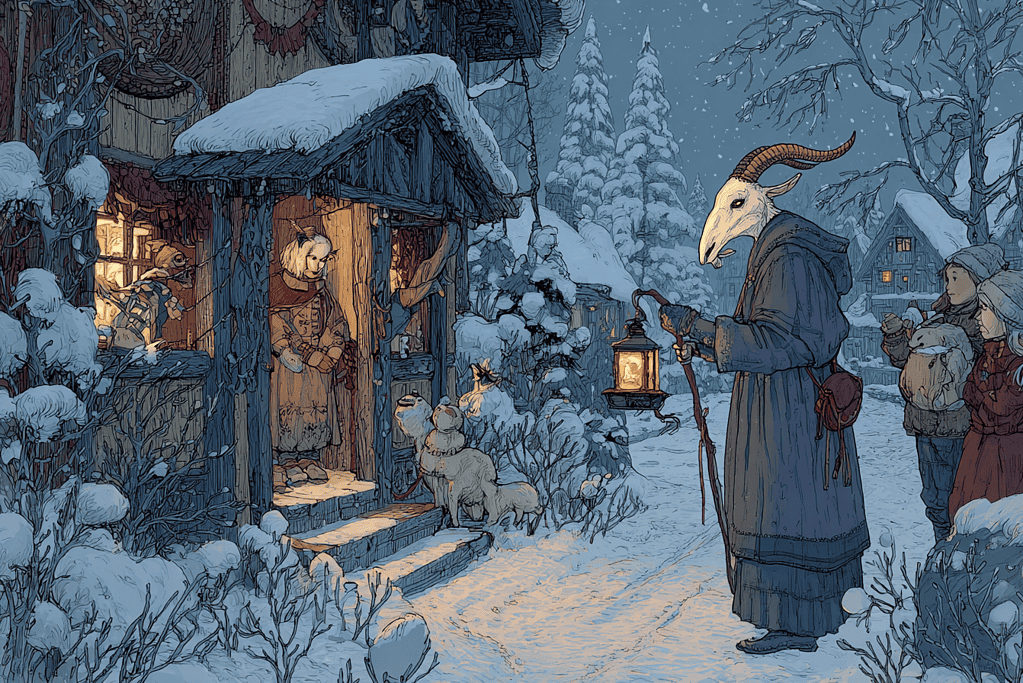
Pagan elements survived even after Christianity spread across Scandinavia. The Yule Goat became part of Christmas and New Year visits. Households in Sweden and Norway expected a goat to knock on the door.
The goat mask or carrying a goat-head effigy made the custom terrifying for children and amusing for adults. The Yule Goat demanded food instead of simply offering gifts.
Some stories say the goat would make loud noises, challenge the family, or frighten the youngest children. In some regions the goat would give gifts and then ask to be paid with ale or bread.
Over time the Yule Goat became a benevolent figure. The Yule Goat is a Scandinavian winter helper, no longer a frightening creature.
The goat would bring gifts to sleeping children and quietly disappear into the night. In modern culture this role passed to Santa Claus and to small Christmas elves.
Yet the goat survives as part of Christmas tradition as Santa in some Swedish stories, especially when the julbock pulls Santa’s sleigh.

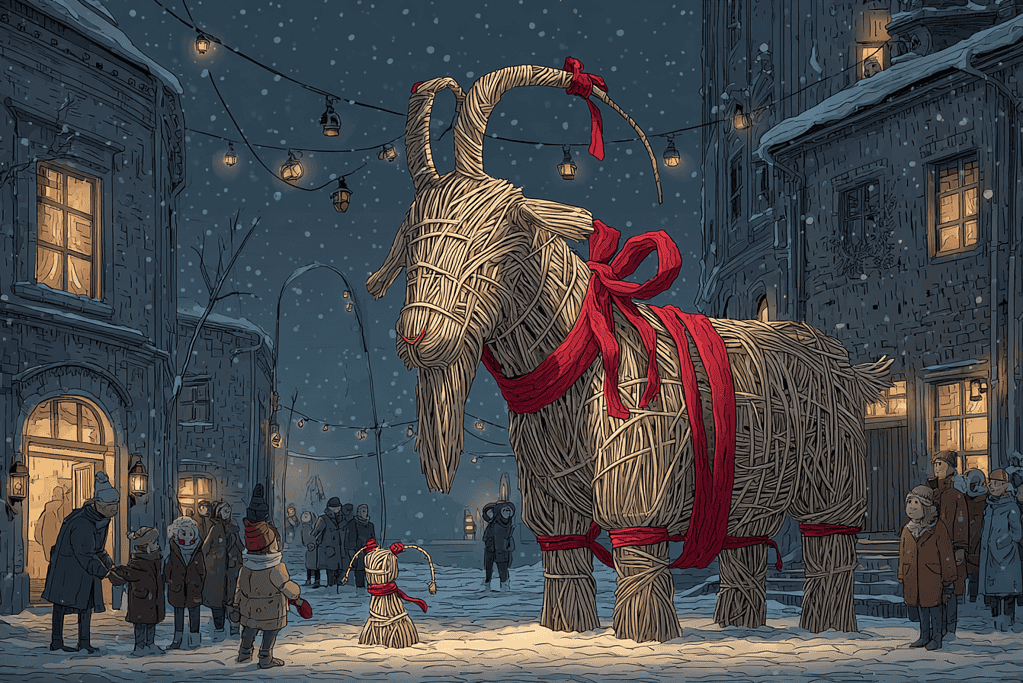
One version of the Yule Goat is made of straw and tied with red ribbon. This is one of the most iconic Christmas ornaments in Scandinavia.
Many homes in Sweden use a straw goat as a Christmas decoration next to the Christmas tree.
The straw goat is a memory of the last sheaf of grain saved for the Yule celebrations. This last sheaf was shaped into a goat that represented the spirit of the harvest.
The straw goat is also connected to the memory of the julebukk, when a man dressed as a goat went from house to house.
When modern Christmas traditions replaced the masked goat with Santa Claus, the goat remained as a sweet, silent symbol placed beneath the tree.
In this way, the goat became a Christmas ornament that keeps the memory of older Scandinavian celebrations.
Julebukking is a winter activity where performers go from house to house wearing masks, singing carols, or acting out small plays.
In older times the lead performer carried or wore a goat mask.
The group would go from house to house offering song, dance, or blessings in exchange for food or drink. This door to door custom survives mainly in rural areas.
Julebukking helped keep the Yule Goat alive as a character in living performance.
Even when the modern Santa Claus became popular, the goat remained at the center of julebukking.
This tradition shows that the Yule Goat is as much a part of Christmas tradition as Santa in some Scandinavian villages.
Early Christian writings did not treat the Yule Goat kindly. The goat was linked to pagan times and sometimes to dark and scary demonic imagery.
Some sermons described the Yule Goat as a demon who haunted the countryside.
This idea shifted over time. Instead of a demon, the goat became a trickster. Instead of a trickster, the goat became a gift-bringer.
The Yule Goat became a benevolent figure who brought presents rather than fear.
In some plays the goat would be symbolically killed and then return to life. The return reflects the seasonal rebirth that the sun does at Yule. Winter kills the year, and spring renews it.
One version of the Yule Goat prepared the family for the coming light. Even this version still kept the goat close to ancient pagan meanings.
The most famous modern goat is the Gävle Goat. Swedens Gävle Goat erected every year in the town of Gävle stands as one of the most recognizable symbols of Christmas in the country.
It is a giant Yule Goat made of straw. It was first built in 1966 and quickly became part of Christmas tradition. The Gävle Yule Goat is the world’s largest straw goat.
The Guinness Book of World Records recognizes it as a record holder.
The Gävle Goat has been destroyed many times. Vandals have set the goat on fire. In some years the goat has been burned before Christmas arrives.
Local residents often try to protect it so that it will make it to Christmas.
For many years the goat has been destroyed, yet the goat has also returned to life in the minds of the citizens.
Every winter the giant Yule Goat returns to life as a fresh statue.
The goat on fire becomes part of local folklore.
The returned statue proves that Gävle takes the history of the Yule Goat seriously.
The Yule Goat is part of Christmas tradition as Santa in a unique way. In older Swedish stories Santa Claus, or the tomten, rides on the Yule Goat.
The christmas goat often serves as Santa’s helper. Some modern illustrations of Scandinavian Christmas elves show the goat pulling a sleigh instead of reindeer.
The Yule Goat’s place beside Santa Claus shows how two traditions blended into one.
In this version of the legend, the Yule Goat is not symbolically killed. Instead, the goat became a benevolent companion who delivered gifts.
In many Swedish families the goat brings gifts to sleeping children on Christmas Eve.
This version of the Yule Goat became a benevolent and friendly winter character that children looked forward to meeting.
The Yule Goat is a Scandinavian tradition. Sweden, Norway, and parts of Finland share the julebukk custom. Julebukking remains alive in rural areas where door to door visiting continues. The goat mask continues to appear in winter plays.
The Christmas Goat appears on cards, gifts, and decorations. The Gävle Yule Goat is only one version of the Yule Goat statue. Many towns in Scandinavia build their own straw goats during the winter solstice.
Scandinavia has kept the tradition alive because it is part of Christmas time. The Yule Goat is as much a part of Christmas tradition as Santa in these countries.
Even when the holiday becomes more modern, the goat remains because it is a powerful cultural memory.
The history of the Yule Goat shows a character who changed repeatedly. The goat would bring gifts. The goat would demand food. The goat would frighten children.
The goat would make jokes. The goat became a Christmas ornament made of straw.
The goat became a giant Yule Goat statue. The Yule Goat as a demon no longer survives. The benevolent goat remains.
The history of the Yule Goat proves how old pagan times can survive inside modern winter customs.
The Yule Goat is a Scandinavian tradition that never disappeared. It changed shape and changed meaning, but it remained a winter visitor.
It is still part of Scandinavian history and part of Christmas celebration.
Cyriax, A. K. (1923). Swedish Christmas Customs. Folklore, 34(4), 314–321. Stable URL: https://www.jstor.org/stable/1256552
Walsh, M. W. (1997). Review of The Origins of Drama in Scandinavia by Terry Gunnell. Comparative Drama, 31(2), 304–309. Stable URL: https://www.jstor.org/stable/41153859
Weaver, S. (2020). Goats & People. In The Goat: A Natural and Cultural History (pp. [chapter pages]). Princeton University Press. Stable URL: https://www.jstor.org/stable/j.ctvxcrz9q.8

ᛉ 100% handcrafted artisan pagan , viking, witchcraft and shamanic inspired jewelry.
ᛉ Runes, Symbolism & European Folklore
Get 20% off👇🏻

Five witches dance around a blazing bonfire beneath a citrine cabochon in this Walpurgisnacht pendant....
Happy washing day 🙃
A few rings I’ve worked on the last couple days…
Freya’s cats rule and dogs drool?
Or was that the other way around? 🙃

Garm barely shows up in the old Norse stories.
Still… he leaves a mark.
A...
Leave a comment with your result ❤️
Bavarian Folklore says that you might just cross paths with a Wolpertinger in the alpine...

🐇🌲✨
He finally stepped out of the forest…
The Wolpertinger Pendant has arrived.
Inspired by...

I don’t often sell them, but love it when I do!
Vinca symbol bracelets ❤️...

Rooted in strength + guarded by ravens

The serpent waits 🖤
(Handcrafted Jörmungandr ring made to order in my shop)

Stay warm, everyone ❤️

😑😑😑🤮

I thought I had closed the book on the Alice in Wonderland rings…
But you...

Can this be over now, please?

In case you forgot 💜

Something I’ve been thinking about lately.
If there’s one thing I would’ve done differently early...

This year, we’re not buying things just to keep up.
If you need the reminder:...

My husband is from Bavaria (southern Germany) and I originally made this Krampus pendant for...

Some of the items I’m shipping out today ❤️
Please forgive my dirty nails 😂...

A few items shipping out today 🥰

This mornings rings shipping out ❤️

A few of the rjngs I’m shipping out this morning ❤️
How do you like...

Krampus is coming 🫶🏻

Getting ready to pack up these pretties and ship to their owners ❤️

Freya, cats and pentacles. Doesn’t get any better ❤️

You all got me going crazy making all these fairytale + storybook rings.
But I’ll...

Just launched these pretties ❤️
Size 9 amethyst ring + size 7.25 green kyanite

What would you trade to learn Baba Yaga’s secrets?

It *finally* looks, feels and smells like October!
And here are some items I’m packing...

This mornings pretties getting ready to ship :)

Getting ready to pack up these pretties and ship to their owners ❤️

You bet I’m hopping on this trend 😂
Thank you @shes_sinister for the prompt!

While I welcome the seasonal darkness…it sure is going to make my morning quick videos...

Finally finished the rings I’ve been working on in my stories ❤️
I think I...

Was going to post this update to my stories but it’s too long.

“How do you know I’m mad?” said Alice.
“You must be,” said the Cat, “or...

Some of this mornings orders getting ready to ship. Those little bats are so cute...

Here is the finished ring I was working on in my stories yesterday, along with...

A few of today’s orders shipping out this morning ❤️

The two silver raven rings I was working on in my stories yesterday.
…as well...

Eeeek! I’m so happy to add these to my shop ❤️
I’ve gotten so many...

I had 6 clamshells ready to ship this morning but I dropped and lost my...

Not the story you were told.
The girl didn’t run.
The wolf didn’t win.
This...

I love these raven rings so much 🖤
This mornings pretties shipping out.
All items...

Sleek + minimal Mjölnir ring ⚒️


About the author Jacqueline Fatica


