No products in the cart.
March 30, 2026 9:46 pm

Free USA shipping on orders $35+
March 30, 2026 9:46 pm
Few figures in Norse mythology are as intriguing as Skadi, a powerful huntress whose story moves between vengeance, marriage, and independence.
She appears only briefly in the surviving sources, yet the fragments preserved in medieval literature reveal a remarkably vivid character.
Skadi is remembered as a goddess of winter and skiing, a mountain-dwelling huntress, and a figure whose myth reflects the dramatic landscapes of the north.
Scholars have examined her story carefully, drawing on medieval texts, skaldic poetry, and comparative folklore to understand her place among the Norse gods and goddesses.
This article introduces the research surrounding Skadi and explains what we know about her from the sources.
While this article is not meant to be a research paper, it reflects the work of serious scholarship and draws on academic studies that illuminate the mythological world of the Viking Age.
By looking closely at the literary evidence, the cultural context, and the interpretations of modern scholars, we can better understand how Skadi is the goddess who stands at the crossroads between wilderness and divine society.
In the surviving texts of Norse mythology, Skadi appears as a striking and unusual figure.
She is a giantess, the daughter of the giant Thiazi, yet she becomes integrated among the Norse gods through a complicated myth involving vengeance and marriage.
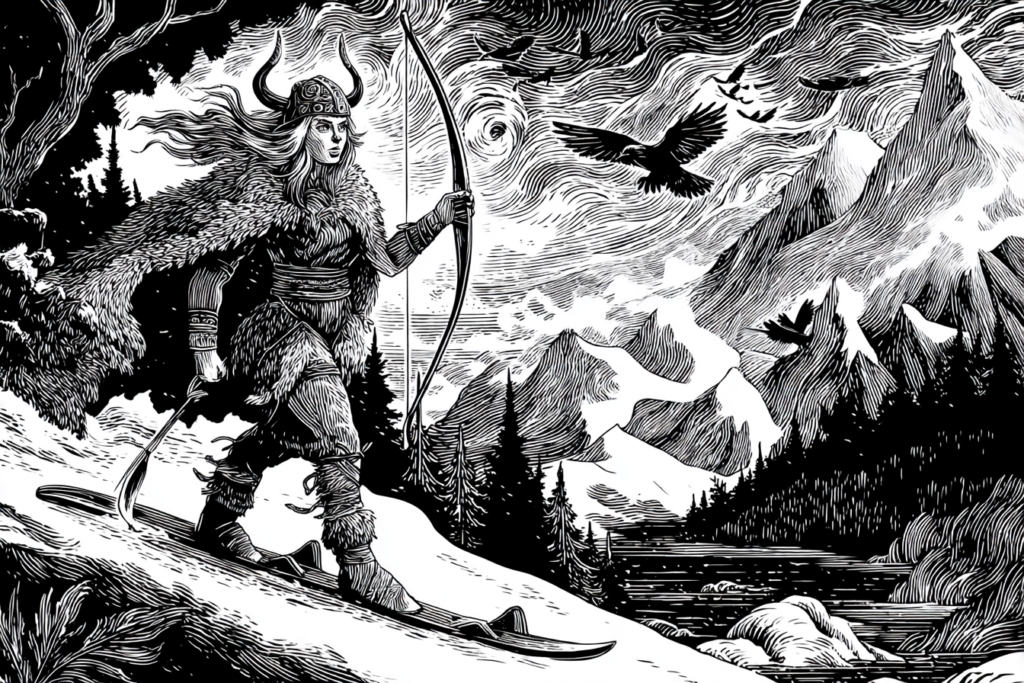
Medieval writers describe her as a powerful huntress who travels through the mountains with bow and arrow, moving across the snow on skis.
These attributes have led scholars to describe her as a snowshoe goddess closely tied to the northern wilderness.
The earliest surviving narratives portray her as a woman who crosses the boundary between the world of the gods and giants.
According to Snorri Sturluson’s Prose Edda, Skadi is the daughter of Thiazi, a giant who was killed by the gods after abducting the goddess of youth, Idun.
When news of her father’s death reached her, Skadi armed herself for vengeance and journeyed toward the divine realm (Sprenkle, 2020, p. 27).
Her story begins not as a passive figure but as a warrior who challenges the divine order.
Scholars frequently emphasize that Skadi is a Norse goddess whose identity combines elements of wilderness, hunting, and independence.
Davidson describes her as a figure strongly connected to the northern environment, especially the rugged terrain of mountains and forests where hunting and skiing were essential skills (Davidson, 1993, p. 61).
Her myth therefore reflects the environmental realities of ancient Norse culture.
Our knowledge of Skadi comes mainly from medieval Icelandic texts written in the thirteenth century.
These include the Poetic Edda, the Prose Edda, and scattered references in skaldic poetry.
While these texts were recorded centuries after the Viking Age, scholars generally believe they preserve much older traditions of the Scandinavian world, however, viewed through a Christian lens.
The most detailed account of Skadi appears in Snorri Sturluson’s Prose Edda.
In this narrative, Skadi came to Asgard, the home of the gods, determined to avenge the death of her father.
The story unfolds through a series of negotiations between Skadi and the divine assembly, revealing how myth often reflects social patterns such as reconciliation.
Sprenkle notes that the episode mirrors real practices of medieval Iceland, where disputes were resolved through compensation rather than endless cycles of revenge (Sprenkle, 2020, p. 29).
Additional references to Skadi appear in skaldic poetry, where she is described using kennings that emphasize her association with skiing.
Davidson observes that early poems refer to her as a divinity of skis, suggesting that this connection was already established in early mythic tradition (Davidson, 1993, p. 61).
These poetic fragments help confirm that Skadi’s identity was tied to the winter landscape long before the myths were written down.
The central turning point in Skadi’s story begins with her father. The giant Thiazi, one of the enemies of the gods, had kidnapped Idun, the keeper of the apples of youth.
When the gods rescued Idun, Thiazi was killed in the ensuing conflict.
According to the myth, Skadi came to Asgard wearing armor and carrying weapons, intending to avenge (Sprenkle, 2020, p. 27).
Her arrival highlights an important aspect of early Scandinavian society.
When a family member died, relatives were expected to demand compensation. Sprenkle explains that Skadi’s behavior reflects this cultural framework.
As the only surviving heir of Thiazi, she steps into the role normally played by a son who would defend family honor (Sprenkle, 2020, p. 31).
Faced with a potentially dangerous conflict, the Norse gods sought a diplomatic solution.
Rather than fighting the warrior giantess, gods offered Skadi a settlement that would prevent further harm. This negotiation lies at the heart of the myth.
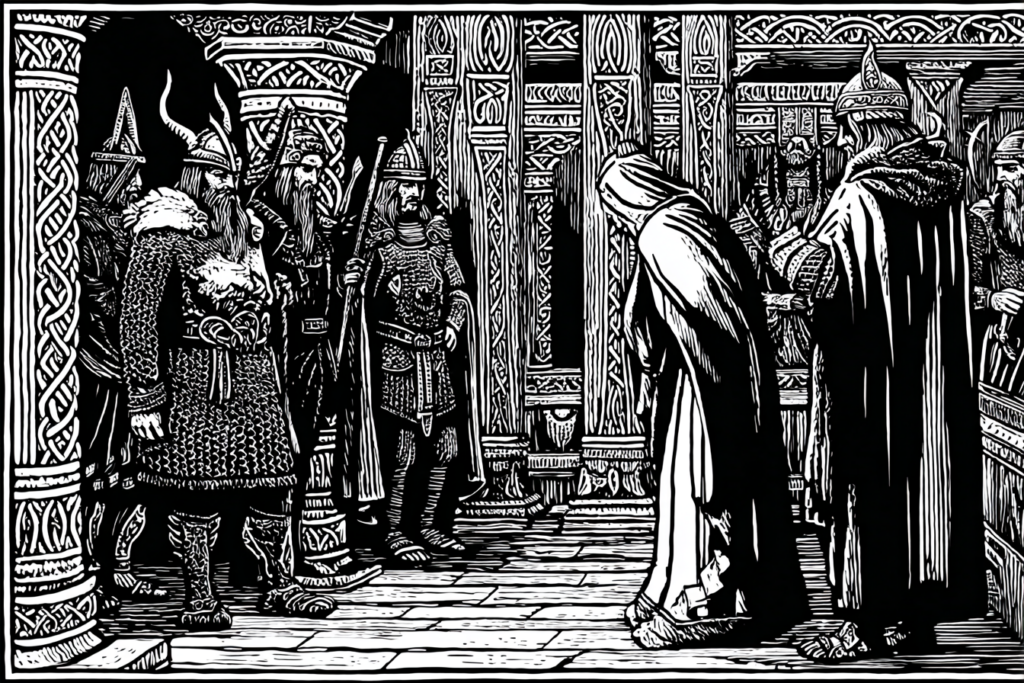
The gods proposed an unusual settlement. Instead of more conflict, they offered Skadi a compensation for her father’s death.
One part of this settlement allowed her to choose a husband from among the divine assembly.
However, there was a strange condition. She had to choose a husband from among the gods by looking only at their feet.
This strange contest has fascinated scholars for generations. The myth tells us that Skadi hoped to choose Baldr, the most handsome of the gods.
She believed that the most beautiful feet must belong to him.
Yet when she made her choice, she discovered that the feet actually belonged to Njord, the sea god (Sprenkle, 2020, p. 28).
This episode is both humorous and symbolic. It shows how myth often plays with expectations and misunderstandings.
The choice also reflects the mythological theme of compromise between gods and giants, where conflict is resolved through marriage alliances rather than warfare.
The marriage between Skadi and god Njord quickly proved difficult. Although the two were now united as husband and wife, they belonged to completely different worlds.
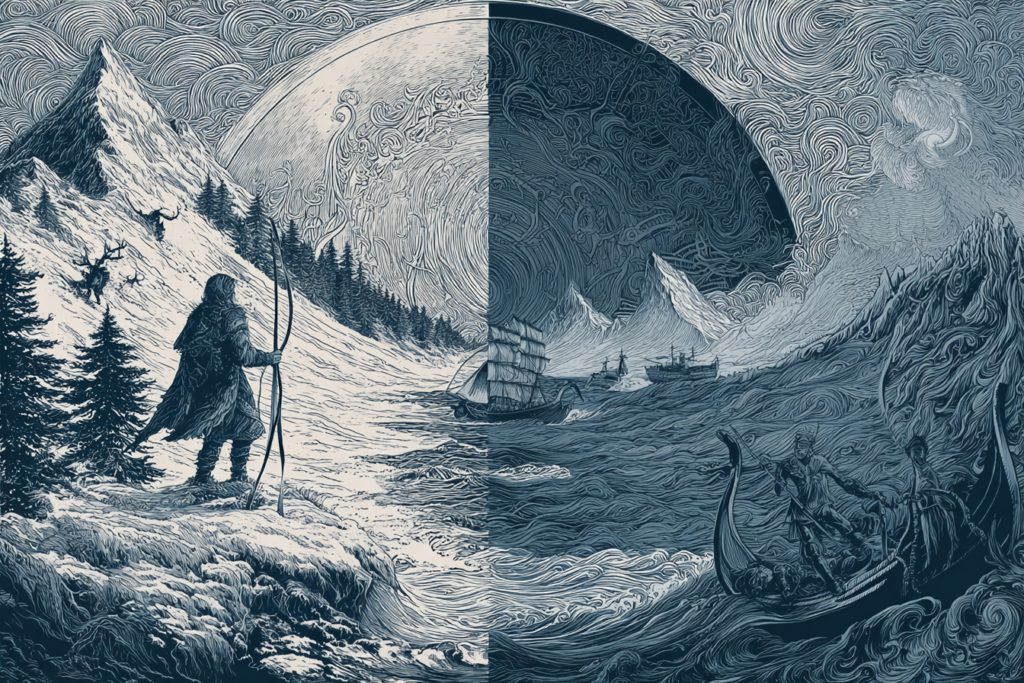
Njord was a god of the sea, associated with ships and coastal prosperity. Skadi, by contrast, was a mountain hunter who thrived in the snowy wilderness.
The myth vividly describes their disagreement about where to live. Skadi preferred Thrymheim, the mountain hall inherited from her father, while Njord longed for the sound of waves along the coast.
They tried to compromise by spending nine nights in each location. Yet the arrangement failed because each despised the other’s environment (Sprenkle, 2020, p. 28).
Eventually the couple separated. Njord returned to the sea, while Skadi returned to Thrymheim, where she resumed her life in the mountains.
The story illustrates the contrast between sea and the mountains, two environments that shaped the lives of the Norse people.
Among all the gods and goddesses of Norse mythology, Skadi stands out because of her strong association with winter.
Medieval texts describe her traveling across snow-covered landscapes on skis and hunting animals with bow and arrow.
Davidson cites the passage in which Snorri writes that she travels “much on skis” and shoots wild beasts (Davidson, 1993, p. 61).
This imagery connects Skadi with the harsh realities of northern life. In the far north, winter travel required specialized equipment such as skis or snowshoes.
Hunting during the harsh winter months was essential for survival.
As a result, Skadi embodies the traditions of hunting and skiing that were central to northern cultures.
Motz notes that such myths likely reflect real environmental practices in northern Eurasia, where snow made it easier to track animals during winter hunts (Motz, 1984, p. 160).
In this sense, Skadi can be understood as a goddess associated with the rhythms of the natural world.
Scholars often compare Skadi and Ullr, another deity linked to winter landscapes.
Both figures appear connected with skiing and hunting, suggesting that they may have belonged to a similar religious tradition.
Motz even refers to them collectively as “snow-shoe gods” because of their association with winter travel (Motz, 1984, p. 160).
The relationship between Skadi and Ullr remains uncertain.
Some researchers believe they may represent parallel cult traditions in northern regions, where winter survival depended heavily on hunting.
Others suggest that they reflect older mythological patterns tied to wilderness spirits.
What is clear is that both deities share an association with winter and mountains, reinforcing the importance of the natural environment in Norse mythology.
Another memorable moment in Skadi’s myth involves Loki, the infamous trickster god.
As part of the settlement with Skadi, the gods promised to make her laugh, even though she was grieving for her father.
Loki accomplished this by tying a rope between his body and a goat in a ridiculous contest that eventually caused him to collapse into Skadi’s lap (Sprenkle, 2020, p. 39).
This bizarre episode illustrates the unpredictable character of Loki.
Scholars often interpret the scene as a mythological motif in which humor breaks the tension of grief. Clunies Ross has suggested that such moments restore balance after tragedy (Sprenkle, 2020, p. 39).
The story also highlights how myth blends comedy with cosmic drama.
Even in the presence of mourning and vengeance, the unpredictable actions of the trickster god shift the tone of the narrative.
Modern scholarship has paid close attention to Skadi’s role as a figure who challenges traditional occupation expectations.
Sprenkle argues that Skadi’s narrative demonstrates how such roles could be flexible in medieval Scandinavian literature.
She begins as an avenger acting like a warrior son, then becomes a wife, and finally returns to an independent life as a landholder (Sprenkle, 2020, p. 38).
The myth therefore portrays Skadi as a figure who moves between different social roles rather than remaining confined to one occupation.
Direct evidence for the worship of Skadi is limited.
Yet scholars believe she likely held religious significance. One clue appears in the poem Lokasenna, where Loki refers to Skadi’s sacred places.
Davidson suggests that this passage may indicate that she once had cult sites or sanctuaries (Davidson, 1993, p. 61).
Researchers have also explored possible place names connected to Skadi, although the evidence remains uncertain.
Even so, the literary sources strongly imply that she was considered an important deity within the mythological tradition.
Her connection with winter and mountains may reflect the worldview of northern hunting societies, where survival depended on understanding the harsh landscape.
Davidson, H. R. E. (1988). Myths and symbols in pagan Europe: Early Scandinavian and Celtic religions. Syracuse University Press.
Davidson, H. R. E. (1993). The lost beliefs of Northern Europe. Routledge.
Jacobs, M. A. (2014). Hon stóð ok starði: Vision, love, and gender in Gunnlaugs saga ormstungu. Scandinavian Studies, 86(2), 148–168.
Larsen, E. G. (1989). Language and early literature. The Year’s Work in Modern Language Studies, 51, 877–885.
Motz, L. (1984). The winter goddess: Percht, Holda, and related figures. Folklore, 95(2), 151–166.
Snorri Sturluson. (1995). Edda (A. Faulkes, Trans.). Everyman.
Sprenkle, A. (2020). Negotiating gender in Snorri’s Edda: A reading of the Skaði episodes. Journal of English and Germanic Philology, 119(1), 27–41.

ᛉ 100% handcrafted artisan pagan , viking, witchcraft and shamanic inspired jewelry.
ᛉ Runes, Symbolism & European Folklore
Get 20% off👇🏻
Happy washing day 🙃
A few rings I’ve worked on the last couple days…
Freya’s cats rule and dogs drool?
Or was that the other way around? 🙃

Garm barely shows up in the old Norse stories.
Still… he leaves a mark.
A...
Leave a comment with your result ❤️
Bavarian Folklore says that you might just cross paths with a Wolpertinger in the alpine...

🐇🌲✨
He finally stepped out of the forest…
The Wolpertinger Pendant has arrived.
Inspired by...

I don’t often sell them, but love it when I do!
Vinca symbol bracelets ❤️...

Rooted in strength + guarded by ravens

The serpent waits 🖤
(Handcrafted Jörmungandr ring made to order in my shop)

Stay warm, everyone ❤️

😑😑😑🤮

I thought I had closed the book on the Alice in Wonderland rings…
But you...

Can this be over now, please?

In case you forgot 💜

Something I’ve been thinking about lately.
If there’s one thing I would’ve done differently early...

This year, we’re not buying things just to keep up.
If you need the reminder:...

My husband is from Bavaria (southern Germany) and I originally made this Krampus pendant for...

Some of the items I’m shipping out today ❤️
Please forgive my dirty nails 😂...

A few items shipping out today 🥰

This mornings rings shipping out ❤️

A few of the rjngs I’m shipping out this morning ❤️
How do you like...

Krampus is coming 🫶🏻

Getting ready to pack up these pretties and ship to their owners ❤️

Freya, cats and pentacles. Doesn’t get any better ❤️

You all got me going crazy making all these fairytale + storybook rings.
But I’ll...

Just launched these pretties ❤️
Size 9 amethyst ring + size 7.25 green kyanite

What would you trade to learn Baba Yaga’s secrets?

It *finally* looks, feels and smells like October!
And here are some items I’m packing...

This mornings pretties getting ready to ship :)

Getting ready to pack up these pretties and ship to their owners ❤️

You bet I’m hopping on this trend 😂
Thank you @shes_sinister for the prompt!

While I welcome the seasonal darkness…it sure is going to make my morning quick videos...

Finally finished the rings I’ve been working on in my stories ❤️
I think I...

Was going to post this update to my stories but it’s too long.

“How do you know I’m mad?” said Alice.
“You must be,” said the Cat, “or...

Some of this mornings orders getting ready to ship. Those little bats are so cute...

Here is the finished ring I was working on in my stories yesterday, along with...

A few of today’s orders shipping out this morning ❤️

The two silver raven rings I was working on in my stories yesterday.
…as well...

Eeeek! I’m so happy to add these to my shop ❤️
I’ve gotten so many...

I had 6 clamshells ready to ship this morning but I dropped and lost my...

Not the story you were told.
The girl didn’t run.
The wolf didn’t win.
This...

I love these raven rings so much 🖤
This mornings pretties shipping out.
All items...

Sleek + minimal Mjölnir ring ⚒️

Today’s orders getting ready to ship.
…And I finally got some time to work on...


About the author Jacqueline Fatica


