No products in the cart.
February 26, 2026 7:39 pm

Free USA shipping on orders $35+
February 26, 2026 7:39 pm
Járnsaxa, also known as Saxa, is one of the most intriguing yet lesser-known characters in Norse mythology.
She appears briefly in the oldest texts of Norse culture, yet her influence reaches into the survival of the gods themselves.
As the giantess consort of Thor and the mother to Magni, she represents the powerful union between the Aesir gods and the primordial giants known as jotuns.
Her presence reveals how divine strength was transmitted across generations and preserved beyond the Norse destruction of the world called Ragnarök.
Understanding Járnsaxa helps illuminate the deeper genealogical structure of Norse mythology, where gods and giants were not strictly enemies but ancestral partners.
Through her son, she becomes part of the continuation of the divine order after Ragnarök, making her role far more significant than her brief appearances suggest.
Járnsaxa is a figure in Norse mythology identified as a giantess and consort of Thor, the thunder god and defender of the Aesir.
Her name appears in the Prose Edda, written by Snorri Sturluson, where she is identified as the mother of Thor’s son Magni.
Though she appears only briefly, her role in Norse myth is essential for understanding the transmission of divine strength.
Unlike major goddesses such as Frigg or the goddess Sif, Járnsaxa does not play a central narrative role.
Instead, she represents the genealogical link between the primordial giants and the gods.
She belongs to the jotuns, the ancient race inhabiting Jötunheimr, otherwise also known as the home of the giants.
These beings were older than the gods themselves and represented the elemental forces from which the cosmos emerged.
Her identity as giantess Jarnsaxa demonstrates how divine strength originated partly from the giants.
Scholars have noted that the gods themselves descended from giants, and unions between the Aesir and giantesses were essential to the continuation of divine lineage (Motz, 1982, p. 75).

Járnsaxa was the lover of Thor, the thunder god who protected the gods and humanity.
Thor and the mother of Magni formed a union that represented the integration of divine and primordial strength.
Although Thor’s official wife is Sif, the goddess of fertility, he had relationships with other giantesses, including Járnsaxa.
Thor’s relationship with Járnsaxa reflects the complex interaction between the Aesir gods and the jotuns.
These relationships were not always hostile.
Instead, they often served genealogical purposes, producing offspring who would inherit essential qualities such as strength and endurance.
Thor’s aspect as a thunder god emphasizes his role as a protector and warrior, but his unions with giantesses reveal his connection to the primordial forces of creation.
This relationship with Thor illustrates the mythological structure in which divine strength is reinforced through giant ancestry.
Járnsaxa’s most important role in Norse mythology is as the mother of Magni, whose name means “strength.”
Magni is the son of Thor and Járnsaxa, and he inherited immense physical power from both parents.
In one of the most famous myths, Thor kills the giant Hrungnir, but the giant falls on him, trapping him beneath his enormous body.
None of the gods could free Thor until Magni arrived. Even as a child, Magni lifted Hrungnir’s corpse and rescued his father.
Thor rewarded him by giving Gullfaxi, the splendid horse Gullfaxi to Magni, demonstrating his recognition of his son’s strength (McKinnell, 2014, p. 167).
This act confirms Járnsaxa’s importance as the mother of Thor’s sons and shows how divine strength was transmitted through her lineage.
Magni and Modi would later survive Ragnarök, ensuring the continuation of the Aesir in Ragnarök and the renewal of divine order.
The Eddas, including Snorri Sturluson’s Prose Edda and references preserved in the Poetic Edda, confirm that Járnsaxa was Thor’s consort and the mother of Magni.
These texts are among the oldest texts of Norse culture and preserve the mythological knowledge of the Germanic tribes and Viking Age Scandinavia.
Snorri describes Magni as the son of Thor and Járnsaxa, confirming her genealogical role. These sources establish her identity clearly within Norse mythological tradition.
The prose edda preserves the myth of Hrungnir, where Magni frees Thor, demonstrating the inherited strength of the son of Thor and Járnsaxa.
These stories confirm her importance in maintaining divine continuity.

Járnsaxa represents the integration between the Aesir and the jotuns, showing that the gods and giants were genealogically connected.
The jotuns were primordial beings associated with the creation of the world, and many gods descended from them.
This connection explains how divine strength originated. Odin himself, the son of Odin’s giant ancestry, inherited wisdom and power through his maternal lineage.
Similarly, Thor inherited strength from his giantess mother Jörð, and Magni inherited strength from Járnsaxa.
This genealogical structure demonstrates that giant ancestry was essential to the continuation of divine power.
The name Járnsaxa comes from Old Norse and means “iron dagger.”
The word járn means iron, and sax means blade or knife.
This meaning reflects her symbolic association with strength, endurance, and destructive power.
Scholars interpret her name as representing iron-hard strength, reflecting her role in transmitting power to her son.
This interpretation aligns with early academic scholarship describing her as iron-like in nature (Montelius & Lindberg, 1869, p. 451).
Her name emphasizes her mythological function as a transmitter of strength into divine lineage.
Járnsaxa was a giantess rather than a goddess, but her union with Thor placed her within the divine genealogical framework.
Giantesses often served as mothers of divine offspring, contributing essential qualities to the next generation.
Unlike major goddesses such as Freyja or the goddess of the sea associated with Aegir and Ran, Járnsaxa’s role was primarily genealogical rather than narrative.
Her classification as a jotun confirms her position within the primordial cosmic order.
Járnsaxa belongs to the broader genealogical network connecting the gods and giants.
Odin himself descended from giant ancestry, and Heimdall was born from the nine mothers, demonstrating similar genealogical complexity.
The aesir god Heimdall and his mysterious nine mothers show how divine beings often emerged from unusual maternal origins.
These mythological patterns demonstrate that maternal lineage played a crucial role in divine continuity.

Járnsaxa’s son Magni survives Ragnarök, the Norse apocalypse. Along with his brother Modi, he helps rebuild the world after its destruction.
Magni and Modi inherit Thor’s hammer and continue the divine lineage. This makes Járnsaxa part of the survival mechanism of the gods themselves.
Her role ensures that divine strength continues beyond Ragnarök.
Járnsaxa is one of the lesser-known mythological characters, yet her importance lies in her genealogical role. She ensured the continuation of divine strength through her son Magni.
Her presence reflects the deeper cosmological structure of Norse mythology, where divine power originated from giant ancestry.
She represents the integration of primordial and divine forces.
McKinnell, J. (2014). The paradox of Vafþrúðnismál. In D. Kick & J. D. Shafer (Eds.), Essays on Eddic poetry (pp. 154–171). University of Toronto Press.
Montelius, O., & Lindberg, C. F. (1869). Remains from the Iron Age of Scandinavia. Zeitschrift für Ethnologie, 1, 450–478. https://www.jstor.org/stable/23028765
Morcom, T. (2020). Insult and insight: Skarpheðinn’s performance at the Alþingi. Viking and Medieval Scandinavia, 16, 157–180. https://www.jstor.org/stable/48841702
Motz, L. (1982). Giants in folklore and mythology: A new approach. Folklore, 93(1), 70–84. https://www.jstor.org/stable/1260141
Thompson, C. W. (1970). Review of Runestudier and Runerne på Rökstenen by Niels Åge Nielsen. Scandinavian Studies, 42(2), 200–206. https://www.jstor.org/stable/40917063

ᛉ 100% handcrafted artisan pagan , viking, witchcraft and shamanic inspired jewelry.
ᛉ Runes, Symbolism & European Folklore
Get 20% off👇🏻

Five witches dance around a blazing bonfire beneath a citrine cabochon in this Walpurgisnacht pendant....
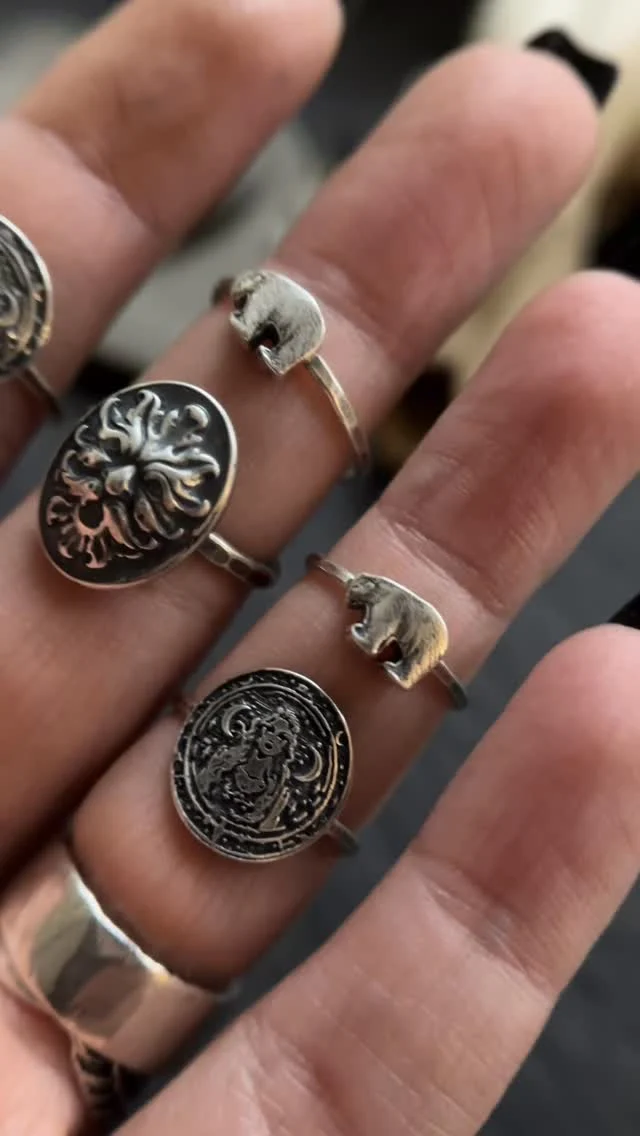
Happy washing day 🙃
A few rings I’ve worked on the last couple days…
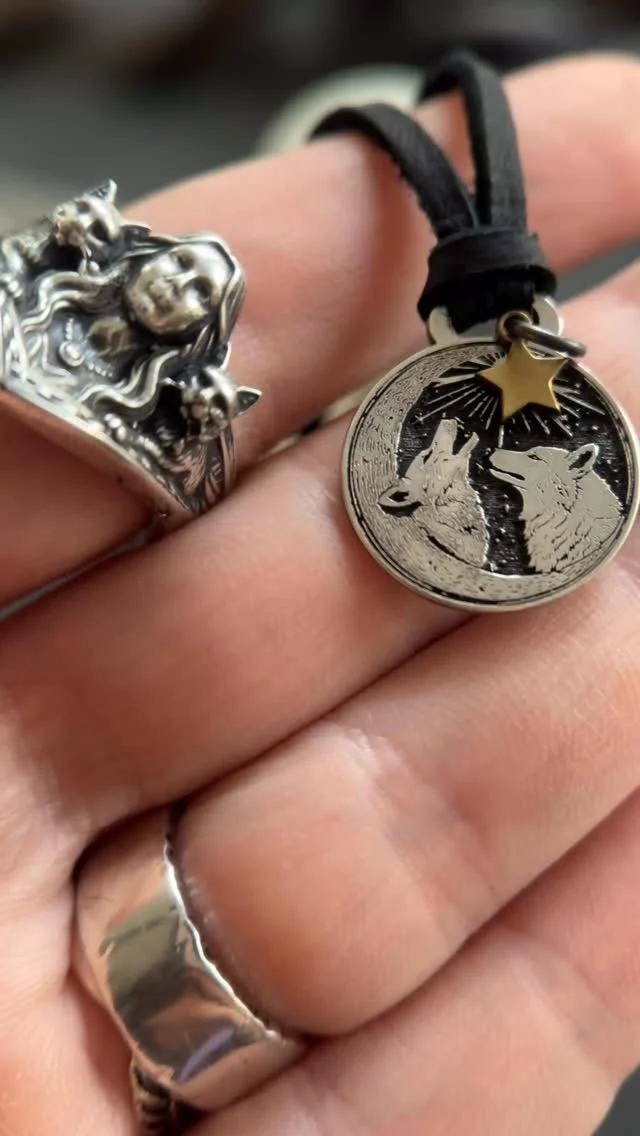
Freya’s cats rule and dogs drool?
Or was that the other way around? 🙃

Garm barely shows up in the old Norse stories.
Still… he leaves a mark.
A...
Leave a comment with your result ❤️
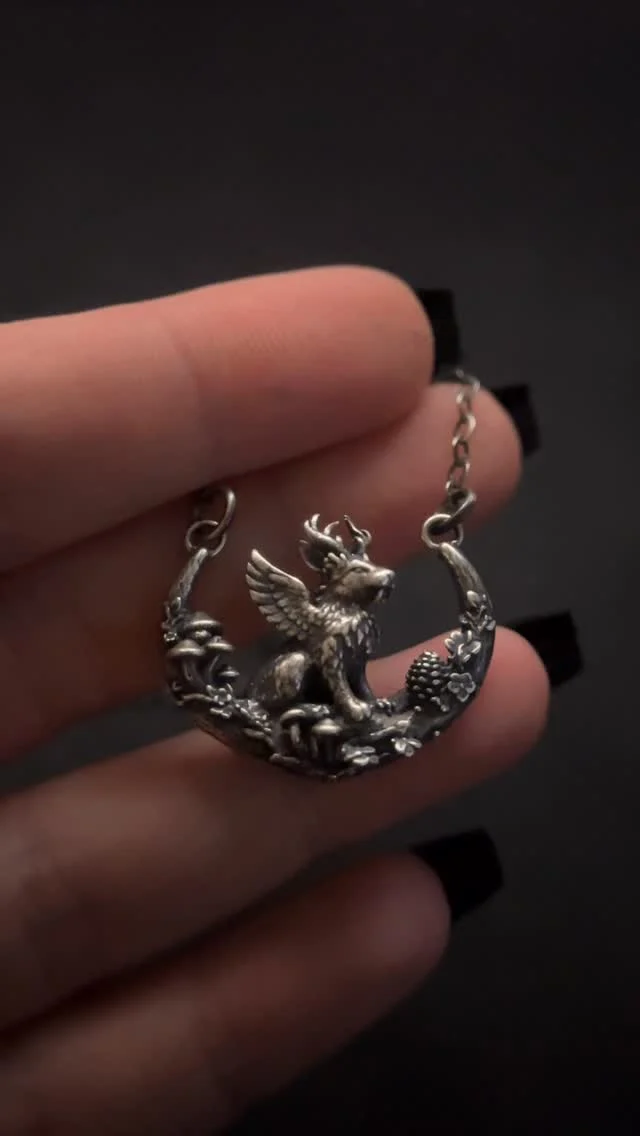
Bavarian Folklore says that you might just cross paths with a Wolpertinger in the alpine...

🐇🌲✨
He finally stepped out of the forest…
The Wolpertinger Pendant has arrived.
Inspired by...

I don’t often sell them, but love it when I do!
Vinca symbol bracelets ❤️...

Rooted in strength + guarded by ravens

The serpent waits 🖤
(Handcrafted Jörmungandr ring made to order in my shop)

Stay warm, everyone ❤️

😑😑😑🤮

I thought I had closed the book on the Alice in Wonderland rings…
But you...

Can this be over now, please?

In case you forgot 💜

Something I’ve been thinking about lately.
If there’s one thing I would’ve done differently early...

This year, we’re not buying things just to keep up.
If you need the reminder:...

My husband is from Bavaria (southern Germany) and I originally made this Krampus pendant for...

Some of the items I’m shipping out today ❤️
Please forgive my dirty nails 😂...

A few items shipping out today 🥰

This mornings rings shipping out ❤️

A few of the rjngs I’m shipping out this morning ❤️
How do you like...

Krampus is coming 🫶🏻

Getting ready to pack up these pretties and ship to their owners ❤️

Freya, cats and pentacles. Doesn’t get any better ❤️

You all got me going crazy making all these fairytale + storybook rings.
But I’ll...

Just launched these pretties ❤️
Size 9 amethyst ring + size 7.25 green kyanite

What would you trade to learn Baba Yaga’s secrets?

It *finally* looks, feels and smells like October!
And here are some items I’m packing...

This mornings pretties getting ready to ship :)

Getting ready to pack up these pretties and ship to their owners ❤️

You bet I’m hopping on this trend 😂
Thank you @shes_sinister for the prompt!

While I welcome the seasonal darkness…it sure is going to make my morning quick videos...

Finally finished the rings I’ve been working on in my stories ❤️
I think I...

Was going to post this update to my stories but it’s too long.

“How do you know I’m mad?” said Alice.
“You must be,” said the Cat, “or...

Some of this mornings orders getting ready to ship. Those little bats are so cute...

Here is the finished ring I was working on in my stories yesterday, along with...

A few of today’s orders shipping out this morning ❤️

The two silver raven rings I was working on in my stories yesterday.
…as well...

Eeeek! I’m so happy to add these to my shop ❤️
I’ve gotten so many...

I had 6 clamshells ready to ship this morning but I dropped and lost my...

Not the story you were told.
The girl didn’t run.
The wolf didn’t win.
This...

I love these raven rings so much 🖤
This mornings pretties shipping out.
All items...

Sleek + minimal Mjölnir ring ⚒️


About the author Jacqueline Fatica


