No products in the cart.
March 1, 2026 7:49 pm

Free USA shipping on orders $35+
March 1, 2026 7:49 pm
In discussions of Norse runes today, much of the conversation is dominated by modern interpretations, however, if we instead open the pages of academic research, the questions and answers regarding rune magic looks very different:
Did rune magic actually exist for the Germanic and Norse peoples, and if so, what form did it take?
Philologists, runologists, and historians have examined inscriptions, artifacts, and sagas to address this question. The answer is complex.
There is evidence that runes could be used for magic work, but their use was rooted in the worldview of early Germanic people, and not in the ideologies, philosophical or political systems imagined or established centuries later.
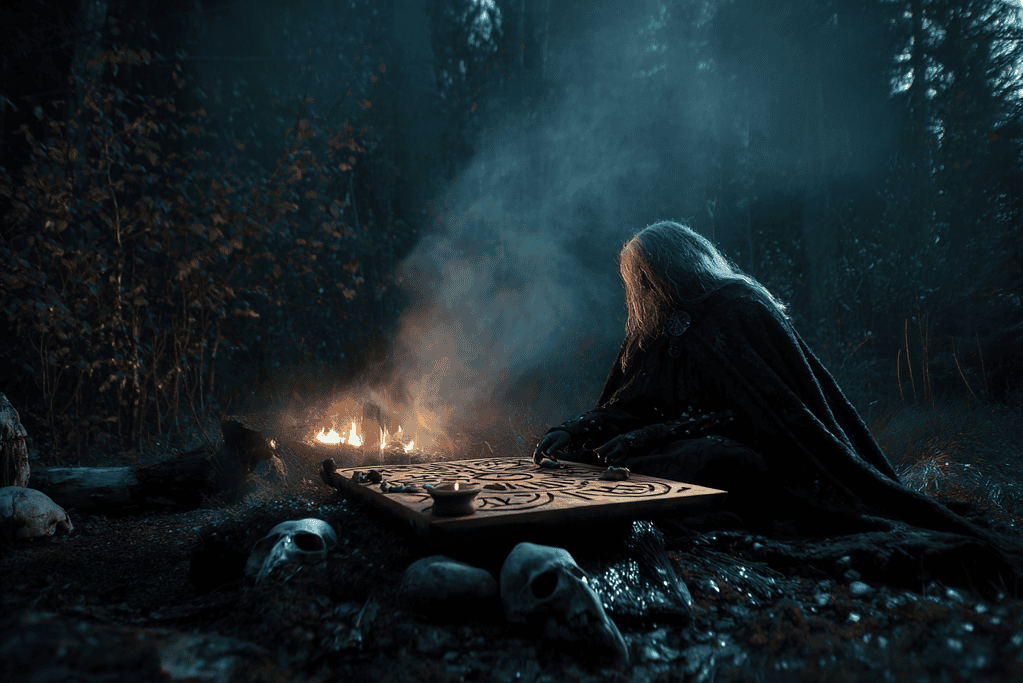
The word rune means “mystery” or “secret” in Proto-Germanic (rūnō) and is attested in multiple early Germanic languages (Düwel, 2004, p. 193).
This term carried connotations of hidden knowledge, whether in the form of writing systems, private counsel, or magical symbols.
The runic alphabet, known in its earliest form as the Elder Futhark consisted of 24 runes and developed by around the second century CE (Hempl, 1899, p. 370).
From the beginning, runes were more than a practical writing system.
In some inscriptions, they appear to have been carved with runes to create effects beyond communication and possibly invoking protection, harm, healing, or victory.
One of the most significant modern academic treatments is Mindy MacLeod and Bernard Mees’ Runic Amulets and Magic Objects (2006).
This work systematically categorizes archaeological finds such as amulets, rune stones, and inscriptions that might be connected to magic applications.
They note that while not all runic inscriptions are magical, a subset clearly fits the category through formulaic phrases, ritual context, or deliberate magical intent (MacLeod & Mees, 2006, p. 10).
Earlier, Ralph W. V. Elliott’s 1957 paper “Runes, Yews, and Magic” in Speculum explored the connection between the yew tree, and the carving of runes, especially on wooden staves and amulets.
Elliott’s philological approach reinforced the idea that runes were occasionally integrated into ritual or spell work, but stressed the need to interpret these uses in the context of Old Norse culture, not through later romanticized frameworks (Elliott, 1957, p. 250).
According to Professor Klaus Düwel in Early Germanic Literature and Culture, the Germanic people who first developed the runic system were already using writing for purposes that could cross into magical practice, though the evidence is fragmentary (Düwel, 2004, p. 195).
The earliest inscriptions are often short and enigmatic single words or names, like the famous runic inscription “alu.”
The term “alu” appears repeatedly on bracteates, spearheads, and other objects across Scandinavia.
While its exact translation remains debated, many scholars agree it likely functioned as a magical word, perhaps invoking luck, protection, or divine favor (MacLeod & Mees, 2006, p. 25).
Such examples suggest that runes could be used by the Vikings and their predecessors in a way that blended symbolic meaning with ritual intent.

MacLeod and Mees highlight several repeated terms across runic inscriptions that scholars interpret as magical.
Alongside “alu,” words like laþu, laukaʀ (“leek”), and gibu auja (“I give luck”) appear in contexts that suggest blessings, charms, or talismans (MacLeod & Mees, 2006, pp. 33–38).
These inscriptions are often on portable objects such as amulets, rings, or tools, anything which could be carried by individuals as protection.
The idea that runes were used for spells is supported by their appearance in Old Norse literature.
The chapter “Healing Charms and Leechcraft” in MacLeod and Mees’ study gives some of the clearest evidence that runes could be used for healing.
In several examples, runes were carved onto sticks or bones, then placed on or near the patient, sometimes in conjunction with spoken charms.
This is described in Egil’s Saga, where the protagonist Egil erases harmful runes carved by someone else and carves new runes to restore health, an act showing that rune means could be both beneficial and dangerous depending on the carver’s skill (MacLeod & Mees, 2006, p. 100).
These healing inscriptions blur the line between medicine and magic.
As Elliott (1957) notes, in the Viking Age and medieval Scandinavia, healing often combined herbal remedies with magical words, making it difficult to separate the two categories (p. 255).
Runes were not only used for blessings and healing, however, they could also curse.
In the chapter “Rune-stones, Death and Curses,” MacLeod and Mees discuss inscriptions on runestones that include threats against anyone who would deface or move them (2006, p. 140).
These curses often invoke supernatural retribution, promising illness, misfortune, or even death.
Some scholars interpret these as legal deterrents with magical overtones, but their wording often invokes norse gods or otherworldly forces.
This suggests that runes in magical contexts could serve both protective and aggressive purposes.
The “Pagan Ritual Items” chapter is less directly connected to rune magic, but it helps establish the cultural environment in which runes were used.
Many ritual items, such as weapons, staffs, and amulets, carried runic inscriptions that may have been part of ceremonial practice.
The placement of runes on these items suggests that they were believed to imbue the object with magical powers or symbolic meaning (MacLeod & Mees, 2006, p. 122).

In norse mythology, Odin discovers the runes by hanging on the world tree Yggdrasil for nine nights, pierced by a spear, sacrificing himself to himself in exchange for hidden knowledge (Hávamál, stanzas 138–139).
This mythic origin links the runes to the god Tyr and other divine figures, embedding them deeply into the Norse mythic imagination.
While this story is mythological, it reflects the cultural belief that runes were a gift from the gods, indeed, powerful tools that could be used for magic in the right hands.
The idea of using runes for structured rune divination such as in drawing lots and reading their meaning comes mostly from later medieval and post-medieval traditions, including the Icelandic magical grimoires, rather than from the period when the Elder Futhark or Younger Futhark were in everyday use.
Across these studies, the consensus is cautious but clear:
The power of the runes in early Scandinavia lay in their integration into a broader magical practice, where writing, symbol, spoken word, and object came together in a single act.
Düwel, K. (2004). Runic. In B. Murdoch & M. Read (Eds.), Early Germanic Literature and Culture (pp. 193–212). Camden House. https://www.jstor.org/stable/10.7722/j.ctt14brqg5.12
Elliott, R. W. V. (1957). Runes, Yews, and Magic. Speculum, 32(2), 250–261. https://www.jstor.org/stable/2849116
Hempl, G. (1899). The Origin of the Runes. The Journal of Germanic Philology, 2(3), 370–374. http://www.jstor.com/stable/27699079
MacLeod, M., & Mees, B. (2006). Runic Amulets and Magic Objects. Boydell Press.

ᛉ 100% handcrafted artisan pagan , viking, witchcraft and shamanic inspired jewelry.
ᛉ Runes, Symbolism & European Folklore
Get 20% off👇🏻

Five witches dance around a blazing bonfire beneath a citrine cabochon in this Walpurgisnacht pendant....
Happy washing day 🙃
A few rings I’ve worked on the last couple days…
Freya’s cats rule and dogs drool?
Or was that the other way around? 🙃

Garm barely shows up in the old Norse stories.
Still… he leaves a mark.
A...
Leave a comment with your result ❤️
Bavarian Folklore says that you might just cross paths with a Wolpertinger in the alpine...

🐇🌲✨
He finally stepped out of the forest…
The Wolpertinger Pendant has arrived.
Inspired by...

I don’t often sell them, but love it when I do!
Vinca symbol bracelets ❤️...

Rooted in strength + guarded by ravens

The serpent waits 🖤
(Handcrafted Jörmungandr ring made to order in my shop)

Stay warm, everyone ❤️

😑😑😑🤮

I thought I had closed the book on the Alice in Wonderland rings…
But you...

Can this be over now, please?

In case you forgot 💜

Something I’ve been thinking about lately.
If there’s one thing I would’ve done differently early...

This year, we’re not buying things just to keep up.
If you need the reminder:...

My husband is from Bavaria (southern Germany) and I originally made this Krampus pendant for...

Some of the items I’m shipping out today ❤️
Please forgive my dirty nails 😂...

A few items shipping out today 🥰

This mornings rings shipping out ❤️

A few of the rjngs I’m shipping out this morning ❤️
How do you like...

Krampus is coming 🫶🏻

Getting ready to pack up these pretties and ship to their owners ❤️

Freya, cats and pentacles. Doesn’t get any better ❤️

You all got me going crazy making all these fairytale + storybook rings.
But I’ll...

Just launched these pretties ❤️
Size 9 amethyst ring + size 7.25 green kyanite

What would you trade to learn Baba Yaga’s secrets?

It *finally* looks, feels and smells like October!
And here are some items I’m packing...

This mornings pretties getting ready to ship :)

Getting ready to pack up these pretties and ship to their owners ❤️

You bet I’m hopping on this trend 😂
Thank you @shes_sinister for the prompt!

While I welcome the seasonal darkness…it sure is going to make my morning quick videos...

Finally finished the rings I’ve been working on in my stories ❤️
I think I...

Was going to post this update to my stories but it’s too long.

“How do you know I’m mad?” said Alice.
“You must be,” said the Cat, “or...

Some of this mornings orders getting ready to ship. Those little bats are so cute...

Here is the finished ring I was working on in my stories yesterday, along with...

A few of today’s orders shipping out this morning ❤️

The two silver raven rings I was working on in my stories yesterday.
…as well...

Eeeek! I’m so happy to add these to my shop ❤️
I’ve gotten so many...

I had 6 clamshells ready to ship this morning but I dropped and lost my...

Not the story you were told.
The girl didn’t run.
The wolf didn’t win.
This...

I love these raven rings so much 🖤
This mornings pretties shipping out.
All items...

Sleek + minimal Mjölnir ring ⚒️


About the author Jacqueline Fatica


