No products in the cart.
March 2, 2026 8:00 pm

Free USA shipping on orders $35+
March 2, 2026 8:00 pm
When people hear Roman mythology names, they often think of Jupiter, Juno, or Venus, i.e., the great gods and goddesses who shaped the fate of ancient Rome.
Yet one of the most revealing names in Roman mythology is not a deity in the usual sense, but a word: anima, the Latin name for the soul.
The Romans treated the soul as something that could be honored, feared, deified, or even placed among the stars. In that sense, anima belongs in any list of Roman names that mattered in life, death, and memory.
Robert Coleman, in his study The Gods in the Aeneid (1982), shows that Vergil’s gods are not mere poetic ornament but reflect Roman religious customs (Coleman, pp. 144–146).
The same Roman habit of turning abstractions into action also applied to the soul.
Anima functioned like a name, a category by which Romans could talk about what makes a person alive and what survives when life ends.
When we think of Roman deities, we must also think of these vital names that structured their mythology. Anima joins Jupiter, Juno, Minerva, and Vesta in shaping the Roman sense of destiny and continuity.

The philosopher-poet Lucretius gives us a striking example.
In De Rerum Natura 3, he describes the soul as having parts, including a mysterious inner core he calls the “soul of the soul,” or anima animae (Jacobson, “Philo, Lucretius, and Anima,” 2004, pp. 635–636).
Howard Jacobson shows how Lucretius and Philo share this phrasing, probably drawing from earlier Epicurean sources.
This layering of the anima resembles the way other Roman mythology names worked:
Minerva, the goddess of wisdom, personified intellect; Flora, the Roman goddess of flowers, personified fertility and growth; and Vesta, the goddess of the hearth, personified fire and continuity.
Each was a deity and a personification of something essential. By contrast, anima named the principle of life itself.
Stephen R. L. Clark, in Classical Mediterranean Conceptions of the Afterlife (2017), demonstrates that the ancient world offered no single doctrine of the soul.
Sometimes the psyche was a weak shadow in the underworld; sometimes it became an astral deity or daimon. Heroes such as Heracles (later Hercules in Rome) were imagined both as shades below and as gods above (Clark 2017, ch. 3).
This tension influenced Roman ideas: the anima could be reduced to atomic breath, as in Lucretius, or elevated to the stars, as in Ovid’s poetry.
Romans borrowed from Greek mythology and Etruscan origin traditions alike, showing that their roman names for the soul carried both philosophical weight and ritual resonance.
One of the most distinctively Roman contributions is ritual.
Charles W. King notes that the dead in Rome were collectively honored as manes, explicitly called gods — di manes — and worshipped with festivals like the Parentalia and Lemuria (King, “Afterlife, Greece and Rome,” 2013, p. 3).
This was not abstract mythology but the lived practice of Roman people. Proper burial allowed the anima to rest as a Roman god among the manes; neglect turned it into a restless lemur.
Compare this with Pluto, god of the underworld, and Proserpina, his queen, whose names inspired myths of descent and return.
Alongside these divine gods and goddesses, anima gave Romans the vocabulary to describe how every mortal could cross into the land of the dead.
Katharina Waldner, in Hippolytus and Virbius (2017), highlights a famous passage in Ovid’s Metamorphoses 15.840–846.
When Julius Caesar is slain, Venus the Roman goddess of love lifts his anima from the corpse and carries it to the heavens, where Jupiter, the king of the gods, sets it as a star (Waldner 2017, pp. 364–366).
Here anima becomes not only a breath but a cosmic sign, placed among constellations as a form of Roman legend.
This poetic scene ties the fate of a mortal to the will of the gods, showing how Roman mythology names could include both rulers and the souls that survived them.

I. Männlein-Robert, in From Hades to Heaven (2020), traces Platonic ideas of the psyche ascending beyond Hades into the celestial realm (pp. 295–302).
Although the study discusses Greek psyche rather than Latin anima, it helps us see how Greek and Roman mythology overlapped.
Romans adapted these philosophical trajectories into their own terms, so that Caesar’s anima could ascend like a Platonic daimon.
The Roman counterpart of the Greek psyche thus became a powerful way to speak of destiny and divine order.
Returning to the Aeneid, Coleman emphasizes that Vergil’s gods embody ancient Roman ritual and fate (Coleman 1982, pp. 144–146).
Just as Juno, Minerva, and Saturn act in the poem as powers that shape history, anima acts as a category that shapes thought about death.
Romans did not sharply divide poetry, philosophy, and cult: all were channels of the same imagination.
The inclusion of anima among Roman mythology names respects this unity, for it names what Jupiter, Juno, and Mars could never personify directly the soul itself.
Later, ancient sources show how the term was debated in Christian theology.
Nicolás Moreira Alaniz examines Tertullian’s De Anima, where the soul is argued to be corporeal, simple, and enduring (Moreira Alaniz, 2013).
Tertullian insists that the anima is transmitted by generation (traducianism), binding it to ancestry and sin.
He rejects Platonic Greek myths of pre-existence and transmigration.
Though writing as a Christian, Tertullian proves how deeply embedded the Roman mythology names of the soul were: anima was still the fundamental name to be defined, against which all new doctrines had to measure themselves.

If one compiles a list of Roman names, one naturally includes Jupiter, Juno, Minerva, Vesta, Venus, Pluto, and Proserpina, the great gods and goddesses of fate, fertility, wisdom, and the underworld.
Yet we must add anima, the Latin name for the soul. Lucretius’ anima animae (Jacobson 2004, pp. 635–636) shows its philosophical subtlety. Clark (2017) reveals the wider Greek and Roman mythology context of soul beliefs.
King (2013) anchors it in Roman ritual, where the dead were worshipped as deities. Ovid, through Venus and Jupiter, raised Caesar’s anima into the stars (Waldner 2017).
Coleman (1982) explains how these names, divine and abstract, functioned within the same Roman history. And Tertullian confirms that the Roman people never ceased to treat anima as a vital name in their tradition.
So when we talk about Roman mythology names, we should remember that it is not only the goddess of love, the goddess of fertility, or the goddess of wisdom who mattered.
The soul itself, the anima, was named, debated, honored, and sometimes even equated with the Greek psyche. That makes it one of the most important names inspired by the Roman imagination.

ᛉ 100% handcrafted artisan pagan , viking, witchcraft and shamanic inspired jewelry.
ᛉ Runes, Symbolism & European Folklore
Get 20% off👇🏻

Five witches dance around a blazing bonfire beneath a citrine cabochon in this Walpurgisnacht pendant....
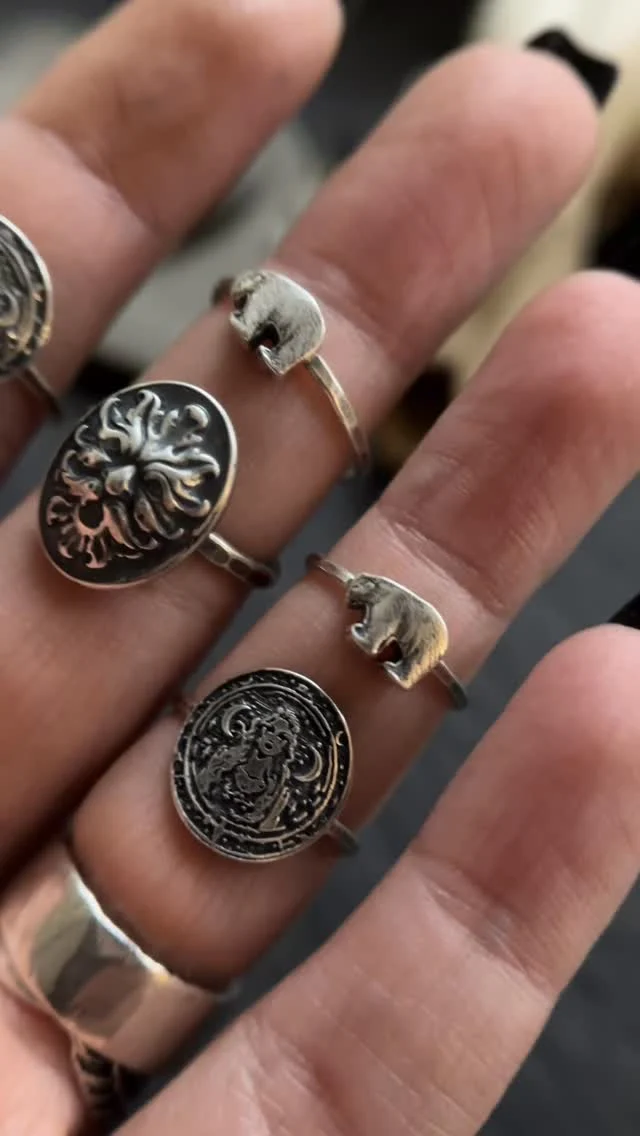
Happy washing day 🙃
A few rings I’ve worked on the last couple days…
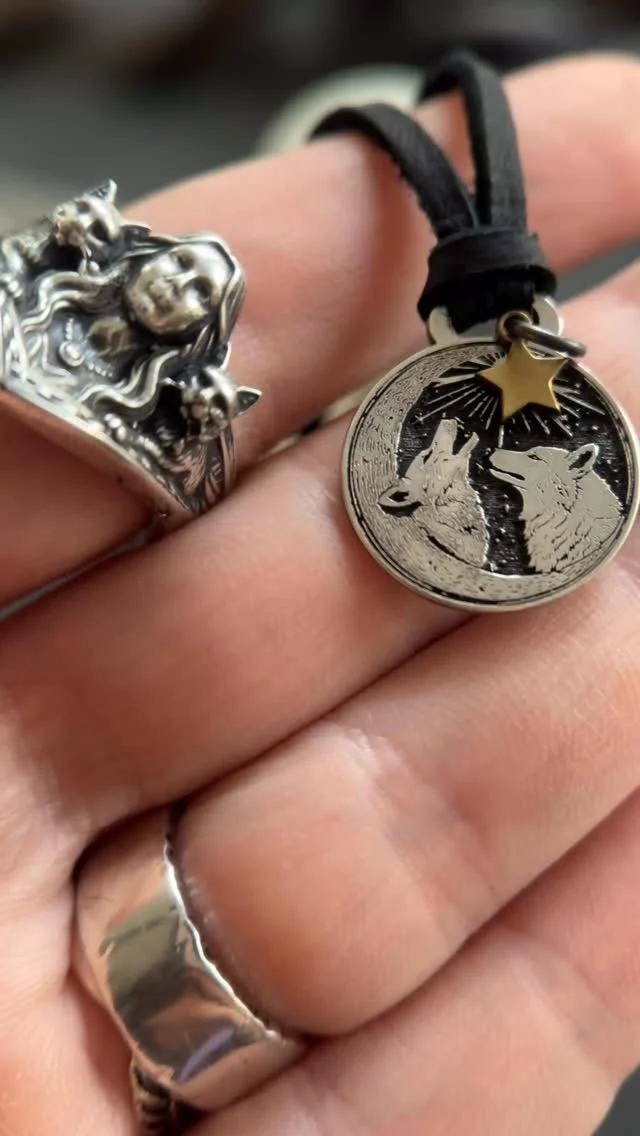
Freya’s cats rule and dogs drool?
Or was that the other way around? 🙃

Garm barely shows up in the old Norse stories.
Still… he leaves a mark.
A...

Leave a comment with your result ❤️
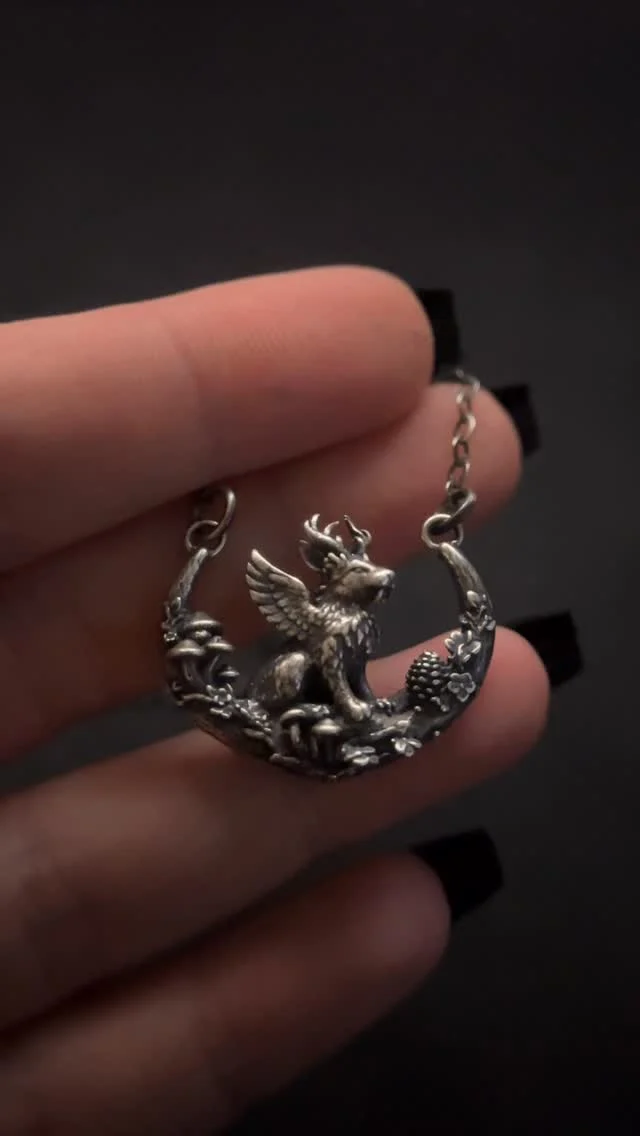
Bavarian Folklore says that you might just cross paths with a Wolpertinger in the alpine...

🐇🌲✨
He finally stepped out of the forest…
The Wolpertinger Pendant has arrived.
Inspired by...

I don’t often sell them, but love it when I do!
Vinca symbol bracelets ❤️...

Rooted in strength + guarded by ravens

The serpent waits 🖤
(Handcrafted Jörmungandr ring made to order in my shop)

Stay warm, everyone ❤️

😑😑😑🤮

I thought I had closed the book on the Alice in Wonderland rings…
But you...

Can this be over now, please?

In case you forgot 💜

Something I’ve been thinking about lately.
If there’s one thing I would’ve done differently early...

This year, we’re not buying things just to keep up.
If you need the reminder:...

My husband is from Bavaria (southern Germany) and I originally made this Krampus pendant for...

Some of the items I’m shipping out today ❤️
Please forgive my dirty nails 😂...

A few items shipping out today 🥰

This mornings rings shipping out ❤️

A few of the rjngs I’m shipping out this morning ❤️
How do you like...

Krampus is coming 🫶🏻

Getting ready to pack up these pretties and ship to their owners ❤️

Freya, cats and pentacles. Doesn’t get any better ❤️

You all got me going crazy making all these fairytale + storybook rings.
But I’ll...

Just launched these pretties ❤️
Size 9 amethyst ring + size 7.25 green kyanite

What would you trade to learn Baba Yaga’s secrets?

It *finally* looks, feels and smells like October!
And here are some items I’m packing...

This mornings pretties getting ready to ship :)

Getting ready to pack up these pretties and ship to their owners ❤️

You bet I’m hopping on this trend 😂
Thank you @shes_sinister for the prompt!

While I welcome the seasonal darkness…it sure is going to make my morning quick videos...

Finally finished the rings I’ve been working on in my stories ❤️
I think I...

Was going to post this update to my stories but it’s too long.

“How do you know I’m mad?” said Alice.
“You must be,” said the Cat, “or...

Some of this mornings orders getting ready to ship. Those little bats are so cute...

Here is the finished ring I was working on in my stories yesterday, along with...

A few of today’s orders shipping out this morning ❤️

The two silver raven rings I was working on in my stories yesterday.
…as well...

Eeeek! I’m so happy to add these to my shop ❤️
I’ve gotten so many...

I had 6 clamshells ready to ship this morning but I dropped and lost my...

Not the story you were told.
The girl didn’t run.
The wolf didn’t win.
This...

I love these raven rings so much 🖤
This mornings pretties shipping out.
All items...

Sleek + minimal Mjölnir ring ⚒️


About the author Jacqueline Fatica


