No products in the cart.
February 19, 2026 6:47 pm

Free USA shipping on orders $35+
February 19, 2026 6:47 pm
If you’re curious whether Rome had a true “chief” among its Roman gods and goddesses, we must ask how Roman power imagined itself.
In Roman mythology, that answer points straight to Jupiter.
In ancient Rome, Jupiter became the public face of victory, oaths, and the legitimacy of the Roman state.
That is why he can feel less like one deity in a Roman pantheon, and more like the divine seal on Rome’s political life.
Below is a guided walk through what our sources actually say about Jupiter, why he mattered, and how he sits among the wider crowd of goddess and roman god figures such as Juno, Minerva, Mar(s), Venus, Neptune, Diana, Vulcan, Apollo, Vesta, Saturn, and Pluto.
Calling Jupiter a kind of king of the gods can mislead modern readers, since Roman religion is not one tidy storybook.
It is a working system of cult, vows, priesthoods, and public rites. Still, Rome does treat Jupiter as first among roman deities, and the evidence shows that his rank is not only theological. It is civic.
A helpful way to say it is this: Jupiter is the Roman god whose cult becomes the most tightly woven into public authority.
In the Histos study on Capitoline Jupiter, the temple on the Capitoline is presented as Rome’s most central sanctuary, a focal point of collective identity that later writers could connect to Rome’s destiny and world rule (Thein, 2014, p. 287).
That phrasing already signals what “chief” means here, in other words, a god who stands at the top of the civic hierarchy.
That is why Jupiter can sound “exceptional.” Roman writers and Roman ritual treat him as the divine guarantor of the state’s most serious acts.
Other goddess and Roman goddess figures can be beloved, feared, and widely invoked, yet Jupiter keeps the position that feels official.
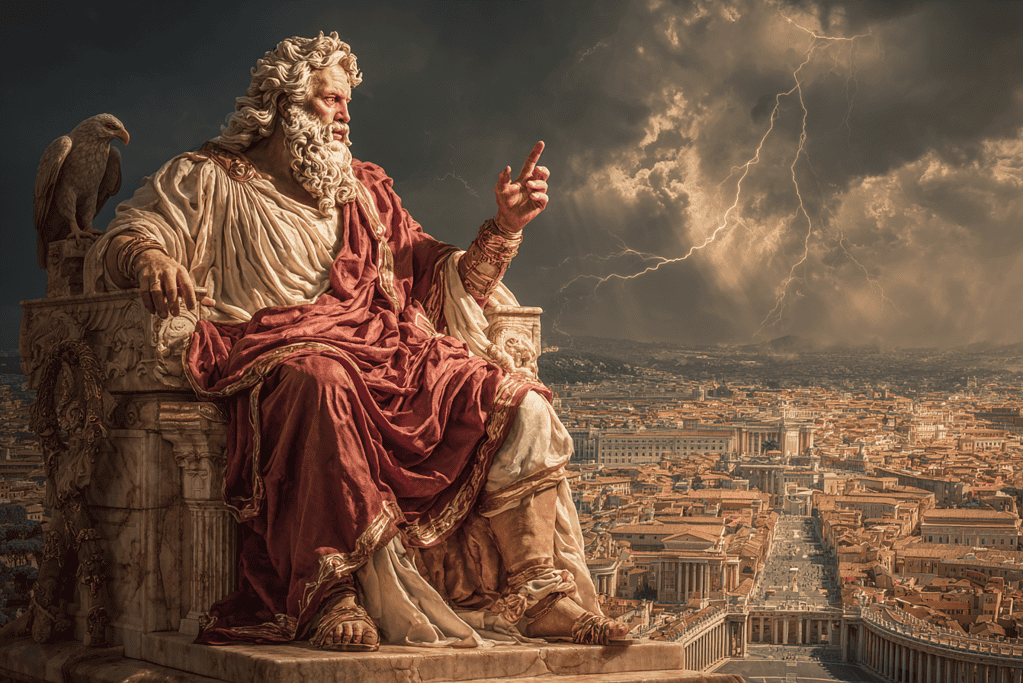
If you want one physical place that says “this is the center,” it is the Capitoline sanctuary: the hilltop temple to the Capitoline triad (Jupiter, Juno, Minerva).
Thein’s article stresses the Capitoline temple as Rome’s most important temple and a “major focal point” in the symbolic topography of the city (Thein, 2014, p. 287).
That centrality is not decorative, however, it shapes how later Romans tell stories about Rome.
One famous narrative tied to the temple’s foundations is the “head” omen found in the ground during construction, which was then interpreted as a sign that Rome would become a “head” of Italy or even the world (Thein, 2014, p. 286).
Thein argues that this began as an etymological tale explaining Capitolium, then grew into an imperial myth with a prophecy of domination (Thein, 2014, p. 286).
In other words, Jupiter’s hilltop shrine becomes a story-narrative for Roman self-understanding.
That helps explain why Jupiter is not merely one deity among many.
He becomes Rome’s divine “top seal” for identity, empire, and legitimacy. He is attached to a location, a ritual life, and a public memory.
It is tempting to treat Jupiter as a Greek equivalent of Zeus with Latin names, a clean swap from Greek mythology into Roman mythology.
Roman authors did practice interpretive matching, and plenty of later art and literature talk in that fashion.
Still, the civic weight placed on Capitoline Jupiter is not a simple mirror of the Greek picture.
Thein’s work is useful here because it shows an explicitly Roman trajectory.
The Capitoline temple and its foundation myths become tied to Rome’s world rule in Latin historiography, with language that intensifies over time, e.g., from “head of Italy” toward “head of the world” (Thein, 2014, p. 286).
hat is not a Zeus story imported from ancient Greek tradition; it is Roman political imagination speaking through Jupiter’s sanctuary.
Indeed, Jupiter has a Greek counterpart, and in later periods you often see him treated as equivalent to the Greek Zeus.
Still, what makes Jupiter “exceptional” in ancient Romans life is how thoroughly he is tied to Roman civic identity, to the Capitoline, and to the public story of Rome itself.
Modern retellings fixate on mythic episodes, but Rome’s daily religion often runs through oaths, vows, and official acts.
In that world, Jupiter’s authority is not only cosmic.
That kind of role elevates him above a specialist god like Vulcan (the god of fire) or a household center like Vesta (goddess of the hearth, guarded by the vestal virgins). Those powers are real, yet different in scope.
This is also where Jupiter’s “sky” identity matters. A god of the sky is the one you cannot hide from.
In practice, that symbolic logic feeds into why Jupiter is the god you call when the stakes are public, collective, and binding.
The Capitoline triad matters because it shows that Rome’s top cult space is not “Jupiter alone.”
It is Jupiter with Juno (a goddess often framed as a goddess of marriage, and here honored as queen of the gods) and Minerva (goddess of wisdom).
The trio makes a statement about sovereignty as a shared civic order.
Thein explicitly frames the Capitoline as the temple “of the Capitoline triad of Jupiter, Juno, and Minerva,” placing them at the heart of Rome’s symbolic and political identity (Thein, 2014, p. 287).
That pairing changes how we read “chief.”
Jupiter is first, yet he is publicly enthroned with a major goddess and another major Roman goddess.
This also helps explain why lists of important Roman gods can look “uneven.”
Someone like Diana, goddess of the hunt, can be hugely loved and widely worshipped, and Apollo can carry prestige and prophecy, yet neither occupies the same civic summit as Jupiter with Juno and Minerva.
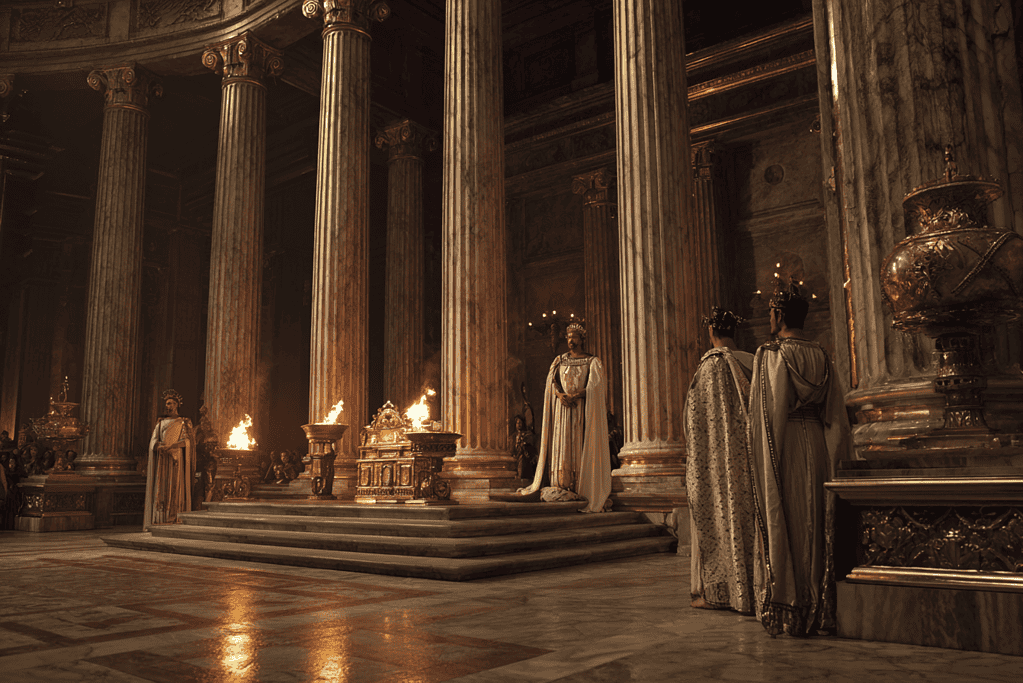
If you are looking for a simple “strongest god,” you might assume Mar(s) who is a classic god of war should outrank the sky god. Roman material does not treat it that way.
A striking piece of evidence comes from priesthood rank.
In the discussion of early Roman religious institutions, the flamen Dialis, i.e., the priest of Jupiter, is described as “of the highest respect,” connected with rites that once belonged to the Roman king (Šmerda, 2020, p. 60).
The same passage context places flamen Martialis (for Mars) and flamen Quirinalis (for Quirinus) beside him, yet the emphasis falls on Jupiter’s priestly prestige (Šmerda, 2020, p. 60).
That hierarchy tells you how Rome ranked divine functions.
Still, Jupiter is the figure placed as supreme.
Venus is the goddess of love and a goddess of her rank and status can move families and cities.
Roman tradition can connect Venus to origins stories, hero lines, and prestige claims (think of Aeneas as an ancestor figure in Roman origin talk, and the broader “founders of rome” discourse).
Yet even where Venus rises in prominence, she does not replace Jupiter as the central public guarantor.
This matters for Roman art and later Roman storytelling.
Venus can become glamorous, intimate, powerful.
Still, Jupiter remains the god whose Capitoline site anchors the idea of Rome as rightful ruler, framed through mythic signs and state memory (Thein, 2014, p. 286).
So you can have a Roman world where Venus matters intensely, where love, lineage, and prestige have public consequences, and where a goddess can dominate narrative attention.
Jupiter still holds the formal summit.
Roman cosmology spreads power across zones.
Neptune is the god of the sea (with the Greek counterpart Poseidon), and Pluto is a god of the underworld tied to the underworld (a conceptual neighbor to Hades, the Greek name often used in comparison).
These are not minor players. They rule realms that shape fear, wealth, storms, and death.
Still, Jupiter’s exceptionality is tied to a different kind of status and rank. Neptune’s power is domain-specific.
Pluto’s is also domain-specific, even when the underworld connects to fertility, wealth, and ancestral fate.
Jupiter on the other hand is the figure whose authority is presented as overarching and public: the sky, the oath, the summit shrine, the state’s self-image.
That does not mean Jupiter “controls” the Roman underworld in any simple way.
It means that Jupiter’s cult position gives him the highest civic status within the Roman system of gods and goddess figures.
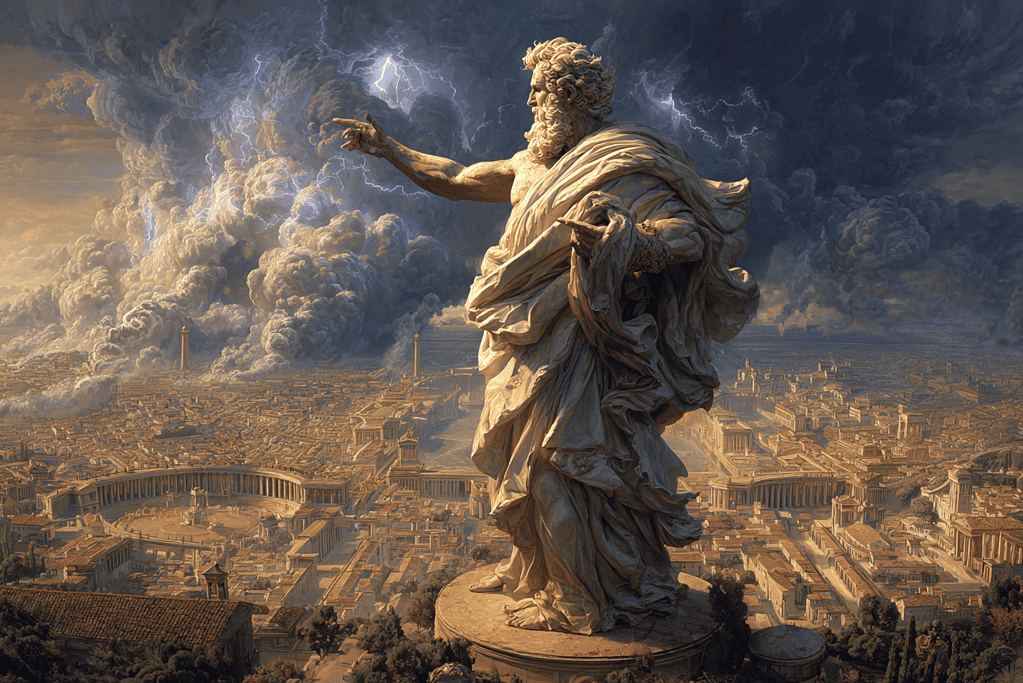
Saturn often appears as a “before” figure, i.e., a remembered age, an older order, a myth of displacement.
That matters because it shows Rome can imagine sovereignty as something that changes hands.
Even where Jupiter is the official summit, the Roman imagination preserves layers beneath him.
In a Roman mythic memory, Saturn can represent an archaic past that is not simply erased.
That story logic helps the Romans explain why authority feels both stable and contested. Jupiter is the present summit, while Saturn is the deep time memory.
This is one reason Roman myth can feel less like one tidy narrative, and more like a set of overlapping stories that Rome uses to think with such as about rule, change, and the costs of power.
For Rome, worship is not only private prayer.
It is a public choreography of vows, priesthoods, and state-visible ritual.
Jupiter sits at the center of that civic religion, marked by high-status priesthood, prominent sanctuaries, and foundation stories that later authors could expand into imperial prophecy (Thein, 2014, p. 286; Šmerda, 2020, p. 60).
This is where the crowd of Roman gods and goddesses comes back into view.
Rome’s religious life includes household ritual to Vesta, craft power around Vulcan, strategic martial identity around Mar(s), sea power and fear around Neptune, the pull of the underworld around Pluto, and protective and interpretive roles across many goddess figures.
Jupiter remains the god whose cult most visibly crowns the public order.
So if the question is “Is there a chief of the gods in Roman myth?”, the Roman answer is not just a name.
It is an institutional and ritual reality, in other words, there is always Jupiter’s position at the top of the civic hierarchy.
Thein, A. (2014). Capitoline Jupiter and the historiography of Roman world rule. Histos, 8, 284–319. (histos.org)
Šmerda, M. (2020). Quirinus and his role in original Capitoline triad. Sapiens ubique civis, 1, 57–64. https://doi.org/10.14232/suc.2020.1.57-64

ᛉ 100% handcrafted artisan pagan , viking, witchcraft and shamanic inspired jewelry.
ᛉ Runes, Symbolism & European Folklore
Get 20% off👇🏻

Leave a comment with your result ❤️
Bavarian Folklore says that you might just cross paths with a Wolpertinger in the alpine...

🐇🌲✨
He finally stepped out of the forest…
The Wolpertinger Pendant has arrived.
Inspired by...

I don’t often sell them, but love it when I do!
Vinca symbol bracelets ❤️...

Rooted in strength + guarded by ravens

The serpent waits 🖤
(Handcrafted Jörmungandr ring made to order in my shop)

Stay warm, everyone ❤️

😑😑😑🤮

I thought I had closed the book on the Alice in Wonderland rings…
But you...

Can this be over now, please?

In case you forgot 💜

Something I’ve been thinking about lately.
If there’s one thing I would’ve done differently early...

This year, we’re not buying things just to keep up.
If you need the reminder:...

My husband is from Bavaria (southern Germany) and I originally made this Krampus pendant for...

Some of the items I’m shipping out today ❤️
Please forgive my dirty nails 😂...

A few items shipping out today 🥰

This mornings rings shipping out ❤️

A few of the rjngs I’m shipping out this morning ❤️
How do you like...

Krampus is coming 🫶🏻

Getting ready to pack up these pretties and ship to their owners ❤️

Freya, cats and pentacles. Doesn’t get any better ❤️

You all got me going crazy making all these fairytale + storybook rings.
But I’ll...

Just launched these pretties ❤️
Size 9 amethyst ring + size 7.25 green kyanite

What would you trade to learn Baba Yaga’s secrets?

It *finally* looks, feels and smells like October!
And here are some items I’m packing...

This mornings pretties getting ready to ship :)

Getting ready to pack up these pretties and ship to their owners ❤️

You bet I’m hopping on this trend 😂
Thank you @shes_sinister for the prompt!

While I welcome the seasonal darkness…it sure is going to make my morning quick videos...

Finally finished the rings I’ve been working on in my stories ❤️
I think I...

Was going to post this update to my stories but it’s too long.

“How do you know I’m mad?” said Alice.
“You must be,” said the Cat, “or...

Some of this mornings orders getting ready to ship. Those little bats are so cute...

Here is the finished ring I was working on in my stories yesterday, along with...

A few of today’s orders shipping out this morning ❤️

The two silver raven rings I was working on in my stories yesterday.
…as well...

Eeeek! I’m so happy to add these to my shop ❤️
I’ve gotten so many...

I had 6 clamshells ready to ship this morning but I dropped and lost my...

Not the story you were told.
The girl didn’t run.
The wolf didn’t win.
This...

I love these raven rings so much 🖤
This mornings pretties shipping out.
All items...

Sleek + minimal Mjölnir ring ⚒️

Today’s orders getting ready to ship.
…And I finally got some time to work on...

That ant ring is so out of place 😂
Not that the mail is coming...

If you had this, which runes would you choose? Or would you accept the runes...

I love making these fun Halloween coffin pendants 🎃
All items you see are always...


About the author Jacqueline Fatica


