No products in the cart.
December 5, 2025 4:36 pm

Free USA shipping on orders $35+
December 5, 2025 4:36 pm
The story of Peter Pan has enchanted generations with its blend of fantasy, adventure, and the timeless struggle between childhood and adulthood.
In this article, we explore the origins of Peter Pan, the key characters that bring the story to life, and how this literary classic continues to shape popular imagination.
From the fairy-lit corners of Neverland to the ticking crocodile that haunts a pirate captain, the tale remains a rich narrative of magic, danger, and youth’s defiance of time.

The Peter Pan story began as a play by J.M. Barrie in 1904 and was later adapted into the 1911 novel Peter and Wendy.
It tells the story about three children who left their parents, Wendy Darling and her two brothers, John and Michael, and traveled far away to the Neverland with the help of Tinker Bell and Peter Pan, the boy who never grew up.
There they meet the lost boys, mermaids, and battle against pirates led by the fearsome Captain Hook.
This original Peter Pan tale is not only a thrilling adventure but also a meditation on memory, identity, and the bittersweet nature of growing up.
The children flew back to London at the story’s end, forever changed by their time in Neverland.
Peter Pan is the eternal child, the boy who never grew old. He lives in Neverland and leads the lost boys, i.e., children who, like him, have left the adult world behind.
Peter and Tinker Bell fly between worlds, appearing in the nursery window to collect stories and sprinkle fairy dust.
Peter Pan’s character combines charm and arrogance, lightheartedness and cruelty.
As Michael A. Foster notes in “Peter Pan: The Lost Last Act,” Barrie’s original version had darker undertones where Peter actively forgets past companions and dismisses emotional bonds (Foster, 1988, p. 29).
This complexity enriches the tale’s exploration of the boundaries between innocence and willful ignorance.
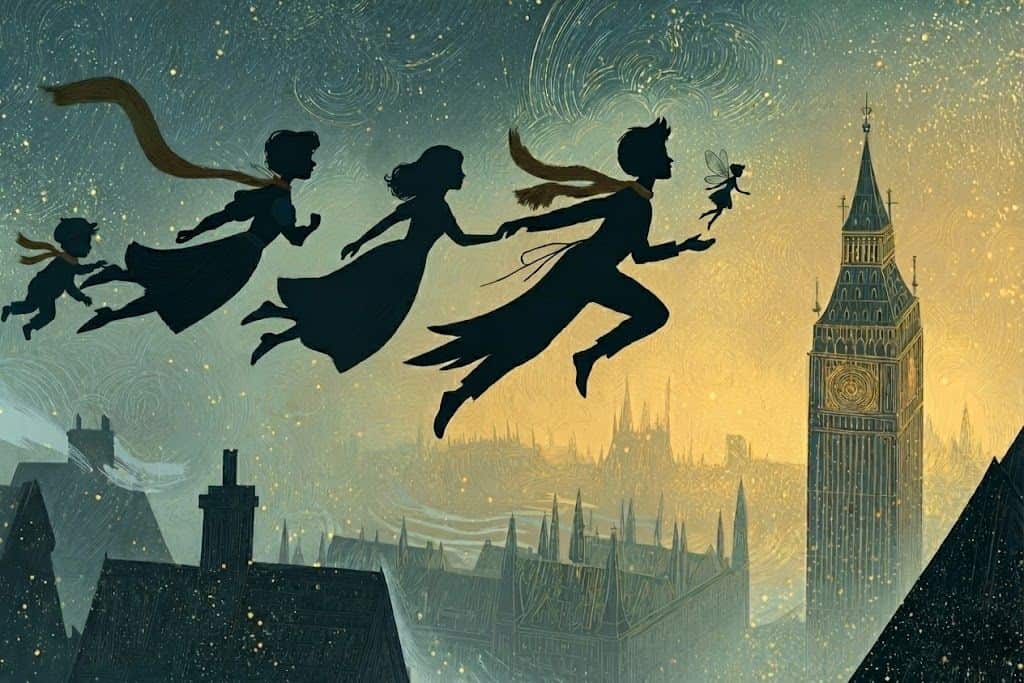
Wendy and her brothers, John and Michael, serve as anchors of empathy and narrative cohesion.
Wendy Darling is central: she is the storyteller, the nurturer, and the girl dreaming of Neverland.
When the children who left their parents fly with Peter to Neverland, Wendy assumes a motherly role among the lost boys.
The bedtime stories she tells offer both comfort and structure to a wild, lawless land.
Allison Kavey points out that Wendy represents “civilizing femininity” in opposition to Peter’s wildness (Kavey, 2009, p. 100).
Her eventual decision to return home symbolizes the necessity of growing up, without fully negating the beauty of imagination.
Tinker Bell, the fairy companion of Peter Pan, is a key figure in the Peter Pan story.
Tinker Bell flew back and forth between the nursery and Neverland, spreading jealousy, loyalty, and light. Children believed in fairies through her.
Her ephemeral nature and emotional extremes add a layer of volatility to Neverland.
The help of Tinker Bell is crucial in both guiding and rescuing the children.
Fairy dust, a magical substance she carries, allows them to fly but only if they believe.
Her sacrifice and resurrection affirm the story’s deep link between belief, imagination, and the survival of magic.
Neverland is the fantastical setting where the story unfolds.
A place born from dreaming of the Neverland and accessed only by flight and fairy dust.
It features pirates, a crocodile who swallowed a clock, a mermaid lagoon, and islands of adventure.
This dreamscape is shaped by children’s memories, fears, and desires.
It is mutable and alive, reflecting the mental landscapes of its inhabitants.
As Foster (1988) explains, Neverland is as much about what the children bring with them as what they discover.
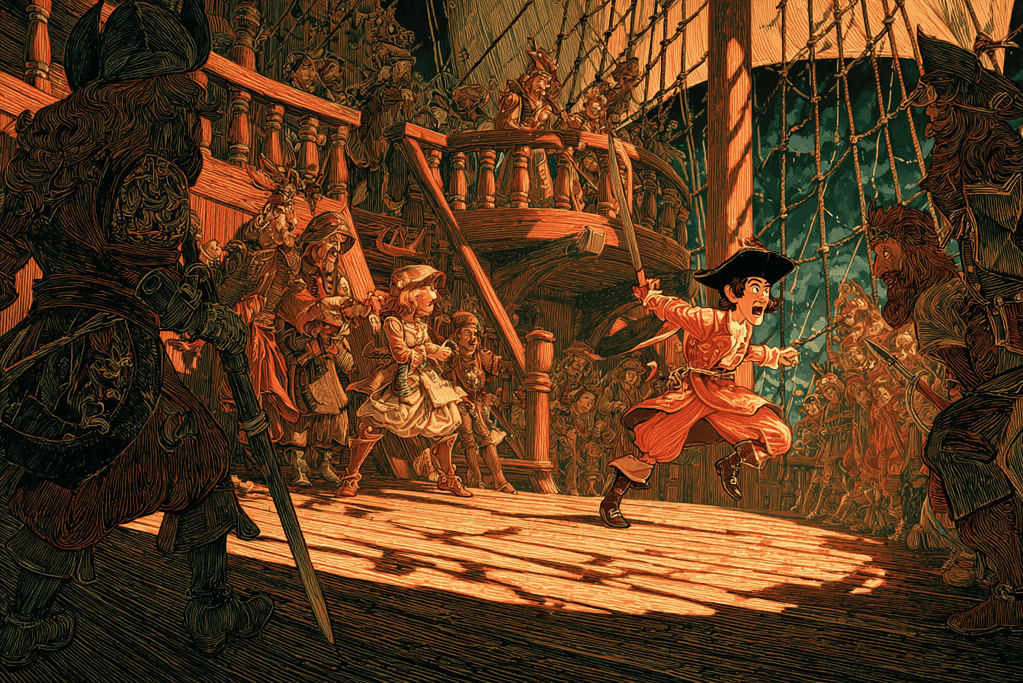
The history of Peter Pan begins with J.M. Barrie’s 1904 stage play Peter Pan; or, The Boy Who Wouldn’t Grow Up and its subsequent transformation into the novel Peter and Wendy.
The original Peter Pan text is marked by shifts in tone, from whimsy to sorrow, that reflect Barrie’s own psychological complexity.
According to Kavey (2009), the character’s creation is steeped in epistemological tension between fantasy and reality, a reaction to the loss of Barrie’s brother and the romanticization of childhood (p. 96).
This tension manifests in Peter’s desire to remain young, regardless of the consequences for those around him.
Captain Hook is the pirate captain who serves as Peter’s foil. A former student of Eton, Hook embodies adult fears, vanity, and a tyrannical need for control.
Captain Hook’s obsession to kill Peter Pan is both comic and tragic, driven by the ticking crocodile that swallowed a clock and is slowly chasing him toward his doom.
This crocodile becomes a symbol of time’s relentless progression, i.e., something Peter ignores and Hook dreads.
Hook’s complex villainy makes him one of the most memorable pirate characters in literature.
The crocodile that swallowed a clock is a central figure in the Peter Pan story.
This creature stalks Hook, announcing its arrival with a ticking sound.
It serves as a literal embodiment of time, always inching closer, reminding Hook of mortality and his incomplete transformation into a complete adult.
The crocodile, both comical and fearsome, represents the fear of time running out.
In Neverland, where Peter Pan resists time, this beast introduces a counter-narrative: no one can truly escape it forever.
The mermaid lagoon is a place of mystery and danger. Mermaids in Peter Pan are not benevolent; they are capricious, occasionally attempting to drown Wendy.
The lagoon scene captures the eerie, untamable aspect of Neverland.
Tiger Lily, a native princess, is portrayed with exoticized charm.
Her character, while underdeveloped by today’s standards, played into Edwardian fantasies of the “noble savage.”
She is caught in the conflict between pirates and lost boys and saved by Peter Pan, solidifying his heroic image.

Peter Pan embodies the freedom and cruelty of childhood. He resists memory and refuses change.
The story of Peter Pan invites us to question whether perpetual childhood is idyllic or irresponsible.
As Kavey (2009) writes, Peter “lives outside of historical time,” making him appealing and tragic (p. 101).
Wendy and the boys return to London, while Peter flies back to Neverland, forever chasing shadows and stories.
The tension between staying young and accepting growth defines the narrative’s lasting appeal.
Foster, M. A. (1988). Peter Pan: The Lost Last Act. Mythlore, 14(4), 27–32. https://www.jstor.org/stable/26812962
Kavey, A. B. (2009). “I do believe in fairies, I do, I do”: The History and Epistemology of Peter Pan. In A. B. Kavey & L. D. Friedman (Eds.), Second Star to the Right: Peter Pan in the Popular Imagination (pp. 95–114). Rutgers University Press. https://www.jstor.org/stable/j.ctt5hj1xf.8

ᛉ 100% handcrafted artisan pagan , viking, witchcraft and shamanic inspired jewelry.
ᛉ Runes, Symbolism & European Folklore
Get 20% off👇🏻

Five witches dance around a blazing bonfire beneath a citrine cabochon in this Walpurgisnacht pendant....
Happy washing day 🙃
A few rings I’ve worked on the last couple days…
Freya’s cats rule and dogs drool?
Or was that the other way around? 🙃

Garm barely shows up in the old Norse stories.
Still… he leaves a mark.
A...
Leave a comment with your result ❤️
Bavarian Folklore says that you might just cross paths with a Wolpertinger in the alpine...

🐇🌲✨
He finally stepped out of the forest…
The Wolpertinger Pendant has arrived.
Inspired by...

I don’t often sell them, but love it when I do!
Vinca symbol bracelets ❤️...

Rooted in strength + guarded by ravens

The serpent waits 🖤
(Handcrafted Jörmungandr ring made to order in my shop)

Stay warm, everyone ❤️

😑😑😑🤮

I thought I had closed the book on the Alice in Wonderland rings…
But you...

Can this be over now, please?

In case you forgot 💜

Something I’ve been thinking about lately.
If there’s one thing I would’ve done differently early...

This year, we’re not buying things just to keep up.
If you need the reminder:...

My husband is from Bavaria (southern Germany) and I originally made this Krampus pendant for...

Some of the items I’m shipping out today ❤️
Please forgive my dirty nails 😂...

A few items shipping out today 🥰

This mornings rings shipping out ❤️

A few of the rjngs I’m shipping out this morning ❤️
How do you like...

Krampus is coming 🫶🏻

Getting ready to pack up these pretties and ship to their owners ❤️

Freya, cats and pentacles. Doesn’t get any better ❤️

You all got me going crazy making all these fairytale + storybook rings.
But I’ll...

Just launched these pretties ❤️
Size 9 amethyst ring + size 7.25 green kyanite

What would you trade to learn Baba Yaga’s secrets?

It *finally* looks, feels and smells like October!
And here are some items I’m packing...

This mornings pretties getting ready to ship :)

Getting ready to pack up these pretties and ship to their owners ❤️

You bet I’m hopping on this trend 😂
Thank you @shes_sinister for the prompt!

While I welcome the seasonal darkness…it sure is going to make my morning quick videos...

Finally finished the rings I’ve been working on in my stories ❤️
I think I...

Was going to post this update to my stories but it’s too long.

“How do you know I’m mad?” said Alice.
“You must be,” said the Cat, “or...

Some of this mornings orders getting ready to ship. Those little bats are so cute...

Here is the finished ring I was working on in my stories yesterday, along with...

A few of today’s orders shipping out this morning ❤️

The two silver raven rings I was working on in my stories yesterday.
…as well...

Eeeek! I’m so happy to add these to my shop ❤️
I’ve gotten so many...

I had 6 clamshells ready to ship this morning but I dropped and lost my...

Not the story you were told.
The girl didn’t run.
The wolf didn’t win.
This...

I love these raven rings so much 🖤
This mornings pretties shipping out.
All items...

Sleek + minimal Mjölnir ring ⚒️


About the author Jacqueline Fatica


