No products in the cart.
February 18, 2026 8:03 pm

Free USA shipping on orders $35+
February 18, 2026 8:03 pm
Among all figures in Indo-European mythology, Persephone stands as profound and symbolically complex when it comes to her role regarding spring and the underworld.
She is at once a goddess of spring and the queen of the underworld, a divine being who governs both the emergence of life and its descent into death.
Her myth explains the seasonal cycle, the fertility of the earth, and the inevitability of mortality. Yet her importance extends beyond Greek mythology.
Persephone belongs to a widespread Indo-European tradition in which divine female figures embody the cyclical return of vegetation, fertility, and cosmic order.
The ancient Greek sources present Persephone not merely as a passive figure but as a powerful deity whose movements shape the natural world.
Her descent into darkness and return to light provided ancient societies with a sacred explanation for the spring season, agricultural renewal, and the continuity of life itself.
As always, we conduct careful examination of primary sources such as the Homeric Hymn to Demeter and major academic scholarship.
Persephone emerges as a central figure in understanding Indo-European concepts of life, death, and rebirth.
Persephone was one of the central divine figures in ancient Greek religion.
She was the daughter of Zeus, king of the gods, and Demeter, the earth goddess and goddess of the harvest.
This lineage made her uniquely positioned between cosmic authority and earthly fertility.
In early Greek religious understanding, Persephone governed both vegetation and the realm of the dead.
The Homeric Hymn to Demeter describes Persephone as a powerful and awe-inspiring deity, ruling beside Hades in the land beneath the earth (Homeric Hymn to Demeter, trans. Evelyn-White, 1914, lines 405–410).
She was not merely a subordinate figure but a divine ruler, often called dread Persephone, reflecting both fear and reverence toward her authority.
Walter Burkert explains that Persephone’s dual identity is essential to her religious role. She was both the goddess of spring and the queen of the underworld, embodying the cycle of life and death that governed agricultural societies (Burkert, 1985, pp. 159–161).
This dual nature reflects one of the most fundamental principles of Indo-European cosmology: that death and renewal are inseparable parts of existence.

The defining event in Persephone’s myth is her abduction by Hades, the god of the underworld.
The Homeric Hymn describes how Persephone was gathering flowers in a meadow when the earth suddenly opened, and Hades emerged to abduct her and carry her into the underworld (Homeric Hymn to Demeter, lines 16–21).
This moment marks Persephone’s descent into the underworld, transforming her from a maiden associated with spring growth into the queen of the lower world.
The myth emphasizes that Zeus himself approved this union, demonstrating that Persephone’s fate was part of a larger cosmic order (Burkert, 1985, p. 160).
Her transformation represents more than a mythological marriage.
It reflects the ancient understanding that vegetation disappears beneath the earth during winter, only to return in spring.
Persephone’s descent symbolizes the disappearance of life, while her return represents renewal.
Persephone’s parentage connects her directly to the fundamental forces governing the cosmos.
Zeus represents divine authority and cosmic law, while Demeter embodies the fertility of the earth. As the daughter of Zeus and Demeter, Persephone unites heaven and earth.
Demeter’s reaction to Persephone’s disappearance reveals her importance.
According to the Homeric Hymn, Demeter withdrew her gifts from the earth, preventing crops from growing and threatening the survival of humanity (Homeric Hymn to Demeter, lines 305–310).
Burkert explains that this episode illustrates Persephone’s essential role in agricultural fertility.
Without Persephone’s return, life cannot continue (Burkert, 1985, p. 161).
Her presence ensures the renewal of vegetation.
Persephone’s descent into the underworld symbolizes the disappearance of vegetation during winter.
Ancient agricultural societies depended on seasonal cycles, and Persephone’s myth provided a sacred explanation for these changes.
A crucial moment in the myth occurs when Persephone eats a pomegranate seed in the underworld.
This act binds her permanently to that realm (Homeric Hymn to Demeter, lines 371–374). Because she consumed the seed, Persephone must spend part of each year beneath the earth.
This division of time reflects the seasonal cycle. Persephone withdraws into the earth during winter and returns to the surface in spring.
Her movement between realms represents the continuity of life through death and renewal.
Persephone’s return marks the beginning of spring.
The Homeric Hymn describes how Demeter restores fertility to the earth when Persephone returns from the underworld (Homeric Hymn to Demeter, lines 470–472).
Martin West explains that Persephone’s myth reflects an ancient Indo-European pattern in which divine figures descend and return, symbolizing seasonal renewal (West, 2007, pp. 181–183).
This pattern appears in multiple Indo-European mythological traditions.
Persephone’s return represents the restoration of life. Her presence allows plants to grow and the earth to flourish once again.

Persephone’s association with fertility derives from her connection to Demeter and agriculture.
Demeter governs grain and the fertility of the soil, and Persephone’s presence enables these forces to operate.
Burkert notes that Persephone was understood as a central figure in agricultural fertility, governing the cycle of planting and harvest (Burkert, 1985, p. 162).
Her myth explains why crops grow during certain times of the year.
Persephone’s role demonstrates the ancient belief that life emerges from beneath the earth. The same earth that receives the dead also produces new life.
Persephone was worshipped throughout the Greek world, particularly in the Eleusinian Mysteries.
These religious rites focused on Persephone’s descent and return, promising initiates hope for renewal after death.
Burkert explains that the Eleusinian Mysteries were among the most important religious rituals in ancient Greece, emphasizing Persephone’s role in the cycle of life and death (Burkert, 1985, pp. 285–289).
Participants believed Persephone could grant a form of spiritual renewal. Her myth offered reassurance that death was not the end.
The Homeric Hymn to Demeter provides the most complete account of Persephone’s myth. It describes her abduction, Demeter’s grief, and her eventual return.
The hymn portrays Persephone as a powerful divine ruler, not merely a victim.
She becomes the queen of the underworld and governs the dead alongside Hades.
Her transformation reflects her maturity and divine authority.

West explains that Persephone belongs to a broader Indo-European tradition of seasonal goddesses associated with fertility and renewal (West, 2007, pp. 181–186).
These figures represent the cyclical nature of life. Persephone is one of the clearest examples of this tradition.
Her myth preserves ancient Indo-European religious ideas.
Persephone’s myth explains fundamental aspects of human existence. She governs life, death, and renewal.
Her story reflects universal human concerns.
She remains one of the most important spring goddesses in mythology.
Burkert, W. (1985). Greek Religion. Harvard University Press.
Homeric Hymns. (1914). Translated by H. G. Evelyn-White. Harvard University Press.
West, M. L. (2007). Indo-European Poetry and Myth. Oxford University Press.
Nilsson, M. P. (1950). The Minoan-Mycenaean Religion and Its Survival in Greek Religion. Lund.
Johnston, S. I. (2004). Restless Dead: Encounters Between the Living and the Dead in Ancient Greece. University of California Press.

ᛉ 100% handcrafted artisan pagan , viking, witchcraft and shamanic inspired jewelry.
ᛉ Runes, Symbolism & European Folklore
Get 20% off👇🏻

Five witches dance around a blazing bonfire beneath a citrine cabochon in this Walpurgisnacht pendant....
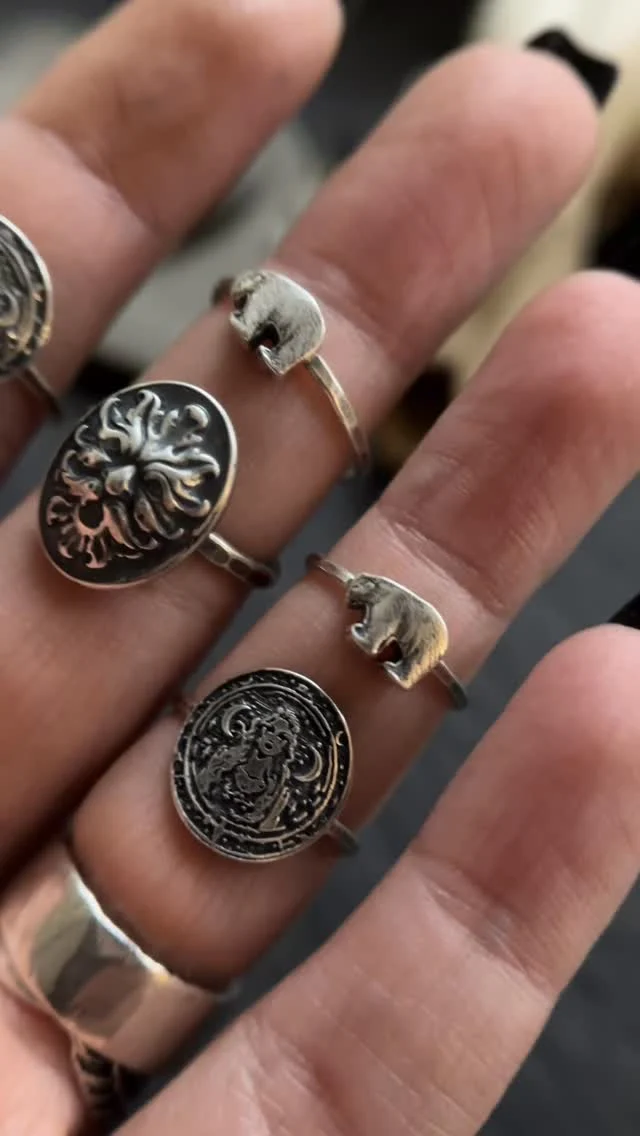
Happy washing day 🙃
A few rings I’ve worked on the last couple days…
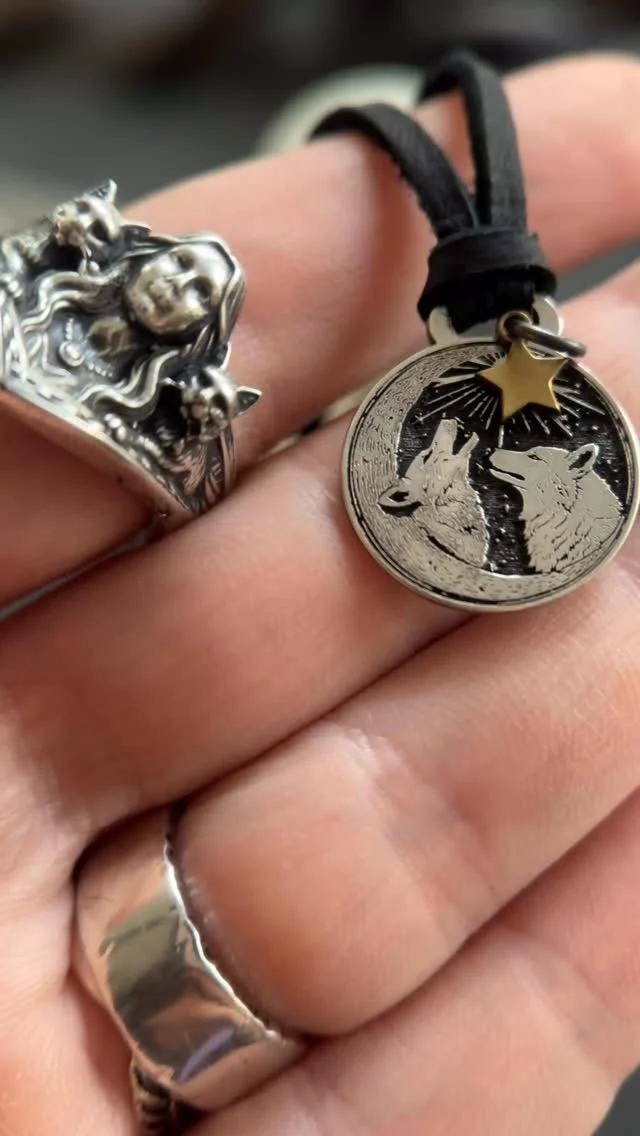
Freya’s cats rule and dogs drool?
Or was that the other way around? 🙃

Garm barely shows up in the old Norse stories.
Still… he leaves a mark.
A...
Leave a comment with your result ❤️
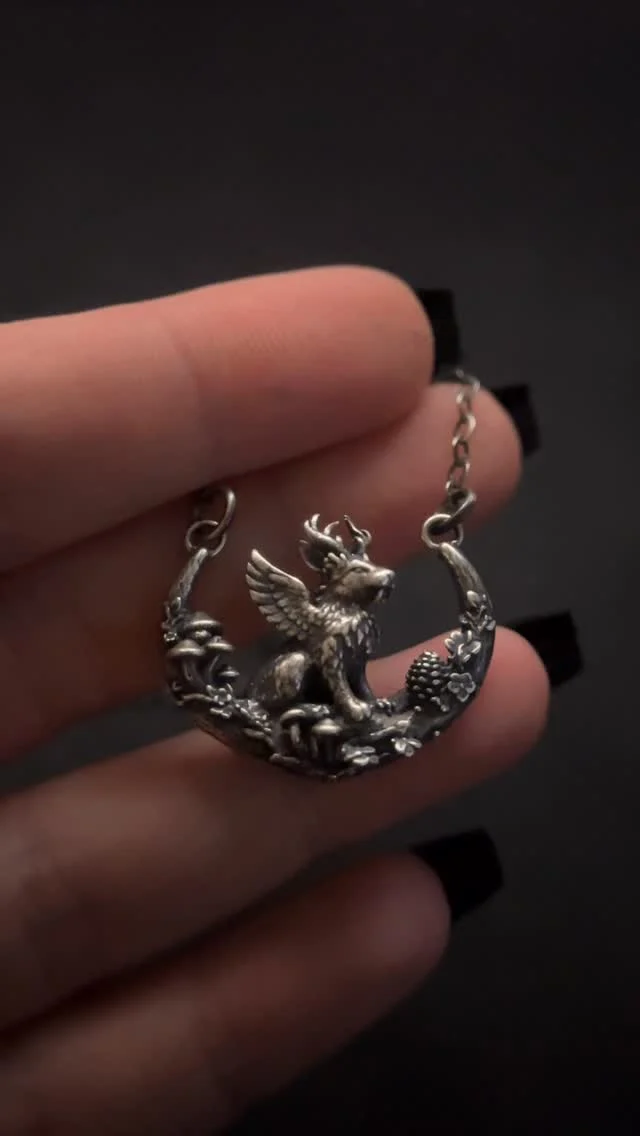
Bavarian Folklore says that you might just cross paths with a Wolpertinger in the alpine...

🐇🌲✨
He finally stepped out of the forest…
The Wolpertinger Pendant has arrived.
Inspired by...

I don’t often sell them, but love it when I do!
Vinca symbol bracelets ❤️...

Rooted in strength + guarded by ravens

The serpent waits 🖤
(Handcrafted Jörmungandr ring made to order in my shop)

Stay warm, everyone ❤️

😑😑😑🤮

I thought I had closed the book on the Alice in Wonderland rings…
But you...

Can this be over now, please?

In case you forgot 💜

Something I’ve been thinking about lately.
If there’s one thing I would’ve done differently early...

This year, we’re not buying things just to keep up.
If you need the reminder:...

My husband is from Bavaria (southern Germany) and I originally made this Krampus pendant for...

Some of the items I’m shipping out today ❤️
Please forgive my dirty nails 😂...

A few items shipping out today 🥰

This mornings rings shipping out ❤️

A few of the rjngs I’m shipping out this morning ❤️
How do you like...

Krampus is coming 🫶🏻

Getting ready to pack up these pretties and ship to their owners ❤️

Freya, cats and pentacles. Doesn’t get any better ❤️

You all got me going crazy making all these fairytale + storybook rings.
But I’ll...

Just launched these pretties ❤️
Size 9 amethyst ring + size 7.25 green kyanite

What would you trade to learn Baba Yaga’s secrets?

It *finally* looks, feels and smells like October!
And here are some items I’m packing...

This mornings pretties getting ready to ship :)

Getting ready to pack up these pretties and ship to their owners ❤️

You bet I’m hopping on this trend 😂
Thank you @shes_sinister for the prompt!

While I welcome the seasonal darkness…it sure is going to make my morning quick videos...

Finally finished the rings I’ve been working on in my stories ❤️
I think I...

Was going to post this update to my stories but it’s too long.

“How do you know I’m mad?” said Alice.
“You must be,” said the Cat, “or...

Some of this mornings orders getting ready to ship. Those little bats are so cute...

Here is the finished ring I was working on in my stories yesterday, along with...

A few of today’s orders shipping out this morning ❤️

The two silver raven rings I was working on in my stories yesterday.
…as well...

Eeeek! I’m so happy to add these to my shop ❤️
I’ve gotten so many...

I had 6 clamshells ready to ship this morning but I dropped and lost my...

Not the story you were told.
The girl didn’t run.
The wolf didn’t win.
This...

I love these raven rings so much 🖤
This mornings pretties shipping out.
All items...

Sleek + minimal Mjölnir ring ⚒️


About the author Jacqueline Fatica


