No products in the cart.
February 20, 2026 5:53 pm

Free USA shipping on orders $35+
February 20, 2026 5:53 pm
Siberia is a vast and complex region of northern Eurasia, stretching from the Ural Mountains to the Pacific Ocean and from the Arctic Ocean to Mongolia and China.
This enormous landmass has been home to diverse indigenous people for thousands of years, each with their own language, spiritual traditions, and ways of life.
Truly ancient migrations happened here and many cultures that live here share ancient hunter-gatherer origins.
Their ways of life may have changed, subsistence has changed, but the cultural origins are nonetheless truly ancient.
The peoples of Siberia represent one of the most remarkable examples of human adaptation to extreme environments, ranging from Arctic tundra to forest and steppe.
Understanding who these people are, how they live, and what they believe reveals one of the oldest and most resilient cultural landscapes on Earth.
This article explains who the indigenous population of Siberia is, how different ethnic groups are related linguistically, how their subsistence systems developed, and how their spiritual traditions evolved.
Let us now have a closer look at the academic linguistic and ethnographic research, particularly the works of Vajda (2009) and Rohr (2014), as well as peer-reviewed research on religion and shamanism in Siberia (Li, 2025).
Siberia is a vast region covering most of northern Asia.
Today, it remains part of the Russian Federation, and many indigenous communities still live in Siberia despite centuries of political and cultural change.
According to linguistic and ethnographic research, Siberia contains dozens of distinct ethnic groups, each with its own language and cultural identity (Vajda, 2009, p. 425; Rohr, 2014, p. 9).
The indigenous people of Siberia include groups such as the Nenets, Evenki, Khanty, Mansi, Buryat, Sakha (Yakuts), Chukchi, and Ket.
Some of these groups number in the hundreds of thousands, while others consist of only a few hundred individuals.
Each ethnic group developed in close relationship with its local environment, forming cultural traditions deeply connected to the landscape of tundra, forest, and steppe (Rohr, 2014, p. 9).
Many indigenous Siberians continue to maintain traditional practices even while interacting with Russian culture.
Although they live in Siberia today as part of Russia, their cultural traditions are truly extremely old and reflect ancient migrations and adaptations across Eurasia (Vajda, 2009, p. 426).
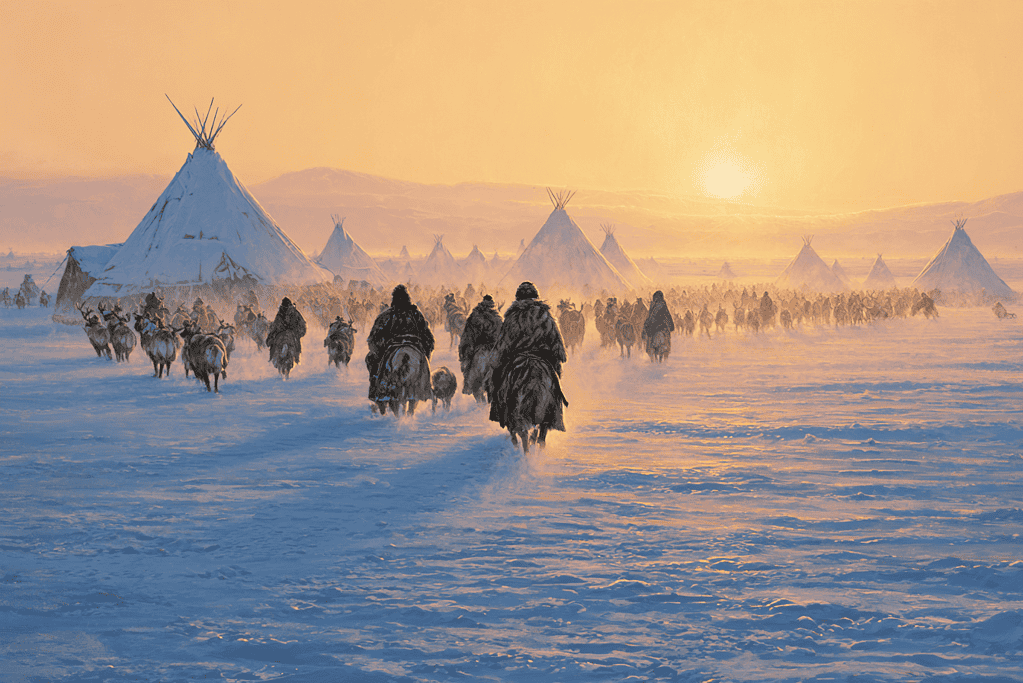
One of the most important ways scholars classify the peoples of Siberia is by their linguistic relationships.
These languages fall into several major families, including Uralic, Turkic, Tungusic, Mongolic, Eskimo-Aleut, and Paleo-Siberian language groups (Vajda, 2009, p. 425; Rohr, 2014, p. 9).
The Uralic language family includes groups such as the Nenets, Khanty, and Mansi.
These languages are related to Finnish and Hungarian, showing that the history of Siberia is deeply connected with broader migrations across northern Eurasia (Rohr, 2014, p. 10).
Meanwhile, Turkic languages such as Sakha (Yakut), Khakas, and Siberian Tatars spread throughout southern Siberia and parts of western Siberia (Rohr, 2014, p. 11).
Other linguistic groups include Tungusic languages spoken by Evenki and Even peoples in eastern Siberia and the Russian Far East.
Additionally, Paleo-Siberian languages such as Ket, Yukaghir, and Chukchi represent some of the oldest surviving language families in the region of Siberia, with no known connection to other major linguistic families (Vajda, 2009, p. 427).
The Nenets, Khanty, and Mansi belong to the Uralic linguistic family, one of the most important language groups in Siberia.
These peoples of the north traditionally lived in western Siberia and regions near the Ob River.
Their languages are closely related to Hungarian and Finnish, showing ancient connections across northern Eurasia (Rohr, 2014, p. 10).
The Nenets are famous reindeer herders who live in the tundra of the Russian Arctic.
They developed a nomadic system of reindeer herding that allowed them to migrate across vast distances while following seasonal grazing patterns.
This subsistence strategy allowed them to survive in one of the harshest environments on Earth (Vajda, 2009, p. 429).
The Khanty and Mansi lived primarily in forest regions of western Siberia, combining hunting, fishing, and limited reindeer herd management.
We find traditional shamanistic beliefs such as bear-ceremonialism and animal-ceremonialism among them, even though they may no longer live as traditional hunter-gatherers, the cultural heritage survived in ritual, myth and cosmology.
Their societies were organized around extended family groups and strong spiritual traditions centered on forest spirits and ancestor worship (Rohr, 2014, p. 11).
The Turkic peoples of Siberia include the Sakha (Yakuts), Khakas, and Siberian Tatars.
These groups live primarily in southern Siberia and eastern Siberia, particularly in Yakutia and the Sakha Republic. T
heir languages belong to the Turkic family, which also includes Turkish and Central Asian languages (Rohr, 2014, p. 11).
The Sakha, also called Yakuts, represent one of the largest indigenous populations in Siberia.
Unlike many Arctic groups, they developed a pastoral economy based on horses and cattle rather than reindeer.
The reasons for this are to be found in their migratory history, i.e., an adaptation that reflects the environmental differences between tundra and forest-steppe regions (Vajda, 2009, p. 430).
Many Turkic peoples also share cultural traditions such as throat singing, oral epic traditions, and spiritual practices rooted in shamanism.
These traditions reflect ancient cultural exchanges between Siberia and Mongolia and China (Rohr, 2014, p. 12).
The Tungusic peoples, including the Evenki and Even, live throughout eastern Siberia and the Russian Far East.
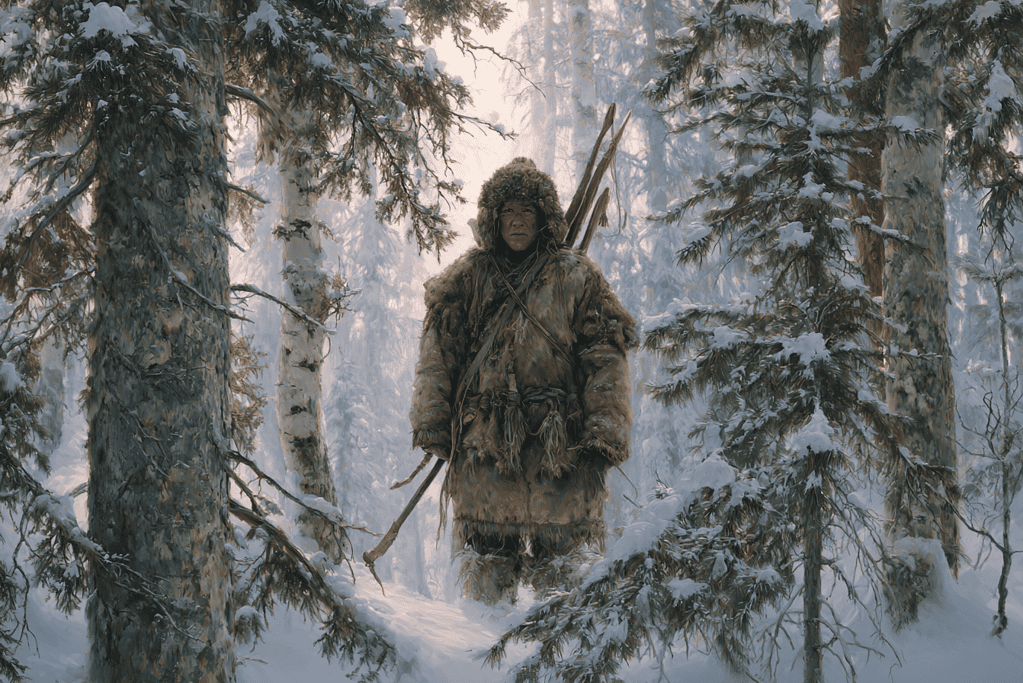
These indigenous Siberian groups historically lived as hunters and reindeer herders, adapting to forest environments and tundra regions (Vajda, 2009, p. 431).
Evenki communities were especially important in the history of Siberia because their reindeer herding techniques allowed them to move efficiently across vast forest territories.
Their skillful mobility made them essential guides and intermediaries during Russian exploration of Siberia (Rohr, 2014, p. 13).
Tungusic languages represent one of the major linguistic families of Siberia, and their distribution across eastern Siberia reflects ancient migration patterns and cultural exchanges between Siberian and East Asian populations (Vajda, 2009, p. 431).
The Chukchi live in northeastern Siberia, particularly on the Kamchatka Peninsula and nearby Arctic regions.
They belong to the Paleo-Siberian language group, which includes languages unrelated to major linguistic families such as Uralic or Turkic (Rohr, 2014, p. 10).
The Chukchi developed a specialized Arctic subsistence system based on reindeer herding, hunting marine animals, and fishing.
This adaptation allowed them to survive in extreme Arctic conditions (Vajda, 2009, p. 429).
Other Arctic indigenous groups include the Yukaghir and Ket, who represent some of the oldest surviving native Siberians. (Rohr, 2014, p. 12).
Many peoples of Siberia developed subsistence systems based on reindeer herding, hunting, and fishing.
Reindeer provided transportation, food, clothing, and shelter materials, making them essential for survival in the tundra and forest environments (Vajda, 2009, p. 429).
Nomadic and semi-nomadic lifestyles allowed indigenous groups to move seasonally in search of food and grazing land.
This mobility was especially important in the Arctic and sub-Arctic regions, where resources vary throughout the year (Rohr, 2014, p. 13).
In southern Siberia, for instance, pastoralism focused more on cattle and horse breeding, reflecting the ecological diversity of the region of Siberia.
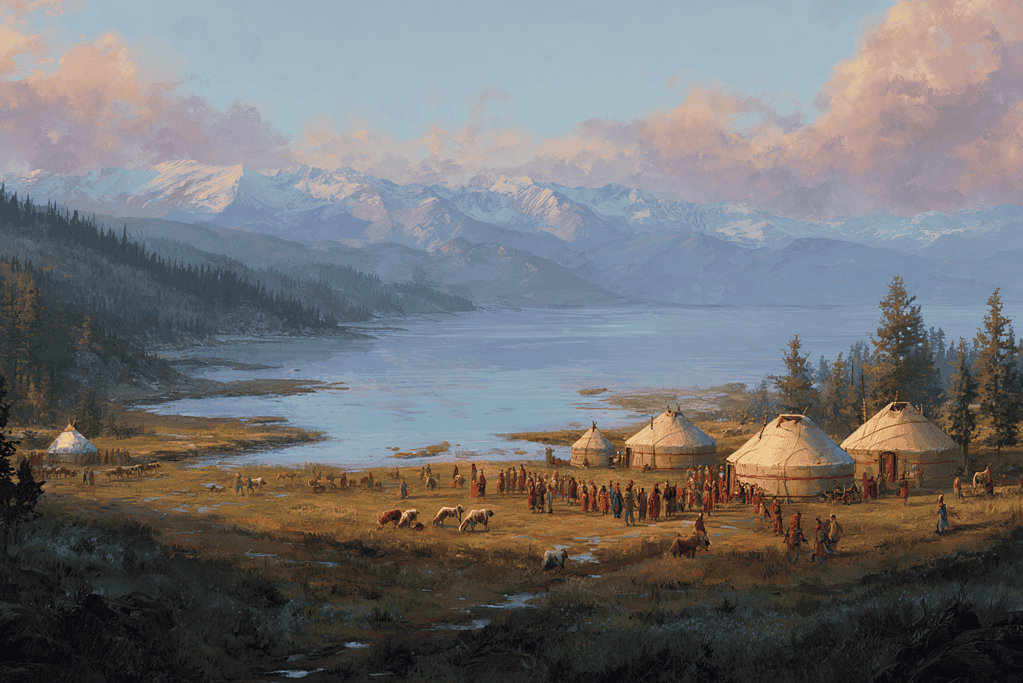
The Buryat people live primarily around Lake Baikal in southern Siberia. Their language belongs to the Mongolic family, showing connections with Mongolia and Central Asia (Rohr, 2014, p. 12).
The Buryats developed pastoral economies based on livestock and maintained cultural traditions connected to steppe nomadic societies.
Their history reflects the cultural exchanges and ancient migrations between Siberia and Mongolia (Vajda, 2009, p. 430).
Lake Baikal remains a central cultural and spiritual landmark for Buryat indigenous communities.
Shamanism represents one of the oldest spiritual systems in Siberia.
Shamans acted as intermediaries between human communities and the spirit world, performing rituals for healing, hunting success, and protection (Li, 2025, p. 369).
Shamanism, however, arose out of even older cosmological beliefs deeply rooted in a hunter-gatherer way of life.
Such beliefs involve bear-ceremonialism, in other words, bear worship in which the bear is often an ancestor to humans, a teacher and healer, animal-ceremonialism (particularly connected to elk, deer, bear), as well as ancestor, hearth/fire and seasonal hunting ceremonials.
Many indigenous Siberians later adopted Buddhism and Orthodox Christianity, especially after Russian expansion.
However, traditional shamanic beliefs often remained integrated into these newer religious systems (Li, 2025, p. 369).
Today, religious practices throughout Siberia reflect a blend of ancient indigenous traditions and newer global religions.
Forsyth, J. (1992). A history of the peoples of Siberia: Russia’s North Asian colony 1581–1990. Cambridge University Press.
Siikala, A.-L., & Hoppál, M. (Eds.). (1992). Studies in Siberian shamanism. Finnish Anthropological Society.
Li, Y. (2025). Shamanism and Christianity: Models of Religious Encounters in East Asia. Religions, 16(2), 128.
Rohr, J. (2014). Indigenous Peoples in the Russian Federation. Copenhagen: IWGIA.
Vajda, E. (2009). The Languages of Siberia. Language and Linguistics Compass, 3(1), 424–440.

ᛉ 100% handcrafted artisan pagan , viking, witchcraft and shamanic inspired jewelry.
ᛉ Runes, Symbolism & European Folklore
Get 20% off👇🏻

Happy washing day 🙃
A few rings I’ve worked on the last couple days…

Freya’s cats rule and dogs drool?
Or was that the other way around? 🙃

Garm barely shows up in the old Norse stories.
Still… he leaves a mark.
A...
Leave a comment with your result ❤️

Bavarian Folklore says that you might just cross paths with a Wolpertinger in the alpine...

🐇🌲✨
He finally stepped out of the forest…
The Wolpertinger Pendant has arrived.
Inspired by...

I don’t often sell them, but love it when I do!
Vinca symbol bracelets ❤️...

Rooted in strength + guarded by ravens

The serpent waits 🖤
(Handcrafted Jörmungandr ring made to order in my shop)

Stay warm, everyone ❤️

😑😑😑🤮

I thought I had closed the book on the Alice in Wonderland rings…
But you...

Can this be over now, please?

In case you forgot 💜

Something I’ve been thinking about lately.
If there’s one thing I would’ve done differently early...

This year, we’re not buying things just to keep up.
If you need the reminder:...

My husband is from Bavaria (southern Germany) and I originally made this Krampus pendant for...

Some of the items I’m shipping out today ❤️
Please forgive my dirty nails 😂...

A few items shipping out today 🥰

This mornings rings shipping out ❤️

A few of the rjngs I’m shipping out this morning ❤️
How do you like...

Krampus is coming 🫶🏻

Getting ready to pack up these pretties and ship to their owners ❤️

Freya, cats and pentacles. Doesn’t get any better ❤️

You all got me going crazy making all these fairytale + storybook rings.
But I’ll...

Just launched these pretties ❤️
Size 9 amethyst ring + size 7.25 green kyanite

What would you trade to learn Baba Yaga’s secrets?

It *finally* looks, feels and smells like October!
And here are some items I’m packing...

This mornings pretties getting ready to ship :)

Getting ready to pack up these pretties and ship to their owners ❤️

You bet I’m hopping on this trend 😂
Thank you @shes_sinister for the prompt!

While I welcome the seasonal darkness…it sure is going to make my morning quick videos...

Finally finished the rings I’ve been working on in my stories ❤️
I think I...

Was going to post this update to my stories but it’s too long.

“How do you know I’m mad?” said Alice.
“You must be,” said the Cat, “or...

Some of this mornings orders getting ready to ship. Those little bats are so cute...

Here is the finished ring I was working on in my stories yesterday, along with...

A few of today’s orders shipping out this morning ❤️

The two silver raven rings I was working on in my stories yesterday.
…as well...

Eeeek! I’m so happy to add these to my shop ❤️
I’ve gotten so many...

I had 6 clamshells ready to ship this morning but I dropped and lost my...

Not the story you were told.
The girl didn’t run.
The wolf didn’t win.
This...

I love these raven rings so much 🖤
This mornings pretties shipping out.
All items...

Sleek + minimal Mjölnir ring ⚒️

Today’s orders getting ready to ship.
…And I finally got some time to work on...


About the author Jacqueline Fatica


