No products in the cart.
February 3, 2026 2:05 pm

Free USA shipping on orders $35+
February 3, 2026 2:05 pm
Easter is one of the most emotionally charged holidays in the Western calendar.
For some, it is the central Christian celebration of the resurrection of Jesus Christ.
For others, it feels tangled up with eggs, bunnies, spring flowers, bonfires, and a sense of rebirth that seems older than Christianity itself.
So what are the pagan roots of Easter? Was Easter originally a pagan holiday?
Are Easter eggs and bunnies really pagan fertility symbols?
And how much of what people call “pagan origins” is actually supported by academic evidence?
This article is worth reading if you want a grounded, source-based overview of Easter customs in Europe.
Especially rural traditions involving fire, eggs, and spring celebration… and of course without slipping into invented claims.
When people talk about the pagan roots of Easter, they often mean that Easter traditions feel older than Christianity.
Eggs, hares, springtime celebration, and fertility imagery don’t automatically sound like the resurrection of Christ.
In academic folklore studies, though, “pagan” is not a simple label.
Rural Easter customs often contain layers: Christian liturgy, vernacular practice, local superstition, seasonal ritual, and community celebration all woven together.
Ethnologists emphasize that calling something “pagan” is usually interpretive rather than provable in a straight line.
Easter in village life often blends religious and profane elements, shaped by history and social change rather than a clean survival of paganism (Popelková, 2023, pp. 126–131).
So instead of asking “Is Easter pagan or Christian?”
Abetter question is: what older seasonal logics remain embedded in Easter customs?
Any honest discussion of origins of Easter has to start with Passover. Easter is linked to the festival calendar through the narrative of the crucifixion and resurrection of Jesus.
The Christian celebration of Easter developed as the commemoration of the resurrection of Jesus Christ, placed in relation to Passover and the early church’s liturgical year.
This is why Easter Sunday is not fixed like Christmas traditions. Easter was originally structured around both theological meaning and calendar calculation, tied to spring and lunar cycles.
The roots of Easter in Christianity are not a late invention: Easter celebrations were central to Christian faith from early centuries, focused on the resurrection of Jesus Christ.
The question is not whether Easter is Christian.
The question is what other celebration layers entered alongside it.
One of the most striking features of Easter is its shifting date. The date of Easter is calculated as the Sunday after the first full moon following the spring equinox.
This is why Easter falls in late March or April: it is the first Sunday after the first full moon after the spring equinox, sometimes described as the Sunday following the first full moon.
This lunar-solar calculation means Easter is always tied to the full moon after the spring equinox, or the moon after the spring equinox.
People sometimes see this as evidence of pagan origins, but it is better understood as part of the Christian church’s calendar logic: Easter season is anchored in springtime, but within a Christian framework.
That of course does not negate the possibility of pre-Christian cultural survivals in rural customs and traditions.
However, it must be emphasized that these are better understood as having both Christian and pre-christian aspects to them.
Still, the alignment with vernal equinox and rebirth themes makes it easy for many pagan celebrations to feel close in atmosphere.
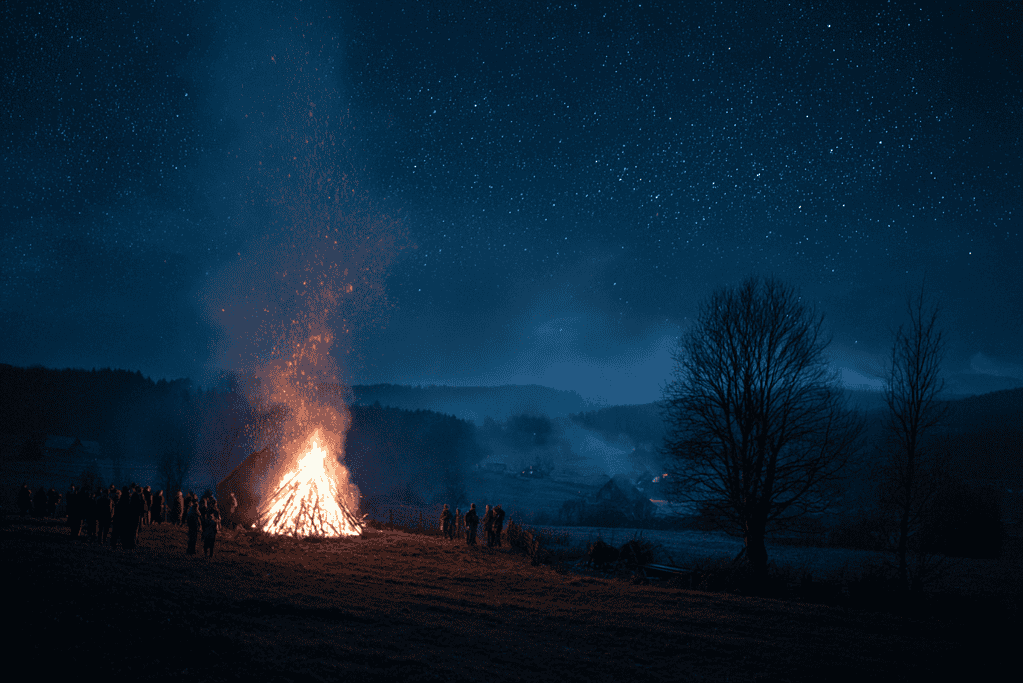
One of the strongest candidates for “pagan roots” discussion is Easter fires.
Across central and northern Europe, rural communities lit Easter bonfires and sometimes on Holy Saturday, sometimes Easter morning.
These fires functioned as public celebration, communal gathering, and ritual protection.
James Frazer documents German Easter fires where villagers carried torches to fields and treated ashes as beneficial for crops, linking the custom to fertility and agricultural blessing (Frazer, 1922, pp. 701–704).
In the Bavarian region of the Allgäu, these traditions still attract many visitors each year in order to gather around a ‘Funkenfeuer’ tradition.
Frazer also notes that in Sweden similar fires were explained as meant to frighten trolls away, showing how folk belief attached supernatural meaning to Easter customs (Frazer, 1922, p. 703).
This is not proof that Easter was originally pagan, but it shows how spring fire rites could be absorbed into Christian celebration while retaining older protective logic and cosmological aspects.
Many Easter traditions in rural Europe were not only about resurrection but about protection from harmful forces.
Ethnographic evidence from Croatia shows Easter bonfires connected explicitly to anti-witchcraft practice.
One account reports driving cattle through the diminished fire so witches would not harm them that year (Kotarski, 1917, cited in Đaković, 2006/2007, p. 46).
This is a clear example of pagan practice? Not exactly. It is better described as vernacular Christianity mixed with folk cosmology. Two cosmologies merged together.
The same study shows tension between church ritual and village bonfire celebration, with priests sometimes disapproving while villagers treated the custom as popular religiosity (Đaković, 2006/2007, pp. 47–50).
Here, pagan tradition is less about gods and more about folk survival logic: fire protects, spring renews, community gathers.

The Easter egg is perhaps the most famous symbol associated with Easter traditions.
Online, eggs on Easter are constantly labeled as pagan fertility symbols. Academic literature is more cautious.
Mariya Lesiv shows that pysanky (Ukrainian decorated eggs) functioned as ritual objects in rural life, but she also emphasizes how earlier ethnographers presumed survivals of an “ancient solar cult” (Lesiv, 2007, pp. 2–3). It could be true but evidence remains scarce.
Eggs are certainly seen as fertility symbols in many cultures and also in pre-Christian Europe this was the case.
To decorate eggs is one of the most widespread Easter customs.
Egg hunts, chocolate Easter treats, and Easter eggs and bunnies dominate modern celebration, but medieval evidence suggests egg traditions often spread during early medieval times.
Viktoryia Makouskaya’s archaeological study of medieval “Easter egg” artifacts argues that their distribution aligns with the spread of Christianity and church building (Makouskaya, 2024, pp. 159–161).
So eggs on Easter can carry rebirth imagery and both pre-Christian and Christian cosmologies emphasized that aspect in traditions and customs.
The egg and the bunny become symbols in Christian celebration as well, layered meanings rather than single origins.
The hare has long been associated with spring and fertility, making it easy to claim the Easter hare is a pagan goddess relic.
Historically, though, Easter bunnies are strongly linked to early modern German-speaking traditions and later transmission through German immigrants.
This is a case where a folk custom becomes commercialized and globalized, however, the hare may indeed have pre-Christian origins but its former meaning have become somewhat lost over time.
The bunny as symbol of fertility fits spring celebration, but academic caution remains: association is not proof of origin.
The question of Eostre is one of the most debated points in pagan roots of Easter discussions.
Some claim Easter is named for a pagan goddess of spring and fertility named Eostre.
Academic consensus is careful: evidence is thin, largely resting on early medieval references and later reconstruction.
The English word Easter comes from Old English word ēastre, but linking this directly to a named pagan goddess requires caution.
Most of what circulates online about named Eostre is not ethnographically grounded.
So if you want to explore the pagan roots responsibly, this is where restraint matters most.

Easter is saturated with spring symbolism.
Rebirth after winter, life after the cold, the return of green growth.
These themes are universal in northern climates.
The equinox and spring equinox mark seasonal turning points, making Easter season feel naturally aligned with renewal.
Easter celebrations become a celebration of resurrection and also a celebration of spring itself.
This is why Christianity and paganism often feel intertwined in popular imagination: both respond to the same seasonal realities.
Certain traditions involving fire, water, eggs, fertility motifs carry deep pre-Christian resonance, even when fully absorbed into Christian celebration of Easter.
Đaković, S. (2006/2007). Easter fires in north-western Croatia. Etnološka istraživanja / Ethnological Researches, 12–13, 43–56.
Frazer, J. G. (1922). The Golden Bough: A Study in Magic and Religion (Abridged ed.). Macmillan.
Lesiv, M. (2007). From ritual object to art form: The Ukrainian Easter egg pysanka in its Canadian context. Folklorica, 12, 1–32.
Makouskaya, V. (2024). The phenomenon of medieval “Easter eggs”: Types of artifacts, probable ways of their distribution and functions. Folia Praehistorica Posnaniensia, 29, 159–182.
Popelková, K. (2023). Easter holiday and the pandemic – the case of Slovakia in 2020. Slovenský národopis / Slovak Ethnology, 71(2), 126–146.

ᛉ 100% handcrafted artisan pagan , viking, witchcraft and shamanic inspired jewelry.
ᛉ Runes, Symbolism & European Folklore
Get 20% off👇🏻

Five witches dance around a blazing bonfire beneath a citrine cabochon in this Walpurgisnacht pendant....
Happy washing day 🙃
A few rings I’ve worked on the last couple days…
Freya’s cats rule and dogs drool?
Or was that the other way around? 🙃

Garm barely shows up in the old Norse stories.
Still… he leaves a mark.
A...
Leave a comment with your result ❤️
Bavarian Folklore says that you might just cross paths with a Wolpertinger in the alpine...

🐇🌲✨
He finally stepped out of the forest…
The Wolpertinger Pendant has arrived.
Inspired by...

I don’t often sell them, but love it when I do!
Vinca symbol bracelets ❤️...

Rooted in strength + guarded by ravens

The serpent waits 🖤
(Handcrafted Jörmungandr ring made to order in my shop)

Stay warm, everyone ❤️

😑😑😑🤮

I thought I had closed the book on the Alice in Wonderland rings…
But you...

Can this be over now, please?

In case you forgot 💜

Something I’ve been thinking about lately.
If there’s one thing I would’ve done differently early...

This year, we’re not buying things just to keep up.
If you need the reminder:...

My husband is from Bavaria (southern Germany) and I originally made this Krampus pendant for...

Some of the items I’m shipping out today ❤️
Please forgive my dirty nails 😂...

A few items shipping out today 🥰

This mornings rings shipping out ❤️

A few of the rjngs I’m shipping out this morning ❤️
How do you like...

Krampus is coming 🫶🏻

Getting ready to pack up these pretties and ship to their owners ❤️

Freya, cats and pentacles. Doesn’t get any better ❤️

You all got me going crazy making all these fairytale + storybook rings.
But I’ll...

Just launched these pretties ❤️
Size 9 amethyst ring + size 7.25 green kyanite

What would you trade to learn Baba Yaga’s secrets?

It *finally* looks, feels and smells like October!
And here are some items I’m packing...

This mornings pretties getting ready to ship :)

Getting ready to pack up these pretties and ship to their owners ❤️

You bet I’m hopping on this trend 😂
Thank you @shes_sinister for the prompt!

While I welcome the seasonal darkness…it sure is going to make my morning quick videos...

Finally finished the rings I’ve been working on in my stories ❤️
I think I...

Was going to post this update to my stories but it’s too long.

“How do you know I’m mad?” said Alice.
“You must be,” said the Cat, “or...

Some of this mornings orders getting ready to ship. Those little bats are so cute...

Here is the finished ring I was working on in my stories yesterday, along with...

A few of today’s orders shipping out this morning ❤️

The two silver raven rings I was working on in my stories yesterday.
…as well...

Eeeek! I’m so happy to add these to my shop ❤️
I’ve gotten so many...

I had 6 clamshells ready to ship this morning but I dropped and lost my...

Not the story you were told.
The girl didn’t run.
The wolf didn’t win.
This...

I love these raven rings so much 🖤
This mornings pretties shipping out.
All items...

Sleek + minimal Mjölnir ring ⚒️


About the author Jacqueline Fatica


