No products in the cart.
November 4, 2025 11:58 am

Free USA shipping on orders $35+
November 4, 2025 11:58 am
Every December, debates reappear online claiming that Christmas is just a pagan Christmas, a disguised pagan holiday, or “really” the continuation of Yule or Saturnalia.
Many bloggers and social media posts insist that the origins of Christmas have nothing to do with the birth of Jesus at all, and that nearly every Christmas tradition comes from older pagan customs.
The truth is more interesting than the myth. Academic historians have spent decades researching the origins of the Christmas date, the feast day, and the rituals around it.
The result is not a simple story of Christians “copying pagans.”
Instead, the sources reveal a fascinating blend, overlap, and reinterpretation in a world where older traditions could not simply be erased.
What follows is a grounded, scholarly guide to the real history of pagan Christmas traditions, based only on academic works, not speculation.
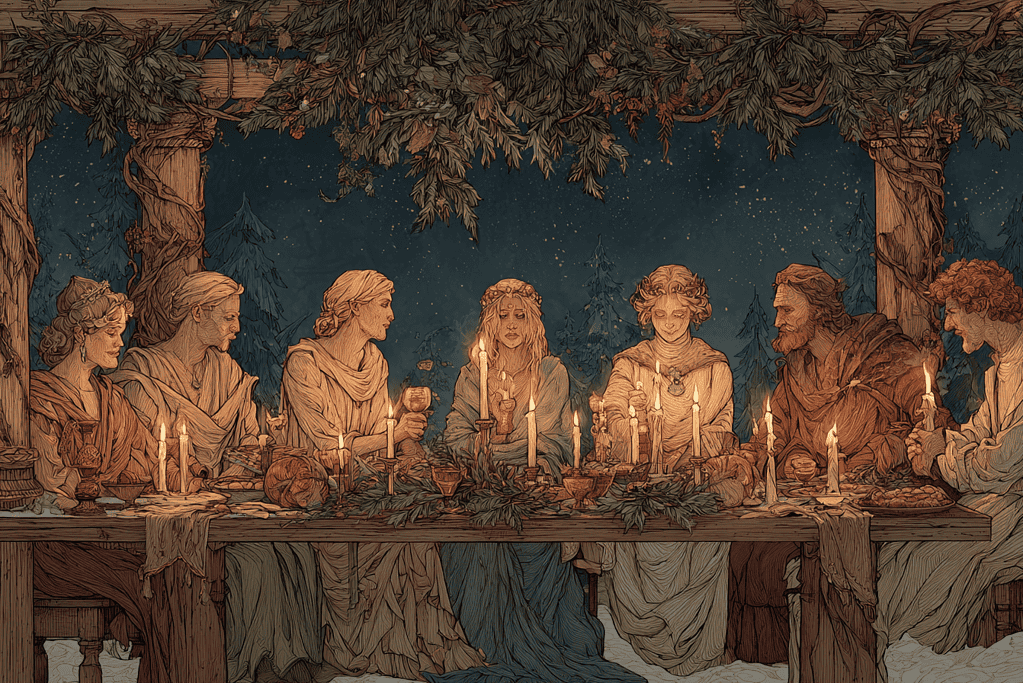
Many online claims state that early Christians chose December 25 because it was already a pagan festival honoring a sun god, making Christmas originally pagan in origin.
However, modern scholars point out that the situation is more complicated.
C. P. E. Nothaft notes that historians used to believe Christians deliberately placed Christ’s birth on the winter solstice to imitate the celebrations of Sol Invictus, the Roman sun god (Nothaft, 2012, pp. 903–904).
Yet the early Christian writers who calculated the date rarely mention pagans at all.
Instead, they calculated the date based on theology: if Jesus was believed to have been conceived on March 25, then his birth would fall nine months later on December 25 (Nothaft, 2012, p. 906).
This means the origins of Christmas are not proven to be a direct takeover of a pagan festival.
At the same time, early Christians lived in a world filled with older customs. That made overlap unavoidable.
The date of Christmas is often claimed to be pagan, but there is no ancient source stating that Church leaders intentionally replaced Saturnalia or another festival.
According to Nothaft, early Christians on both sides of the Empire arrived at December 25 through theological reasoning rather than through copying pagans (2012, pp. 905–907).
However, the choice of a time near the winter solstice carried symbolic meaning.
The birth of Christ as the “light of the world” being celebrated near the darkest time of year offered powerful imagery, especially once Christianity became dominant (Strittmatter, 1941, p. 25).
So while December 25 was not demonstrably stolen from pagans, late antiquity created an environment where religious symbolism overlapped.

One of the most persistent claims about pagan Christmas is that the Roman Saturnalia is the true ancestor of the Christmas season.
Saturnalia was a major celebration of the Roman god Saturn, traditionally held on December 17, but expanded at various points to last up to seven days (Churco, 1938, p. 25).
The Saturnalian season included feasting, leisure, public merriment, and gift giving (Churco, 1938, p. 25). Strittmatter notes that as Christianity spread, many older Roman customs continued socially, even as their religious meaning faded (1941, p. 25).
The Church sometimes attempted to suppress these customs, which is evidence that Romans continued practicing them (Strittmatter, 1941, p. 25).
So was Saturnalia the pagan origin of Christmas?
The academic answer: Saturnalian customs influenced the surrounding culture, which influenced Christmas. But Christmas itself was not simply Saturnalia renamed.
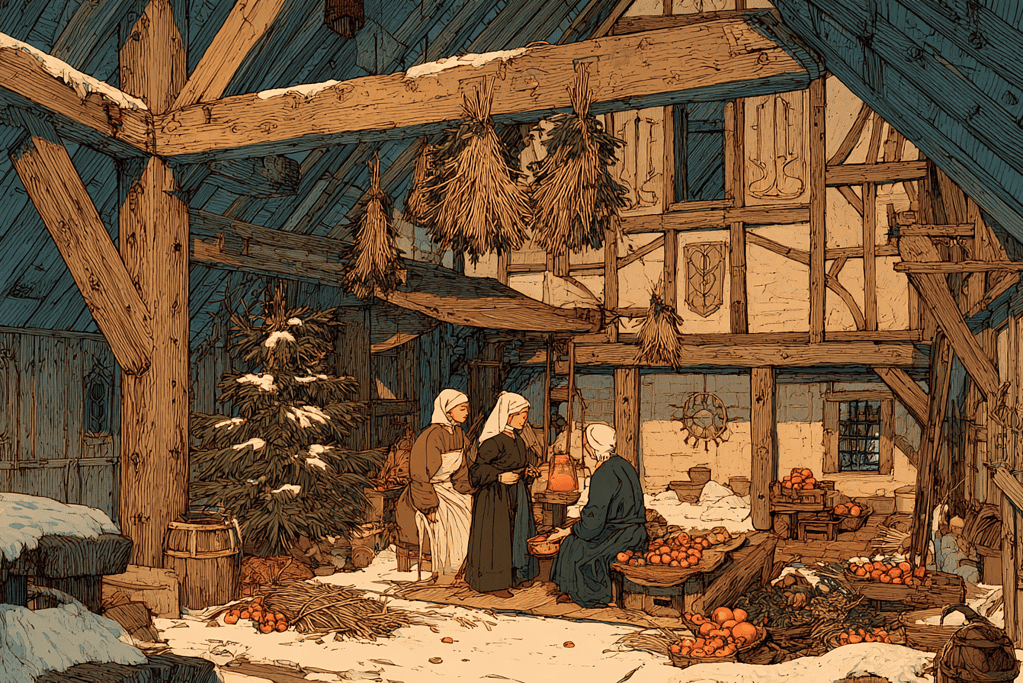
Writers often claim the Christmas tree is a purely pagan tradition, but academic sources caution against certainty.
Romans decorated homes and streets with evergreens during Saturnalia, and early Christian moralists criticized this practice when Christians adopted it (Churco, 1938, p. 25).
Medieval communities across Europe continued decorating with laurel and greenery (Churco, 1938, pp. 25–26).
The modern German Christmas tree emerged much later, first recorded in the late 1500s, decorated with apples, wafers, roses, and gold foil (Churco, 1938, p. 26).
That means the Christmas tree is not directly inherited from a pagan festival, but evergreen customs were common long before Christianity.
In other words: Evergreens are ancient but the Christmas tree is medieval. The two can be related culturally without proving direct pagan borrowing
The burning of a Yule log is frequently cited as a survival of pagan Yule, but the academic record is subtle. Churco notes that large winter fires were common in Roman Kalends celebrations, and early Christian clergy attempted to suppress them (1938, p. 25).
In England, a ceremonial log was burned at Christmas as a public celebration (Churco, 1938, p. 26).
Strittmatter also records that winter fires and feasts were deeply rooted pagan practices, and these customs survived long after conversion (1941, p. 25).
The academic conclusion:
The Yule log today is Christmas-related, but the practice of wintertime fires is much older.
Modern gift-giving is sometimes described as a pagan tradition, especially when linked to Saturnalia.
Churco explains that the Romans exchanged strenae, small presents, during Saturnalia (1938, p. 26). In France, New Year gifts are still called étrennes, linguistically descended from strenae (Churco, 1938, p. 26).
The Church attempted to establish Christmas Eve as a fasting day to counter public feasting, but the celebration continued. In fact, Puritans later attempted to ban Christmas feasting as pagan (Churco, 1938, p. 26).
These customs show that pagan roots of celebration remained socially powerful even in Christian times.
Gudmund Schütte offers insight into Danish paganism. In Denmark, Yule was a pre-Christian winter celebration of feasting, sacrifice, and drinking (Schütte, 1924, p. 361). After conversion, Yule merged with Christmas and retained elements of its older character.
Schütte describes pagan practices such as sacrificial toasting and ritual drinking that were performed at Yule (1924, pp. 361–362). The pagan festival did not disappear; it transformed.
This reinforces the larger scholarly position:
Christmas did not replace Yule.
Christmas absorbed Yule.
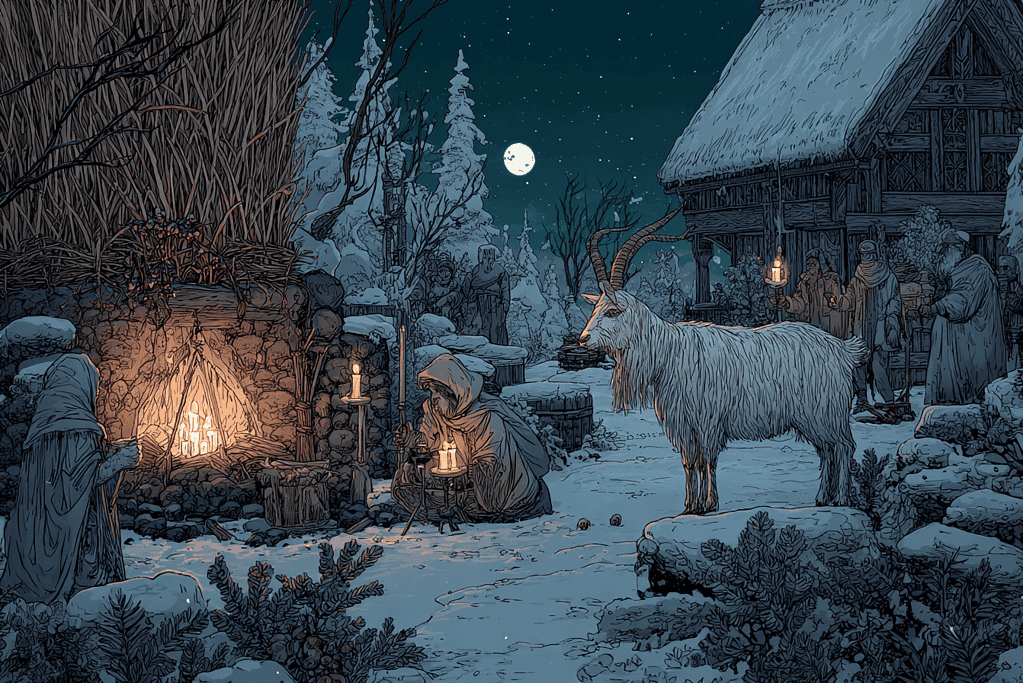
Sweden adds another layer. A. Kellgren Cyriax describes Swedish Christmas customs, including straw ornaments, evergreen decorations, and the presence of the Yule Goat (1923, p. 314).
These were not Christian inventions. They were rural folk traditions that predated modern church influence.
Straw work, house-visiting, and pagan yule symbolism remained alive in Swedish villages long after conversion.
The academic papers do not claim that these are direct survivals from a documented ancient ritual, but they show cultural continuity.
Christmas in Nordic countries became a negotiation between Christian liturgy and rural heritage.
The strongest scholarly lesson is that history is not binary. Christmas was not originally pagan. It was a Christian holy day born within a world where ancient and pagan traditions remained socially powerful.
Nothaft emphasizes that modern claims of a stolen festival often appear in popular writing rather than serious scholarship (2012, pp. 904–906). Strittmatter and Churco both show
that pagan customs continued not because priests copied pagans, but because communities kept their favorite celebrations (Strittmatter, 1941, p. 25; Churco, 1938, p. 26).
So the real answer to whether Christmas traditions are pagan in origin is layered:
This is more nuanced, and more interesting, than the claim that Christmas was “stolen.”
Instead of being a purely pagan holiday or a purely Christian one, Christmas is a cultural hybrid. It grew in a world where ancient winter customs could not simply vanish.
The festival became a Christian holy day layered over older seasonal rhythms, agricultural cycles, and community celebrations.
This blending is exactly what Ronald Hutton describes: early conversion did not mean the annihilation of old beliefs.
It meant reinterpretation, adaptation, and survival inside new frameworks (Hutton, 2022, pp. 271–273).
Christmas is neither pagan nor purely Christian. It is both, historically speaking.
Churco, J. M. (1938). Christmas and the Roman Saturnalia. The Classical Outlook, 16(3), 25–26.
Nothaft, C. P. E. (2012). The Origins of the Christmas Date: Some Recent Trends in Historical Research. Church History, 81(4), 903–911.
Schütte, G. (1924). Danish Paganism. Folklore, 35(4), 360–371.
Strittmatter, D. A. (1941). Christmas and The Epiphany: Their Pagan Antecedents. The Classical Outlook, 19(3), 25–26.
Hutton, R. (2022). The Conversion to Christianity: A Clash of Religions, A Blend of Religions. In Pagan Britain. Yale University Press.
Cyriax, A. K. (1923). Swedish Christmas Customs. Folklore, 34(4), 314–321.

ᛉ 100% handcrafted artisan pagan , viking, witchcraft and shamanic inspired jewelry.
ᛉ Runes, Symbolism & European Folklore
Get 20% off👇🏻

Five witches dance around a blazing bonfire beneath a citrine cabochon in this Walpurgisnacht pendant....
Happy washing day 🙃
A few rings I’ve worked on the last couple days…
Freya’s cats rule and dogs drool?
Or was that the other way around? 🙃

Garm barely shows up in the old Norse stories.
Still… he leaves a mark.
A...
Leave a comment with your result ❤️
Bavarian Folklore says that you might just cross paths with a Wolpertinger in the alpine...

🐇🌲✨
He finally stepped out of the forest…
The Wolpertinger Pendant has arrived.
Inspired by...

I don’t often sell them, but love it when I do!
Vinca symbol bracelets ❤️...

Rooted in strength + guarded by ravens

The serpent waits 🖤
(Handcrafted Jörmungandr ring made to order in my shop)

Stay warm, everyone ❤️

😑😑😑🤮

I thought I had closed the book on the Alice in Wonderland rings…
But you...

Can this be over now, please?

In case you forgot 💜

Something I’ve been thinking about lately.
If there’s one thing I would’ve done differently early...

This year, we’re not buying things just to keep up.
If you need the reminder:...

My husband is from Bavaria (southern Germany) and I originally made this Krampus pendant for...

Some of the items I’m shipping out today ❤️
Please forgive my dirty nails 😂...

A few items shipping out today 🥰

This mornings rings shipping out ❤️

A few of the rjngs I’m shipping out this morning ❤️
How do you like...

Krampus is coming 🫶🏻

Getting ready to pack up these pretties and ship to their owners ❤️

Freya, cats and pentacles. Doesn’t get any better ❤️

You all got me going crazy making all these fairytale + storybook rings.
But I’ll...

Just launched these pretties ❤️
Size 9 amethyst ring + size 7.25 green kyanite

What would you trade to learn Baba Yaga’s secrets?

It *finally* looks, feels and smells like October!
And here are some items I’m packing...

This mornings pretties getting ready to ship :)

Getting ready to pack up these pretties and ship to their owners ❤️

You bet I’m hopping on this trend 😂
Thank you @shes_sinister for the prompt!

While I welcome the seasonal darkness…it sure is going to make my morning quick videos...

Finally finished the rings I’ve been working on in my stories ❤️
I think I...

Was going to post this update to my stories but it’s too long.

“How do you know I’m mad?” said Alice.
“You must be,” said the Cat, “or...

Some of this mornings orders getting ready to ship. Those little bats are so cute...

Here is the finished ring I was working on in my stories yesterday, along with...

A few of today’s orders shipping out this morning ❤️

The two silver raven rings I was working on in my stories yesterday.
…as well...

Eeeek! I’m so happy to add these to my shop ❤️
I’ve gotten so many...

I had 6 clamshells ready to ship this morning but I dropped and lost my...

Not the story you were told.
The girl didn’t run.
The wolf didn’t win.
This...

I love these raven rings so much 🖤
This mornings pretties shipping out.
All items...

Sleek + minimal Mjölnir ring ⚒️


About the author Jacqueline Fatica


