No products in the cart.
March 21, 2026 7:52 pm

Free USA shipping on orders $35+
March 21, 2026 7:52 pm
Norse mythology preserves a vivid landscape of supernatural beings, cosmic animals, and destructive monsters that populated the imagination of medieval Scandinavian society.
These creatures in Norse mythology appear in Old Norse poems, heroic narratives, and mythological prose texts that describe the structure of the universe from the world tree Yggdrasil to the realm of Hel.
They function not only as fearsome adversaries of the Norse gods but also as symbolic expressions of natural forces, mortality, and fate.
Exploring Norse creatures offers insight into how Viking-Age communities interpreted danger, chaos, and cosmic order.
From monstrous wolves that chase the sun and the moon to sea monsters lurking in the northern ocean, the mythology reveals a worldview shaped by harsh landscapes and seafaring experience.
Studying these mythical creatures allows modern readers to understand the deeper narrative framework of Norse myths and their enduring cultural influence.
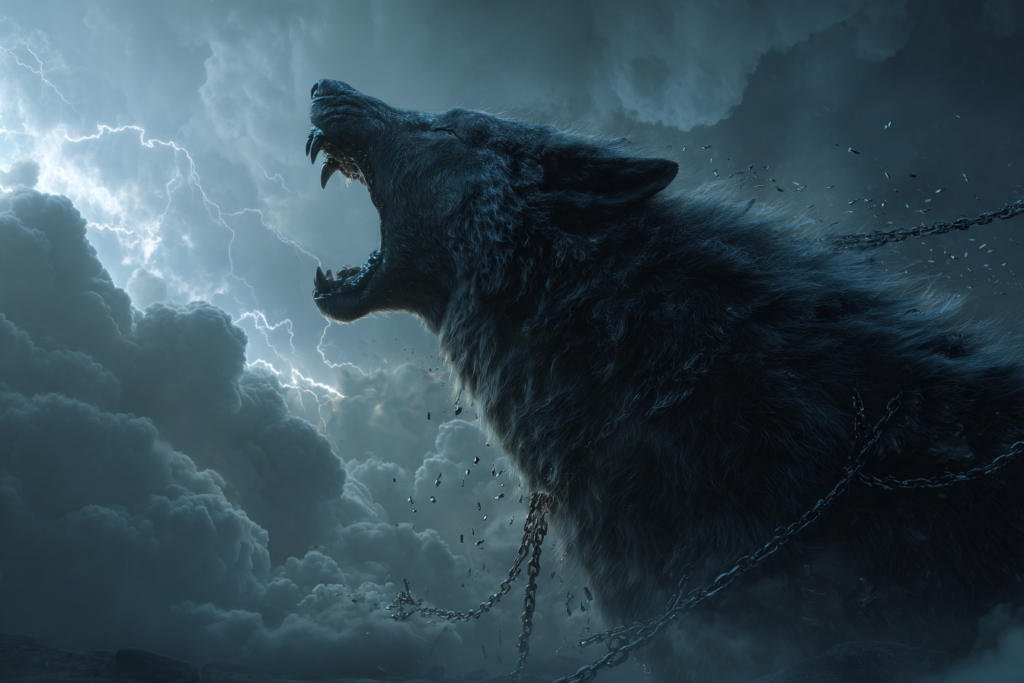
One of the most fearsome beings in Norse mythology is Fenrir, the monstrous wolf born as a child of Loki and the giantess Angrboda.
Raised among the Aesir yet regarded with growing dread, this wolf becomes so powerful that the gods of Asgard bind him using the magical fetter Gleipnir.
His story reflects the mythological theme that forces of destruction cannot be contained forever.
During Ragnarök, Fenrir breaks free and devours Odin, ruler among the Norse gods, bringing the ordered world into darkness.
The wolf’s role in the end of days illustrates how Norse mythology portrays cosmic catastrophe as both inevitable and cyclical.
Fenrir stands as a central beast whose existence marks the fragile boundary between divine authority and chaos.
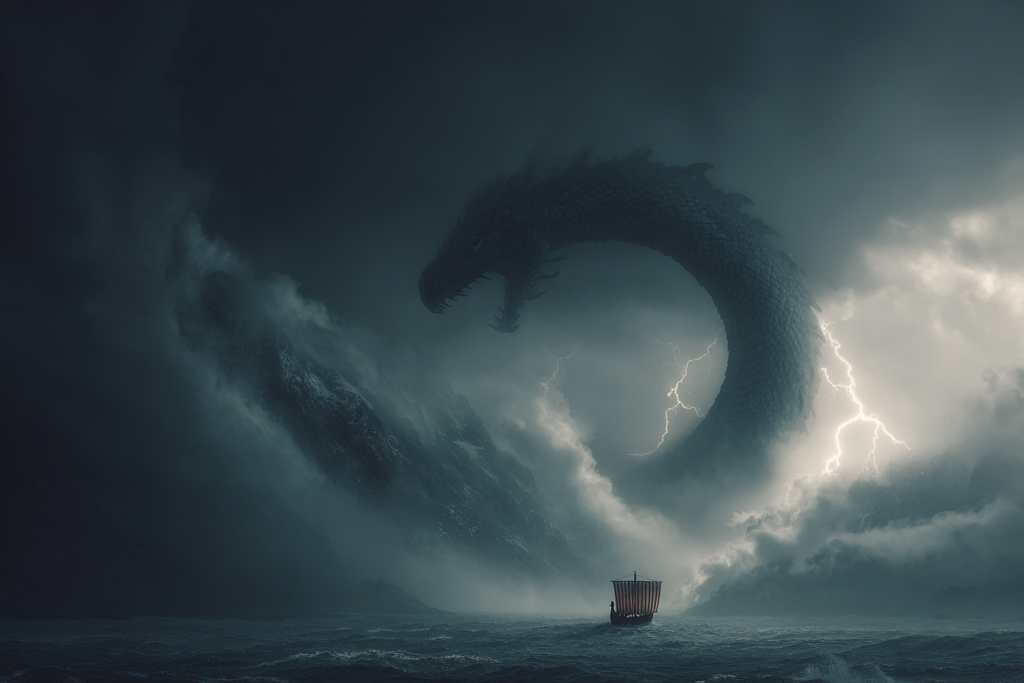
The colossal serpent Jörmungandr, often called the Midgard serpent, occupies a crucial place among creatures in Norse mythology.
Cast into the sea by Odin, the serpent grows until he encircles Midgard itself.
This imagery reflects mythological ideas about the ocean as a boundary separating the human world from the unknown.
Encounters between Thor and Jörmungandr demonstrate the tension between heroic action and unavoidable fate.
Their final battle during Ragnarök ends with the god slaying the serpent yet succumbing shortly afterward to its venom.
Through this myth, Scandinavian tradition expresses how cosmic balance is maintained through struggle and sacrifice.
The draugr represents one of the most unsettling undead beings described in Norse folklore and saga literature.
Unlike insubstantial ghosts, this revenant retains a physical body capable of immense strength and action.
Stories of such undead figures often emphasize the stench of decay and the terror they inspire among the living.
Encounters with a draugr frequently involve heroes forced to slay the creature to restore order to their community.
These narratives reveal social concerns about burial practices, memory, and the relationship between the living and the realm of the dead.
In this way, Norse mythology integrates supernatural fear with ethical and ritual values.
Medieval Scandinavian texts describe enormous sea monsters inhabiting the northern ocean.
The hafgufa is portrayed as a colossal sea creature that lures fish into its mouth, while the lyngbakr resembles an island that sinks beneath ships once sailors land upon it.
Such stories reflect maritime anxieties experienced by Viking navigators.
These accounts belong to the broader myth and folklore tradition in which the ocean represents both livelihood and mortal danger.
The sea monster motif reinforces the perception of the natural world as unpredictable and inhabited by mysterious forces. Through these tales, Norse mythology preserves cultural memories of seafaring risk.
Among the more unusual Norse creatures is Sleipnir, Odin’s eight-legged horse capable of traveling between worlds.
Born when Loki assumes the form of a mare, this eight-legged animal becomes a symbol of supernatural mobility. The horse carries Odin across the realms, including journeys toward the underworld.
Sleipnir’s role reflects shamanic elements within Norse mythology and emphasizes the connection between divine authority and mythic animals.
His presence demonstrates that not all mythological beings are monstrous; some function as sacred companions or guides.
Through Sleipnir, the mythology illustrates the permeability of cosmic boundaries.
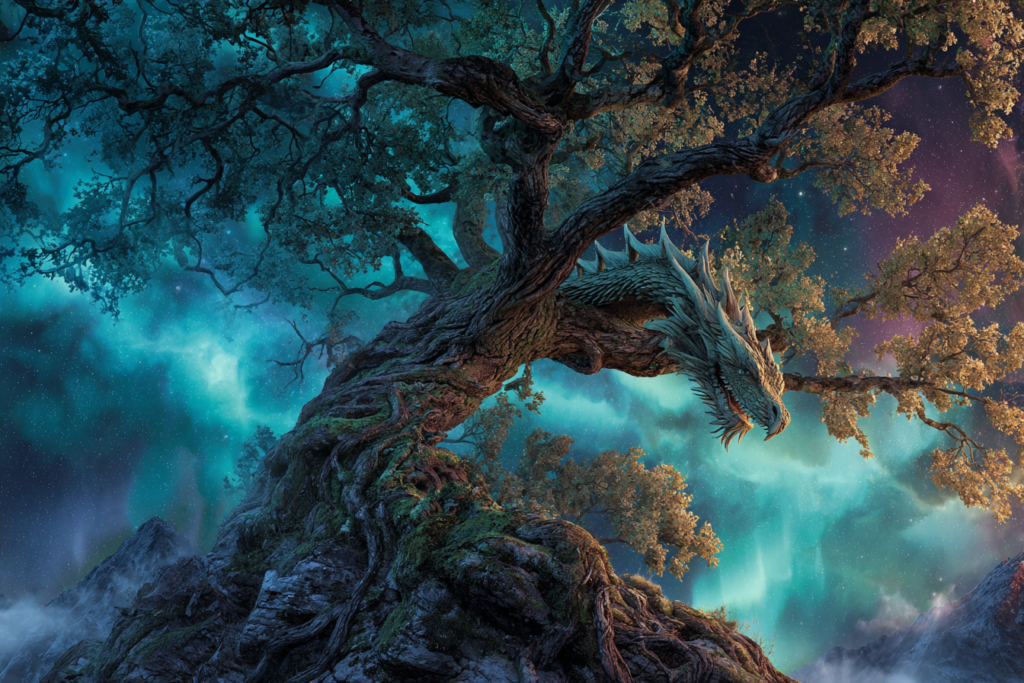
At the roots of the world tree dwells the dragon Níðhöggr, who gnaws at the foundations of creation.
This serpent-like beast feeds upon the dead in the realm of Hel and symbolizes moral corruption and decay. His actions threaten the stability of the mythological cosmos itself.
The image of a dragon gnawing at the roots of the tree reflects the Norse creation narrative in which order continually faces erosion.
Such symbolism would have resonated strongly with medieval audiences aware of environmental hardship and mortality.
Níðhöggr embodies the inevitable decline that precedes renewal.
Norse mythology describes two fearsome wolves, Sköll and Hati, who chase celestial bodies across the heavens.
These monstrous wolf figures pursue the sun and the moon, explaining the movement of the sky through narrative imagery. Their relentless hunt foreshadows cosmic catastrophe.
At Ragnarök, the wolves finally catch their prey, plunging the world into darkness and marking the collapse of divine order.
This myth demonstrates how Norse mythology integrates astronomical observation with symbolic storytelling. The wolves function as agents of destiny within the mythological structure.
Ratatoskr, a cunning squirrel dwelling on Yggdrasil, carries hostile messages between the eagle above and the dragon below.
His activity illustrates the interconnected nature of the mythological cosmos. Even small animals play significant roles in sustaining cosmic tension.
The world tree hosts numerous mythical creatures, including stags feeding upon its branches and serpents inhabiting its roots.
Such imagery emphasizes the idea that the universe is a living structure sustained by relationships among beings.
This vision reflects the holistic worldview of Old Norse tradition.
Not all supernatural beings in Norse mythology are monsters. The jötnar, or giants, often appear as powerful ancestral forces connected to nature and primordial chaos.
Figures such as Ymir, the first being in the Norse creation story, reveal how mythology portrays creation emerging from conflict.
Dwarfs and elf beings also populate Norse tales as skilled craftsmen or mysterious spirits. Their presence complicates simple distinctions between gods and monstrous creatures.
Norse mythology therefore presents a diverse mythological landscape shaped by narrative ambiguity and symbolic meaning.
The ruler of the underworld, Hel, governs a realm inhabited by the spirits of those who did not fall in battle.
At its gates stands the hound Garm, a monstrous guardian whose howling heralds Ragnarök. This underworld reflects beliefs about fate and the inevitability of death.
In contrast, valkyries act as female spirits guiding slain warriors toward Valhalla rather than Helheim. Their role illustrates the importance of heroic identity in Viking culture.
Together these figures reveal how Norse mythology structured the journey between life, death, and cosmic renewal.
Odin’s ravens, Huginn and Muninn, travel across the world gathering knowledge for the god. These birds symbolize memory, thought, and divine perception.
Their presence shows that animals in Norse mythology often carry symbolic as well as narrative significance.
Other mythological beings, such as the eagle giant Hræsvelgr who creates the wind with his wings, reinforce the connection between natural forces and supernatural agency.
Through these figures, Norse myths depict a cosmos animated by living powers.
The monsters and creatures of Norse mythology form a complex symbolic system reflecting the environmental realities and cultural imagination of medieval Scandinavia.
Fearsome wolves, serpents, undead revenants, and sea monsters all contribute to a worldview shaped by uncertainty and resilience.
These Norse monsters and creatures reveal how myth functioned as a framework for interpreting cosmic cycles and human experience.
Studying creatures in Norse mythology allows modern readers to approach ancient texts with historical awareness and philological precision.
By tracing these beings through Old Norse sources, we gain insight into how mythological narratives preserved cultural memory across generations.
The enduring fascination with Norse creatures demonstrates the continuing relevance of these powerful mythic traditions.
Ármann Jakobsson. (2009). The undead in the sagas of Icelanders. Scandinavian Studies, 81(3), 281–304.
Faulkes, A. (Trans.). (1987). Edda. Everyman.
Larrington, C. (Trans.). (2014). The Poetic Edda. Oxford University Press.
Larson, L. M. (Trans.). (1917). The King’s Mirror (Konungs skuggsjá). American-Scandinavian Foundation.
Lindow, J. (2001). Norse Mythology: A Guide to Gods, Heroes, Rituals, and Beliefs. Oxford University Press.
Simek, R. (2007). Dictionary of Northern Mythology (A. Hall, Trans.). D. S. Brewer.
Byock, J. (Trans.). (1999). The Saga of the Volsungs. Penguin Classics.
Smiley, J., & Ellison, R. (Trans.). (2005). The Sagas of the Icelanders. Penguin Classics.

ᛉ 100% handcrafted artisan pagan , viking, witchcraft and shamanic inspired jewelry.
ᛉ Runes, Symbolism & European Folklore
Get 20% off👇🏻

Five witches dance around a blazing bonfire beneath a citrine cabochon in this Walpurgisnacht pendant....
Happy washing day 🙃
A few rings I’ve worked on the last couple days…
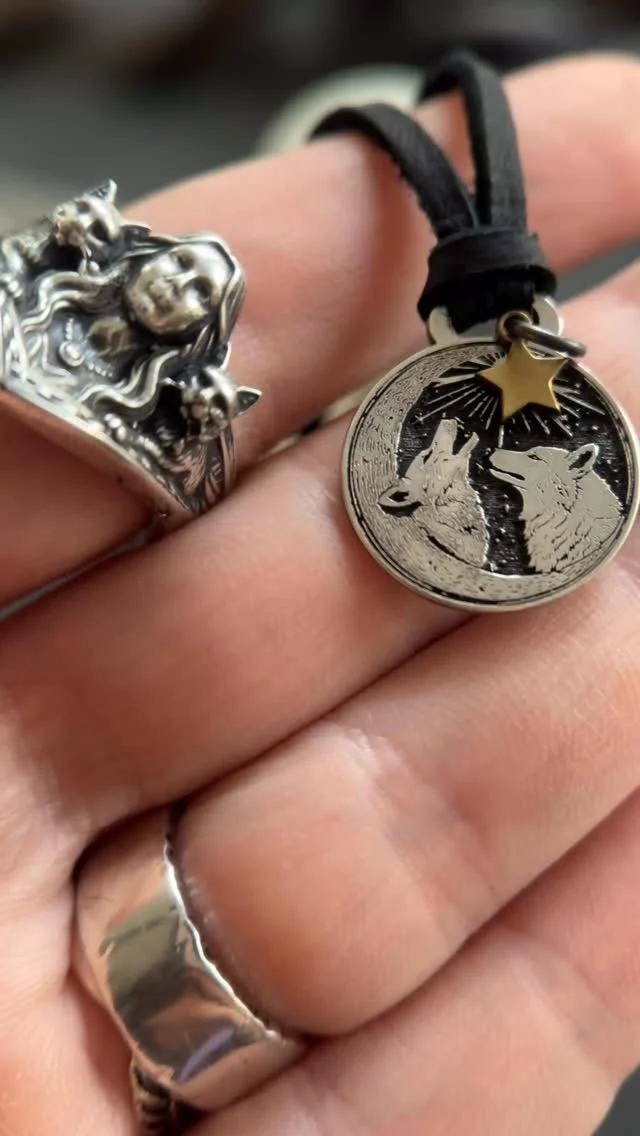
Freya’s cats rule and dogs drool?
Or was that the other way around? 🙃

Garm barely shows up in the old Norse stories.
Still… he leaves a mark.
A...
Leave a comment with your result ❤️
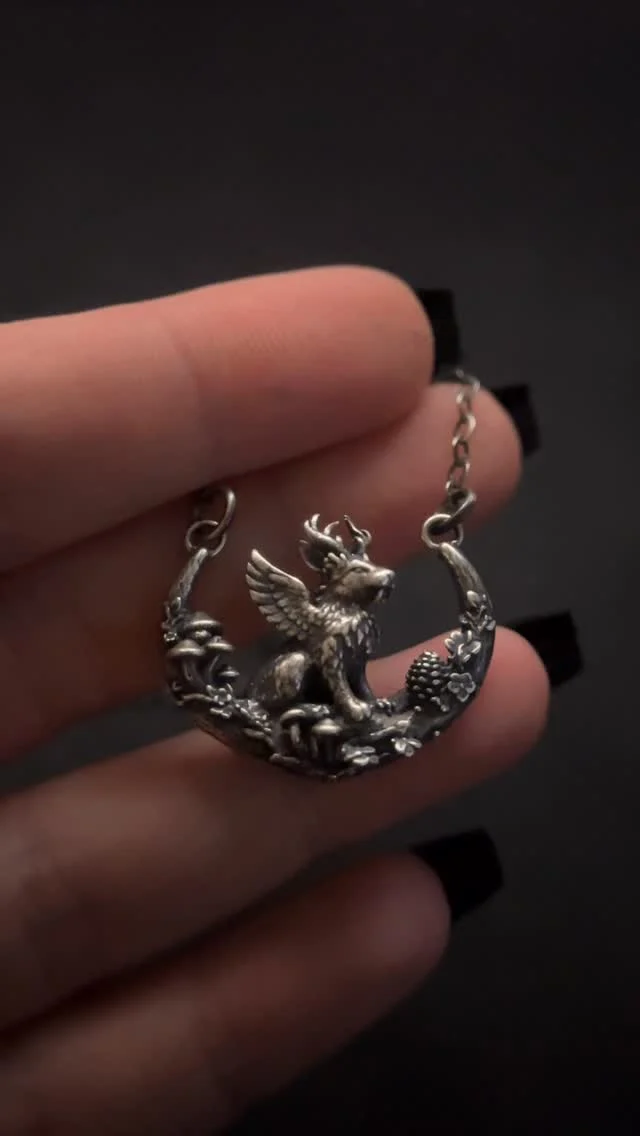
Bavarian Folklore says that you might just cross paths with a Wolpertinger in the alpine...

🐇🌲✨
He finally stepped out of the forest…
The Wolpertinger Pendant has arrived.
Inspired by...

I don’t often sell them, but love it when I do!
Vinca symbol bracelets ❤️...

Rooted in strength + guarded by ravens

The serpent waits 🖤
(Handcrafted Jörmungandr ring made to order in my shop)

Stay warm, everyone ❤️

😑😑😑🤮

I thought I had closed the book on the Alice in Wonderland rings…
But you...

Can this be over now, please?

In case you forgot 💜

Something I’ve been thinking about lately.
If there’s one thing I would’ve done differently early...

This year, we’re not buying things just to keep up.
If you need the reminder:...

My husband is from Bavaria (southern Germany) and I originally made this Krampus pendant for...

Some of the items I’m shipping out today ❤️
Please forgive my dirty nails 😂...

A few items shipping out today 🥰

This mornings rings shipping out ❤️

A few of the rjngs I’m shipping out this morning ❤️
How do you like...

Krampus is coming 🫶🏻

Getting ready to pack up these pretties and ship to their owners ❤️

Freya, cats and pentacles. Doesn’t get any better ❤️

You all got me going crazy making all these fairytale + storybook rings.
But I’ll...

Just launched these pretties ❤️
Size 9 amethyst ring + size 7.25 green kyanite

What would you trade to learn Baba Yaga’s secrets?

It *finally* looks, feels and smells like October!
And here are some items I’m packing...

This mornings pretties getting ready to ship :)

Getting ready to pack up these pretties and ship to their owners ❤️

You bet I’m hopping on this trend 😂
Thank you @shes_sinister for the prompt!

While I welcome the seasonal darkness…it sure is going to make my morning quick videos...

Finally finished the rings I’ve been working on in my stories ❤️
I think I...

Was going to post this update to my stories but it’s too long.

“How do you know I’m mad?” said Alice.
“You must be,” said the Cat, “or...

Some of this mornings orders getting ready to ship. Those little bats are so cute...

Here is the finished ring I was working on in my stories yesterday, along with...

A few of today’s orders shipping out this morning ❤️

The two silver raven rings I was working on in my stories yesterday.
…as well...

Eeeek! I’m so happy to add these to my shop ❤️
I’ve gotten so many...

I had 6 clamshells ready to ship this morning but I dropped and lost my...

Not the story you were told.
The girl didn’t run.
The wolf didn’t win.
This...

I love these raven rings so much 🖤
This mornings pretties shipping out.
All items...

Sleek + minimal Mjölnir ring ⚒️


About the author Jacqueline Fatica


