No products in the cart.
April 16, 2024 3:34 pm

Free USA shipping on orders $35+
April 16, 2024 3:34 pm
Muspelheim, often envisioned as a blazing and untamed land, stands prominent in the cosmos of Norse mythology as the primordial realm of fire. This elemental world, replete with lava flows and intense heat, is not only a pivotal location within the Norse cosmological framework but also serves as a vivid backdrop to some of the most dramatic narratives found within the Poetic Edda and Prose Edda. Its fiery landscapes are believed to be the first day’s creation, setting the stage for the unfolding of the Norse creation myth where fire and ice clash, leading to the birth of life from the primordial void, Ginnungagap.
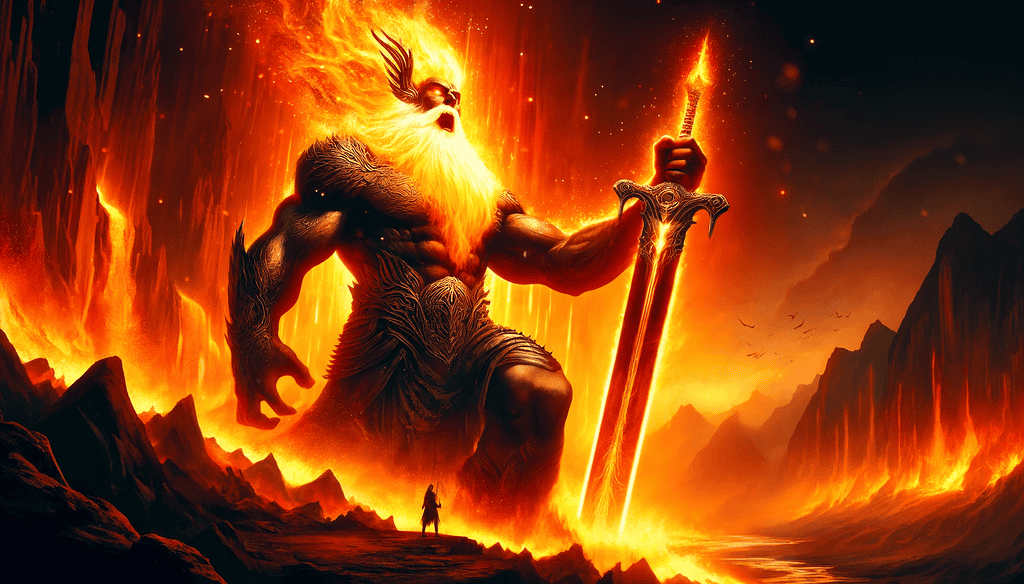
For enthusiasts of Norse mythology and paganism, understanding Muspelheim is crucial as it represents not just physical but also metaphysical boundaries. Here, the fierce and formidable fire giant Surt (Surtr Old Norse) wields his flaming sword, guarding the fiery realm against the incursions of gods and mortals alike. The heat of Muspelheim contrasts starkly with the icy realm of Niflheim, highlighting the profound dualism that is central to Norse cosmology.
This exploration of Muspelheim will delve deeper into its myths, symbols, and the significant role it plays within the rich tapestry of Norse mythology, inviting you to reflect on the fiery essence that fuels both destruction and creation in the ancient stories of the Norse gods.
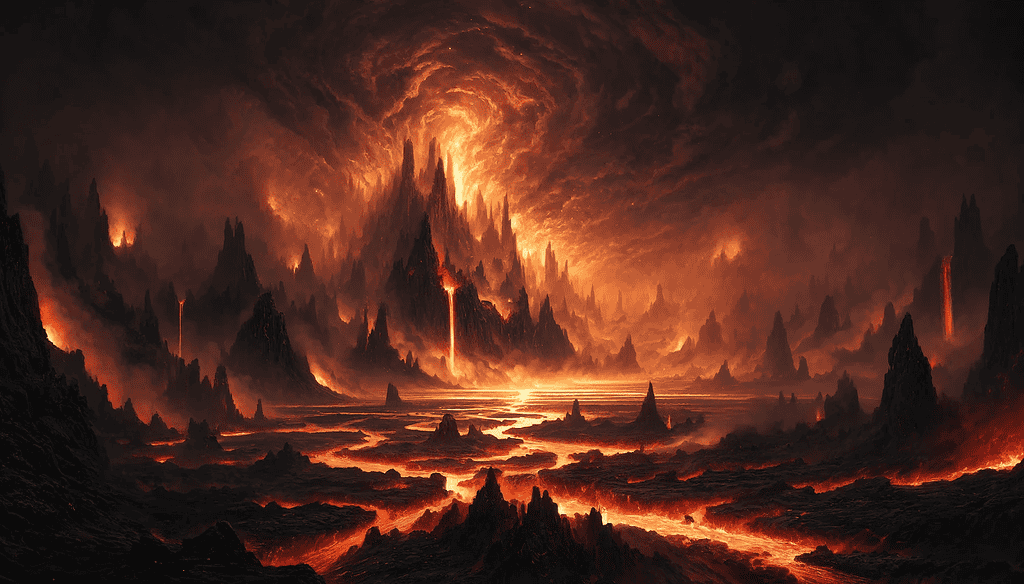
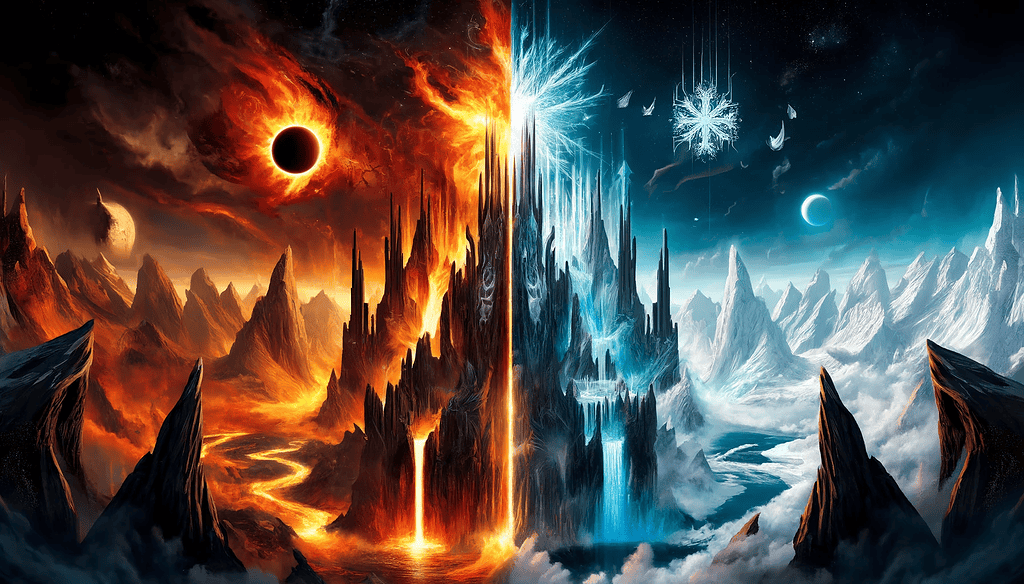
Muspelheim, often called the realm of fire, embodies one of the nine realms within the Norse cosmos and represents the essential force of heat and light. As one of the primordial realms, it exists at the creation of the cosmos, contrasting starkly with the cold and dark Niflheim, the realm of ice and fog. This elemental polarity is central to Norse cosmology, illustrating the fundamental balance and tension between fire and ice that sparks the creation of the universe.
According to Norse myths, the warm air of Muspelheim meets the cold ice of Niflheim, creating the primordial void, Ginnungagap, from which life begins. This dynamic interplay sets the stage for all subsequent mythological events, embodying a powerful narrative of origin and elemental force.
Muspelheim is rich with symbolic imagery that resonates deeply within Norse mythology. Central among these symbols is the fiery sword, wielded by Surt, the ruler of Muspelheim. This flaming sword is not merely a weapon but a symbol of the cosmic and cataclysmic power inherent in the realm. It epitomizes the fierce and destructive nature of fire, poised to play a crucial role in Ragnarok, the prophesied end of the world.
Additionally, the frequent depiction of lava flows within Muspelheim’s descriptions conveys the uncontrolled and flowing power of fire, further emphasizing the realm’s untamed nature. These symbols are not just literal representations of fire but are imbued with deeper meanings, often reflecting themes of transformation and renewal.
Fire, in Norse mythology, is both destroyer and purifier, capable of ending the world in Ragnarok and forging it anew. The fiery nature of Muspelheim, therefore, encapsulates a significant element of the Norse understanding of the cosmos—where endings and beginnings coexist within the flames of change.
Surt, the formidable lord of Muspelheim, wields immense power within his fiery realm. His depiction across the Norse myths is consistent: a giant wielding a fiery sword, embodying the intense heat and destructive force of fire. Surt’s role extends far beyond guardian of Muspelheim; he is destined to play a pivotal role in Ragnarok, the apocalyptic battle that marks the end of the world.
At this cataclysmic event, it is foretold that Surt will lead the sons of Muspell to storm the Bifrost Bridge, clashing with the gods in a battle that ultimately leads to the world’s rebirth. His flaming sword, bright and hot enough to scorch the Earth, symbolizes the inevitable destruction that will bring about renewal.
The fire giants, or Eldjotnar, of Muspelheim stand in stark contrast to the frost giants of Niflheim, embodying the elemental dualism at the heart of Norse mythology. These beings are not only embodiments of physical elements but also represent the philosophical opposites of creation and destruction, heat and cold, life and death.
The fire giants’ fierce and volcanic nature contrasts with the cold and calculating demeanor of the frost giants. This dichotomy is crucial in Norse cosmology, highlighting the balance and tension between opposing forces that drive the myths forward. In the stories, while the frost giants often plot against the gods of Asgard, the fire giants are prophesied to end their reign, emphasizing the significant role these elemental beings play in the Norse narrative of the cosmos.
The Eldjotnar, with their primordial connection to the forces of creation and destruction, remind us of the ever-present possibility of chaos and change, symbolizing the raw power of nature and its capacity to shape the fate of the gods and the world itself.
| Realm | Description | Elemental Association | Interaction with Muspelheim |
|---|---|---|---|
| Muspelheim | The realm of fire, home to the fire giants and ruled by Surt. It is one of the two primordial realms. | Fire | Source of cosmic fire, interacts primarily with Niflheim at the creation of the cosmos. |
| Niflheim | The realm of ice and mist, often considered the polar opposite of Muspelheim. | Ice | Its cold meets Muspelheim’s heat to spark the creation of life, including the first giant Ymir. |
| Midgard | The middle realm, home to humans. It is connected to Asgard by the Bifrost bridge. | Earth (Human World) | Not directly interacting with Muspelheim but affected by the events of Ragnarok initiated by Muspelheim’s fire giants. |
| Asgard | The realm of the Aesir gods, including Odin and Thor. Connected to Midgard by the Bifrost. | Divine | As the site of Ragnarok, it faces direct threats from Muspelheim during the apocalyptic battle. |
| Jotunheim | The land of the giants (Jotnar), excluding the fire giants of Muspelheim. | Rock, Forest (Giant World) | While mainly home to frost and mountain giants, Jotunheim occasionally interacts with Muspelheim in myths concerning giant-god conflicts. |
| Helheim | The underworld and realm of the dead, ruled by the goddess Hel. | Death, Underworld | Indirectly related, as souls from battles including those initiated by Muspelheim may end up here. |
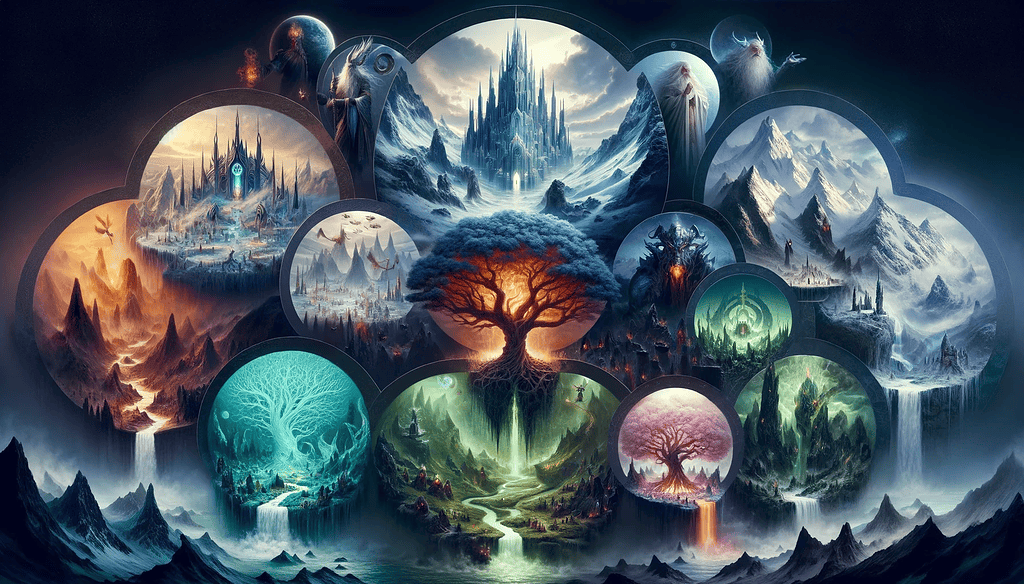
The cosmology of Norse mythology is structured around Yggdrasil, the immense mythological tree that connects the Nine Worlds, each distinct in its inhabitants and essence. Muspelheim, the fiery realm, is positioned as one of these worlds, often depicted as situated at the lower branches or even at the base of Yggdrasil, symbolizing its foundational and volatile nature. It directly contrasts with Niflheim, the world of ice and mist, located on the opposite end of the cosmic tree.
This placement is crucial as it highlights the interaction between fire and ice, which is central to the Norse cosmological view. Muspelheim’s fiery influence extends across the other realms, impacting their mythological narratives and the interactions between the various beings of Norse mythology.
Muspelheim’s intense heat represents a primal force in Norse mythology, crucial for the creation myth where it collides with the cold ice of Niflheim. This meeting results in the creation of life, including the first being, Ymir, a primeval giant from whose body the world was formed. The sparks from Muspelheim melt the ice of Niflheim, releasing the life-giving waters that nourish the world tree, Yggdrasil.
This interaction not only sets the stage for the emergence of life but also underlines the realm’s significant role in shaping the narrative framework of the cosmos. Through these mythic interactions, Muspelheim is depicted not just as a realm of destruction but as a vital contributor to the cycle of life and death, emphasizing its dual capacity to both devastate and renew.
This dual role is reflective of the Norse understanding of the cosmos as a place of perpetual conflict and balance, where the fiery realm plays a crucial role in the continuous rebirth of the world.
In Norse mythology, fire serves as a powerful symbol of transformation, embodying both the destructive and renewing powers of nature. This elemental force is most vividly represented in the realm of Muspelheim, where fire not only consumes but also catalyzes creation, reflecting a deep-seated belief in the necessity of destruction for renewal. The most dramatic illustration of this concept occurs during Ragnarok, the end of the world foretold in Norse sagas.
Here, fire plays a critical role, with Surt, wielding his fiery sword, leading the charge that ultimately consumes the cosmos. This apocalyptic event is not just an end but a precursor to a new beginning, symbolizing the cyclical nature of life and the universe—a constant rebirth that is sparked by the flames of Muspelheim.
Muspelheim’s imagery and the elemental force of fire have profoundly influenced modern interpretations of Norse paganism, resonating deeply with contemporary Viking and pagan cultures. In these communities, fire continues to symbolize transformation and is often central to ritual practices that emphasize change, purification, and renewal.
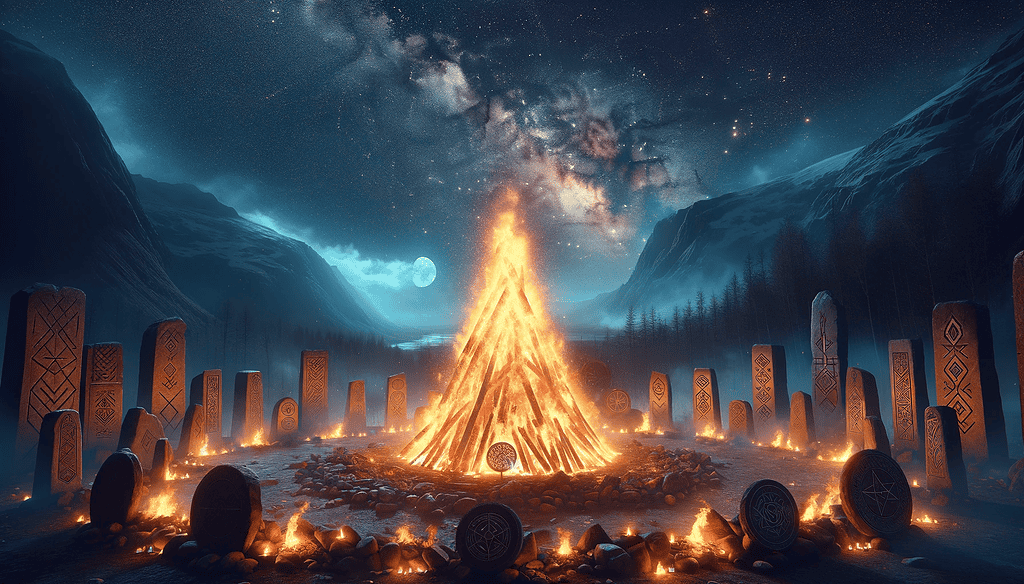
The fiery realm’s enduring imagery is invoked during festivals and ceremonies, where bonfires represent Muspelheim’s energy, helping participants connect with their Norse heritage. Additionally, Muspelheim’s themes of strength and endurance inspire modern pagans, who see in the realm’s intense heat a metaphor for personal trials and the power of resilience.
This cultural resonance underscores the significance of Muspelheim not just in ancient texts but as a living part of Norse spiritual practice today, highlighting how ancient myths continue to ignite modern spiritual and cultural identities.
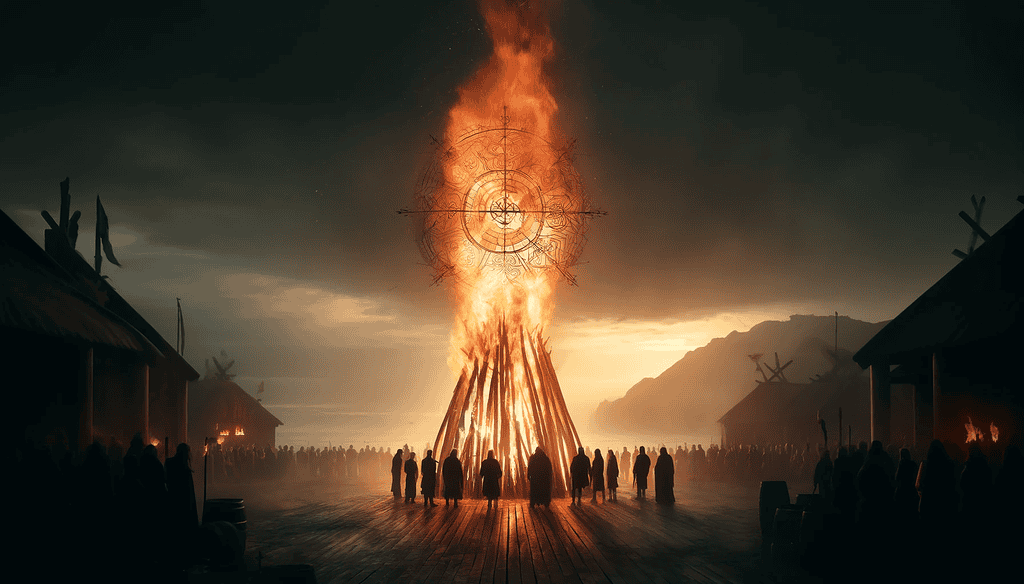
The conventional portrayal of Muspelheim and its inhabitants often casts the fire giants, led by Surt, solely as agents of destruction within Norse mythology. This perspective hinges on their apocalyptic role in Ragnarok, where they are seen primarily as adversaries of the gods, bringing about the end of the world with fire and brimstone.
However, a deeper exploration into the nature of Muspelheim offers a fresh perspective that can challenge these traditional views. By considering the essential role of fire in transformation and renewal, Muspelheim can be reinterpreted not just as a realm of destruction but as a crucible of creation.
Fire, in many cultures, is seen as a purifying force that makes way for new growth by clearing the old and decayed. In this light, the fire giants could be viewed not merely as destroyers but as harbingers of necessary change and renewal. This reframing adds a layer of complexity to their role in the Norse cosmology, presenting them as indispensable to the cycle of destruction and rebirth that is central to the Norse understanding of the cosmos.
This perspective also resonates with the broader themes of Norse mythology, which often embrace the idea of an interconnected universe where endings are precursors to beginnings. By seeing Muspelheim’s fiery nature as integral to the cyclical renewal of the world, we can appreciate the fire giants in a more nuanced light. This approach encourages us to rethink not only the nature of Muspelheim but also the essential and often misunderstood role of its fiery inhabitants in shaping the destiny of the Norse cosmos.
In our journey through the fiery depths of Muspelheim, we’ve uncovered not just the realm’s pivotal roles in Norse cosmology but also its broader implications in the cyclical nature of destruction and rebirth. This exploration invites us to view Muspelheim not merely as a place of chaos and destruction but as a fundamental force of change and regeneration within Norse mythology.
For enthusiasts of Norse myths and modern paganism, the stories of Muspelheim offer a rich source of inspiration and reflection. They challenge us to consider the transformative power of fire, both in myth and in our personal lives. As we delve deeper into these ancient narratives, let us appreciate their relevance today, reminding us of the enduring power of myth to shape our understanding of the world around us.

ᛉ 100% handcrafted artisan pagan , viking, witchcraft and shamanic inspired jewelry.
ᛉ Runes, Symbolism & European Folklore
Get 20% off👇🏻

Five witches dance around a blazing bonfire beneath a citrine cabochon in this Walpurgisnacht pendant....
Happy washing day 🙃
A few rings I’ve worked on the last couple days…
Freya’s cats rule and dogs drool?
Or was that the other way around? 🙃

Garm barely shows up in the old Norse stories.
Still… he leaves a mark.
A...
Leave a comment with your result ❤️
Bavarian Folklore says that you might just cross paths with a Wolpertinger in the alpine...

🐇🌲✨
He finally stepped out of the forest…
The Wolpertinger Pendant has arrived.
Inspired by...

I don’t often sell them, but love it when I do!
Vinca symbol bracelets ❤️...

Rooted in strength + guarded by ravens

The serpent waits 🖤
(Handcrafted Jörmungandr ring made to order in my shop)

Stay warm, everyone ❤️

😑😑😑🤮

I thought I had closed the book on the Alice in Wonderland rings…
But you...

Can this be over now, please?

In case you forgot 💜

Something I’ve been thinking about lately.
If there’s one thing I would’ve done differently early...

This year, we’re not buying things just to keep up.
If you need the reminder:...

My husband is from Bavaria (southern Germany) and I originally made this Krampus pendant for...

Some of the items I’m shipping out today ❤️
Please forgive my dirty nails 😂...

A few items shipping out today 🥰

This mornings rings shipping out ❤️

A few of the rjngs I’m shipping out this morning ❤️
How do you like...

Krampus is coming 🫶🏻

Getting ready to pack up these pretties and ship to their owners ❤️

Freya, cats and pentacles. Doesn’t get any better ❤️

You all got me going crazy making all these fairytale + storybook rings.
But I’ll...

Just launched these pretties ❤️
Size 9 amethyst ring + size 7.25 green kyanite

What would you trade to learn Baba Yaga’s secrets?

It *finally* looks, feels and smells like October!
And here are some items I’m packing...

This mornings pretties getting ready to ship :)

Getting ready to pack up these pretties and ship to their owners ❤️

You bet I’m hopping on this trend 😂
Thank you @shes_sinister for the prompt!

While I welcome the seasonal darkness…it sure is going to make my morning quick videos...

Finally finished the rings I’ve been working on in my stories ❤️
I think I...

Was going to post this update to my stories but it’s too long.

“How do you know I’m mad?” said Alice.
“You must be,” said the Cat, “or...

Some of this mornings orders getting ready to ship. Those little bats are so cute...

Here is the finished ring I was working on in my stories yesterday, along with...

A few of today’s orders shipping out this morning ❤️

The two silver raven rings I was working on in my stories yesterday.
…as well...

Eeeek! I’m so happy to add these to my shop ❤️
I’ve gotten so many...

I had 6 clamshells ready to ship this morning but I dropped and lost my...

Not the story you were told.
The girl didn’t run.
The wolf didn’t win.
This...

I love these raven rings so much 🖤
This mornings pretties shipping out.
All items...

Sleek + minimal Mjölnir ring ⚒️


About the author Jacqueline Fatica


