No products in the cart.
March 1, 2026 8:02 pm

Free USA shipping on orders $35+
March 1, 2026 8:02 pm
Bind runes (bindrunes) are some of the most fascinating forms of runic writing.
A bind rune is created when two or more runes are joined together to form a single glyph, a practice found in early Scandinavian runic inscriptions (Düwel, 2008, p. 65).
These combinations were used historically in Viking Age inscriptions and continue to inspire modern interest, especially as tattoos or amulets.
This article is worth reading if you want to understand how bindrunes work, their meaning, and how custom bindrunes can embody empowerment, spirituality, and even mysticism.
A rune is a character from the runic alphabets such as the Elder Futhark or Younger Futhark, each carrying its own meaning (Barnes, 2012, p. 42).
When a bind rune is created, it is a ligature of two or more runes that form a single glyph.
Archaeological evidence like the Järsberg stone shows how runes were often joined to form such ligatures (Düwel, 2008, p. 65).
Bindrunes are often used to compress names, highlight words, or serve as ancient symbols of identity.
The meaning of the rune does not disappear in a bind rune, rather, it combines, embodying individual meanings together (MacLeod, 2002, p. 57).

In Viking Age inscriptions, bindrunes were rare but significant.
On the Ludgo stone (Sö 140), five runes were bound into a cross, interpreted as the invocation siþi Þor (“May Thor protect”) (Williams, 1996, p. 127).
Another example, the Ärsta stone (Sö 158), incorporates a sequence of bindrunes along the mast of a carved ship (Jesch, 1998, p. 91).
Though rare in Viking Age inscriptions, bindrunes illustrate how Vikings combined practical writing with mystical and ornamental expression.
These ancient symbols show that bindrunes were often used historically for both aesthetic and symbolic purposes.
The meaning of the rune is the foundation.
When two runes are joined to form a single glyph, their meanings combine, whether linguistic (compressing letters in a name) or symbolic (uniting powers such as protection or fertility).
Runic inscriptions often used bindrunes in personal names. Page (1999, p. 173) shows how on the Franks Casket, runes for f and a were fused into a single glyph to write sefa (“mind”).
These runes used together reflect both practical literacy and mystical interpretation.
Scholars identify different types of bind runes.
A stacked bindrune places runes along a single stave, while another type merges strokes to form a single glyph (MacLeod, 2002, pp. 61–63).
The types of bind runes depend on how the carver chose to join the runic letters.
Examples of bindrunes can be found across Scandinavian runic inscriptions, though they were not commonly used.
As Page (1987, p. 62) stresses, they should not be seen as inherently magical symbols, but as stylistic or practical ligatures.

A stave is the vertical line that forms the backbone of most runes. In a stacked bindrune, multiple runes share the same stave (Barnes, 2012, p. 44).
This method was often used on runestones or amulets when space was limited.
By aligning two or more runes along a stave, the carver created inscriptions that were efficient and visually striking.
This shows how artistry and writing intertwined in Norse culture.
Bindrunes and sigils overlap in their design.
A sigil is a symbol crafted to embody intent or magical purpose. Norse mythology connects runes to Odin’s discovery of runic magic, and later Icelandic galdrastafir developed from the same principle (MacLeod & Mees, 2006, pp. 102–103).
Although most bindrunes were used historically as practical ligatures, some appear as magical symbols on amulets or charms, embodying spiritual practices and mystical empowerment.
A stacked bindrune places multiple runes along one stave. Reading requires identifying each element from top to bottom and reconstructing them. The Sö 158 runestone demonstrates this method (Jesch, 1998, p. 91).
Stacked bindrunes show the skill of the carver and highlight the ornamental and mystical qualities of runic inscriptions.
They illustrate both the history of runes and the creativity of Norse spiritual practices.

Norse mythology presents runes as gifts of Odin, discovered through his sacrifice. Old Norse sagas describe runes used in inscriptions for healing, fertility, or divination (Spurkland, 2005, p. 144).
Bindrunes naturally fit into this tradition, combining the powers of individual meanings into a single glyph.
As MacLeod (2002, p. 57) notes, bindrunes could serve practical purposes, but when carved into pendants or necklaces they could also function as amulets of empowerment.
These ancient symbols embody the intersection of literacy, spirituality, and mysticism.
Today, custom bindrunes are often used as tattoos.
A bind rune tattoo can embody empowerment, fertility, or ancestry, combining runes with individual meanings into a personal sigil (Barnes, 2012, p. 151).
Modern new age mysticism often treats bindrunes as magical symbols.
While their use as tattoos is contemporary, it continues the history of runes being adapted for spiritual practices and self-expression.
Creating a custom bindrune begins with selecting runes from the Elder Futhark runes or Younger Futhark alphabets, each with individual meanings such as fehu for wealth or algiz for protection (Düwel, 2008, pp. 88–90).
These runes are then combined into a single glyph.
The result can be carved, inscribed, or worn as jewelry.
As Page (1987, p. 62) emphasizes, the bind rune itself is not inherently magical, but when integrated into amulets, pendants, or tattoos, it becomes a symbol of personal empowerment.
Antonsen, E. H. (2002). Runes and Germanic linguistics. Mouton de Gruyter.
Barnes, M. P. (2012). Runes: A handbook. Boydell Press.
Düwel, K. (2008). Runenkunde (4th ed.). J.B. Metzler.
Elliott, R. W. V. (1989). Runes: An introduction. Manchester University Press.
Jesch, J. (1998). Runic inscriptions and words for “ship.” In O. Crumlin-Pedersen & B. Munch Thye (Eds.), The Viking ships in a global context (pp. 87–102). Viking Ship Museum.
MacLeod, M. (2002). Bind-runes: An investigation of ligatures in runic epigraphy. Uppsala University.
MacLeod, M., & Mees, B. (2006). Runic amulets and magic objects. Boydell Press.
Page, R. I. (1987). Runes. The British Museum Press.
Page, R. I. (1999). An introduction to English runes (2nd ed.). Boydell Press.
Spurkland, T. (2005). Norwegian runes and runic inscriptions. Boydell Press.
Williams, H. (1996). The Ludgo runestone and the invocation of Thor. Futhark: International Journal of Runic Studies, 11, 119–138.
Wimmer, L. F. A. (1887). Runeskriftens oprindelse og udvikling i Norden. Gyldendal.
Worm, O. (1651). Runir, seu Danica literatura antiquissima. Copenhagen.

ᛉ 100% handcrafted artisan pagan , viking, witchcraft and shamanic inspired jewelry.
ᛉ Runes, Symbolism & European Folklore
Get 20% off👇🏻

Five witches dance around a blazing bonfire beneath a citrine cabochon in this Walpurgisnacht pendant....
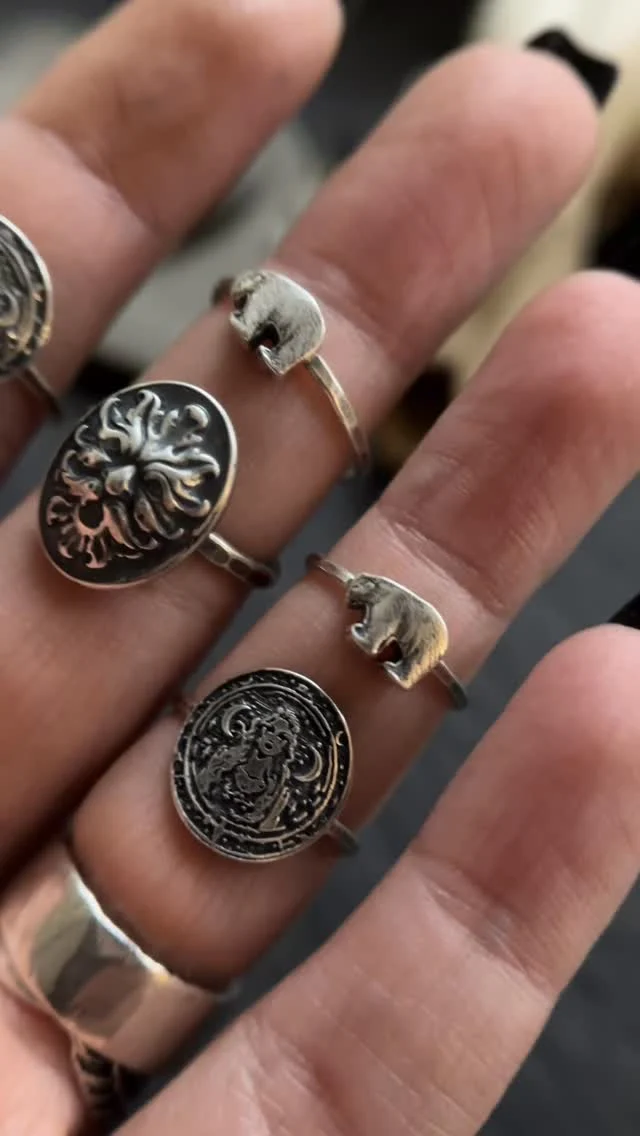
Happy washing day 🙃
A few rings I’ve worked on the last couple days…
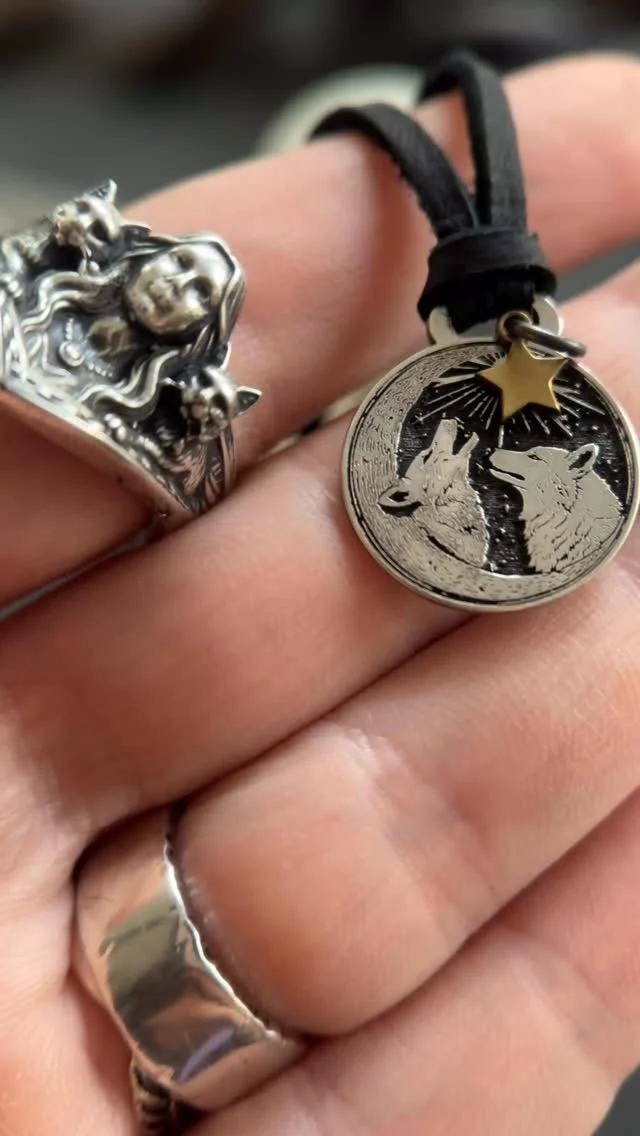
Freya’s cats rule and dogs drool?
Or was that the other way around? 🙃

Garm barely shows up in the old Norse stories.
Still… he leaves a mark.
A...
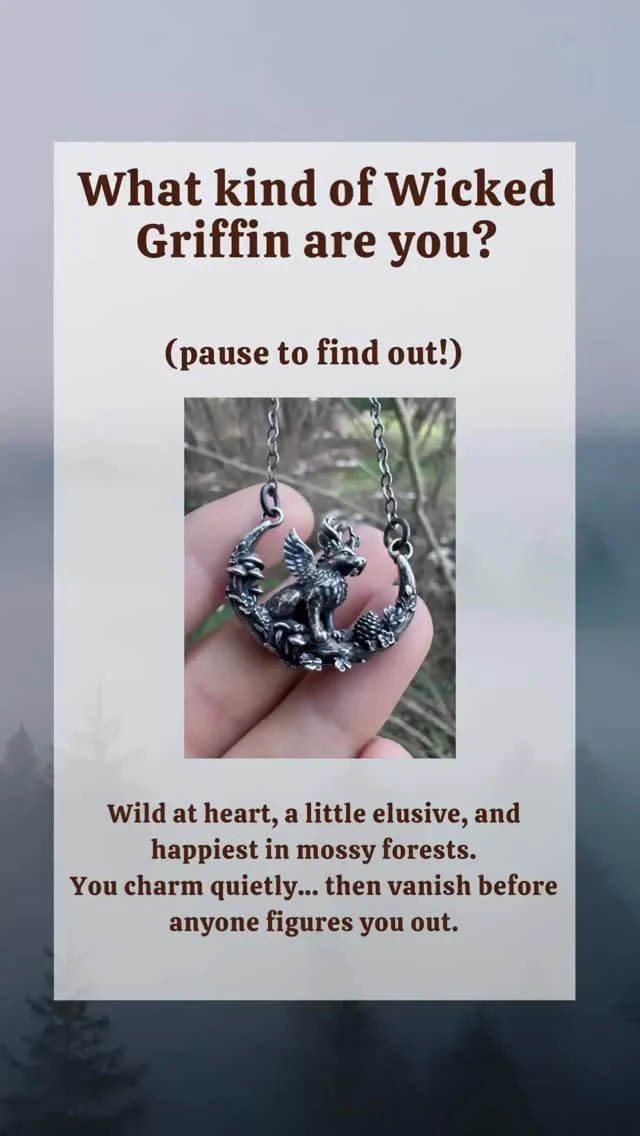
Leave a comment with your result ❤️
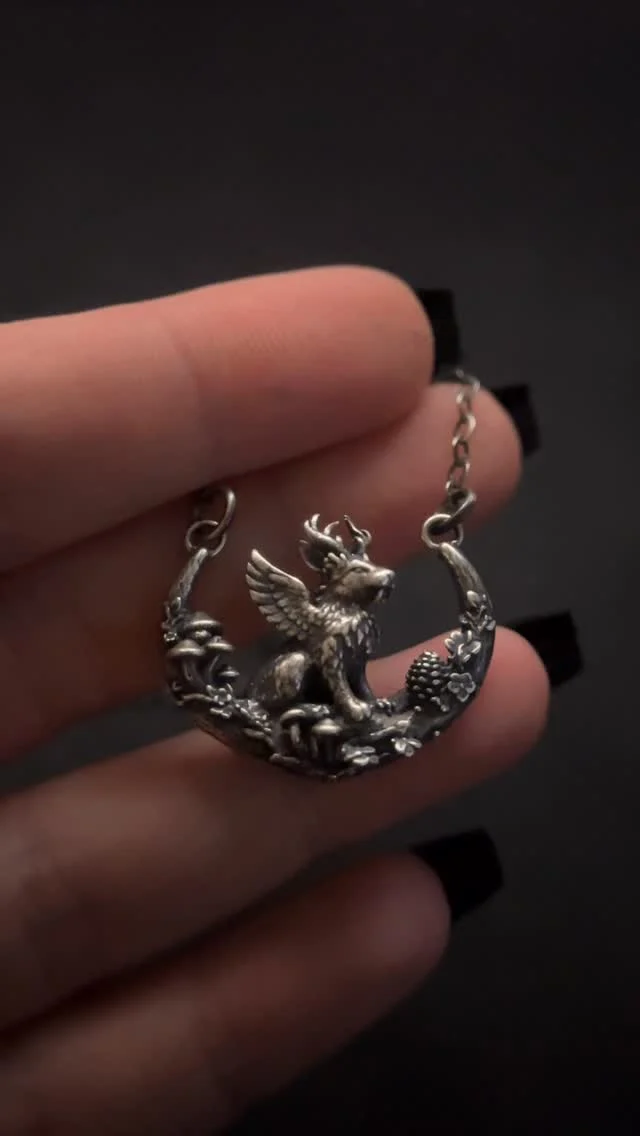
Bavarian Folklore says that you might just cross paths with a Wolpertinger in the alpine...

🐇🌲✨
He finally stepped out of the forest…
The Wolpertinger Pendant has arrived.
Inspired by...

I don’t often sell them, but love it when I do!
Vinca symbol bracelets ❤️...

Rooted in strength + guarded by ravens

The serpent waits 🖤
(Handcrafted Jörmungandr ring made to order in my shop)

Stay warm, everyone ❤️

😑😑😑🤮

I thought I had closed the book on the Alice in Wonderland rings…
But you...

Can this be over now, please?

In case you forgot 💜

Something I’ve been thinking about lately.
If there’s one thing I would’ve done differently early...

This year, we’re not buying things just to keep up.
If you need the reminder:...

My husband is from Bavaria (southern Germany) and I originally made this Krampus pendant for...

Some of the items I’m shipping out today ❤️
Please forgive my dirty nails 😂...

A few items shipping out today 🥰

This mornings rings shipping out ❤️

A few of the rjngs I’m shipping out this morning ❤️
How do you like...

Krampus is coming 🫶🏻

Getting ready to pack up these pretties and ship to their owners ❤️

Freya, cats and pentacles. Doesn’t get any better ❤️

You all got me going crazy making all these fairytale + storybook rings.
But I’ll...

Just launched these pretties ❤️
Size 9 amethyst ring + size 7.25 green kyanite

What would you trade to learn Baba Yaga’s secrets?

It *finally* looks, feels and smells like October!
And here are some items I’m packing...

This mornings pretties getting ready to ship :)

Getting ready to pack up these pretties and ship to their owners ❤️

You bet I’m hopping on this trend 😂
Thank you @shes_sinister for the prompt!

While I welcome the seasonal darkness…it sure is going to make my morning quick videos...

Finally finished the rings I’ve been working on in my stories ❤️
I think I...

Was going to post this update to my stories but it’s too long.

“How do you know I’m mad?” said Alice.
“You must be,” said the Cat, “or...

Some of this mornings orders getting ready to ship. Those little bats are so cute...

Here is the finished ring I was working on in my stories yesterday, along with...

A few of today’s orders shipping out this morning ❤️

The two silver raven rings I was working on in my stories yesterday.
…as well...

Eeeek! I’m so happy to add these to my shop ❤️
I’ve gotten so many...

I had 6 clamshells ready to ship this morning but I dropped and lost my...

Not the story you were told.
The girl didn’t run.
The wolf didn’t win.
This...

I love these raven rings so much 🖤
This mornings pretties shipping out.
All items...

Sleek + minimal Mjölnir ring ⚒️


About the author Jacqueline Fatica


