No products in the cart.
February 18, 2026 8:37 pm

Free USA shipping on orders $35+
February 18, 2026 8:37 pm
In the vast literary tradition of Norse mythology, certain figures stand vividly at the center of myth, such as Odin and Thor.
Others exist only in the margins of ancient texts, appearing briefly but raising profound questions. One such figure is Laufey, the mother of Loki.
Though her presence is limited to genealogical references, the survival of her name in medieval sources reveals important insights into kinship, naming traditions, and mythological identity in the Old Norse world.
This article examines who Laufey was, where she appears in the primary sources, and what modern academic scholarship says about her meaning and significance.
Understanding Laufey offers a rare glimpse into how mythology preserved maternal lineage, even in a cultural system normally dominated by male ancestry.
The earliest and most authoritative attestation of Laufey appears in medieval Icelandic mythological literature, particularly the Prose Edda and Eddic poetry.
These texts, written in the thirteenth century but preserving far older traditions, provide the only reliable evidence for her existence as a figure from Norse mythology.
In these sources, Laufey is never described through actions or narratives. Instead, she appears solely as part of Loki’s parentage.
In the Prose Edda, written by Snorri Sturluson around 1220, the section Gylfaginning introduces Loki as the son of the giant Fárbauti and Laufey or Nál (Sturluson, 1982, p. 26).
However, this genealogical statement represents the clearest and most definitive reference to her.
The text introduces Loki as the son of these parents without elaborating further on her character, deeds, or personality.
This confirms that her primary mythological function was genealogical rather than narrative.
Similarly, in Eddic poetry preserved in the Poetic Edda, Loki is frequently mentioned by the matronymic Loki Laufeyjarson, meaning “Loki, son of Laufey” (Neckel & Kuhn, 1983, p. 86).
This is highly significant.
In Old Norse naming conventions, individuals were normally identified through patronymics, meaning by their father’s name.
The fact that Loki is referred to instead as Laufeyjarson shows that maternal lineage could carry symbolic importance.

Snorri Sturluson puts Laufey firmly within the mythological genealogies of the gods. In Gylfaginning, the narrator High introduces Loki as the son of Fárbauti and Laufey or Nál (Sturluson, 1982, p. 26).
This introduction establishes both parents and emphasizes Loki’s dual heritage. For example, his father belongs to the jötun, the giants, while his mother’s status is more ambiguous.
The Prose Edda also preserves important mythological genealogies tracing divine ancestry back to primordial beings such as Ymir and Bergelmir.
Within this framework, the inclusion of Laufey demonstrates how mythology where kinship determines identity preserves both maternal and paternal lineage.
Although she is not described as active in myth, her presence defines Loki’s origin.
Snorri Sturluson also includes Laufey in lists of female divine figures called ásynja, meaning goddess (Faulkes, 1998, p. 157).
This classification suggests that she was regarded as an aesir goddess, or at least associated with the divine community of Asgard.
This inclusion further reinforces her importance as part of divine genealogy rather than as a narrative character.
One of the most striking features of the sources is that Loki is frequently mentioned by the matronymic Loki Laufeyjarson instead of by a patronymic derived from his father, Farbauti.
This naming pattern appears repeatedly in Eddic poetry and prose texts.
For example, in Þrymskviða, Loki identifies himself as Loki Laufeyjarson, clearly emphasizing his maternal ancestry (Neckel & Kuhn, 1983, p. 86).
This use of matronymics is unusual in Old Norse culture. Normally, ancestry was reckoned through male ancestry.
Patronymic names such as Fárbautason would have been expected. But the preference for Laufeyjarson instead indicates that Laufey held greater mythological or symbolic importance than Farbauti.
This naming choice may reflect mythological interpretation, suggesting that Loki’s maternal lineage connected him more closely with the aesir gods.
The repeated reference to Loki as Laufey’s son highlights the importance of maternal lineage in shaping identity.
Even though Farbauti means lightning striker, and represents elemental force, Laufey’s name was used to define Loki’s identity within divine society.
The Old Norse name Laufey has long puzzled scholars.
Linguists agree that it is related to lauf, meaning leaf or foliage (de Vries, 1962, p. 371).
This connection suggests that her name may have originally meant “leafy one” or referred to vegetation.
This interpretation aligns with mythological symbolism involving trees and natural forces.
The name structure is also found in female personal names like Bjargey and Þórey, which include the suffix ey, commonly used in female personal names (Simek, 2007, p. 181).
This confirms that Laufey was understood as a feminine name in Old Norse culture.
Some scholars have proposed that Laufey may represent a hypothetical tree-goddess named Lauf-awiaz, meaning the leafy one (de Vries, 1962, p. 371).
While it is of importance to remain cautious with us hypothetical names, this interpretation connects her to symbolic imagery involving lightning hitting the leaves, suggesting mythological imagery of a tree struck by lightning, and metaphorically giving rise to Loki.

The Prose Edda explicitly identifies Laufey or Nál as Loki’s mother, presenting both names as referring to the same figure (Sturluson, 1982, p. 26).
The name Nál means needle, and scholars interpret this as referring to slenderness or thinness.
John Lindow explains that Nál is a figure known only through genealogical references, with no independent narrative role (Lindow, 2001, p. 205).
This confirms that she exists purely as a genealogical figure in Norse mythology.
The dual naming may reflect different poetic traditions or symbolic interpretations.
Some scholars suggest that Nál refers metaphorically to the needles of a tree, reinforcing connections to plant imagery and the name Laufey.
A later Icelandic text describes Nál as slender and weak, meaning delicate in appearance (Lindow, 2001, p. 205).
This description reflects symbolic interpretation rather than narrative action. The meaning of the name Nál itself supports this interpretation.
Scholars interpret this imagery as reinforcing plant symbolism, connecting her identity to foliage and trees.
This interpretation supports the broader theory that she may represent natural or vegetation-related symbolism.
However, these descriptions remain speculative and secondary to the primary sources.

Snorri Sturluson puts Laufey among the ásynja, meaning female divine beings (Faulkes, 1998, p. 157).
This classification suggests she was understood as part of the divine community. This distinguishes her from typical giantess figures such as Angrboda, Loki’s consort.
Her inclusion among the aesir gods helps explain Loki’s acceptance within Asgard despite his giant ancestry.
But what is of importance here is that it is precisely this dual ancestry that reflects the complex relationships between gods and giants in Norse mythology.
The use of matronymics such as Laufeyjarson demonstrates the importance of maternal lineage in defining identity.
Although Norse society normally emphasized male ancestry, mythology preserved maternal connections in meaningful ways.
This naming pattern highlights how maternal lineage could carry symbolic authority. Loki’s identification through his mother reflects this tradition.
This demonstrates the complexity of mythological kinship.
Some scholars have proposed connections between Laufey and figures in Finnish mythology, such as Louhi. However, these connections remain speculative and lack definitive linguistic evidence.
Modern scholars treat these comparisons cautiously.
Laufey remains obscure because she serves only as a genealogical figure. She appears only to define Loki’s origin.
Her importance lies in what her name reveals about mythology, identity, and ancestry.
Sturluson, Snorri. (1998).
Edda: Skáldskaparmál. Edited by Anthony Faulkes. Viking Society for Northern Research.
Sturluson, Snorri. (1982).
Edda: Prologue and Gylfaginning. Edited by Anthony Faulkes.
Neckel, Gustav & Kuhn, Hans. (1983).
Edda: Die Lieder des Codex Regius. Heidelberg: Winter.
Lindow, John. (2001).
Norse Mythology: A Guide to the Gods, Heroes, Rituals, and Beliefs. Oxford University Press.
de Vries, Jan. (1962).
Altnordisches etymologisches Wörterbuch. Leiden: Brill.
Simek, Rudolf. (2007).
Dictionary of Northern Mythology. D.S. Brewer.

ᛉ 100% handcrafted artisan pagan , viking, witchcraft and shamanic inspired jewelry.
ᛉ Runes, Symbolism & European Folklore
Get 20% off👇🏻
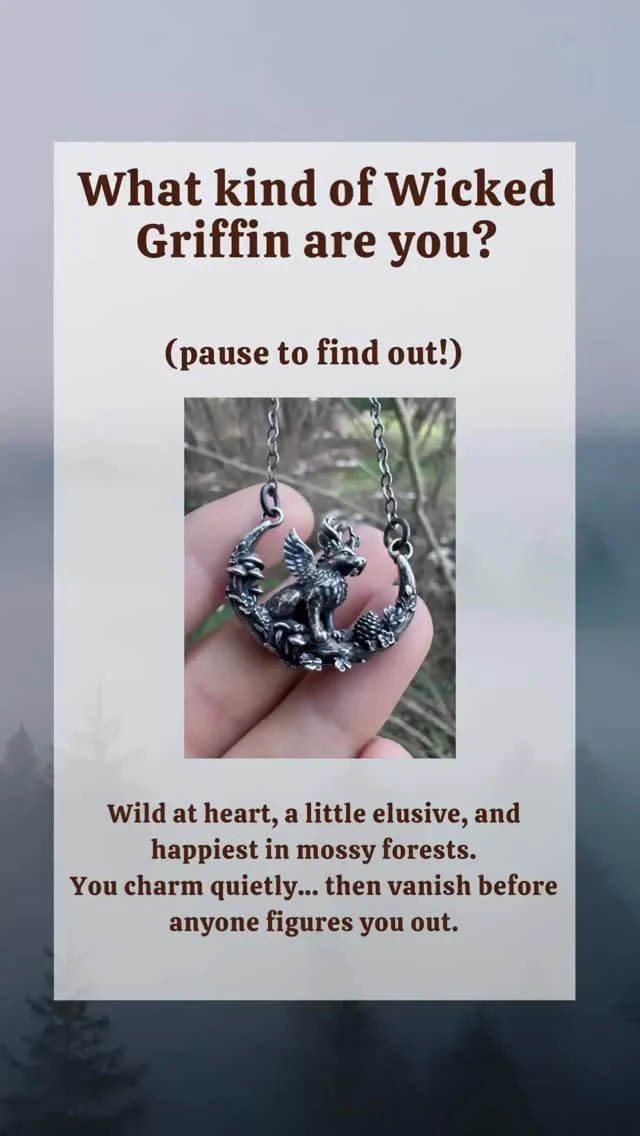
Leave a comment with your result ❤️
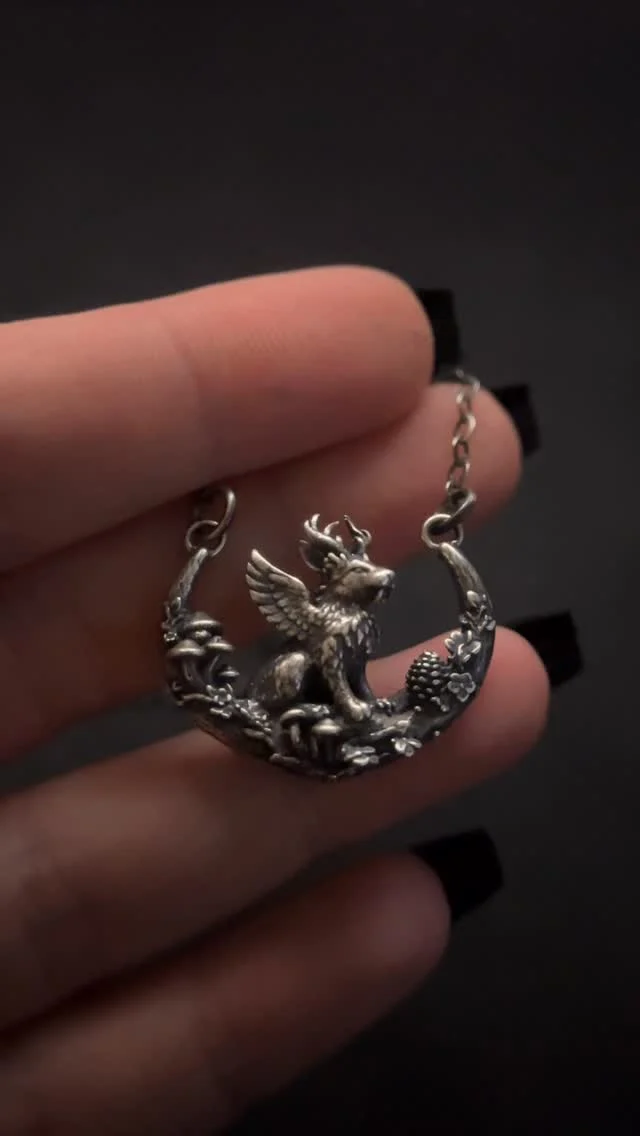
Bavarian Folklore says that you might just cross paths with a Wolpertinger in the alpine...

🐇🌲✨
He finally stepped out of the forest…
The Wolpertinger Pendant has arrived.
Inspired by...

I don’t often sell them, but love it when I do!
Vinca symbol bracelets ❤️...

Rooted in strength + guarded by ravens

The serpent waits 🖤
(Handcrafted Jörmungandr ring made to order in my shop)

Stay warm, everyone ❤️

😑😑😑🤮

I thought I had closed the book on the Alice in Wonderland rings…
But you...

Can this be over now, please?

In case you forgot 💜

Something I’ve been thinking about lately.
If there’s one thing I would’ve done differently early...

This year, we’re not buying things just to keep up.
If you need the reminder:...

My husband is from Bavaria (southern Germany) and I originally made this Krampus pendant for...

Some of the items I’m shipping out today ❤️
Please forgive my dirty nails 😂...

A few items shipping out today 🥰

This mornings rings shipping out ❤️

A few of the rjngs I’m shipping out this morning ❤️
How do you like...

Krampus is coming 🫶🏻

Getting ready to pack up these pretties and ship to their owners ❤️

Freya, cats and pentacles. Doesn’t get any better ❤️

You all got me going crazy making all these fairytale + storybook rings.
But I’ll...

Just launched these pretties ❤️
Size 9 amethyst ring + size 7.25 green kyanite

What would you trade to learn Baba Yaga’s secrets?

It *finally* looks, feels and smells like October!
And here are some items I’m packing...

This mornings pretties getting ready to ship :)

Getting ready to pack up these pretties and ship to their owners ❤️

You bet I’m hopping on this trend 😂
Thank you @shes_sinister for the prompt!

While I welcome the seasonal darkness…it sure is going to make my morning quick videos...

Finally finished the rings I’ve been working on in my stories ❤️
I think I...

Was going to post this update to my stories but it’s too long.

“How do you know I’m mad?” said Alice.
“You must be,” said the Cat, “or...

Some of this mornings orders getting ready to ship. Those little bats are so cute...

Here is the finished ring I was working on in my stories yesterday, along with...

A few of today’s orders shipping out this morning ❤️

The two silver raven rings I was working on in my stories yesterday.
…as well...

Eeeek! I’m so happy to add these to my shop ❤️
I’ve gotten so many...

I had 6 clamshells ready to ship this morning but I dropped and lost my...

Not the story you were told.
The girl didn’t run.
The wolf didn’t win.
This...

I love these raven rings so much 🖤
This mornings pretties shipping out.
All items...

Sleek + minimal Mjölnir ring ⚒️

Today’s orders getting ready to ship.
…And I finally got some time to work on...

That ant ring is so out of place 😂
Not that the mail is coming...

If you had this, which runes would you choose? Or would you accept the runes...

I love making these fun Halloween coffin pendants 🎃
All items you see are always...


About the author Jacqueline Fatica


