No products in the cart.
March 26, 2026 8:51 pm

Free USA shipping on orders $35+
March 26, 2026 8:51 pm
The landvættir, often described as the spirits of the land in Norse mythology, are among the most misunderstood beings in Norse culture.
They are frequently regarded as “nature spirits” or grouped alongside an elf or dwarf, yet the surviving Norse sources do not support such a classification per se.
What we actually find is a much more grounded and localized concept: a relational ontology with the land itself, as spiritual beings tied to specific places, reacting to human presence, and embedded in the lived experience of the landscape.
This article draws directly on primary sources and modern scholarship, including the Landnámabók, Heimskringla, and multiple peer-reviewed research papers, to reconstruct what we can actually say about the landvættir, the land-spirits of the medieval north, and their role in Norse culture and society.
If you are looking for a source-based explanation of the importance of the land-spirits, rather than a generalized overview, this is worth reading.
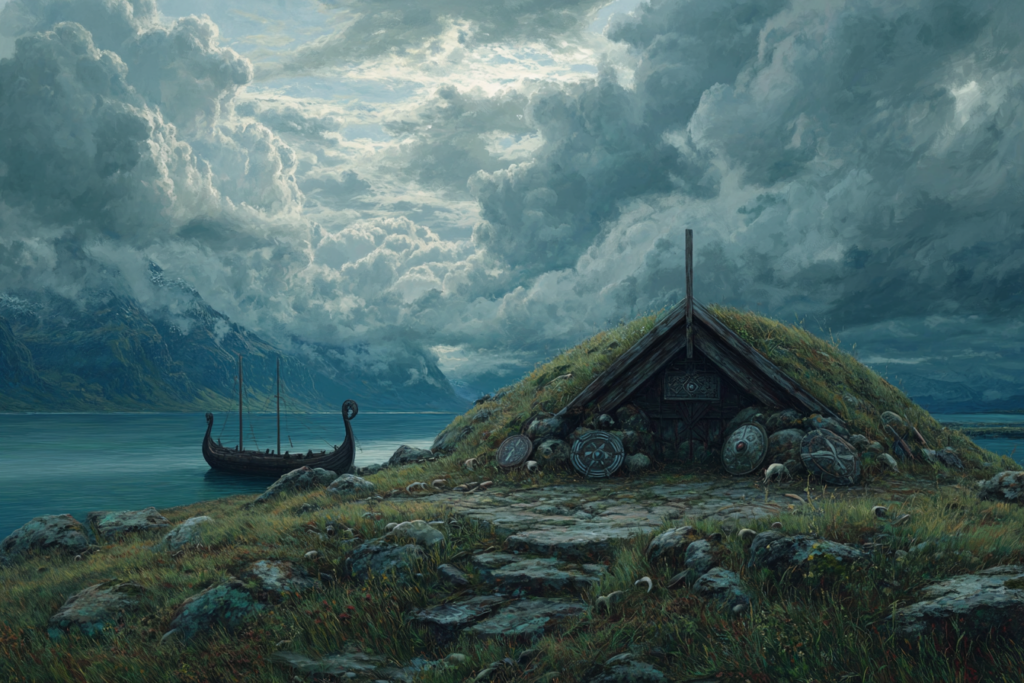
The Old Norse word landvættir (sometimes written landvaettir) literally means “land wights” or “land-spirits.”
The word vættir itself is cognate with Old English wiht, meaning a being or entity, and is derived from proto-west Germanic roots (de Vries, 1970, p. 260).
This linguistic background already shows that we are dealing with a broad category of beings in Norse thought rather than a fixed class.
In Norse mythology and folklore and mythology more broadly, the landvættir are not systematically defined. Instead, they appear in specific contexts and are always tied to place.
They are not presented as part of a structured pantheon of Norse gods, but as beings connected to the land itself.
For this reason, modern scholarship describes them cautiously as local beings associated with particular landscapes (Lindow, 2001, p. 188).
The landvættir are often understood as land spirits or guardian spirits, but this must be framed carefully.
The sources show that they are not simply protective figures, but reactive presences embedded in the environment. In other words, they can also cause harm.
The landvættir appear rarely in the Norse sources, but their appearances are precise and revealing. One of the clearest examples comes from Egils saga, one of the most important primary sources.
In this passage, Egill raises a curse and directly addresses the landvættir: “…I turn this scorn against the landvættir that inhabit this land…” (Egils saga, 1933, p. 171).
This shows that the landvættir are understood as spirits inhabiting specific land, not abstract beings. They can be addressed and influenced through ritual action.
Simpson interprets this passage as evidence that the beings invoked in Egill’s curse are landvættir tied to the land itself (Simpson, 1967, p. 198).
In Landnámabók, one of Iceland’s earliest historical texts, we find further evidence of a worldview in which the land is not empty, but already inhabited (Benediktsson, 1968, p. 358).
This reinforces the idea that the landvættir are part of a broader system of beings in Norse thought.
The term “guardian spirits of Iceland” is often used, and it is not entirely wrong. Some scholars describe the landvættir as protectors of specific regions (Lindow, 2001, p. 188).
However, the sources themselves do not consistently present them as purely protective.
Instead, the landvættir are often reactive. They respond to human behavior.
They can be addressed, influenced, and potentially disturbed. In Egill’s case, they are invoked as forces that can act against an enemy.
A more precise formulation would be that the landvættir are often interpreted as protectors of the land, but the Norse sources present them primarily as place-bound beings that can be influenced through ritual interaction.
This distinction is important if we want to examine carefully what is primary sources, because classifications such as ‘guardian spirits’ may be too broad and overgeneralized.
The belief in the Landvaettir demonstrate a complex human-nature relationship.
In Icelandic tradition, the landvættir play a particularly important role.
The belief in the landvættir reflects a worldview in which the land is already inhabited before human arrival, and personhood, agency, and spiritual power is assigned to animals and the land itself.
Bryan emphasizes that settlers needed to avoid disturbing or frightening the landvættir already present in the landscape (Bryan, 2021, pp. 72–76). This suggests that these beings were understood as prior occupants.
This aligns with what we see in Norse culture more broadly: the land is not empty territory but something encountered.
The belief in the landvættir reflects an understanding of Iceland as a place inhabited by spirits of the land rather than a neutral environment.
One of the most well-known traditions concerns ships approaching Iceland.
Ships were required to remove figureheads that were often carved into the shape of a whale or dragon so as to avoid frightening the landvættir.
Simpson describes these as ships with “gaping heads or yawning snouts,” which could frighten the land spirits (Simpson, 1967, p. 197).
This idea appears in Norse legal tradition and reflects a broader concern with frightening the landvættir. The assumption is that these beings are perceptive and capable of reacting to human presence.
This is one of the clearest indications that the landvættir were understood as responsive beings in Norse culture, not simply symbolic abstractions.
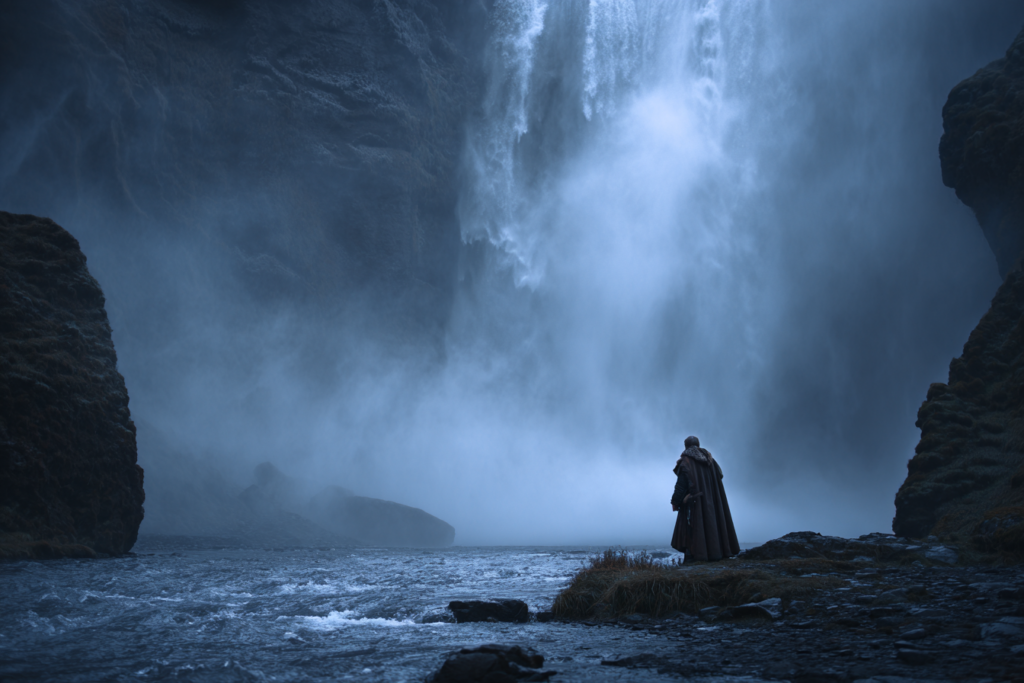
The Norse sources consistently associate landvættir with specific landscape features.
According to Norse legal traditions cited in scholarship, the landvættir are associated with groves, mounds, and waterfalls (Egeler, 2023, p. 102).
This shows that the landvættir are localized. They are tied to particular features such as mountains and hills, waterfalls, caves, and other natural formations.
Egeler describes these locations as points of supernatural interaction, where rituals take place and where beings are encountered (Egeler, 2023, p. 102).
The land is therefore not passive, but more importantly, it is structured and inhabited. There is personhood embedded within the landscape itself.
This is one of the most debated questions. The Norse sources do not explicitly state that landvættir are the spirits of the dead.
However, Mayburd shows that the distinction between different types of beings is often unclear. The distinction between the human dead and other beings is blurred (Mayburd, 2014, p. 132)
The dead may remain associated with the landscape, particularly in burial mounds. These locations become places of continued presence.
However, the sources do not equate landvættir directly with the spirits of the dead.
The safest conclusion is that both belong to a broader system of beings inhabiting the landscape, without a strict boundary between them.
Ritual is one of the clearest ways to understand the landvættir. Egeler emphasizes that ritual activity takes place directly within the landscape.
In this sense, the landscape becomes the stage of ritual performance itself, the landscape itself becomes alive (Egeler, 2023, p. 99).
This includes practices such as:
In Landnámabók, a figure sacrifices to a waterfall and deposits offerings into it (Benediktsson, 1968, p. 358). This suggests that offerings of food were given to beings associated with that place.
These practices suggest that interaction with beings associated with the land was understood as concrete rather than abstract.
In Heimskringla, written in the 13th century, Snorri Sturluson describes how King Harald Bluetooth (Haraldr), a Danish king, attempts to approach Iceland. In this account, four powerful beings appear protecting the island.
These include:
Although Snorri does not explicitly call them landvættir, they are commonly interpreted as the guardians of Iceland in later tradition (Sturluson, 1941, Óláfs saga Tryggvasonar, ch. 33).
These figures later appear on the Icelandic coat of arms and even on the obverse of the Icelandic króna, reinforcing the idea of Iceland as a land protected by powerful beings.
Modern scholarship emphasizes that there is no single definition of landvættir.
Lindow describes them as local guardian spirits (Lindow, 2001, p. 188), while de Vries places them within a broader Germanic category of nature spirits (de Vries, 1970, p. 260).
Simpson highlights their association with fertility and ritual, though this remains interpretive (Simpson, 1967, p. 198).
More recent work, especially by Mayburd and Egeler, emphasizes the role of the landscape itself.
The land is inhabited, and the beings within it cannot always be clearly categorized, however, this raises even more important question about animistic ideas circulating among the Norse, especially when it comes to personhood and the landscape itself:
Perhaps, the Landvaettir demonstrate that according to Norse belief systems, everything was indeed alive.
Benediktsson, J. (Ed.). (1968). Íslendingabók. Landnámabók (Íslenzk fornrit 1). Hið íslenzka fornritafélag.
Bryan, E. S. (2021). The elf church: Memories of contested sacred spaces. In Icelandic folklore and the cultural memory of religious change (pp. 72–76). Arc Humanities Press.
Egeler, M. (2023). Rituals in the open landscape. In L. Gardeła, S. Bønding, & P. Pentz (Eds.), The Norse sorceress: Mind and materiality in the Viking world (pp. 99–107). Oxbow Books.
Mayburd, M. (2014). The hills have eyes: Post-mortem mountain dwelling and the (super)natural landscape in the Íslendingasögur. Viking and Medieval Scandinavia, 10, 129–154.
Simpson, J. (1967). Some Scandinavian sacrifices. Folklore, 78(3), 190–202.
de Vries, J. (1970). Altgermanische Religionsgeschichte (Vol. 1). Walter de Gruyter.
Lindow, J. (2001). Norse mythology: A guide to the gods, heroes, rituals, and beliefs. Oxford University Press.
Nordal, S. (Ed.). (1933). Egils saga Skalla-Grímssonar (Íslenzk fornrit 2). Hið íslenzka fornritafélag.
Sturluson, S. (1941). Heimskringla I (B. Aðalbjarnarson, Ed.). Hið íslenzka fornritafélag.

ᛉ 100% handcrafted artisan pagan , viking, witchcraft and shamanic inspired jewelry.
ᛉ Runes, Symbolism & European Folklore
Get 20% off👇🏻

Garm barely shows up in the old Norse stories.
Still… he leaves a mark.
A...
Leave a comment with your result ❤️
Bavarian Folklore says that you might just cross paths with a Wolpertinger in the alpine...

🐇🌲✨
He finally stepped out of the forest…
The Wolpertinger Pendant has arrived.
Inspired by...

I don’t often sell them, but love it when I do!
Vinca symbol bracelets ❤️...

Rooted in strength + guarded by ravens

The serpent waits 🖤
(Handcrafted Jörmungandr ring made to order in my shop)

Stay warm, everyone ❤️

😑😑😑🤮

I thought I had closed the book on the Alice in Wonderland rings…
But you...

Can this be over now, please?

In case you forgot 💜

Something I’ve been thinking about lately.
If there’s one thing I would’ve done differently early...

This year, we’re not buying things just to keep up.
If you need the reminder:...

My husband is from Bavaria (southern Germany) and I originally made this Krampus pendant for...

Some of the items I’m shipping out today ❤️
Please forgive my dirty nails 😂...

A few items shipping out today 🥰

This mornings rings shipping out ❤️

A few of the rjngs I’m shipping out this morning ❤️
How do you like...

Krampus is coming 🫶🏻

Getting ready to pack up these pretties and ship to their owners ❤️

Freya, cats and pentacles. Doesn’t get any better ❤️

You all got me going crazy making all these fairytale + storybook rings.
But I’ll...

Just launched these pretties ❤️
Size 9 amethyst ring + size 7.25 green kyanite

What would you trade to learn Baba Yaga’s secrets?

It *finally* looks, feels and smells like October!
And here are some items I’m packing...

This mornings pretties getting ready to ship :)

Getting ready to pack up these pretties and ship to their owners ❤️

You bet I’m hopping on this trend 😂
Thank you @shes_sinister for the prompt!

While I welcome the seasonal darkness…it sure is going to make my morning quick videos...

Finally finished the rings I’ve been working on in my stories ❤️
I think I...

Was going to post this update to my stories but it’s too long.

“How do you know I’m mad?” said Alice.
“You must be,” said the Cat, “or...

Some of this mornings orders getting ready to ship. Those little bats are so cute...

Here is the finished ring I was working on in my stories yesterday, along with...

A few of today’s orders shipping out this morning ❤️

The two silver raven rings I was working on in my stories yesterday.
…as well...

Eeeek! I’m so happy to add these to my shop ❤️
I’ve gotten so many...

I had 6 clamshells ready to ship this morning but I dropped and lost my...

Not the story you were told.
The girl didn’t run.
The wolf didn’t win.
This...

I love these raven rings so much 🖤
This mornings pretties shipping out.
All items...

Sleek + minimal Mjölnir ring ⚒️

Today’s orders getting ready to ship.
…And I finally got some time to work on...

That ant ring is so out of place 😂
Not that the mail is coming...

If you had this, which runes would you choose? Or would you accept the runes...


About the author Jacqueline Fatica


