No products in the cart.
December 12, 2025 5:13 pm

Free USA shipping on orders $35+
December 12, 2025 5:13 pm
The story of Jack and the Beanstalk is one of the most enduring fairy tales in the English-speaking world.
Passed down through generations, this classic tale of courage, risk, and magical beans has enchanted children and adults alike.
But what makes this fairy tale so timeless?
And where did the story of Jack come from in the first place?
In this post, we’ll explore the roots of Jack and the Beanstalk, uncover fascinating academic insights, and see how a boy named Jack climbed more than just a giant beanstalk as he climbed into literary history.
Jack and the Beanstalk tells the tale of a poor boy named Jack who trades his family’s cow for magical beans.
These beans grow into a towering beanstalk, leading Jack to an ogre’s castle in the clouds. There, he finds a goose that lays golden eggs, a magical harp, and a chance to change his life forever.
With his fairy tale courage and a bit of mischief, Jack climbs the beanstalk, steals treasures, and finally cuts the beanstalk to defeat the ogre.
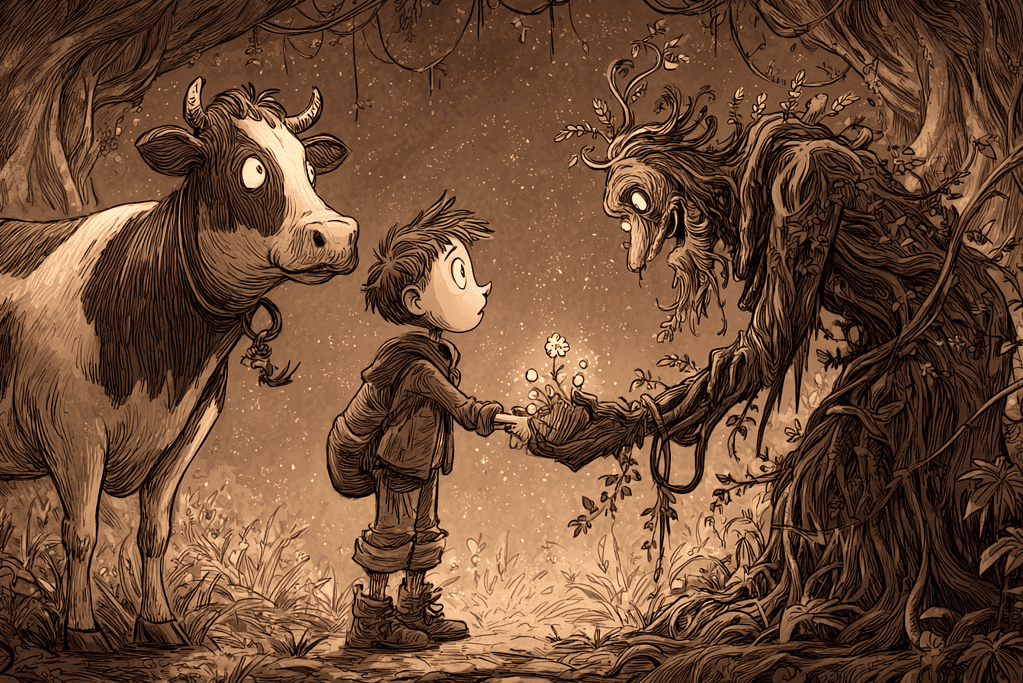
This English fairy tale first appeared in print as The Story of Jack Spriggins and the Enchanted Bean in 1734, but scholars like Christine Goldberg argue the tale has even older origins in oral storytelling traditions (Goldberg, 2001, p. 11).
The history of Jack reveals a tale shaped by centuries of telling and retelling, incorporating elements of medieval romance, morality plays, and folklore.
Earlier versions of Jack and the Beanstalk did not always cast Jack as a clear hero. In some versions, Jack steals from the ogre without any real justification.
Victorian writers, uncomfortable with this moral ambiguity, reshaped the story so the ogre deserved his fate (Goldberg, 2001, pp. 18–21).
Over time, Jack’s theft became framed as a rightful reclamation, indeed a shift that reveals how fairy tales evolve with society’s values.
Jack begged for beans, traded unwisely, and stole magical treasures. So, is he truly heroic?
Scholars like Rosemary Zumwalt suggest fairy tales allow children to navigate ethical questions (Zumwalt, 1999, p. 124).
Jack’s journey reflects a rite of passage. The ogre symbolizes fearsome adult power, and Jack’s daring actions dramatize youthful independence.
The giant beanstalk is more than a magical ladder.
Goldberg suggests it may represent the axis mundi, or world axis, linking earth to the sky realm, a motif found in Indo-European mythology (Goldberg, 2001, p. 24).
When Jack climbed the beanstalk, he entered not only the ogre’s world, but also a realm of cosmic possibility.

Jack and his mother lived in poverty, and their relationship frames the tale. His mother’s disbelief in magic contrasts with Jack’s hopeful risk-taking.
She threw the beans out the window in anger, but the story rewards Jack’s disobedience. In some readings, this dynamic mirrors generational tension (Zumwalt, 1999, p. 121).
The ogre, sometimes called a giant, lives in a castle in the clouds. In earlier tellings, he is simply rich, not necessarily evil.
Victorian versions added that he ate children and had killed Jack’s father, giving Jack moral justification to steal the golden egg and other treasures (Goldberg, 2001, pp. 19–20).
Interestingly, Truman Michelson recorded a similar story among the Piegan Blackfeet in 1916, showing how Jack and the Beanstalk traveled and transformed across continents (Michelson, 1916, p. 409).
The Piegan tale features vertical journeys and magical beings, highlighting the tale’s cross-cultural resonance.

Its popularity stems from its archetypal themes: risk, adventure, and triumph over adversity.
Jack’s rise from poor boy to victorious hero taps into dreams of social mobility. And who could forget iconic elements like the golden egg, the climb the beanstalk scene, or the chant “Fee-fi-fo-fum?

Modern educators use Jack and the Beanstalk to discuss themes like courage, consequences, and resourcefulness.
Rosemary Zumwalt sees such fairy tales as tools for children to understand the adult world through symbolic storytelling (Zumwalt, 1999, p. 119). In this way, Jack tales become lessons in disguise.
References
Goldberg, C. (2001). The composition of “Jack and the Beanstalk.” Marvels & Tales, 15(1), 11–26.
Michelson, T. (1916). Piegan tales of European origin. The Journal of American Folklore, 29(113), 409.
de la Mare, W. (1955). Jack and the Beanstalk. In Told again (pp. 144–150). Princeton University Press.
Zumwalt, R. L. (1999). The complexity of children’s folklore. In B. Sutton-Smith, J. Mechling, T. W. Johnson & F. R. McMahon (Eds.), Children’s folklore: A source book (pp. 118–128). University Press of Colorado.

ᛉ 100% handcrafted artisan pagan , viking, witchcraft and shamanic inspired jewelry.
ᛉ Runes, Symbolism & European Folklore
Get 20% off👇🏻

Five witches dance around a blazing bonfire beneath a citrine cabochon in this Walpurgisnacht pendant....
Happy washing day 🙃
A few rings I’ve worked on the last couple days…
Freya’s cats rule and dogs drool?
Or was that the other way around? 🙃

Garm barely shows up in the old Norse stories.
Still… he leaves a mark.
A...
Leave a comment with your result ❤️
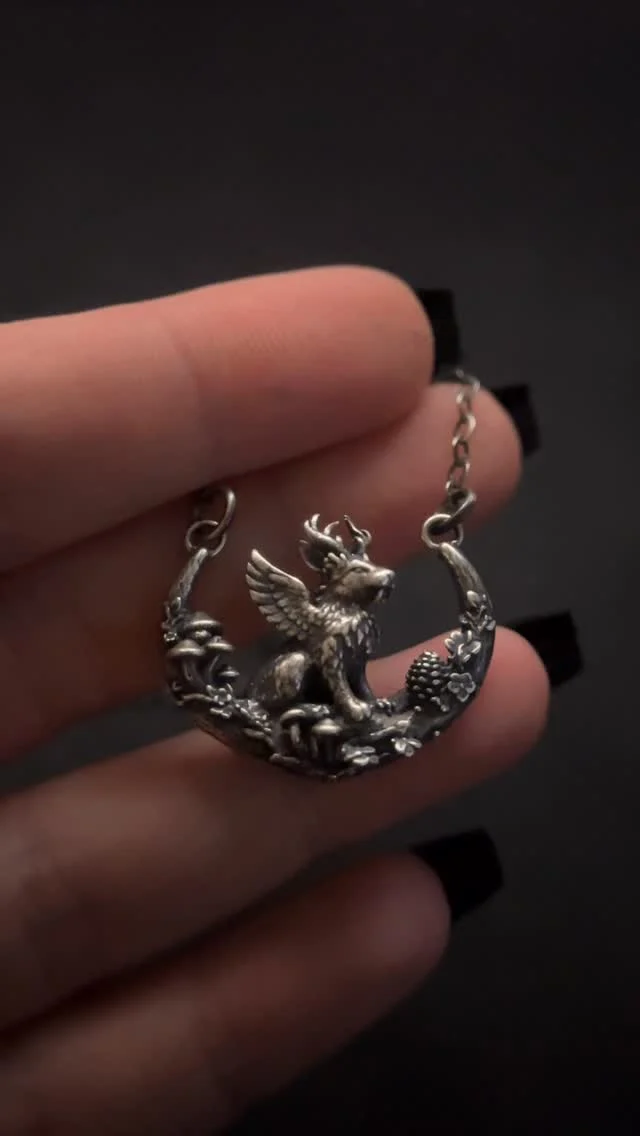
Bavarian Folklore says that you might just cross paths with a Wolpertinger in the alpine...

🐇🌲✨
He finally stepped out of the forest…
The Wolpertinger Pendant has arrived.
Inspired by...

I don’t often sell them, but love it when I do!
Vinca symbol bracelets ❤️...

Rooted in strength + guarded by ravens

The serpent waits 🖤
(Handcrafted Jörmungandr ring made to order in my shop)

Stay warm, everyone ❤️

😑😑😑🤮

I thought I had closed the book on the Alice in Wonderland rings…
But you...

Can this be over now, please?

In case you forgot 💜

Something I’ve been thinking about lately.
If there’s one thing I would’ve done differently early...

This year, we’re not buying things just to keep up.
If you need the reminder:...

My husband is from Bavaria (southern Germany) and I originally made this Krampus pendant for...

Some of the items I’m shipping out today ❤️
Please forgive my dirty nails 😂...

A few items shipping out today 🥰

This mornings rings shipping out ❤️

A few of the rjngs I’m shipping out this morning ❤️
How do you like...

Krampus is coming 🫶🏻

Getting ready to pack up these pretties and ship to their owners ❤️

Freya, cats and pentacles. Doesn’t get any better ❤️

You all got me going crazy making all these fairytale + storybook rings.
But I’ll...

Just launched these pretties ❤️
Size 9 amethyst ring + size 7.25 green kyanite

What would you trade to learn Baba Yaga’s secrets?

It *finally* looks, feels and smells like October!
And here are some items I’m packing...

This mornings pretties getting ready to ship :)

Getting ready to pack up these pretties and ship to their owners ❤️

You bet I’m hopping on this trend 😂
Thank you @shes_sinister for the prompt!

While I welcome the seasonal darkness…it sure is going to make my morning quick videos...

Finally finished the rings I’ve been working on in my stories ❤️
I think I...

Was going to post this update to my stories but it’s too long.

“How do you know I’m mad?” said Alice.
“You must be,” said the Cat, “or...

Some of this mornings orders getting ready to ship. Those little bats are so cute...

Here is the finished ring I was working on in my stories yesterday, along with...

A few of today’s orders shipping out this morning ❤️

The two silver raven rings I was working on in my stories yesterday.
…as well...

Eeeek! I’m so happy to add these to my shop ❤️
I’ve gotten so many...

I had 6 clamshells ready to ship this morning but I dropped and lost my...

Not the story you were told.
The girl didn’t run.
The wolf didn’t win.
This...

I love these raven rings so much 🖤
This mornings pretties shipping out.
All items...

Sleek + minimal Mjölnir ring ⚒️


About the author Jacqueline Fatica


