No products in the cart.
March 19, 2026 7:25 pm

Free USA shipping on orders $35+
March 19, 2026 7:25 pm
The maypole stands at the center of one of Europe’s most recognizable seasonal celebrations. In village squares and on grassy commons, from England to southern Germany’s Bavaria up north to Sweden, people dance around it in patterns that blend festivity, symbolism, and community memory.
This article explores the history of the maypole, the meaning of maypole customs, and the development of may day celebrations through verifiable historical records and careful folklore research.
By examining literary descriptions, parish documents, and modern scholarship, readers can understand why this tradition continues to fascinate both scholars and participants.
The maypole is a tall wooden trunk or pole raised as a focal point for festive celebration, most often on or near the first of May.
Historical descriptions suggest that communities selected straight tree trunks, sometimes birch, stripped of branches except for greenery left only at the top.
The maypole definition in early English usage emphasizes its role as a seasonal marker that helped structure communal gatherings.
Over time, maypoles were erected in different forms, from temporary installations to long-standing ceremonial structures.
Evidence from parish accounts shows that maypoles were treated as physical objects requiring maintenance and storage.
Churchwardens’ records from Buckinghamshire mention payments for iron fittings connected with a maypole and later note the handling of maypole pieces after festivities (Brown & Brown, 2019, pp. 192, 221).
Such references demonstrate that the tradition dates back to at least the late sixteenth century in documented parish life, even if earlier origins remain uncertain.
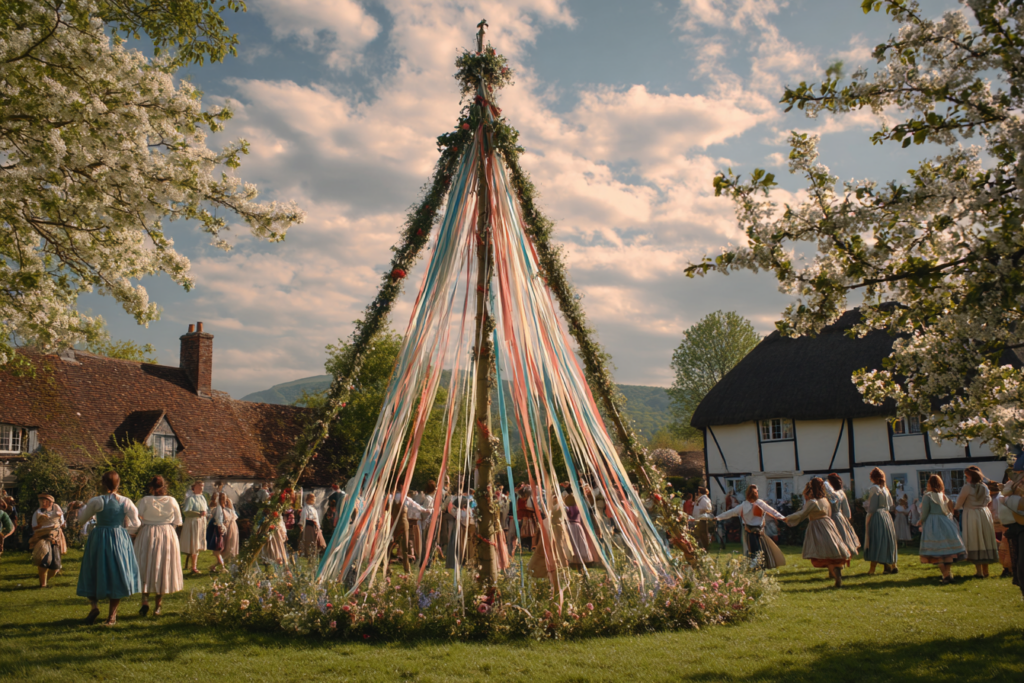
One of the most detailed descriptions of festive practice appears in a polemical tract from 1583.
Philip Stubbes recounts how groups traveled into the woods before 1 May, returning with greenery and hauling a tall pole into the settlement.
Once erected, participants gathered for music and dancing around a maypole (Stubbes, 1583, pp. 153–154).
Although Stubbes wrote in a critical tone, his account offers valuable insight into how celebration might have unfolded in some places.
Later visual evidence suggests choreographed movement by dancers who circle the pole in coordinated patterns.
In certain contexts, people dance in circular formations that transform the space around the pole into a lively stage for ritualized festivity.
Decoration played an important role in shaping the atmosphere of may day celebrations.
Communities decorate the maypole with garlands, greenery, and flowers and ribbons that symbolized seasonal renewal.
In some depictions, long ribbons hang from the top of the pole, allowing dancers weave ribbons around its trunk during a maypole dance.
These visual elements create a striking display that marks the celebration of spring and the May Queen (Maikönigin).
An eighteenth-century engraving analyzed by Violet Alford shows ribbon dancing around a decorated pole.
She cautions, however, that the artistic context and reuse of printing plates make it difficult to treat the image as evidence of widespread traditional practice (Alford, 1943, pp. 146–148).
Such warnings remind historians to distinguish between representation and documented custom.
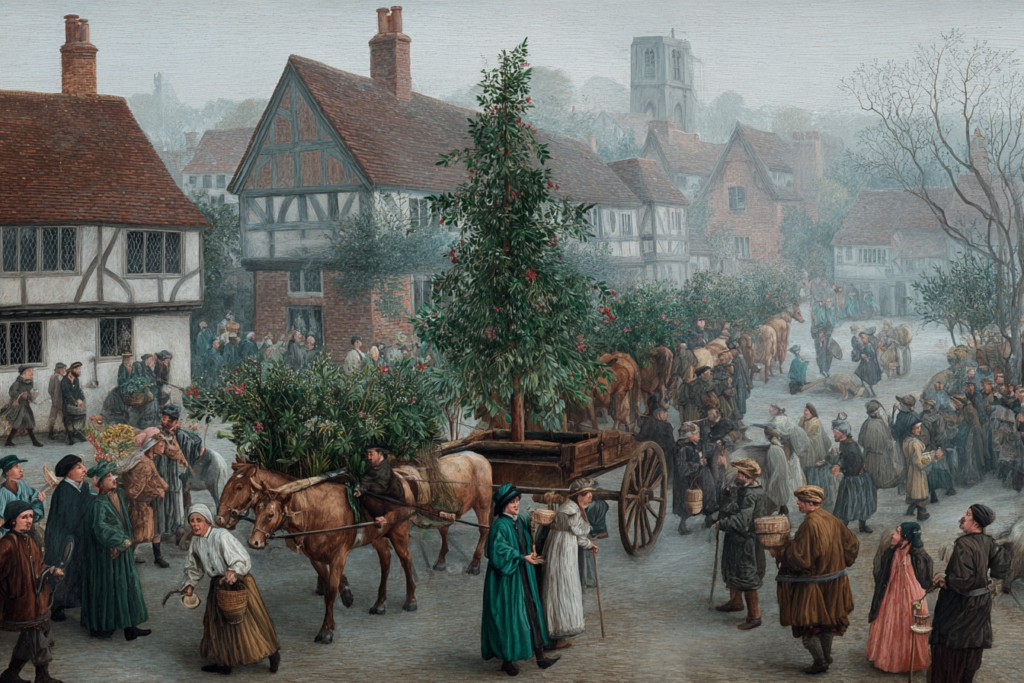
The meaning of maypole symbolism has inspired scholarly debate for generations.
Some writers have compared the vertical pole to sacred trees or cosmic pillars that appear in mythological traditions.
A late nineteenth-century review of comparative mythology, for instance, notes that ritual pillars were sometimes interpreted as symbolic links between heaven and earth and that Maypoles were occasionally discussed in this framework (G. S., 1893, p. 451).
Modern folklore research approaches such parallels with caution.
Scholars emphasize that symbolic themes such as fertility, seasonal renewal, and communal identity can reappear in different cultural settings without indicating direct historical continuity.
This perspective helps explain why the maypole is a tall structure associated with festive meaning while avoiding overly generalized claims about a single ancient origin (Davidson, 1989, p. 131).
Folklore research reveals that maypole customs formed part of broader seasonal performance traditions.
Studies of ritual dance in Europe describe festivals in which dancers gather around a decorated pole as a central feature of celebration (Domokos, 1968, pp. 234–237).
These performances sometimes included theatrical characters, music, and symbolic enactments of the transition from winter to spring. In other words, an important time during the agricultural year.
Regional variation shaped different expressions of the maypole tradition.
In some places, dancing around a maypole occurred at the end of May, while elsewhere similar poles were raised at midsummer.
Such diversity demonstrates that the maypole tradition developed through local adaptation rather than a single uniform pattern.
The idea that maypoles derive directly from pagan rituals has long attracted attention.
Antiquarian writers linked the pole to goddess Flora celebrations or to Beltane festivals, interpreting it as a sign of masculine and feminine energy united in seasonal renewal, as noted for instance by the German folklorist Wilhelm Mannhardt (1875, p. 452).
While these theories remain influential in popular writing, modern scholarship stresses the need for documentary evidence before drawing firm conclusions.
Instead, historians note that maypoles were erected within Christian communities that reinterpreted older symbolic motifs.
Seasonal feasts, communal dancing, and decorative greenery became part of local tradition.
The absence of a continuous written record linking ancient rites with later customs encourages a careful approach to interpretation.
In certain English villages, a permanent maypole stood on the village greens as a visible emblem of local heritage.
These structures might be decorated with emblems or garlands and refurbished each year.
A tall pole rising above surrounding buildings could become a recognizable landmark, shaping both spatial identity and festive memory.
Elsewhere, temporary poles were raised only for specific occasions.
Parish accounts describing the dismantling and storage of maypole pieces illustrate how communities balanced practicality with ceremonial importance (Brown & Brown, 2019, p. 221).
Such evidence reveals the varied ways in which maypoles were erected and maintained.
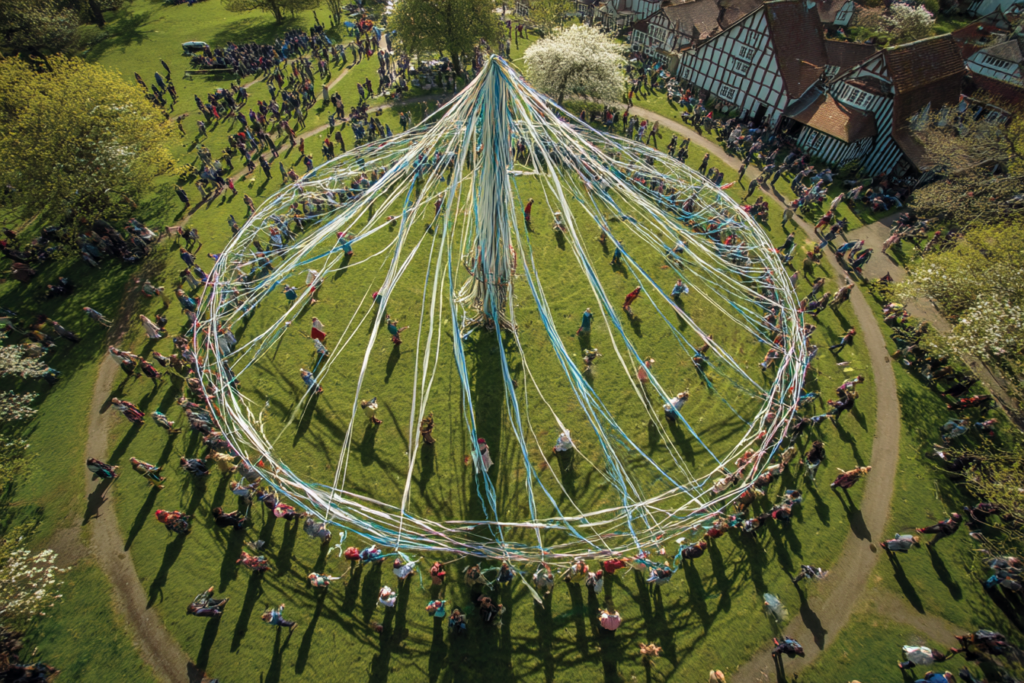
In parts of Central Europe, seasonal tree-raising customs involved suitors placing decorated trunks near the homes of admired partners.
These gestures, sometimes carried out by unmarried men may illustrate how celebration could blend communal ritual with personal relationships.
The maypole thus functioned not only as a festive symbol but also as a medium of social communication.
These customs might include greenery, streamers, or garlands that signaled romantic intent.
Although practices differed widely across regions, the shared emphasis on decoration and display suggests a common interest in marking seasonal transition through visible symbols.
The continuing popularity of maypole festivities reflects their ability to combine visual spectacle with historical resonance.
Schools, heritage festivals, and civic events often stage maypole dance performances that echo older traditions while adapting them to modern contexts.
Dancers weave ribbons around the pole in rhythmic movement, transforming a simple trunk into a vibrant focal point of celebration.
Such performances remind participants that tradition is both inherited and reinvented.
By raising and decorating a maypole, communities express continuity with the past while shaping new meanings for the present.
The enduring appeal of dancing around a maypole shows how ritual celebration can connect generations through shared experience.
Alford, V. (1943). The Maypole: An engraving of 1751. Journal of the English Folk Dance and Song Society, 4(4), 146–148.
Brown, M., & Brown, P. (Eds.). (2019). Wing churchwardens’ accounts, 1527–1662. Buckinghamshire Record Society.
Davidson, H. E. (1989). Myths and symbols in religion and folklore. Folklore, 100(2), 131–142.
Domokos, P. P. (1968). Der Moriskentanz in Europa und in der ungarischen Tradition. Studia Musicologica Academiae Scientiarum Hungaricae, 10(3/4), 229–311.
G. S. (1893). Review of The Night of the Gods: An inquiry into cosmic and cosmogonic mythology and symbolism by John O’Neill. T’oung Pao, 4(5), 444–452
Mannhardt, W. (1875) : Der Baumkultus der Germanen und ihrer Nachbarstamme Mythologische untersuchungen. Germany: gebrüder Borntraeger..
Rushworth, J. (1721). Historical collections of private passages of state: Vol. 5 (1642–45). London: D. Browne.
Stubbes, P. (1583). The anatomie of abuses. London: Richard Jones.
Stow, J. (1603/1908). A survey of London (C. L. Kingsford, Ed.). Oxford: Clarendon Press.

ᛉ 100% handcrafted artisan pagan , viking, witchcraft and shamanic inspired jewelry.
ᛉ Runes, Symbolism & European Folklore
Get 20% off👇🏻
Leave a comment with your result ❤️
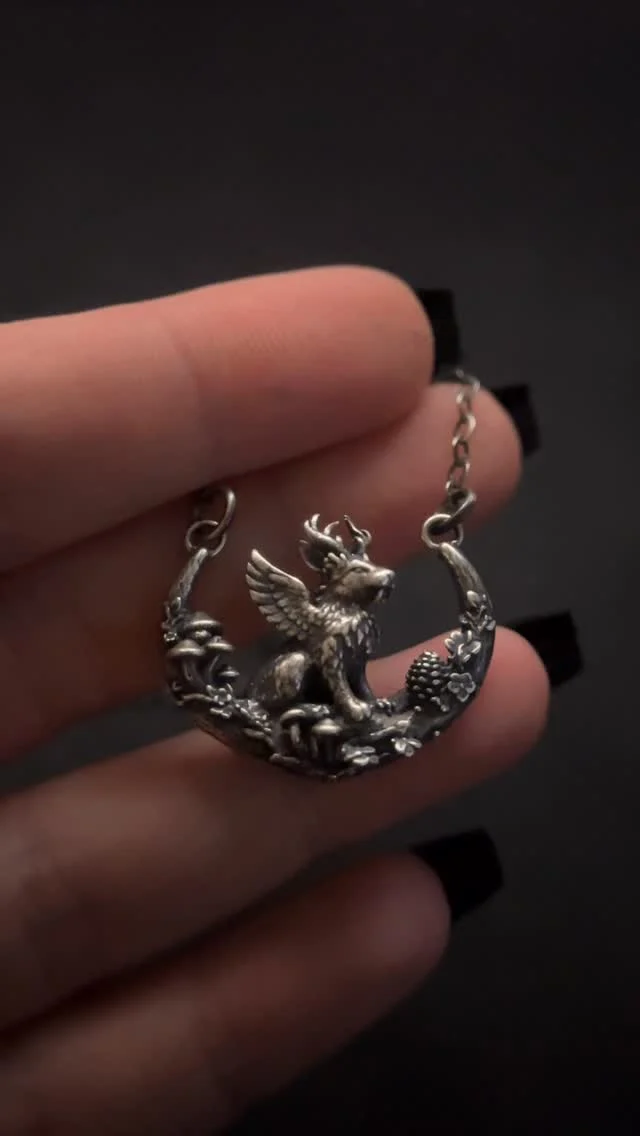
Bavarian Folklore says that you might just cross paths with a Wolpertinger in the alpine...

🐇🌲✨
He finally stepped out of the forest…
The Wolpertinger Pendant has arrived.
Inspired by...

I don’t often sell them, but love it when I do!
Vinca symbol bracelets ❤️...

Rooted in strength + guarded by ravens

The serpent waits 🖤
(Handcrafted Jörmungandr ring made to order in my shop)

Stay warm, everyone ❤️

😑😑😑🤮

I thought I had closed the book on the Alice in Wonderland rings…
But you...

Can this be over now, please?

In case you forgot 💜

Something I’ve been thinking about lately.
If there’s one thing I would’ve done differently early...

This year, we’re not buying things just to keep up.
If you need the reminder:...

My husband is from Bavaria (southern Germany) and I originally made this Krampus pendant for...

Some of the items I’m shipping out today ❤️
Please forgive my dirty nails 😂...

A few items shipping out today 🥰

This mornings rings shipping out ❤️

A few of the rjngs I’m shipping out this morning ❤️
How do you like...

Krampus is coming 🫶🏻

Getting ready to pack up these pretties and ship to their owners ❤️

Freya, cats and pentacles. Doesn’t get any better ❤️

You all got me going crazy making all these fairytale + storybook rings.
But I’ll...

Just launched these pretties ❤️
Size 9 amethyst ring + size 7.25 green kyanite

What would you trade to learn Baba Yaga’s secrets?

It *finally* looks, feels and smells like October!
And here are some items I’m packing...

This mornings pretties getting ready to ship :)

Getting ready to pack up these pretties and ship to their owners ❤️

You bet I’m hopping on this trend 😂
Thank you @shes_sinister for the prompt!

While I welcome the seasonal darkness…it sure is going to make my morning quick videos...

Finally finished the rings I’ve been working on in my stories ❤️
I think I...

Was going to post this update to my stories but it’s too long.

“How do you know I’m mad?” said Alice.
“You must be,” said the Cat, “or...

Some of this mornings orders getting ready to ship. Those little bats are so cute...

Here is the finished ring I was working on in my stories yesterday, along with...

A few of today’s orders shipping out this morning ❤️

The two silver raven rings I was working on in my stories yesterday.
…as well...

Eeeek! I’m so happy to add these to my shop ❤️
I’ve gotten so many...

I had 6 clamshells ready to ship this morning but I dropped and lost my...

Not the story you were told.
The girl didn’t run.
The wolf didn’t win.
This...

I love these raven rings so much 🖤
This mornings pretties shipping out.
All items...

Sleek + minimal Mjölnir ring ⚒️

Today’s orders getting ready to ship.
…And I finally got some time to work on...

That ant ring is so out of place 😂
Not that the mail is coming...

If you had this, which runes would you choose? Or would you accept the runes...

I love making these fun Halloween coffin pendants 🎃
All items you see are always...


About the author Jacqueline Fatica


