No products in the cart.
March 12, 2026 8:42 pm

Free USA shipping on orders $35+
March 12, 2026 8:42 pm
If you have ever wondered where the garden gnome came from, the answer is stranger and more interesting than most modern articles admit.
The figure sitting in flower beds and beside stepping stones did not begin as a harmless lawn accessory.
In the surviving academic literature, gnomes appear first as earth beings in Renaissance natural philosophy, then as literary figures tied to treasure and secrecy, then as underground spirits linked to mining, and only later as the familiar garden ornament of modern popular culture.
This article is worth reading because it shows how the history of the garden gnome is really part of the broader history of gnomes in European thought, folklore, and material culture.
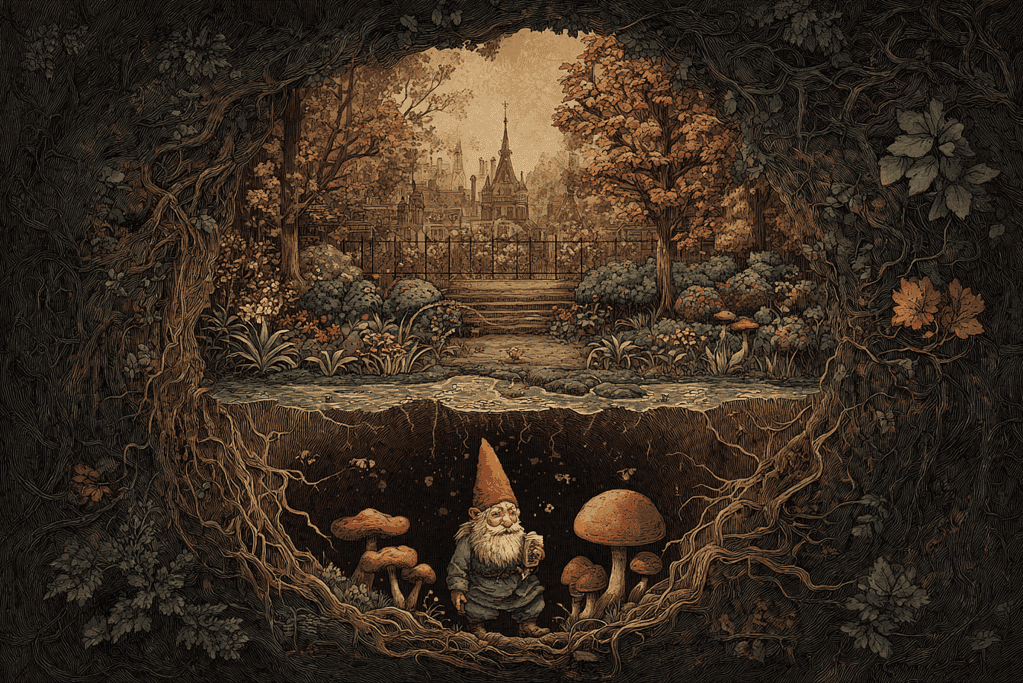
A modern garden gnome usually appears as a small statue or figurine, most often male, with a cap, a beard, and a sturdy little body made for outdoor display. That image is so familiar that many people assume it must be ancient.
The academic record tells a different story. The modern garden figure is late.
The older gnome belongs first to a conceptual world of earth beings, hidden places, and subterranean life. In other words, the garden version is not the beginning of the story. It is one historical phase in a much longer chain.
Gnomes are best understood as beings tied to earth, underground places, and the hidden life of nature.
They are often imagined as humanlike, but not fully human. They are linked to treasure, secrecy, buried matter, and the mystery of what lies beneath ordinary sight.
That is why the history of garden gnomes cannot be told well without first looking at the earlier history of gnomes in learned writing, literary tradition, and folklore and mythology (Paracelsus, 1941, pp. 229, 235; Rogers, 1974, p. 28; Manning, 2005, pp. 236–237).
The clearest early definition comes from Paracelsus, whose Book on Nymphs, Sylphs, Pygmies, and Salamanders became foundational for later discussion.
In his scheme of elemental beings, the gnomes belong to earth. Their proper sphere is subterranean matter, and Paracelsus describes them as beings who move through rock and soil as easily as humans move through air.
He also describes elemental beings as humanlike, yet “without soul,” which gives them a strangely unstable place between personhood and otherness (Paracelsus, 1941, pp. 229, 235).
This matters because so many later descriptions of gnomes still carry traces of that model. Even when later texts stop sounding theological or alchemical, the same core features remain.
Gnomes are earth-aligned, subterranean, elusive, and close to hidden wealth or concealed natural processes.
So when people say that gnomes “live underground,” that idea is not just a random fairy-tale detail. It reflects a very old conceptual pattern that became unusually explicit in Paracelsus’s writing (Paracelsus, 1941, p. 235), although with likely older sources that are to be found in older pre-Christian ideas.
And they survived in folklore across Europe, e.g. the Underjordiske in Sweden, Wichtel und Heinzelmännchen in Germany, and so forth.
This is one of the most interesting problems in the scholarship. Gnomes do not sit neatly in only one category.
Although they indeed may have their origins in European pre-Christian concepts such as dwarves and elves, as we can read in The tradition of household spirits : ancestral lore and practices (2013) by the French historian and philologist Professor Claude Lecouteux.
Ideas regarding such ‘little people’ have been ethnographically recorded across Europe, and may have their origins in a shared Indo-European heritage.
Indeed, gnomes move between mythical thought, literary imagination, occupational belief, and modern object culture. That unstable position is part of what makes them so hard to define.
T. D. Janssen helps clarify this by showing that Paracelsian elemental beings are not floating abstractions. They are tied to specific environments such as caves, forests, rivers, and volcanoes, and their meaning depends on the mode of contact between humans and the natural world (Janssen, 2024, pp. 137–140).
That makes gnomes useful for thinking about the borderland between learned systems and vernacular imagination.
They belong to gnome folklore, but they also belong to a wider history of thought about nature, hidden beings, and the structure of the cosmos, a kind of window to an older – and indeed shared – set of ideas and beliefs about nature across the European Continent.
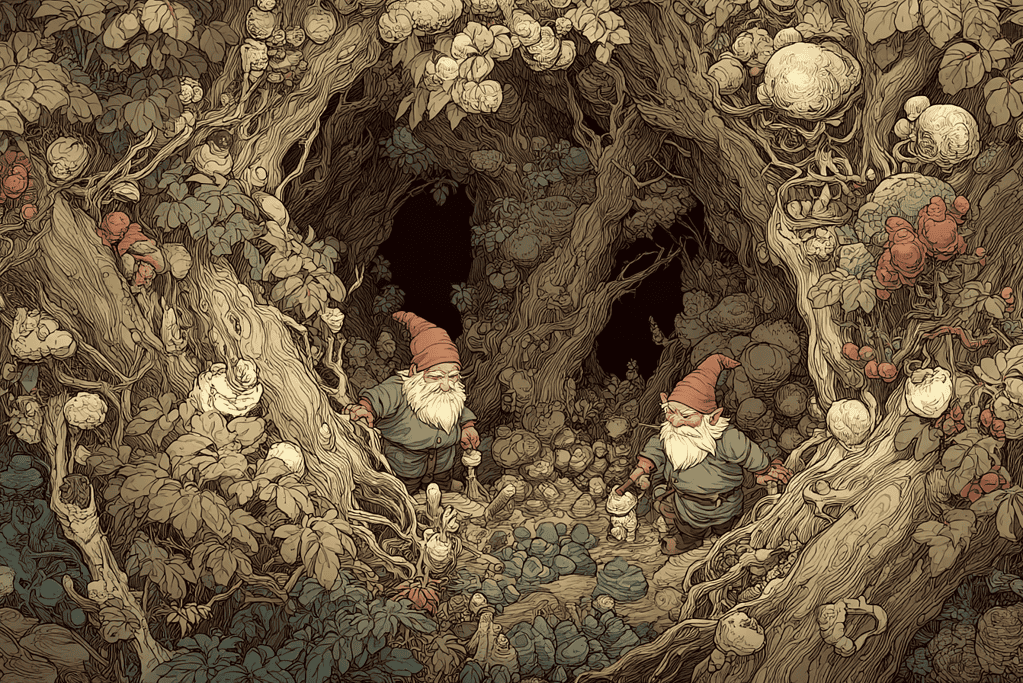
One of the strongest continuities in the sources is the connection between gnomes and hidden wealth.
In Paracelsus, the earth-being is closely tied to underground existence and to the material richness of the earth itself (Paracelsus, 1941, p. 235).
In later literary history, that becomes sharper. Pat Rogers shows that in the Comte de Gabalis tradition and in Pope’s adaptation, gnomes are linked to concealed valuables and appear as guardians of treasure, secrecy, and morally shadowed motives (Rogers, 1974, p. 28).
That treasure motif is worth pausing over. A gnome is not just “small.” A gnome is a figure of hidden value. That may mean literal buried treasure, mineral wealth, or symbolic forms of secrecy and hoarding.
This helps explain why the gnome persists so easily across genres. It can stand for the riches of the earth, for the fear of what is buried, or for the moral unease that comes with digging, extracting, or possessing what lies below the surface (Rogers, 1974, p. 28; Manning, 2005, p. 237).
Yes, but the relationship is messy.
The sources do not present a single clean genealogy. Instead, they show overlap. Ueli Gyr explicitly treats garden gnomes as “nanofied” descendants of earlier dwarf traditions and related miniature figures in European culture and pre-Christian ideas (Gyr, 2016, p. 124).
Manning, in turn, discusses mine sprites that are described as kin to gnomes without treating them as exactly identical beings (Manning, 2005, p. 236).
That means a gnome is often a hinge figure.
It touches the semantic world of the goblin, the dwarf, the mine sprite, and the little underground being without collapsing into any one of them. In everyday storytelling, people often blur such categories.
Scholarship shows why.
These figures all cluster around similar functions: hiddenness, earth, craft, treasure, and uneasy relations with humans.
So it is fair to say that gnomes belong to a family of gnome-like beings, but not that every dwarf or goblin is simply a gnome under another name (Gyr, 2016, p. 124; Manning, 2005, p. 236).
Mining culture offers some of the richest evidence for how underground beings function in social life. Paul Manning’s work on Cornish mine spirits is especially valuable.
He shows that sprites such as knackers and tommyknockers were not trivial superstition.
They were embedded in the working life of mines, in danger, in labor relations, and in the moral imagination of extraction. He also cites a description that places these beings alongside gnomes as spirit kinfolk, marked by invisibility and underground presence (Manning, 2005, pp. 236–237).
This is where the history of gnomes becomes socially concrete.
Gnomes and related mining spirits helped explain sounds in the mine, the feeling of unseen presence, and the ethics of disturbing subterranean spaces.
Manning’s evidence even preserves the idea that such beings “keep everlasting watch” over buried spaces and materials (Manning, 2005, p. 237).
In that sense, the gnome is not merely decorative or literary. It can function as a moral figure inside a working environment where wealth, danger, and the earth are entangled.
The sources used here do not support a neat single-origin myth for the first garden gnome, and that is worth saying plainly.
The strongest academic evidence in this limited corpus points instead to a gradual transformation.
Gyr traces the modern garden gnome through Central European dwarf and park traditions, then into domestic garden culture and global popular circulation (Gyr, 2016, pp. 124, 132–133). That gives us a historical process, not a magical first moment.
The academic picture is that garden gnomes emerge from older miniature and dwarf traditions and become recognizable modern garden decorations in the nineteenth and twentieth centuries, rather than springing fully formed from one inventor or one estate (Gyr, 2016, pp. 124, 132–133).
Gyr’s article is especially strong on this point.
He explains that the garden gnome moved from a broader European genealogy of dwarfs, court curiosities, and designed landscape figures into the domestic garden.
Once there, it became a household ornament, a small being placed in controlled nature. That shift matters. It turned the gnome from a being imagined in hidden earth into a being visibly staged above ground, smiling from the flower bed (Gyr, 2016, pp. 124–125).
Yet the older logic did not disappear.
The modern garden ornament still keeps traces of older meaning. It still suggests closeness to earth, seasonal life, digging, tending, and quiet guardianship.
Gyr argues that garden gnomes project a longing for an “intact world,” a miniature vision of stability and continuity in an unstable modern age (Gyr, 2016, p. 140).
That is a powerful idea. The garden gnome looks silly to some viewers, but academically speaking, it works as a small image of order, rootedness, and protected domestic space.
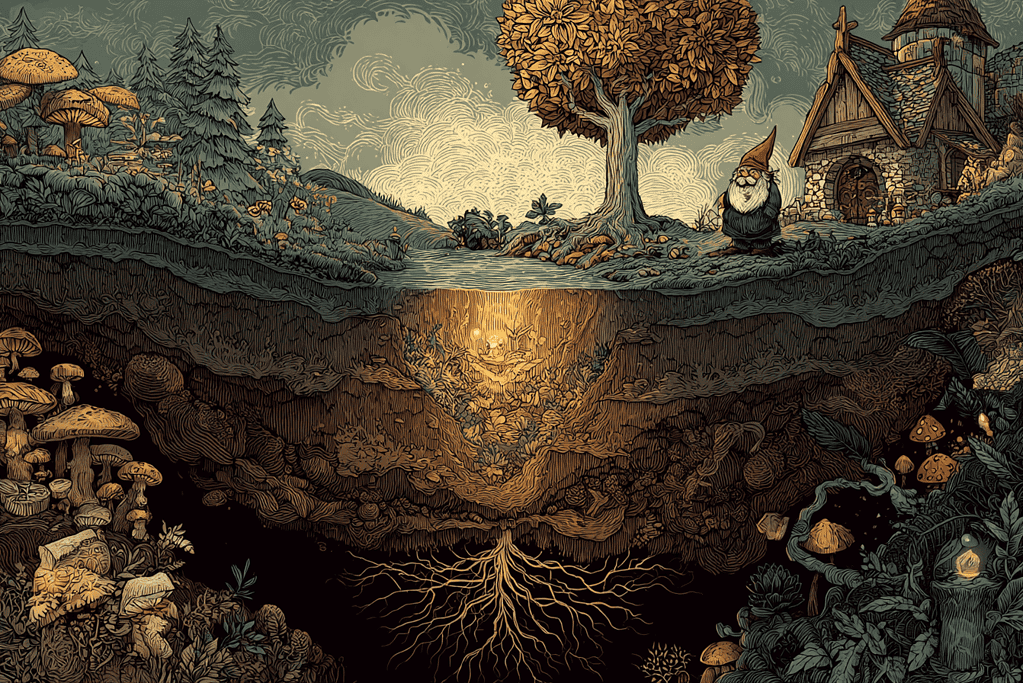
The answer lies in flexibility.
A garden gnome can be comic, sentimental, eerie, nostalgic, or rebellious. Gyr shows how the figure became caught up in debates over taste, class, kitsch, museums, and legality.
In one setting it is mocked. In another, it is curated. In yet another, it becomes part of a playful modern mythology of theft, tourism, or display (Gyr, 2016, pp. 124, 140). That is why gnomes in popular culture have survived so well.
Dimitra Fimi’s reading of Upton Sinclair’s The Gnomobile adds another layer.
In that novel, gnomes become “elemental spirits of nature,” almost spokesmen for threatened forests, while still being folded into modern fantasies of technology and energy (Fimi, 2024, p. 332). That combination is fascinating.
The gnome becomes both old and new at once. It speaks for the earth, but it can be packaged for modern entertainment. It can belong to fairy tales, children’s fiction, ecological critique, and mass culture without losing its earth-bound aura.
Today, the garden or lawn gnomes that appear in shops and yards may be made of resin instead of clay, and their expressions may be goofy rather than solemn, but the figure still carries an old symbolic charge.
Even now, gnomes are generally imagined as little guardians of place, figures of the earth, or keepers of a patch of cultivated nature.
They remain creatures of threshold space, half comic and half old-world. That is why they continue to appear in both nostalgic imagery and parody.
The deeper point is that the garden gnome survives because it condenses several old ideas into one portable figure. It joins the underground with the domestic, the strange with the familiar, and the hidden with the visible.
A small statue in a garden can still echo Renaissance elementals, literary treasure guardians, and mine spirits watching buried spaces. That is the real force of the symbol.
The gnome is small, but the cultural history behind it is not (Paracelsus, 1941, p. 235; Manning, 2005, p. 237; Gyr, 2016, p. 140).
Fimi, D. (2024). Gnomes, gnature, and the “gnifty gnomobile”: Elemental spirits, deforestation and energy systems in transition in Upton Sinclair’s The Gnomobile. Children’s Literature in Education, 55, 329–342. https://doi.org/10.1007/s10583-022-09507-7
Gyr, U. (2016). Garden gnomes from the perspective of popular culture nanology. Journal of European Ethnology and Cultural Analysis, 1(2), 124–147.
Janssen, T. D. (2024). Encounters, evocations and elemental beings: Modes of contact and the natural world in the “Liber de nymphis” and “A Treatise on Angel Magic.” Correspondences: Journal for the Study of Esotericism, 12(1), 137–176.
Lecouteux, C. (2013). The tradition of household spirits: Ancestral lore and practices. Inner Traditions
Manning, P. (2005). Knackers, tommyknockers, and other sprites of capitalism in the Cornish mines. Cornish Studies, 13(1), 216–255. https://doi.org/10.1386/corn.13.1.216_1
Paracelsus. (1941). A book on nymphs, sylphs, pygmies, and salamanders, and on the other spirits (H. E. Sigerist, Ed.). In Four treatises of Theophrastus von Hohenheim called Paracelsus (pp. 213–253). Johns Hopkins Press. (Original work written 1536–1537)
Rogers, P. (1974). Faery lore. The Review of English Studies, 25(97), 25–38. https://doi.org/10.1093/res/XXV.97.25

ᛉ 100% handcrafted artisan pagan , viking, witchcraft and shamanic inspired jewelry.
ᛉ Runes, Symbolism & European Folklore
Get 20% off👇🏻
Leave a comment with your result ❤️
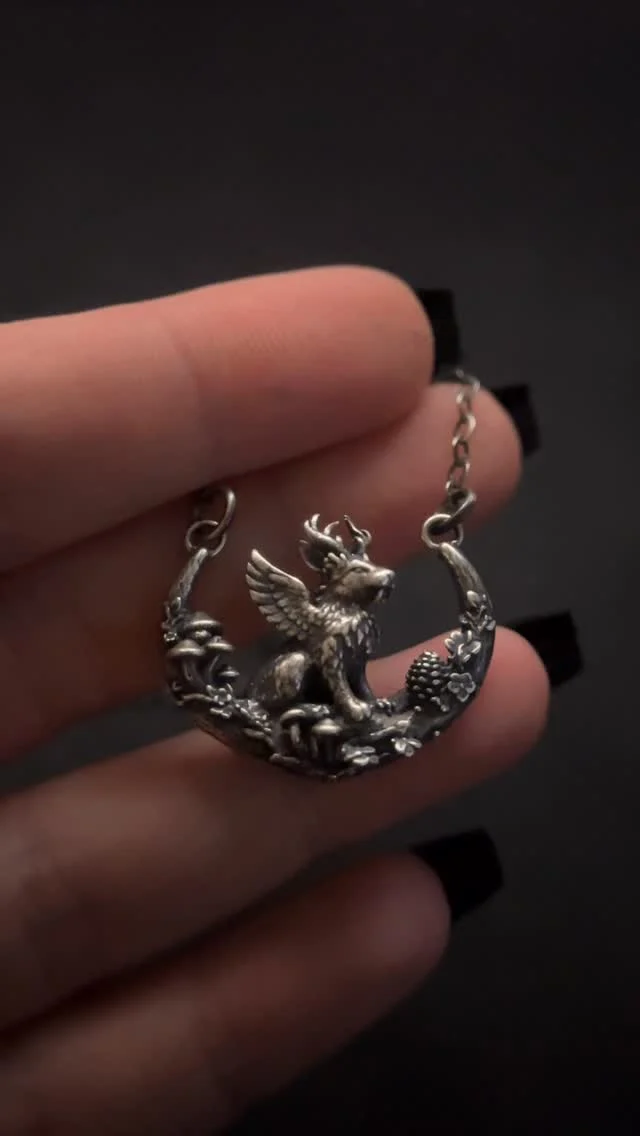
Bavarian Folklore says that you might just cross paths with a Wolpertinger in the alpine...

🐇🌲✨
He finally stepped out of the forest…
The Wolpertinger Pendant has arrived.
Inspired by...

I don’t often sell them, but love it when I do!
Vinca symbol bracelets ❤️...

Rooted in strength + guarded by ravens

The serpent waits 🖤
(Handcrafted Jörmungandr ring made to order in my shop)

Stay warm, everyone ❤️

😑😑😑🤮

I thought I had closed the book on the Alice in Wonderland rings…
But you...

Can this be over now, please?

In case you forgot 💜

Something I’ve been thinking about lately.
If there’s one thing I would’ve done differently early...

This year, we’re not buying things just to keep up.
If you need the reminder:...

My husband is from Bavaria (southern Germany) and I originally made this Krampus pendant for...

Some of the items I’m shipping out today ❤️
Please forgive my dirty nails 😂...

A few items shipping out today 🥰

This mornings rings shipping out ❤️

A few of the rjngs I’m shipping out this morning ❤️
How do you like...

Krampus is coming 🫶🏻

Getting ready to pack up these pretties and ship to their owners ❤️

Freya, cats and pentacles. Doesn’t get any better ❤️

You all got me going crazy making all these fairytale + storybook rings.
But I’ll...

Just launched these pretties ❤️
Size 9 amethyst ring + size 7.25 green kyanite

What would you trade to learn Baba Yaga’s secrets?

It *finally* looks, feels and smells like October!
And here are some items I’m packing...

This mornings pretties getting ready to ship :)

Getting ready to pack up these pretties and ship to their owners ❤️

You bet I’m hopping on this trend 😂
Thank you @shes_sinister for the prompt!

While I welcome the seasonal darkness…it sure is going to make my morning quick videos...

Finally finished the rings I’ve been working on in my stories ❤️
I think I...

Was going to post this update to my stories but it’s too long.

“How do you know I’m mad?” said Alice.
“You must be,” said the Cat, “or...

Some of this mornings orders getting ready to ship. Those little bats are so cute...

Here is the finished ring I was working on in my stories yesterday, along with...

A few of today’s orders shipping out this morning ❤️

The two silver raven rings I was working on in my stories yesterday.
…as well...

Eeeek! I’m so happy to add these to my shop ❤️
I’ve gotten so many...

I had 6 clamshells ready to ship this morning but I dropped and lost my...

Not the story you were told.
The girl didn’t run.
The wolf didn’t win.
This...

I love these raven rings so much 🖤
This mornings pretties shipping out.
All items...

Sleek + minimal Mjölnir ring ⚒️

Today’s orders getting ready to ship.
…And I finally got some time to work on...

That ant ring is so out of place 😂
Not that the mail is coming...

If you had this, which runes would you choose? Or would you accept the runes...

I love making these fun Halloween coffin pendants 🎃
All items you see are always...


About the author Jacqueline Fatica


