No products in the cart.
December 19, 2025 2:08 pm

Free USA shipping on orders $35+
December 19, 2025 2:08 pm
Happy Ostara is often shared as a seasonal greeting tied to the equinox and the coming of spring.
Yet behind this modern observance lies a complicated story shaped by linguistics, folklore, and scholarly debate.
This article examines what academic literature actually tells us about Ostara, the spring equinox, and the relationship between language, tradition, and celebration.
It is worth reading because it separates evidence from assumption and shows how meaning is created, preserved, and sometimes reinvented over time.
Ostara is commonly used today as the name for a celebration marking the spring equinox.
Saying happy Ostara functions as a seasonal greeting much like happy spring.
In modern pagan and neopagan contexts, Ostara marks a time of balance, renewal, and the gradual return of warmth and light in the northern hemisphere.
Academic literature shows that Ostara as a named festival is not securely attested in ancient sources.
Instead, it emerges through linguistic interpretation and later cultural synthesis. Scholars stress that this does not invalidate the observance itself.
It means that the meaning of Ostara develops through interpretation rather than continuous documentation (Hutton, 2008, pp. 252–254).
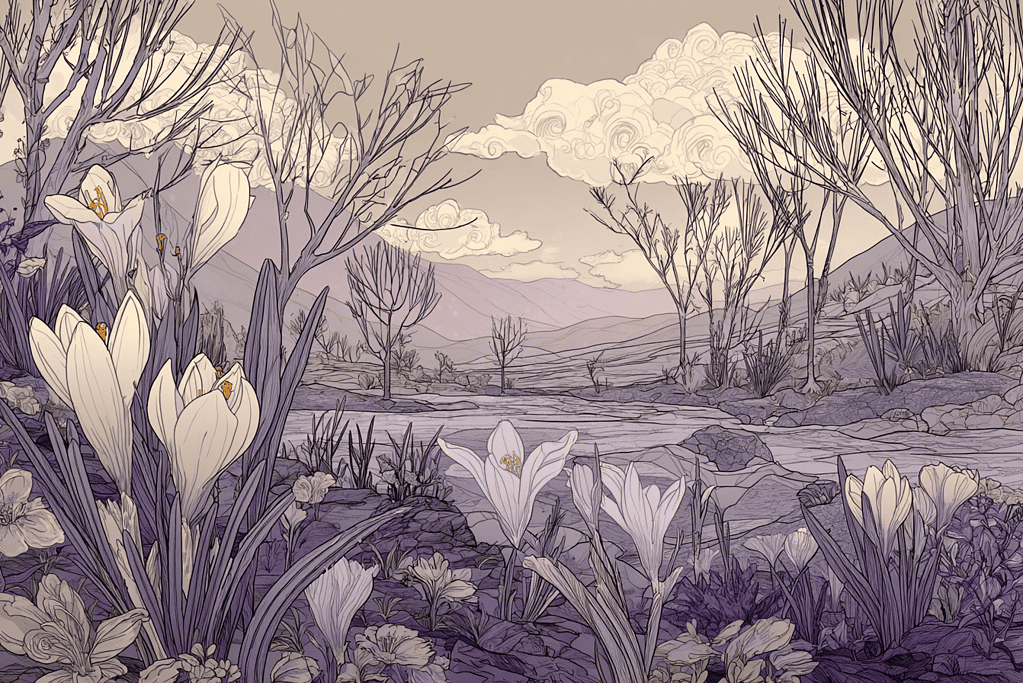
The equinox occurs when day and night are approximately equal in length.
The spring equinox, also called the vernal equinox, signals the transition from winter to spring.
Astronomically, it marks the point when the sun crosses the celestial equator, bringing longer daylight and warmer conditions.
Cultures across Europe and beyond have recognized this moment as significant.
Agricultural cycles depend on planting and preparation, and human societies respond to visible changes in bloom and warmth.
Academic discussions emphasize that seasonal awareness does not require a named deity. Observance can exist without mythological personalization (Barnett, 1949, pp. 62–63).
The idea of Ostara as a goddess rests on limited evidence.
Linguists and philologists in the nineteenth century proposed the existence of a Germanic goddess of dawn based on comparative language study.
A. Kuhn argued that Indo-European traditions frequently personified dawn as female, linking light, fate, and cyclical renewal (Kuhn, 1854, pp. 449–451).
This hypothesis influenced later scholars, yet it remains speculative.
There is no archaeological or ritual evidence confirming a widespread cult.
The name Ostara reflects linguistic reconstruction rather than documented worship.
Academic caution remains essential when discussing a deity whose existence depends on inference rather than direct testimony.
The only early medieval reference to a goddess connected to Easter comes from the Venerable Bede.
He states that the Anglo-Saxon month Ēosturmōnaþ was named after a goddess called Eostre, whose name later transferred to the Christian celebration of Easter (Bede, cited in Billson, 1892, p. 442).
This single reference creates a methodological problem.
One source cannot establish widespread belief or ritual practice. Scholars note that Bede does not describe cult activity, myths, or observance beyond naming.
The figure of Eostre remains an anglo-saxon goddess mentioned once, not a fully documented deity (Billson, 1892, pp. 442–444).
Easter as a Christian festival centers on resurrection rather than astronomical balance.
Barnett explains that Easter absorbed seasonal symbols associated with spring and rebirth while retaining its theological framework (Barnett, 1949, pp. 63–65).
The timing of Easter near the spring equinox encouraged symbolic overlap. Light, new life, and the coming of spring naturally aligned with resurrection imagery.
This process reflects cultural change rather than direct continuity from pagan observance to Christian ritual.
Egg symbolism appears frequently in spring celebrations. Eggs represent rebirth, new beginnings, and potential.
Billson documents egg customs throughout Europe, especially in connection with Easter, rather than Ostara specifically (Billson, 1892, pp. 445–450).
The hare and rabbit appear later as folkloric figures associated with fertility and abundance.
Billson traces hare customs in German and English regions, noting their seasonal presence without proving goddess worship (Billson, 1892, pp. 450–456).
These symbols function independently of named deities, serving as motifs tied to the coming of spring.
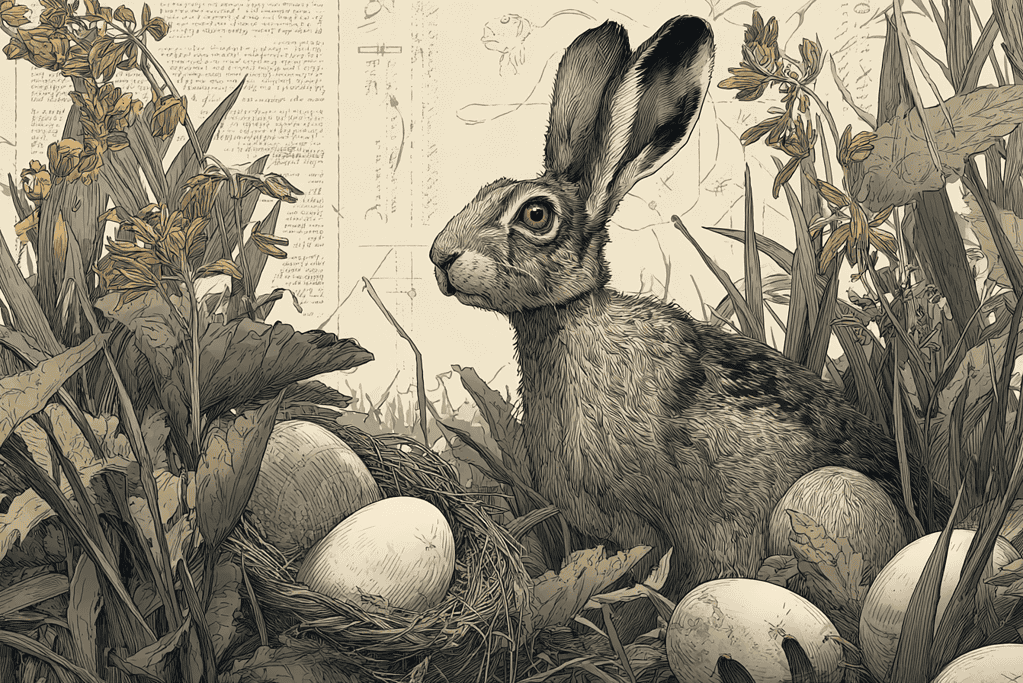
Nineteenth-century scholars attempted to reconstruct ancient belief systems using folklore and comparative linguistics.
Billson illustrates how scholars connected the hare, eggs, and springtime customs to hypothetical pagan rituals (Billson, 1892, pp. 456–462).
Modern scholarship treats these reconstructions cautiously.
Folklore preserves practice and memory, not direct theology. The leap from custom to deity reflects scholarly imagination shaped by the intellectual climate of the time.
Ostara gained prominence within modern pagan frameworks, particularly the wheel of the year.
Ronald Hutton explains that the eightfold ritual calendar developed in the twentieth century, shaped by symmetry, seasonal logic, and ritual coherence rather than ancient precedent (Hutton, 2008, pp. 258–260).
Within neopagan and witchcraft communities, Ostara celebrates renewal, balance, and awakening.
These meanings reflect lived religious experience rather than historical reconstruction.
Tradition forms through repetition and shared observance, not solely through antiquity (Hutton, 2008, pp. 255–257).

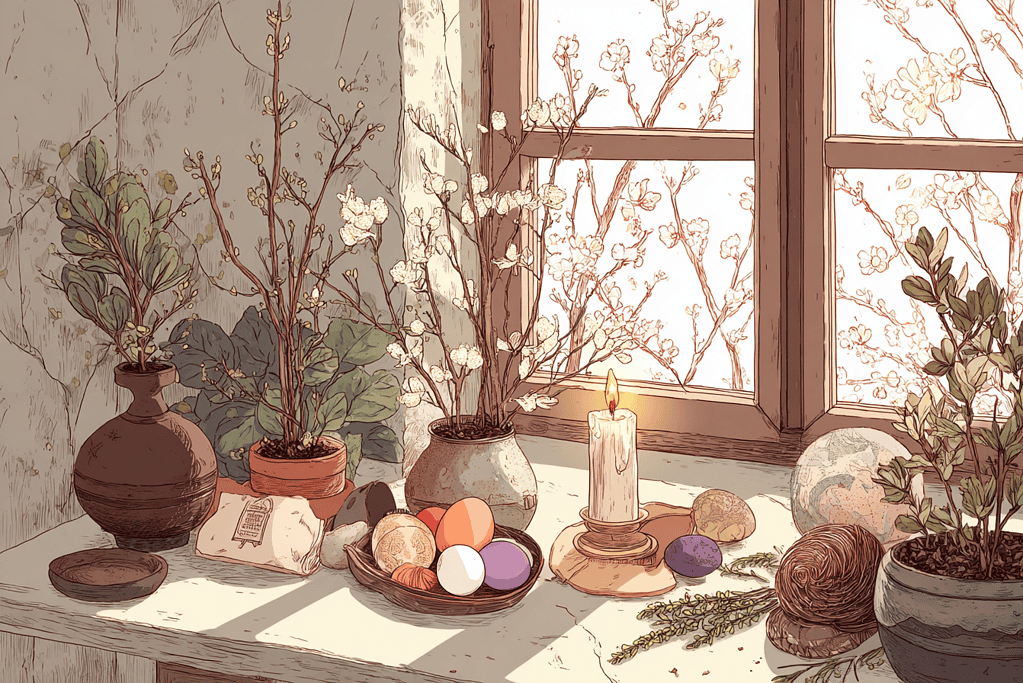
Modern celebrations of Ostara often include decorating colored eggs, planting herbs, and creating baskets of spring flowers.
Daffodil, crocus, and iris appear frequently as seasonal markers. Ritual blessing and simple observance reflect themes of new life and rebirth.
People may decorate altars, light candles, or mark the first day of spring with joy.
These practices emphasize celebration and connection to seasonal change rather than devotion to a specific deity.
The act to celebrate carries meaning through intention rather than historical reenactment.
Academic literature allows clear conclusions. Ostara exists as a modern festival shaped by language, scholarship, and practice.
The name of Ostara derives from linguistic interpretation influenced by a single medieval reference and nineteenth-century philology.
This does not diminish the value of the observance. It clarifies its origin.
Ostara represents renewal, balance, and the great spring through modern tradition rather than ancient continuity.
Saying happy Ostara expresses participation in a living celebration shaped by knowledge, creativity, and seasonal awareness.
Barnett, J. H. (1949). The Easter festival: A study in cultural change. American Sociological Review, 14(1), 62–70.
Billson, C. J. (1892). The Easter hare. Folklore, 3(4), 441–466.
Hutton, R. (2008). Modern pagan festivals: A study in the nature of tradition. Folklore, 119(3), 251–273.
Kuhn, A. (1854). Die Morgenröthe und die Schicksalsgöttinnen. Zeitschrift für vergleichende Sprachforschung, 3(6), 449–452.

ᛉ 100% handcrafted artisan pagan , viking, witchcraft and shamanic inspired jewelry.
ᛉ Runes, Symbolism & European Folklore
Get 20% off👇🏻

Five witches dance around a blazing bonfire beneath a citrine cabochon in this Walpurgisnacht pendant....
Happy washing day 🙃
A few rings I’ve worked on the last couple days…
Freya’s cats rule and dogs drool?
Or was that the other way around? 🙃

Garm barely shows up in the old Norse stories.
Still… he leaves a mark.
A...
Leave a comment with your result ❤️
Bavarian Folklore says that you might just cross paths with a Wolpertinger in the alpine...

🐇🌲✨
He finally stepped out of the forest…
The Wolpertinger Pendant has arrived.
Inspired by...

I don’t often sell them, but love it when I do!
Vinca symbol bracelets ❤️...

Rooted in strength + guarded by ravens

The serpent waits 🖤
(Handcrafted Jörmungandr ring made to order in my shop)

Stay warm, everyone ❤️

😑😑😑🤮

I thought I had closed the book on the Alice in Wonderland rings…
But you...

Can this be over now, please?

In case you forgot 💜

Something I’ve been thinking about lately.
If there’s one thing I would’ve done differently early...

This year, we’re not buying things just to keep up.
If you need the reminder:...

My husband is from Bavaria (southern Germany) and I originally made this Krampus pendant for...

Some of the items I’m shipping out today ❤️
Please forgive my dirty nails 😂...

A few items shipping out today 🥰

This mornings rings shipping out ❤️

A few of the rjngs I’m shipping out this morning ❤️
How do you like...

Krampus is coming 🫶🏻

Getting ready to pack up these pretties and ship to their owners ❤️

Freya, cats and pentacles. Doesn’t get any better ❤️

You all got me going crazy making all these fairytale + storybook rings.
But I’ll...

Just launched these pretties ❤️
Size 9 amethyst ring + size 7.25 green kyanite

What would you trade to learn Baba Yaga’s secrets?

It *finally* looks, feels and smells like October!
And here are some items I’m packing...

This mornings pretties getting ready to ship :)

Getting ready to pack up these pretties and ship to their owners ❤️

You bet I’m hopping on this trend 😂
Thank you @shes_sinister for the prompt!

While I welcome the seasonal darkness…it sure is going to make my morning quick videos...

Finally finished the rings I’ve been working on in my stories ❤️
I think I...

Was going to post this update to my stories but it’s too long.

“How do you know I’m mad?” said Alice.
“You must be,” said the Cat, “or...

Some of this mornings orders getting ready to ship. Those little bats are so cute...

Here is the finished ring I was working on in my stories yesterday, along with...

A few of today’s orders shipping out this morning ❤️

The two silver raven rings I was working on in my stories yesterday.
…as well...

Eeeek! I’m so happy to add these to my shop ❤️
I’ve gotten so many...

I had 6 clamshells ready to ship this morning but I dropped and lost my...

Not the story you were told.
The girl didn’t run.
The wolf didn’t win.
This...

I love these raven rings so much 🖤
This mornings pretties shipping out.
All items...

Sleek + minimal Mjölnir ring ⚒️


About the author Jacqueline Fatica


