No products in the cart.
March 1, 2026 8:18 pm

Free USA shipping on orders $35+
March 1, 2026 8:18 pm
The world of classical Greek mythology is as rich historically as it is vivid and multi-faceted in its poetic ways of storytelling and the worldviews of the ancient Greek people.
Indeed, many Greek and Roman philosophers, writers and historians have written in great detail about the powerful Titans, the mysterious overlaps and parallels between the Roman Diana and the Greek Artemis and Hekate.
And of course the many qualities and special powers of the Gods and Goddesses themselves.
Magic and magicians are an integral aspect of Greek mythology and likewise ancient Greek culture.
There are tales of powerful sorcerers and equally female sorceresses, and also highly detailed descriptions of what these magical characters are able to do.
In classical Greek mythology, we will find that both Artemis and Hecate are often linked and associated as a mistress of the hunt and the wild nature, that which lies beyond the tamed and domesticated spheres of a predominantly agricultural society.
Indeed, Artemis conveys for instance an old warrior-huntress motif that has provided scholars and researchers with profound questions on the time-depth and age of said Goddesses, possibly deriving the Bronze Age and even older layers of mythic motifs (M.C. Green, 2007, p.114).
The Greek Pantheon of the ancient world knew of Goddesses and mythical sorceresses who were able to travel ‘between’ the spaces, and who could teach magical powers and skills such pharmakos, that is the art of casting spells to others.
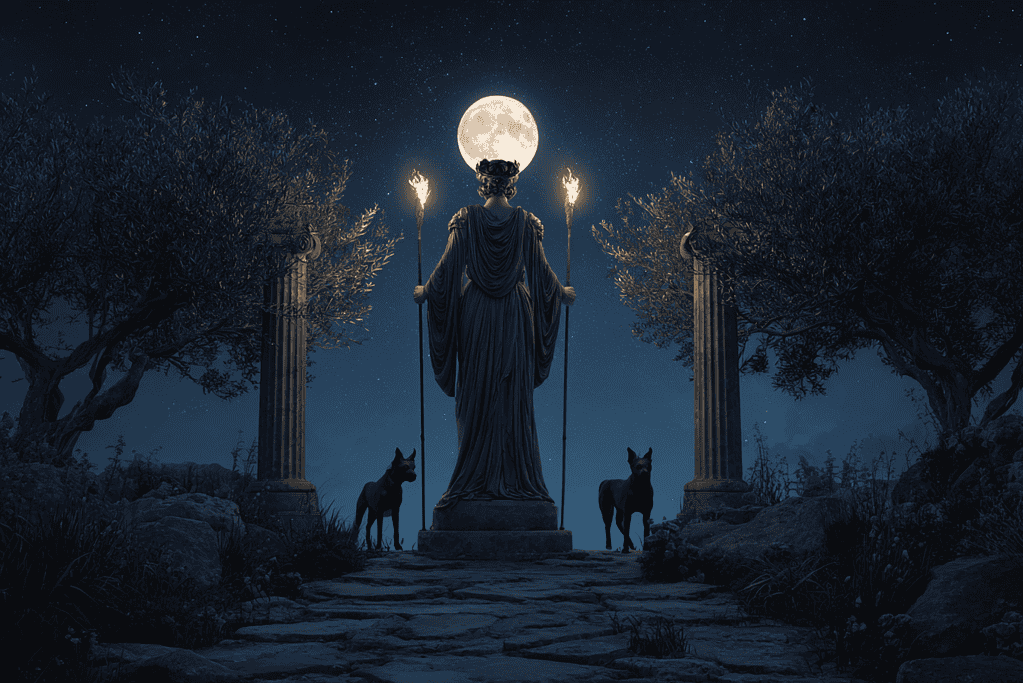
There are three main characters in Greek mythology that are interlinked with highly gifted and powerful Goddesses and sorceresses.
The ancient Greek poet Hesiod mentions for instance the magically gifted Hecate in his work ‘Theogony’ which was written and composed in 730–700 BC.
In ‘Theogony’ right before the birth of Zeus we learn about the Hymn to Hecate (411-52).
When studying this poetic account on the origins and lineages of the ancient Greek Gods, we read that Hecate is the daughter of the Titan Perses and the nymph Asteria and has power over heaven, earth, and sea; hence, she bestows wealth and all the blessings of daily life.
We likewise learn that Zeus, son of Kronos, honored Hecate dearly. It was in accordance to his will that Hecate shall have a share of the starry sky, the sea and the earth.
Furthermore, religious prayers to Hecate would bring plentiful fish harvest, increase livestock and a plentiful flock of goats, sheep, … but Hecate would also take them from the farmer if she felt the need to do so.
In addition, Hecate participates in rather universal aspects of day to day life, but most importantly the ones that could bring great outcomes to the Greek people such as her assistance to men at war in achieving victory.
She likewise sits in judgment besides reverend kings, and in athletic contests she likewise aids in victorious outcomes. (Glenn W. Most, Hesiod: Theogony,, 2006, pp.37, 38, 39).
What is important here is that in Theogony we learn about a different side of Hecate: a powerful Goddess without a doubt, but one with universal powers and a rather fierce independence.
In other words, Hecate may have evolved into a Goddess of Witchcraft and the Underworld at a later time but this may have not always been the case (e.g. Deborah Boedeker, 1983).
Goddess Hecate, who rules the worlds ‘beneath’, in the Underworld, has 3 different ways of manifesting. Scholars who specialize in classical mythology have noted this for decades.
It is Hecate who rules over and who rules also between ‘mediatory spaces’, between the 3 spheres (sky, earth, underworld).
These 3 spheres echo a widely pre-Christian idea of tripartite spheres or dimensions. And it is within the Underworld where the darker aspects such as Witchcraft or Ancestor worship can be found.
The Greek scholar and historian Apollonius Rhodius wrote the ancient Hellenistic epic Argonautica in the 3rd century BC – an important text that provides important and detailed descriptions of how Hecate became a Goddess and skilled practitioner of Witchcraft.
Besides her reign over 3 dimensions and the liminal spaces in between, Hecate appears in many shapes and forms. Hence why she is also depicted as having 3 faces.
For instance, the goddesses Artemis, Selene, and Hekate are often to be identified as the same goddesses, however, they appear as three seemingly separate characters.
First as Selene in the sky (moon), then Artemis on earth (hunting), and Hecate beneath the earth (Underworld) (M.C. Green, 2007).
Greek literature is certainly not as scarce as other cultural regions in Europe prior to the adoption of Christianity.
The Greek epics, historians and philosophers have shared great epics and poems with the world.
Circe is a powerful sorceress in Greek mythology, with many human-like characters, human speech and braided hair.
According to Greek legend, Circe the sorceress is the daughter of Helios, the sun god, and of the ocean nymph Perse, (Homer, Odyssey 10. 135 ff (trans. Shewring) (Greek epic C8th B.C.).
Her name already conveys magical powers, as Circe’s name may be indeed a reference to binding powers via will and mind through the art of magic and pharmakos (see e.g. Christopher Faraon et al, 1991, p. 165)
Circe is said to be a goddess of magic and her magical capabilities are many (pharmakeia).
She possessed many magical powers that other scholars (e.g. Matthew Dickie, 2003) have been noticed as ‘like a shaman’, although such a term must be and should be used very carefully when studying the mythological motifs within an Indo-European context.
Indeed, she was skilled in the magic of spellcasting, magical commands and she possessed the art of shapeshifting.
She lived on the mythical island of Aiaia (Aeaea) in southern Italy. (source, rewrite), as we learn in Hesiod, Catalogues of Women Fragment 46.
“Apollonios (Apollonius), following Hesiod, tells us that Kirke (Circe) came to the island against Tyrrhenia on the chariot of Helios. He further notes that this island lies somewhere far out west.
Indeed, when Odysseus came to her island she transformed his men into beasts but, with the help of the god Hermes, she was forced to end this magical act of transmutation and shapeshifting.
Once Hermes confronted her she was forced to end the magical spell again.
Some scholars claim that the Homeric portrayal of Circe may be the first depiction of a witch in Greek literature.
Ancient descriptions of her indeed portray a female character who knows how to cast spells, how to craft magical potions and remedies, how to consult the Dead and spirits and so forth (Daniel Ogden, 2002, p.94)
The Greek word for such magical abilities and ritual practice is pharmakis and pharmakeutria (drugs, herbal remedies and magical potions, spells).
It is said that Circe knows many of such drug-remedies (polu-pharmakos; 274-80) and it is repeatedly said that she uses the knowledge of pharmaka. In Homer Epigram 14 we can read her many magical abilities, such as:
Circe had magical animal helpers that were particularly important to late Medieval descriptions and depictions of her.
A woman whose natural domain was shown to be the animal world would also have fitted well with images of witchcraft in the early sixteenth century.
Circe here epitomizes that mythical space witches were understood to inhabit between the realm of the human and the beastly, an idea strongly communicated from the turn of the sixteenth century through the common image of witches in the presence of animals (Charles Zika, 2002, p.17)
Circe was one of several classical sorcerers or witches who became the subjects of sixteenth-century visual images.
Of them all, it was Circe who received the most widespread and long-lived attention.
The powerful sorceress of classical mythology, especially well known for her transformation of the companions of the wandering Odysseus (or Ulysses) into beasts, was an immensely popular subject in the art and illustration of the period. (Charles Zika, 2002, p.5).
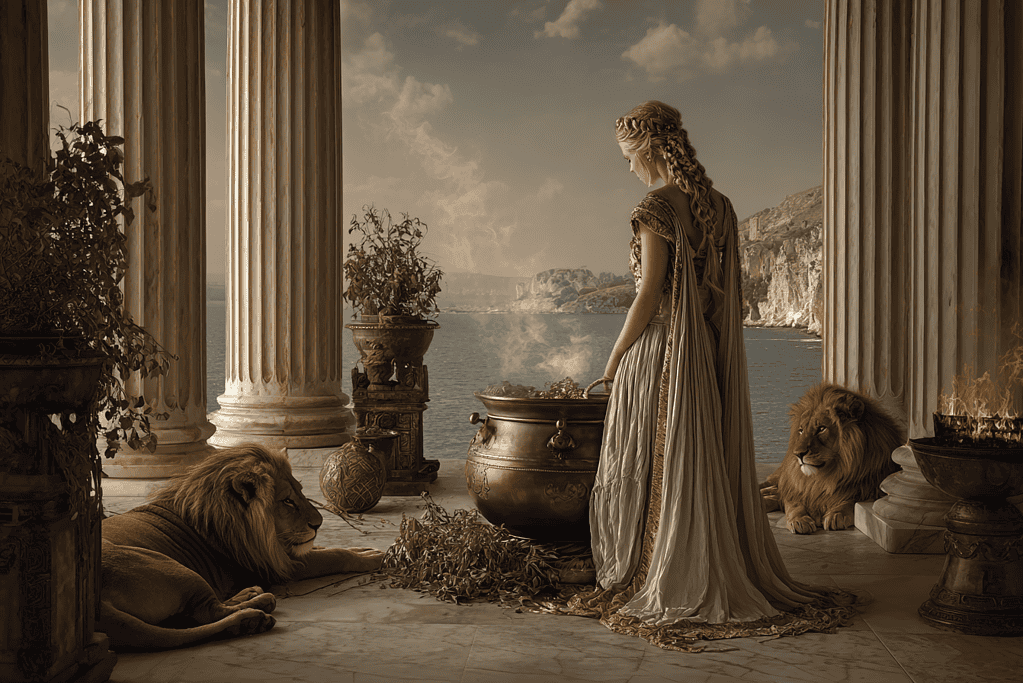
Medea was the daughter of King Aeëtes of Colchis and Eidyia, as well as the granddaughter of Helios, an important sun god.
She is also the niece of Circe, a famous sorceress in Greek mythology. She is a skilled sorceress and high-priestess of the temple of Hecate, a Goddess of magic with many magical capabilities.
In Greek Mythology Medea, is an enchantress who helped Jason, leader of the Argonauts, to obtain the Golden Fleece from her father, King Aeëtes of Colchis.
She is mentioned and described for instance by the Roman poet Ovid in the tale of Jason and the golden Fleece in Book VII of The Metamorphoses (Brain Kinsey, 2011).
Although not originally a witch she became known for her cruel acts and as a vengeful Greek character, in particular the murder of her brother Apsyrtus by throwing his remains into the sea and her abandoning her fathers kingdom.
As an important reference to her magical abilities serves the line 195 by Ovid where he states that she uses cantusque artisque magorum which means that she uses the arts of incantations and magicians.
According to scholars who have specialized in Classical mythology we may learn in Ovid’s metamorphoses a lot about Medea if we pay particular attention to the invocations to Hekate.
Medea clearly has magical abilities such as flying on a chariot through the sky in order to reach the Thessalian land which is known for and is associated with magic, controlling and manipulating natural elements.
Furthermore, she even has a kind of animal helper: Medea sends forth a dragon that assists her in finding the right herbs in order to craft magical potions (Marina Montesano, 2018, pp. 18, 19, 20).
She was of divine descent and had the gift of prophecy. She married Jason and used her magic powers and advice to help him.
However, Medea has a dark and shady reputation as she is known for the brutal act of killing her own children to exact vengeance on her deceitful husband, the Argonauts leader Jason and the murder of her brother Apsyrtus.
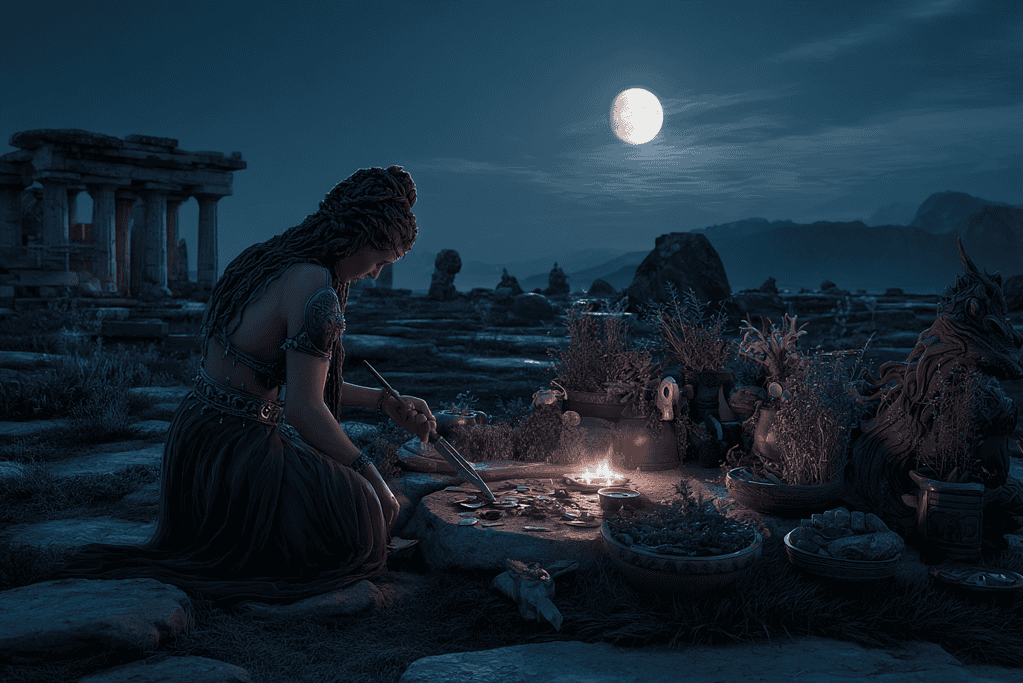
When we study the art of Witchcraft in ancient cultures it is of course important to stress that the very term Witchcraft comes with certain modern interpretations that can be problematic because they tend to say more about our own modern assumptions.
Thereby the term witchcraft might be problematic as its use relies heavily on modern associations and interpretations and should be used with caution.
However, Greek culture and mythology knows very well acts of magic, magical remedies, the art of casting spells, binding via curses and commands, consulting the mythical spaces beyond where the Spirits reside (hereby the Greek Underworld).
For instance both Circe and Medea were known to use herbs and plants to craft potions.
Such magical potions can be traced back into Antiquity and even though potions do likewise play a role in the historical documents of 16th and 17th witchcraft trials, magical remedies and poisons were often used to describe a potent cure or medicine (Marina Montesano, 2018, p.21).
The Greek word for magicians is manganeia or manganeuma whereas spells used in magical work are called pharmaka. In Latin this would be veneficia. (Matthew Dickie, 2001, p.16).
The ancient Greek world knew many different kinds of magical acts and arts.
Besides the crafting of powerful herbal remedies and casting spells, another kind of magic was for instance consulting spirits or oracles at tombs and for other divination purposes and the use of magical binding spells to work with these entities (katadesmoi) (Matthew Dickie, 2001, pp. 6, 7).
Each and every magical art and practice in ancient Greek mythology and culture deserves further research and an in-depth presentation which will be discussed in future research articles.
References:
Green, C. M. C. (2007). Roman Religion and the Cult of Diana at Aricia. Spain: Cambridge University Press.
Hesiod: Theogony, Works and days, Testimonia. (2006). United Kingdom: Harvard University Press.
Boedeker, D. (1983). Hecate: A Transfunctional Goddess in the Theogony? Transactions of the American Philological Association (1974-), 113, 79–93. https://doi.org/10.2307/284004
The Odyssey. (2004). United Kingdom: Pan Macmillan.
Homer. (2017). The Homeric Hymns and Epigrams: Homer. (n.p.): CreateSpace Independent Publishing Platform.
Ogden, D. (2002). Magic, Witchcraft, and Ghosts in the Greek and Roman Worlds: A Sourcebook. Kiribati: Oxford University Press.
Charles Zika: Images of Circe and Discourses of Witchcraft, 1480 – 1580, in: zeitenblicke 1 (2002), Nr. 1 [08.07.2002], URL: <http://www.zeitenblicke.historicum.net/2002/01/zika/zika.html>
Kinsey, Brian. Heroes and Heroines of Greece and Rome. (2012). United States: Marshall Cavendish Reference.
Montesano, M. (2018). Classical Culture and Witchcraft in Medieval and Renaissance Italy. Germany: Springer International Publishing.
Dickie, M. W., Dickie, M. W. (2003). Magic and Magicians in the Greco-Roman World. United Kingdom: Taylor & Francis.
Magika Hiera: Ancient Greek Magic and Religion. (1997). United States: Oxford University Press

ᛉ 100% handcrafted artisan pagan , viking, witchcraft and shamanic inspired jewelry.
ᛉ Runes, Symbolism & European Folklore
Get 20% off👇🏻

Five witches dance around a blazing bonfire beneath a citrine cabochon in this Walpurgisnacht pendant....
Happy washing day 🙃
A few rings I’ve worked on the last couple days…
Freya’s cats rule and dogs drool?
Or was that the other way around? 🙃

Garm barely shows up in the old Norse stories.
Still… he leaves a mark.
A...
Leave a comment with your result ❤️
Bavarian Folklore says that you might just cross paths with a Wolpertinger in the alpine...

🐇🌲✨
He finally stepped out of the forest…
The Wolpertinger Pendant has arrived.
Inspired by...

I don’t often sell them, but love it when I do!
Vinca symbol bracelets ❤️...

Rooted in strength + guarded by ravens

The serpent waits 🖤
(Handcrafted Jörmungandr ring made to order in my shop)

Stay warm, everyone ❤️

😑😑😑🤮

I thought I had closed the book on the Alice in Wonderland rings…
But you...

Can this be over now, please?

In case you forgot 💜

Something I’ve been thinking about lately.
If there’s one thing I would’ve done differently early...

This year, we’re not buying things just to keep up.
If you need the reminder:...

My husband is from Bavaria (southern Germany) and I originally made this Krampus pendant for...

Some of the items I’m shipping out today ❤️
Please forgive my dirty nails 😂...

A few items shipping out today 🥰

This mornings rings shipping out ❤️

A few of the rjngs I’m shipping out this morning ❤️
How do you like...

Krampus is coming 🫶🏻

Getting ready to pack up these pretties and ship to their owners ❤️

Freya, cats and pentacles. Doesn’t get any better ❤️

You all got me going crazy making all these fairytale + storybook rings.
But I’ll...

Just launched these pretties ❤️
Size 9 amethyst ring + size 7.25 green kyanite

What would you trade to learn Baba Yaga’s secrets?

It *finally* looks, feels and smells like October!
And here are some items I’m packing...

This mornings pretties getting ready to ship :)

Getting ready to pack up these pretties and ship to their owners ❤️

You bet I’m hopping on this trend 😂
Thank you @shes_sinister for the prompt!

While I welcome the seasonal darkness…it sure is going to make my morning quick videos...

Finally finished the rings I’ve been working on in my stories ❤️
I think I...

Was going to post this update to my stories but it’s too long.

“How do you know I’m mad?” said Alice.
“You must be,” said the Cat, “or...

Some of this mornings orders getting ready to ship. Those little bats are so cute...

Here is the finished ring I was working on in my stories yesterday, along with...

A few of today’s orders shipping out this morning ❤️

The two silver raven rings I was working on in my stories yesterday.
…as well...

Eeeek! I’m so happy to add these to my shop ❤️
I’ve gotten so many...

I had 6 clamshells ready to ship this morning but I dropped and lost my...

Not the story you were told.
The girl didn’t run.
The wolf didn’t win.
This...

I love these raven rings so much 🖤
This mornings pretties shipping out.
All items...

Sleek + minimal Mjölnir ring ⚒️


About the author Jacqueline Fatica


