No products in the cart.
February 16, 2026 8:39 pm

Free USA shipping on orders $35+
February 16, 2026 8:39 pm
Greek and Roman mythology is not exactly a “shared religion” with two sets of names. Although they are both firmly grounded in a shared prehistory, i.e., they are both part of the cultural, linguistic and cosmological Indo-European family tree.
However, they also along each other and quite often with plenty of contact over time.
Indeed, it is a long conversation across centuries, languages, and empires, where stories travel, get translated, get argued over, and sometimes also repurposed.
You see the overlap most clearly when a Roman god is treated as the Greek counterpart of a famous Greek god, like Jupiter with Zeus, or Venus with Aphrodite.
You see the difference when you watch Romans use these figures to speak about Roman identity, Roman power, and Roman values, in ways that Greek mythology did not need to do.
This article is worth reading if you have ever wondered why the Romans sound like they are retelling Greek myths, why the same goddess can feel like a different person in a different culture.
Myths are traditional stories.
They explain origins, divine power, human traits, and the creation of the universe, and they give communities a way to speak about what feels larger than ordinary life.
In Greek mythology, Hesiod can start with gods being born in generations and ending with Zeus as the ruler who distributes honors and powers (Hesiod, 2021, p. 10).
That framing is already a kind of theology in story form.
Academic work helps here, since it keeps us from treating mythology as “just stories.”
Burkert’s account of Greek religion keeps insisting that myth and ritual belong in the same neighborhood.
In other words, myth is one way Greeks and Romans understood their own myths, and ritual is how that understanding is enacted in a community (Burkert, 1985, p. 55).
Once you look at greek religion that way, “Greek and Roman mythology” becomes less like a list of characters and more like a set of practices, poems, and public meanings tied to real ancient cultures.
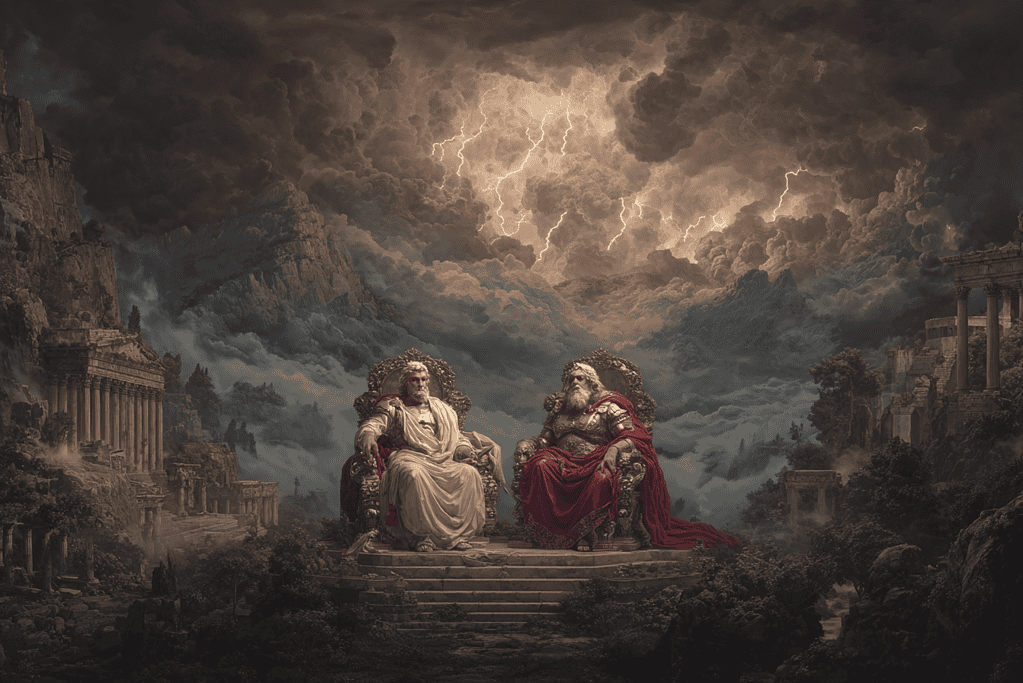
The earliest surviving Greek texts that anchor a lot of greek myths are early epic and early didactic poetry.
The Odyssey shows gods debating human fates and stepping into human lives, with Athena and Zeus treating Odysseus’ return as a problem the divine world can solve (Homer, 1900, p. 1).
Hesiod’s Theogony gives the genealogical backbone for the Greek pantheon and keeps Zeus at the center of cosmic order (Hesiod, 2021, p. 10).
Roman myth, in the form most readers recognize today, comes to us heavily through Latin literature that is from a later time period than Homer.
Virgil’s Aeneid builds a Roman story of origins from Trojan material, openly tying the story to “the gods” and to Juno’s anger, and it makes the founding of Rome feel like the end of a long mythic pressure wave (Virgil, 2015, p. 2).
Livy’s legends of ancient Rome treat the birth of Romulus and Remus as a divine scandal that is still useful:
Mars fathers the twins, the city is born out of violence and destiny, and the story gives Romans a myth of legitimacy and a myth of danger at the same time (Livy, 1905, p. 18).
This is a big part of the why. Rome did not simply “copy Greece” in a single moment.
Greek culture was already old and prestigious when Rome became a Mediterranean power, and Greek-speaking worlds surrounded Roman life in the South of Italy, in Sicily, and later across the eastern Mediterranean.
Myths move easily across trade, conquest, education, and performance, and Rome indeed had all four.
The Romans did equate gods, yet “equate” is not the same as “erase differences.” Most famously, Tacitus also compared Germanic Gods to the Roman Pantheon.
A Roman god might be introduced to an audience by saying, in effect, “this is our version of that.”
In scholarship, this habit is often discussed as interpretatio: translating one people’s divine world into another people’s categories.
Rives shows that these identifications are often pragmatic, and sometimes context-driven: a traveler might notice the function that matters most to them and label the deity through that lens, even if the local cult would describe the deity differently (Rives, 2011, p. 18).
That point matters for greek and roman mythology, since it explains why “counterpart” language can be both helpful and misleading. It is helpful as a map.
But it is also misleading when we forget that maps simplify.
The Roman god is not only a renamed greek god.
The Roman deity lives inside Roman institutions, Roman civic religion, Roman politics, and Roman family identity in ways that Greek sources do not always match.
Versnel’s discussions of “the gods” as a flexible category in Greek theology also help keep our footing.
Greek speech can talk about “the gods” as if they were a conceptual unity, even inside polytheism, which changes how a culture thinks about divine agency (Versnel, 2011, p. 284).
That kind of conceptual framing shapes how stories are told and how theology sits behind story.
The sky god is one of the easiest matches to see.
Zeus is already framed in Greek mythology as a ruler who distributes honors and powers, and the poem treats that distribution as part of cosmic order (Hesiod, 2021, p. 10).
You can see why a Roman audience would look at Jupiter and say, “Yes, that is the same kind of god.”
In Roman epic, the same divine household logic shows up with Latin names and Roman stakes.
The Aeneid opens by asking why Juno’s anger drives events, and it assumes a world where the gods have personal motives and political consequences (Virgil, 2015, p. 2).
That is deeply Homeric in feel and understanding, yet it is also Roman in purpose, because the whole poem is about how Rome comes to be.
At the same time, the equation is not perfect.
Zeus in greek mythology often feels like the center of a quarrelsome family that still rules the cosmos, with relationships between gods and mortals constantly creating chaos and consequence.
Jupiter can be framed that way, yet Roman religion also ties Jupiter into public sovereignty and civic order in a more institutional key.
The overlap is real, yet the Roman version is often more explicitly about Rome.
This is one of the cleanest places to feel difference.
In Greek sources, Ares can be treated as violent and disruptive, and Greek tragedy can make war feel like a moral sickness that spreads through a household and a city.
Tragedy is one of the genres where myth becomes a public argument, not a bedtime story, and Greek narratives used that space to question divine justice and human suffering (Versnel, 2011, p. 223).
Mars, by contrast, sits inside roman myth as a founding force.
Livy frames Mars as the father of Romulus and Remus, which means war is not merely destruction; it is ancestry and civic birth (Livy, 1905, p. 18).
That does not make Romans “more warlike” in some cartoon sense.
Ares and mar and Mars are a counterpart pair in the simplest chart. Yet the stories around them tell different aspects of what war means inside different ancient cultures.
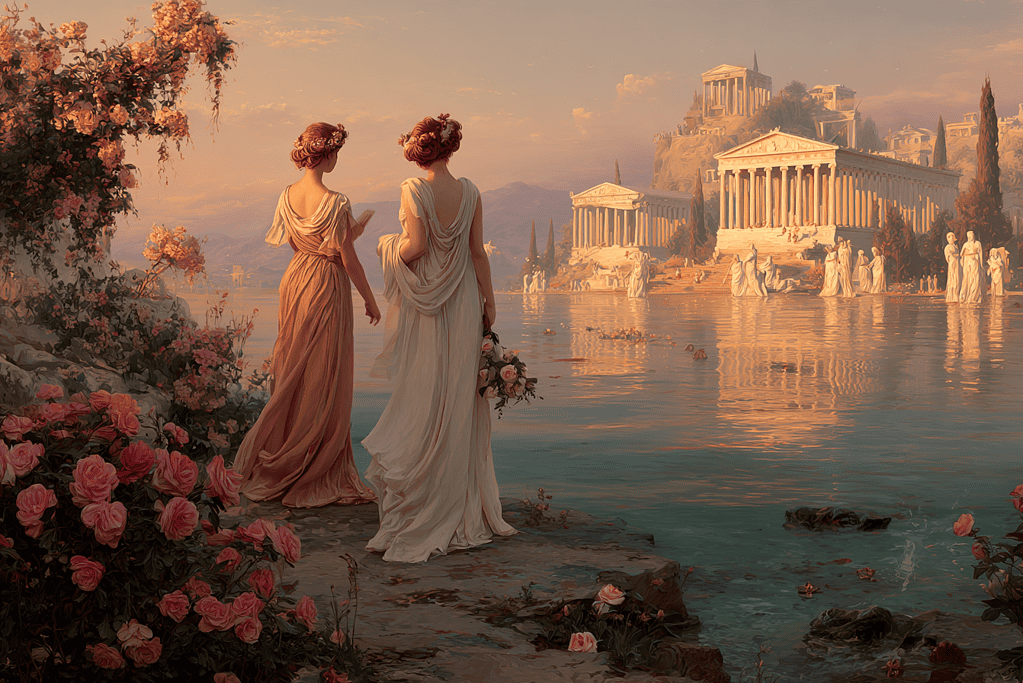
Aphrodite in greek mythology is not only romance. She is desire, compulsion, social chaos, and the strange force that can topple houses.
Roman Venus can carry that too, yet Roman literature leans hard into Venus as an ancestral goddess tied to Roman destiny.
You can see the Roman move in the Aeneid’s setup, where the Trojan story is being carried into Italy under divine pressure and divine protection, and the poem keeps anchoring that journey in the will of the gods (Virgil, 2015, p. 2).
Venus is part of that world, not as a private love goddess only, but as a divine sponsor of lineage and future.
Ovid, writing roman myth in a different register, gives you another angle.
Metamorphoses presents myth as a rolling chain of transformations, and it frames the poem as reaching “to Caesar’s times,” which is a Roman way of placing myth inside history (Ovid, 2015, p. 2).
When Venus appears in Ovid, she belongs to a Roman literary universe that treats myth as inherited material that can be reshaped into commentary, spectacle, and memory.
Apollo is a fun case because the name itself stays Apollo in both Greek and Latin usage, which makes the greco-roman crossover feel visible on the surface.
In Hesiod’s opening invocation, Apollo appears as part of the divine list, already anchored as Phoebus Apollo among the Olympians (Hesiod, 2021, p. 8). The Greek side is secure and quite certain.
Roman literature shows that “Greek or Roman” is not always a forced choice.
Romans could adopt, sponsor, and publicize a deity whose prestige was already strong in Greek culture, and they could still treat that deity as part of their own pantheon.
In Roman epic, divine machinery often looks Homeric, yet it is aimed at Roman identity and Roman destiny (Virgil, 2015, p. 2).
Apollo’s presence in Roman life is one more example of how Roman and greek culture can overlap without becoming identical.
This is one reason classical mythology feels like a shared library. It is shared, and it is not the same.
Although they may have come from the same cultural source in prehistory, they also developed and evolved alongside each other, just like many other Indo-European mythologies.
The underworld in Greek myth is not only a place; it is a moral and cosmic boundary.
The Odyssey famously includes a journey that treats the dead as real presences whose knowledge comes with dread and cost, and Odysseus’ encounter with that world is part of what makes him Odysseus (Homer, 1900, p. 11).
The underworld functions as a kind of narrative for making mortality feel unavoidable.
Roman literature inherits that, yet it often reframes the underworld with Roman ethical and political questions in mind.
Ovid’s metamorphoses repeatedly uses transformation and punishment to show how divine power can reorder bodies, lives, and social meaning (Ovid, 2015, p. 2).
That is not “the same underworld,” yet it is the same mythic grammar: divine power reaches past the limits of human life.
So when Hades becomes “Pluto” as a label, the deeper question is how the story functions.
The name changes, yet the underworld keeps doing the same kind of work: it makes the ancient world face death in public narrative.
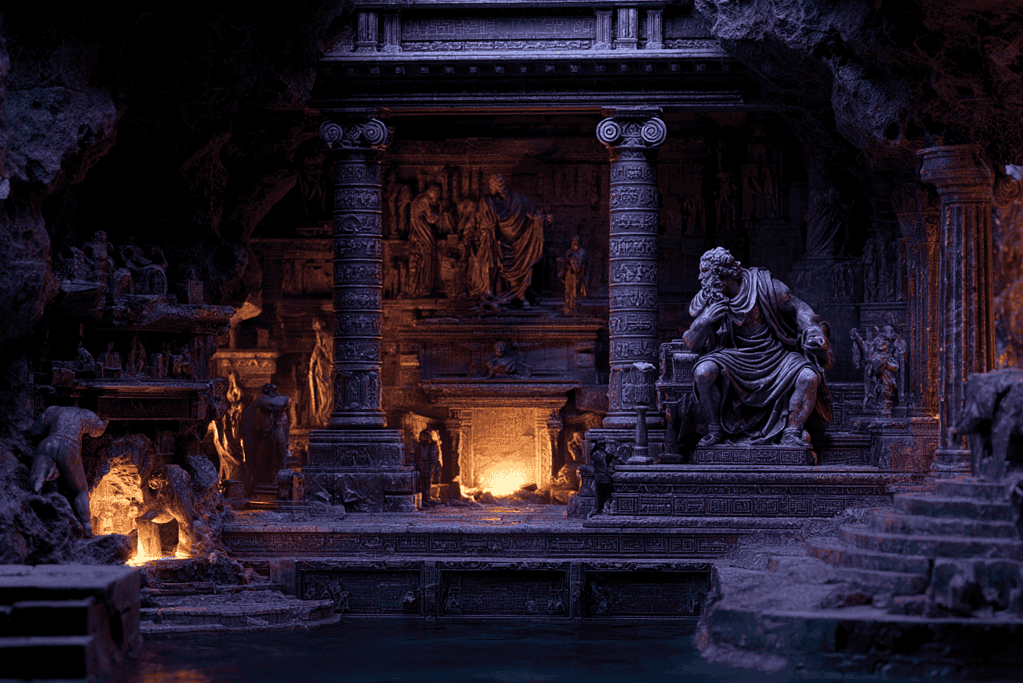
The Odyssey is a homecoming epic.
It makes heroism look like endurance, cunning, and survival, with gods nudging the human world as if the human story matters to them personally (Homer, 1900, p. 1).
Odysseus becomes a model of intelligence and suffering.
The Aeneid is a national origin epic.
It begins by tying the hero to “arms and the man” and treats the founding of Rome as an almost unimaginable labor under divine conflict, especially Juno’s pressure (Virgil, 2015, p. 2).
That is a different kind of heroism. It is not “get home.” It is “become the seed of a people.”
This is a big difference between greek and roman mythology in practice.
Greek mythology gives you many city-stories and many hero-lines.
Roman myth, especially in Virgil, pulls toward a single mythical story of ancient greece and rome. Both are meeting each other in an origin narrative where Trojans become Romans.
Ovid is one of the clearest examples of how Romans could retell Greek myths without pretending they invented them.
Metamorphoses opens with a creation scene, and it frames the poem as a continuous thread from the world’s beginning to Roman historical time (Ovid, 2015, p. 2).
That is a Roman literary gesture: it makes myth part of a long arc that points toward Rome.
From a scholarly angle, Burkert’s insistence that myth belongs alongside cult and ritual helps explain why retellings matter. A retell is not just entertainment.
It changes what a story highlights, what a deity feels like, and what a community thinks the story is “for” (Burkert, 1985, p. 55).
Rives’ discussion of interpretive translation adds a final piece. When cultures identify foreign gods with familiar ones, they do not only translate names.
They translate meaning, function, and social relevance, and the translation often reflects the translator’s needs and context (Rives, 2011, p. 18).
That dynamic sits behind a lot of the “why are they the same?” feeling in greek and roman myths.
Burkert, W. (1985). Greek Religion: Archaic and Classical (J. Raffan, Trans.). Harvard University Press.
Hesiod. (2021). Theogony (M. Heumann, Trans.). (Original work composed ca. 8th–7th c. BCE).
Homer. (1900). The Odyssey (S. Butler, Trans.). (Original work composed ca. 8th c. BCE).
Livy. (1905). The Early History of Rome: Books I–V (A. de Sélincourt, Trans.). (Original work composed ca. late 1st c. BCE–early 1st c. CE).
Ovid. (2015). Metamorphoses (S. Garth & J. Dryden, Trans.). (Original work composed ca. 8 CE).
Rives, J. B. (2011). Roman translation, Tacitus and ethnographic interpretation.
Versnel, H. S. (2011). Coping with the Gods: Wayward Readings in Greek Theology. Brill.
Virgil. (2015). The Aeneid (A. S. Kline, Trans.). (Original work composed ca. 29–19 BCE).

ᛉ 100% handcrafted artisan pagan , viking, witchcraft and shamanic inspired jewelry.
ᛉ Runes, Symbolism & European Folklore
Get 20% off👇🏻

Five witches dance around a blazing bonfire beneath a citrine cabochon in this Walpurgisnacht pendant....
Happy washing day 🙃
A few rings I’ve worked on the last couple days…
Freya’s cats rule and dogs drool?
Or was that the other way around? 🙃

Garm barely shows up in the old Norse stories.
Still… he leaves a mark.
A...

Leave a comment with your result ❤️
Bavarian Folklore says that you might just cross paths with a Wolpertinger in the alpine...

🐇🌲✨
He finally stepped out of the forest…
The Wolpertinger Pendant has arrived.
Inspired by...

I don’t often sell them, but love it when I do!
Vinca symbol bracelets ❤️...

Rooted in strength + guarded by ravens

The serpent waits 🖤
(Handcrafted Jörmungandr ring made to order in my shop)

Stay warm, everyone ❤️

😑😑😑🤮

I thought I had closed the book on the Alice in Wonderland rings…
But you...

Can this be over now, please?

In case you forgot 💜

Something I’ve been thinking about lately.
If there’s one thing I would’ve done differently early...

This year, we’re not buying things just to keep up.
If you need the reminder:...

My husband is from Bavaria (southern Germany) and I originally made this Krampus pendant for...

Some of the items I’m shipping out today ❤️
Please forgive my dirty nails 😂...

A few items shipping out today 🥰

This mornings rings shipping out ❤️

A few of the rjngs I’m shipping out this morning ❤️
How do you like...

Krampus is coming 🫶🏻

Getting ready to pack up these pretties and ship to their owners ❤️

Freya, cats and pentacles. Doesn’t get any better ❤️

You all got me going crazy making all these fairytale + storybook rings.
But I’ll...

Just launched these pretties ❤️
Size 9 amethyst ring + size 7.25 green kyanite

What would you trade to learn Baba Yaga’s secrets?

It *finally* looks, feels and smells like October!
And here are some items I’m packing...

This mornings pretties getting ready to ship :)

Getting ready to pack up these pretties and ship to their owners ❤️

You bet I’m hopping on this trend 😂
Thank you @shes_sinister for the prompt!

While I welcome the seasonal darkness…it sure is going to make my morning quick videos...

Finally finished the rings I’ve been working on in my stories ❤️
I think I...

Was going to post this update to my stories but it’s too long.

“How do you know I’m mad?” said Alice.
“You must be,” said the Cat, “or...

Some of this mornings orders getting ready to ship. Those little bats are so cute...

Here is the finished ring I was working on in my stories yesterday, along with...

A few of today’s orders shipping out this morning ❤️

The two silver raven rings I was working on in my stories yesterday.
…as well...

Eeeek! I’m so happy to add these to my shop ❤️
I’ve gotten so many...

I had 6 clamshells ready to ship this morning but I dropped and lost my...

Not the story you were told.
The girl didn’t run.
The wolf didn’t win.
This...

I love these raven rings so much 🖤
This mornings pretties shipping out.
All items...

Sleek + minimal Mjölnir ring ⚒️


About the author Jacqueline Fatica


