No products in the cart.
February 17, 2026 7:42 pm

Free USA shipping on orders $35+
February 17, 2026 7:42 pm
Throughout Greek mythology, the natural world was never viewed as empty or lifeless.
Every forest, mountain, river, and field was understood as the domain of a deity or spirit.
Deities lurked behind every bush or a tree. A small hidden cave could be a sacred shrine.
Yet unlike later traditions that centered nature in a single divine figure, the Greeks developed a complex network of nature deities, each governing different aspects of wild nature, fertility, animals, and the earth itself.
Let us explore who the Greek god of nature was, why Pan and Artemis play an important role as nature figures, and how these beliefs developed from the earliest Titan goddess Gaia to the Olympians of classical Greece.
As always, we are examining academic sources and ancient literature, so that we can understand how the Greeks interpreted the forces of nature through divine personalities, myths, and cult traditions.
Greek mythology did not assign the entire natural world to one single greek god of nature.
Instead, the Greeks distributed the forces of nature among many gods and goddesses, each governing specific aspects such as forests, animals, agriculture, and wilderness.
This reflects the Greek worldview, which understood nature as diverse, unpredictable, and alive with divine presence.
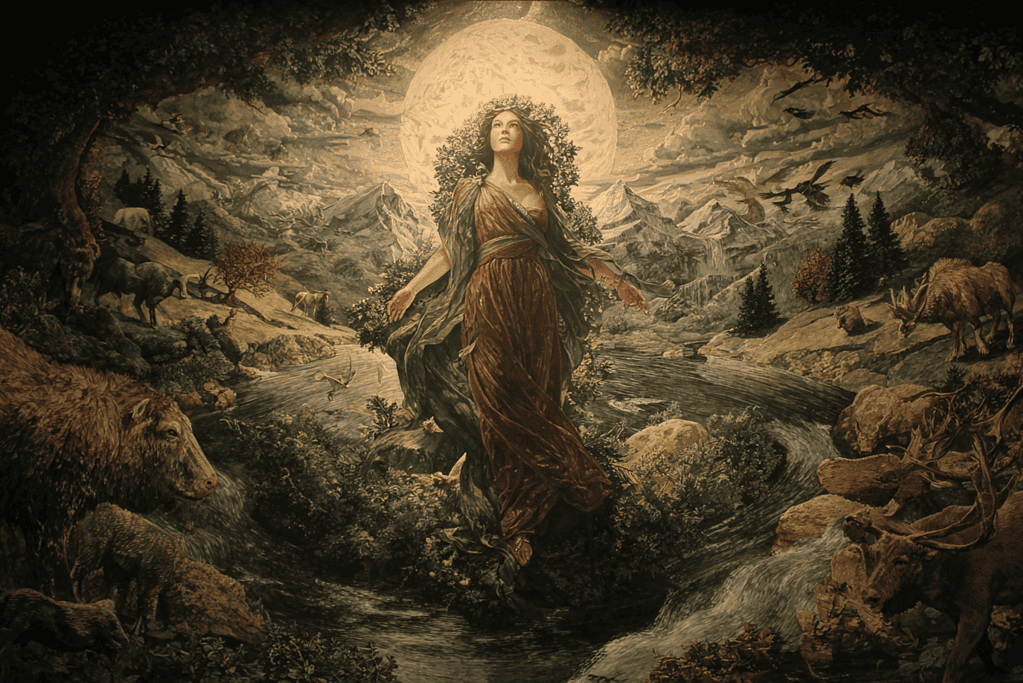
The earliest divine representation of nature itself was Gaia, the goddess of the earth.
In Hesiod’s Theogony, Gaia emerges at the beginning of creation and gives birth to mountains, seas, and the Titan race, establishing her as the original mother goddess and foundation of all life (Hesiod, trans. West, 1988, p. 12).
As a titan goddess, Gaia represented the living earth itself rather than one part of nature.
Later generations of gods divided Gaia’s domain into smaller, and also into more specialized roles. For instance Poseidon ruled the sea, Demeter governed grain and agriculture, and Artemis protected wild animals.
This division of responsibility reflects a religious system in which nature was understood through many divine personalities rather than a single ruling deity.
This complex system allowed Greek religion to express the full range of natural experience, from gentle fertility to destructive storms.
Gaia was not simply a goddess of soil or land. She was the earth itself, the literal ground beneath human feet and the source of all life.
Hesiod describes Gaia as the primordial titan goddess who gave birth to Uranus, the sky, and became the mother of the Titans, including Rhea, Cronus, and others (Hesiod, trans. West, 1988, p. 14).
Through her children, Gaia became the ancestor of the Olympian gods and goddesses.
Rhea later gave birth to Zeus, Hera, and Poseidon, establishing Gaia as the ultimate origin of divine authority.
This lineage shows that nature, represented by Gaia, existed before the Olympians and remained the foundation of their power.
Gaia’s role demonstrates that early Greek religion viewed nature itself as sacred and conscious.
She was not merely symbolic. She was understood as a living presence of a god within the world.
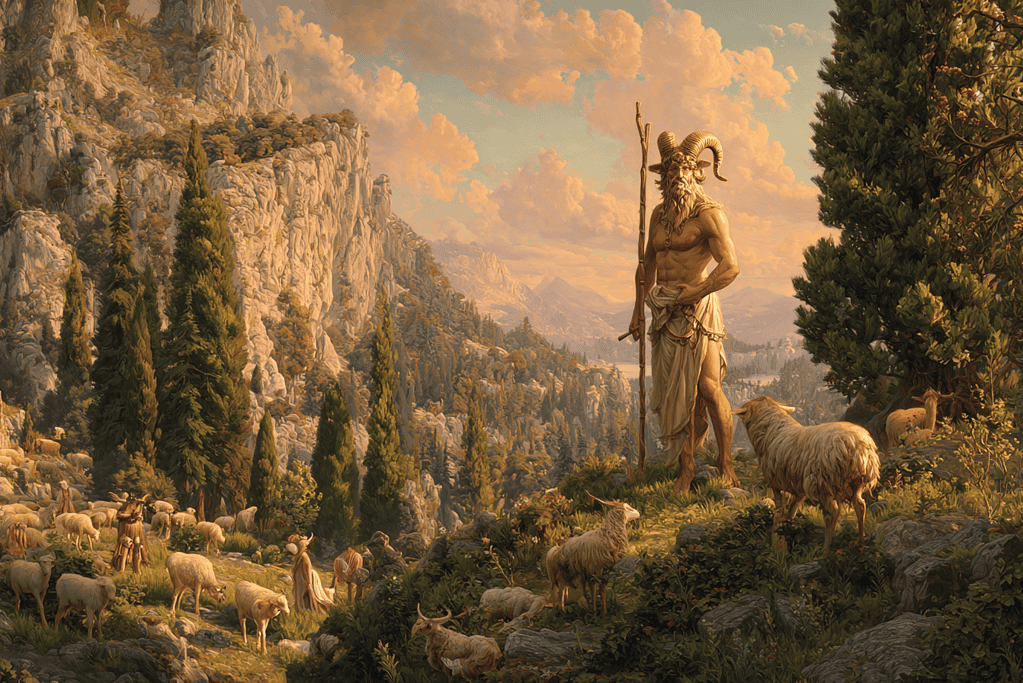
Among all nature deities, Pan became the most recognizable figure of wild nature.
Pan originated in Arcadia, a mountainous region of Greece known for its forests and pastoral culture.
According to academic research, Pan was originally a local rustic god worshipped by shepherds and rural communities (Trofimova, 2024, p. 28).
Pan was known as the god of shepherds, protector of flocks, and guardian of lonely places. He wandered the mountains and forests, accompanied by satyrs and nymphs.
His presence symbolized the untamed wilderness beyond human civilization.
Pan’s physical appearance reflected his connection to animals. He had cloven hooves, horns of a goat, and the body of both human and animal combined.
This hybrid form showed that Pan existed at the boundary between civilization and wild nature.
The figure of Pan represented the unpredictable power of nature itself.
Pan’s parentage connects him directly to the Olympian gods.
According to the Homeric Hymn to Pan, Pan is the son of Hermes, the messenger god, and a nymph (Homeric Hymn, trans. Athanassakis, 2004, p. 89).
This makes Pan part of the Olympian divine family.
Hermes himself was likewise closely associated with rural life and shepherds. As the son of Hermes, Pan inherited these pastoral qualities.
The hymn describes how Pan’s goat-like appearance frightened the gods when he arrived on Olympus, leading them to name him Pan, meaning “all,” because he amused them all (Homeric Hymn, trans. Athanassakis, 2004, p. 90).
This myth reveals Pan’s dual nature. He belonged to the Olympians but remained connected to wilderness rather than civilized society.
Pan was closely connected to emotional and physical responses to wilderness. His sudden appearance in lonely places could cause panic, a word derived directly from his name.
This fear reflected the unpredictability of wild environments (Borgeaud, 1988, p. 45).
Pan was also associated with fertility and reproduction. His constant pursuit of nymphs symbolized the generative power of nature itself.
One famous myth tells of the nymph Syrinx, who transformed into reeds to escape Pan.
Pan then created his musical pipes from those reeds, establishing his connection to rustic music and natural sound (Borgeaud, 1988, p. 53).
This story illustrates how Pan’s creative power came directly from nature. He symbolizes personhood assigned to nature.
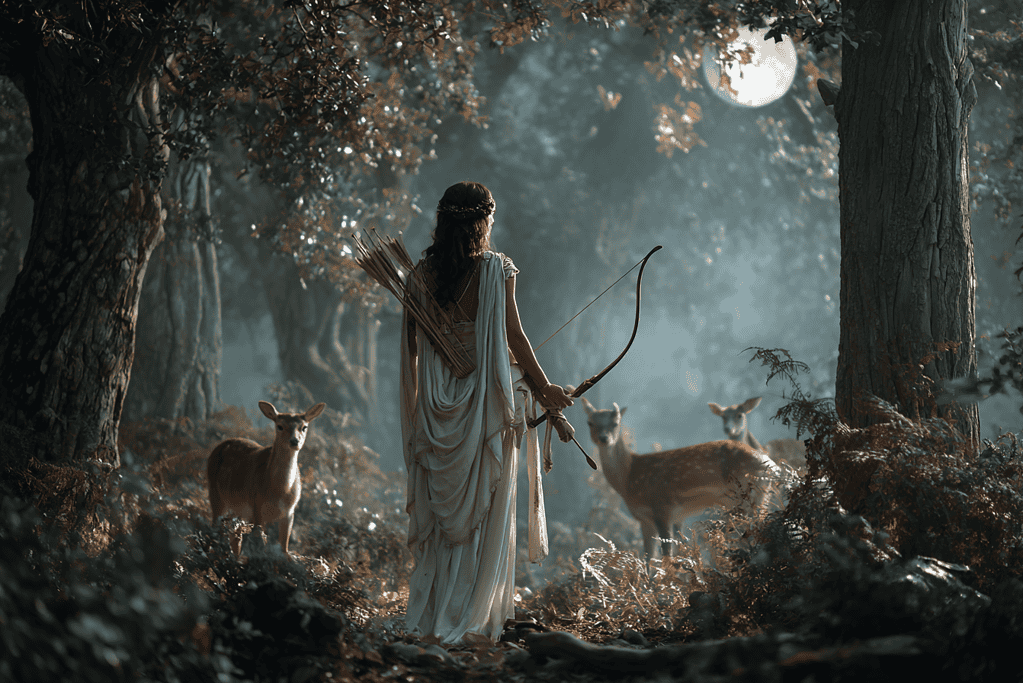
Artemis was another important greek goddess associated with nature.
She was the daughter of Zeus and Leto and the twin sister of Apollo. Artemis was known as a virgin goddess who protected wild animals and forests (Burkert, 1985, p. 149).
Scholars have shown that Artemis originally existed as a local goddess connected to animals and fertility before becoming part of the Olympian system (Zolotnikova, 2017, p. 10).
Over time, her role expanded to include protection of childbirth and women.
Artemis represented a different aspect of nature than Pan.
While Pan symbolized wild chaos, Artemis represented balance and protection within wilderness.
Nymphs were nature spirits associated with trees, rivers, and mountains. They were not Olympian gods but minor deity figures connected directly to natural and local locations.
According to ancient sources, each forest, cave, and river could have its own nymph.
These spirits represented the presence of divine life within the environment (Burkert, 1985, p. 173).
Pan was often accompanied by nymphs of the trees, showing his connection to natural fertility.
Zeus controlled storms and thunder, representing the sky’s destructive power.
Apollo was associated with sunlight, music, and prophecy. Dionysus, the god of wine, represented plant growth and fertility (Burkert, 1985, p. 162).
Together, these Olympian gods controlled different aspects of natural forces.
Ancient hymns describe Pan and Artemis as living presences within the landscape.
Worship often took place in caves, forests, and mountain shrines.
The Corycian cave near Delphi was sacred to Pan and nymphs, showing how nature itself functioned as a temple.
Archaeological evidence shows that nature worship existed long before classical mythology developed. Early Greeks worshipped earth and fertility deities such as Gaia and Demeter.
Over time, these early beliefs merged into the Olympian religion.
Borgeaud, P. (1988). The Cult of Pan in Ancient Greece. University of Chicago Press.
Burkert, W. (1985). Greek Religion. Harvard University Press.
Hesiod. (1988). Theogony (M. L. West, Trans.). Oxford University Press.
Homeric Hymns. (2004). (A. N. Athanassakis, Trans.). Johns Hopkins University Press.
Zolotnikova, O. A. (2017). Becoming Classical Artemis. Journal of Arts and Humanities, 6(5), 8–20.

ᛉ 100% handcrafted artisan pagan , viking, witchcraft and shamanic inspired jewelry.
ᛉ Runes, Symbolism & European Folklore
Get 20% off👇🏻

Five witches dance around a blazing bonfire beneath a citrine cabochon in this Walpurgisnacht pendant....
Happy washing day 🙃
A few rings I’ve worked on the last couple days…
Freya’s cats rule and dogs drool?
Or was that the other way around? 🙃

Garm barely shows up in the old Norse stories.
Still… he leaves a mark.
A...
Leave a comment with your result ❤️
Bavarian Folklore says that you might just cross paths with a Wolpertinger in the alpine...

🐇🌲✨
He finally stepped out of the forest…
The Wolpertinger Pendant has arrived.
Inspired by...

I don’t often sell them, but love it when I do!
Vinca symbol bracelets ❤️...

Rooted in strength + guarded by ravens

The serpent waits 🖤
(Handcrafted Jörmungandr ring made to order in my shop)

Stay warm, everyone ❤️

😑😑😑🤮

I thought I had closed the book on the Alice in Wonderland rings…
But you...

Can this be over now, please?

In case you forgot 💜

Something I’ve been thinking about lately.
If there’s one thing I would’ve done differently early...

This year, we’re not buying things just to keep up.
If you need the reminder:...

My husband is from Bavaria (southern Germany) and I originally made this Krampus pendant for...

Some of the items I’m shipping out today ❤️
Please forgive my dirty nails 😂...

A few items shipping out today 🥰

This mornings rings shipping out ❤️

A few of the rjngs I’m shipping out this morning ❤️
How do you like...

Krampus is coming 🫶🏻

Getting ready to pack up these pretties and ship to their owners ❤️

Freya, cats and pentacles. Doesn’t get any better ❤️

You all got me going crazy making all these fairytale + storybook rings.
But I’ll...

Just launched these pretties ❤️
Size 9 amethyst ring + size 7.25 green kyanite

What would you trade to learn Baba Yaga’s secrets?

It *finally* looks, feels and smells like October!
And here are some items I’m packing...

This mornings pretties getting ready to ship :)

Getting ready to pack up these pretties and ship to their owners ❤️

You bet I’m hopping on this trend 😂
Thank you @shes_sinister for the prompt!

While I welcome the seasonal darkness…it sure is going to make my morning quick videos...

Finally finished the rings I’ve been working on in my stories ❤️
I think I...

Was going to post this update to my stories but it’s too long.

“How do you know I’m mad?” said Alice.
“You must be,” said the Cat, “or...

Some of this mornings orders getting ready to ship. Those little bats are so cute...

Here is the finished ring I was working on in my stories yesterday, along with...

A few of today’s orders shipping out this morning ❤️

The two silver raven rings I was working on in my stories yesterday.
…as well...

Eeeek! I’m so happy to add these to my shop ❤️
I’ve gotten so many...

I had 6 clamshells ready to ship this morning but I dropped and lost my...

Not the story you were told.
The girl didn’t run.
The wolf didn’t win.
This...

I love these raven rings so much 🖤
This mornings pretties shipping out.
All items...

Sleek + minimal Mjölnir ring ⚒️


About the author Jacqueline Fatica


