No products in the cart.
December 3, 2025 5:24 pm

Free USA shipping on orders $35+
December 3, 2025 5:24 pm
From the dense forests of Northern Europe to the sunlit groves of the Mediterranean, the hunt was never just survival. It was sacred.
Across Indo-European traditions and beyond, deities of hunting held powerful roles as guardians of balance between humanity and the wilderness.
This article explores the most significant gods and goddesses of the hunt, their mythic roles, and their enduring symbolism.
If you’re drawn to pre-Christian mythology, nature-based belief systems, or the ancient art of the hunt, you’ll find insight and inspiration here.
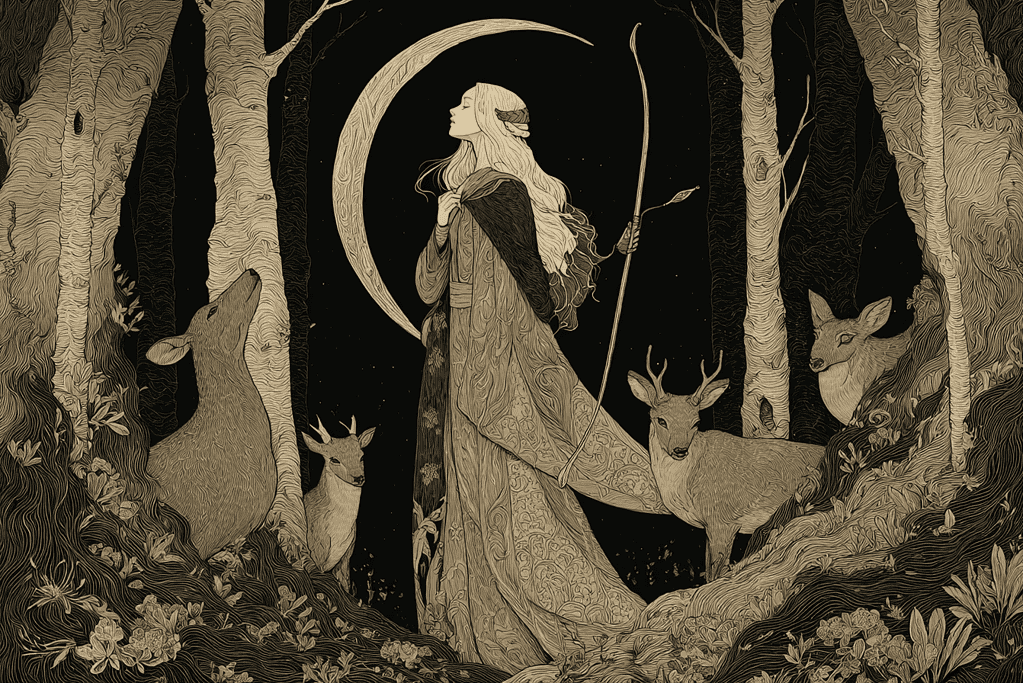
In Greek mythology, Artemis stands as the quintessential goddess of the hunt.
Twin sister of Apollo, daughter of Leto and Zeus, she was also associated with wild animals, forests, and the moon. Her Roman counterpart is Diana, who retained these attributes.
Both were depicted with a bow and arrows, often in the company of deer or hounds.
They were more than just huntresses. Artemis and Diana governed transitions: girlhood to womanhood, wild to domestic, human to divine.
Worship of Artemis included rituals in the wild hunt, sacred groves, and offerings to her as protector of animals and huntress supreme.
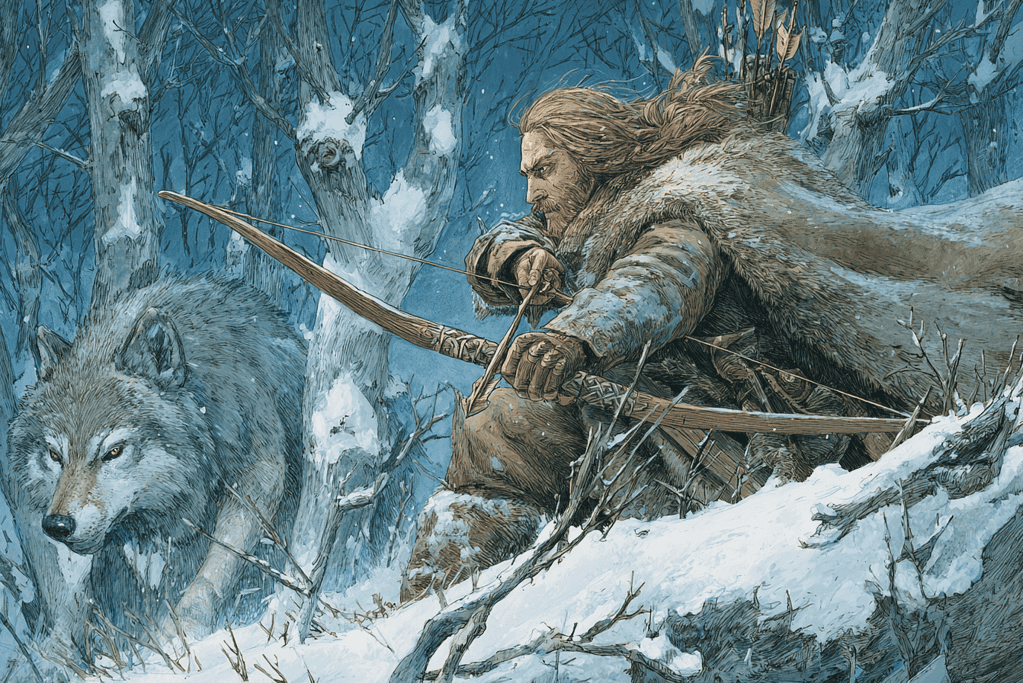
Ullr is a lesser-known Norse god associated with the hunt, archery, skiing, and winter.
Though overshadowed by more famous deities like Odin, Ullr’s name appears in ancient place names across Scandinavia.
He was invoked for success in hunting and is sometimes linked with justice and dueling.
In the broader pantheon of Norse gods, Ullr embodies the self-reliant outdoorsman: skilled, silent, and deadly in winter’s domain.
While the wild hunt tradition later associated Odin with spectral nighttime rides, Ullr remains more grounded in the physical act of tracking and killing prey.
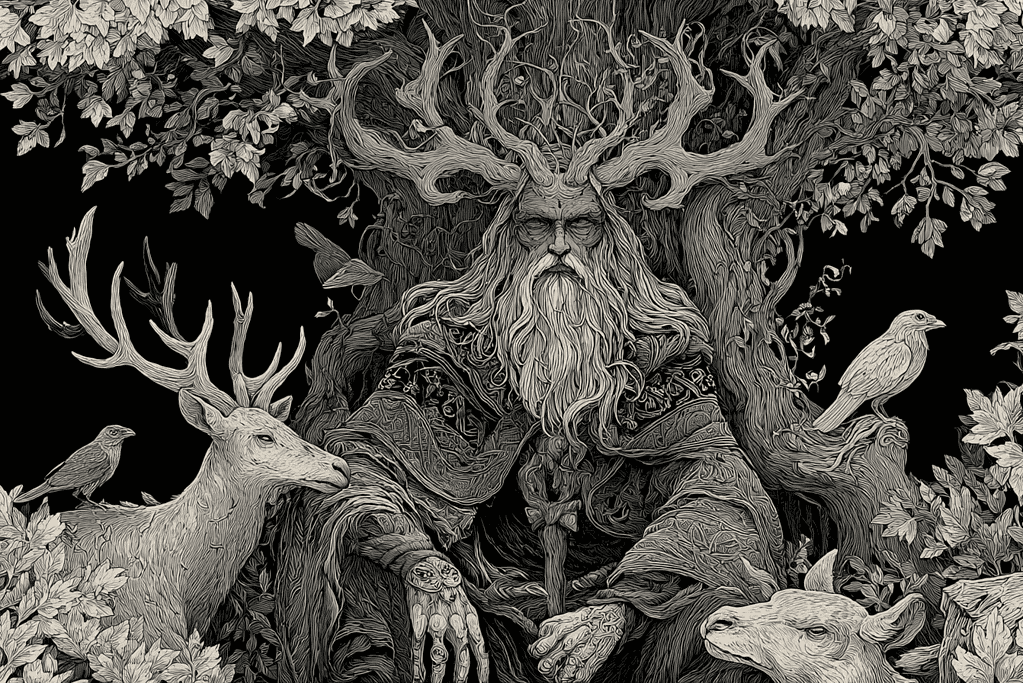
In Celtic mythology, Cernunnos, the horned god, represents wilderness, fertility, and the hunt.
Offerings to Cernunnos were made in shrines deep in forest glades.
His image survives in carvings and coinage, revealing a deity who was more about balance than bloodshed as a guardian of wild animals and the sacred cycle of life and death.
In Baltic mythology, the goddess of the hunt is Medeina, sometimes called Žvėrūna (“she-wolf”).
She is protector of animals, forests, and hunters, and her name is linguistically linked to both trees and hunting.
Folklore describes her as solitary, beautiful, and often accompanied by wolves. Her role is similar to Artemis, though specific to the Lithuanian context.
Sacrifices were made to her before hunts, particularly among forest-dwelling peoples.
In Finnish mythology, Tapio is the god of the forest and hunt, while his wife Mielikki is the goddess who holds the keys to the forest’s luck.
Hunters prayed to Mielikki before entering the woods, hoping she would grant them success.
In Siberian mythology, many shamanic traditions include spirit beings who control the availability of game.
These entities were often appeased with solemn rituals before a hunt. While less anthropomorphic than Indo-European gods, they performed similar roles in regulating the sacred balance.
The wild hunt is a spectral procession of riders and hounds led by a deity or ghostly figure, often Odin or Wodan in Germanic lore.
In Slavic mythology, similar tales speak of divine or demonic hunters sweeping through the sky.
These narratives aren’t about literal hunting with dogs, but about supernatural hunts as omens of plague, war, or death.
The wild hunt reinforces the sacred and terrifying power of the hunt in myth.
In Aztec mythology, Mixcoatl is the god of hunting, war, and the Milky Way. His name means “cloud serpent,” and he is often shown with a quiver of arrows.
He is also associated with human sacrifices, especially in connection to the hunt and fertility.
In Yoruba mythology, the hunter deity is Ogun, who also governs iron and warfare.
He is revered as a pathfinder, clearing the way through the forest, both literally and spiritually. Among the Yoruba people in West Africa, he remains an active force in ritual life.
Diana, the Roman goddess of hunting, was worshipped in temples and forest shrines. She was sometimes linked with human sacrifices, particularly at her cult center in Aricia.
Her image is that of a goddess of the moon, purity, and deadly precision.
As the counterpart of Artemis, Diana absorbed both lunar and chthonic attributes.
Her cult persisted far into Roman mythology, where she was also invoked by women in childbirth and young maidens.
Chinese mythology does not emphasize a single god of the hunt, though figures like the archer Hou Yi appear.
In Hindu mythology, Skanda (Kartikeya) and Rudra have aspects connected to the hunt, warfare, and wild places.
These traditions reflect regional differences in how the hunt is spiritualized.
While deities of war and wilderness abound, a formal goddess of hunting as seen in European traditions is less central.

Across cultures, the hunt often intertwines with fertility and lunar cycles. Artemis, for example, is both huntress and goddess of the moon.
Her twin brother, Apollo, governs the sun. The daughter of Leto guards transitions, including that between life and death.
The horned god motif, found in Cernunnos, Mixcoatl, and others, also relates to virility and the hunt and kill cycle.
Stag, boar, and other potent animals appear frequently, symbolizing abundance and wild strength.
Whether you follow the footsteps of Artemis or honor the forest spirits of the North, the god of the hunt remains a potent symbol of humanity’s oldest pursuit.
References
Brison, A. (2007). The goddess Inara and the symbolism of the hunt in Hittite ritual and myth. Annuaire de l’École Pratique des Hautes Études (Section des Sciences Religieuses), 116, 65–81.
Kolesnikova, I., & Peleckis, K. (2022). The goddess Medeina in Baltic mythology: Between the forest and war. Res Humanitariae, 31, 93–107.
Kozal, E. (2023). The Stag God and the hunt: Reading Kurunta’s iconography in Hittite art. Journal of Ancient Near Eastern Religions, 23(1), 27–52.
Sokos, C. K., Birtsas, P. K., & Tsachalidis, E. P. (2014). The myth of Artemis and the animal welfare ethic in ancient Greece. Society & Animals, 22(5), 448–466. https://doi.org/10.1163/15685306-12341325

ᛉ 100% handcrafted artisan pagan , viking, witchcraft and shamanic inspired jewelry.
ᛉ Runes, Symbolism & European Folklore
Get 20% off👇🏻

Five witches dance around a blazing bonfire beneath a citrine cabochon in this Walpurgisnacht pendant....
Happy washing day 🙃
A few rings I’ve worked on the last couple days…
Freya’s cats rule and dogs drool?
Or was that the other way around? 🙃

Garm barely shows up in the old Norse stories.
Still… he leaves a mark.
A...
Leave a comment with your result ❤️
Bavarian Folklore says that you might just cross paths with a Wolpertinger in the alpine...

🐇🌲✨
He finally stepped out of the forest…
The Wolpertinger Pendant has arrived.
Inspired by...

I don’t often sell them, but love it when I do!
Vinca symbol bracelets ❤️...

Rooted in strength + guarded by ravens

The serpent waits 🖤
(Handcrafted Jörmungandr ring made to order in my shop)

Stay warm, everyone ❤️

😑😑😑🤮

I thought I had closed the book on the Alice in Wonderland rings…
But you...

Can this be over now, please?

In case you forgot 💜

Something I’ve been thinking about lately.
If there’s one thing I would’ve done differently early...

This year, we’re not buying things just to keep up.
If you need the reminder:...

My husband is from Bavaria (southern Germany) and I originally made this Krampus pendant for...

Some of the items I’m shipping out today ❤️
Please forgive my dirty nails 😂...

A few items shipping out today 🥰

This mornings rings shipping out ❤️

A few of the rjngs I’m shipping out this morning ❤️
How do you like...

Krampus is coming 🫶🏻

Getting ready to pack up these pretties and ship to their owners ❤️

Freya, cats and pentacles. Doesn’t get any better ❤️

You all got me going crazy making all these fairytale + storybook rings.
But I’ll...

Just launched these pretties ❤️
Size 9 amethyst ring + size 7.25 green kyanite

What would you trade to learn Baba Yaga’s secrets?

It *finally* looks, feels and smells like October!
And here are some items I’m packing...

This mornings pretties getting ready to ship :)

Getting ready to pack up these pretties and ship to their owners ❤️

You bet I’m hopping on this trend 😂
Thank you @shes_sinister for the prompt!

While I welcome the seasonal darkness…it sure is going to make my morning quick videos...

Finally finished the rings I’ve been working on in my stories ❤️
I think I...

Was going to post this update to my stories but it’s too long.

“How do you know I’m mad?” said Alice.
“You must be,” said the Cat, “or...

Some of this mornings orders getting ready to ship. Those little bats are so cute...

Here is the finished ring I was working on in my stories yesterday, along with...

A few of today’s orders shipping out this morning ❤️

The two silver raven rings I was working on in my stories yesterday.
…as well...

Eeeek! I’m so happy to add these to my shop ❤️
I’ve gotten so many...

I had 6 clamshells ready to ship this morning but I dropped and lost my...

Not the story you were told.
The girl didn’t run.
The wolf didn’t win.
This...

I love these raven rings so much 🖤
This mornings pretties shipping out.
All items...

Sleek + minimal Mjölnir ring ⚒️


About the author Jacqueline Fatica


