
Giveaway
Days
Hours
Minutes
Seconds
GIVEAWAY HAS ENDED. Congratulations to Michelle S!



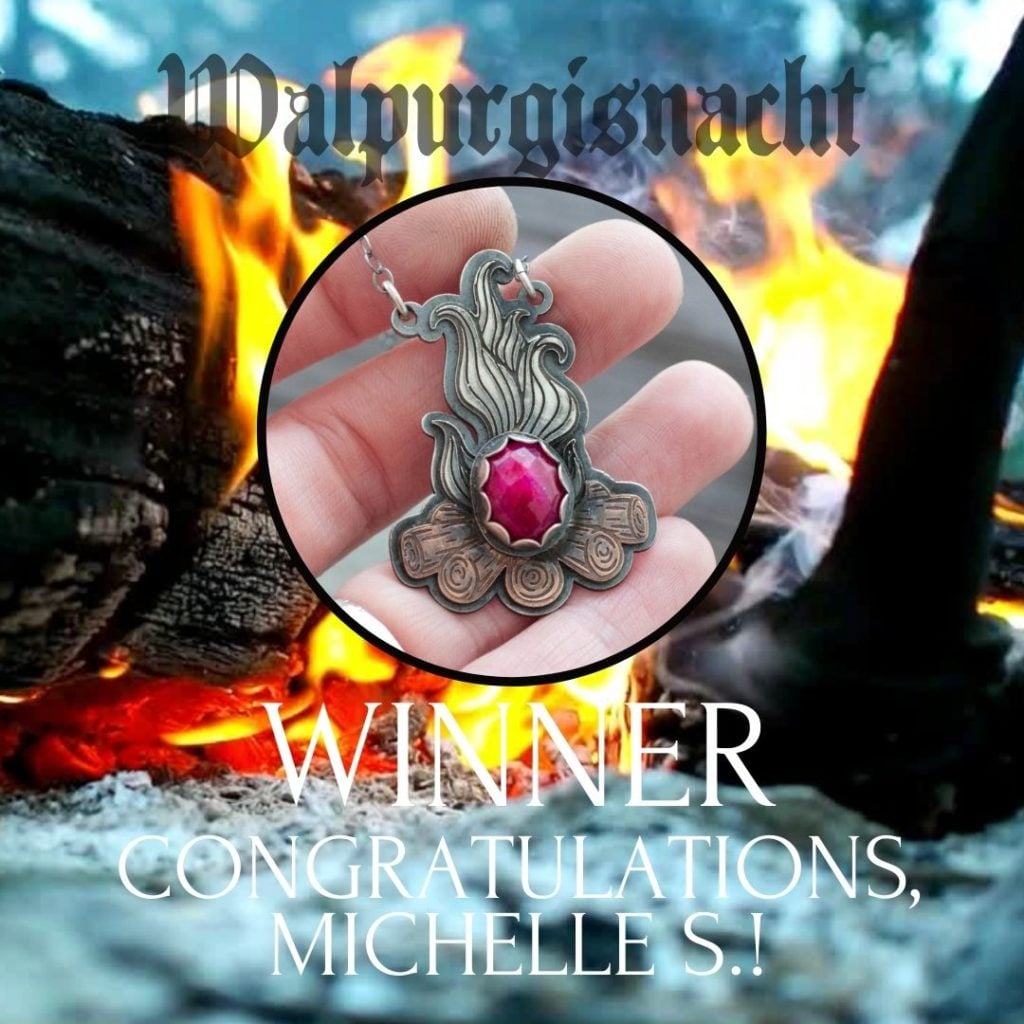
To this day, bonfires are held to ‘repel’ the spirits of winter and darkness and to bring about the change from spring to summer. In honor of this tradition, I present to you this Walpurgisnacht Fire Pendant with rose cut Ruby. Welcome this warmth with a Sowilo Rune sun in brass hiding on the back – which is hallmarked for the year 2021.
This pendant is one of a kind.
Handcrafted in solid fine silver (.999% pure silver), copper and brass. Rose cut ruby is bezel set and the pendant rests on a 20″ solid sterling silver chain.
- Pendant 45mm X 34mm
- NECKLACE: 20 inches
FOLKLORE
With the arrival of spring, there are many local variants of bonfire rituals across Europe and many of them can be traced back to shared pre-christian cosmology.
These traditions in particularly mostly revolve around the idea of the resurrection of the sun. As mentioned, the pre-christian cosmology was shared across much of Europe and even western Siberia and it is therefore important to note that these traditions can not be reduced to a single linguistic ancestor or culture (e.g. Germanic, Norse or Celtic).
In Germany, the night from the 30th of April to the 1st of May is called Walpurgisnacht which is dedicated to the Saint Walpurga. She came from England to what is today Germany during the 8th Century as a missionary.
Christians venerated her as they believed she had protective powers from pandemics, disease and the powers of witchcraft. (Mendelssohn-Bartholdy, 2005). Saint Walpurga established a monastery in the Swabian town of Heidenheim (‘Home of Heathens’) in southern Germany. Her tomb is located in Eichstätt. In central Germany, the mountain range of the Harz mountains is especially rich in folklore and tales about local witches who dance, practice rituals and conjure spirits on this special night.
The Brocken mountain is said to harbor dark spirits who live on the mountain top and its surrounding spruce and fir woods. (Stark Lucien, 1998, Eduard Jacobs, 1897).