No products in the cart.
November 5, 2025 9:15 am

Free USA shipping on orders $35+
November 5, 2025 9:15 am
In Alpine folklore, the long, dark weeks between Christmas and Epiphany were not empty. They belonged to a mysterious woman known as Frau Perchta.
She is a figure imagined as a radiant Winter Lady, a winter guardian, or even a quiet goddess moving through forests and households.
This article examines who she was, how she appeared in tradition, and why her name survives in Austria, Bavaria, and Switzerland.
Rather than proving or dismissing pre-Christian origins, this post presents what the ethnographic and historical sources actually say.
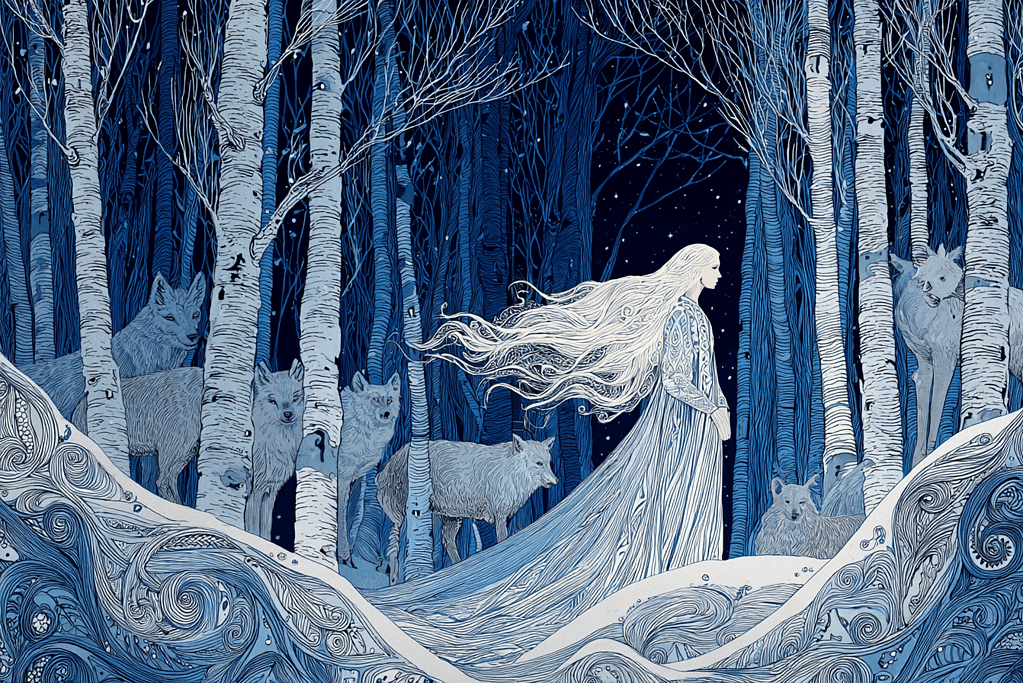
Across Alpine regions, Perchta appears as a visiting woman during the days between Christmas and Epiphany, especially on the 12th night of Christmas.
Lotte Motz notes that Frau Perchta was believed to walk through settlements, inspect homes, and move with followers of Perchta, ghostly processions that traveled through the night (Motz, 1984, p. 152).
She is also called Berchta, Bertha, or simply a White Lady, “known by many names,” depending on local custom (Rumpf et al., 1977, p. 181).
Some scholars classified her as a winter goddess because she governs women’s work, oversees the turning of the year, and moves during a sacred period (Motz, 1984, pp. 152-153).
Others emphasize her role as a crone or seasonal enforcer who examines behavior and rewards order.

Because she travels during the twelve days of Christmas, visits homes at night, and judges behavior, later folklore began describing her as a Christmas witch.
Motz records tales in which Frau Perchta enters houses at night, checks that work has been completed, and either gives blessings or punishments (1984, p. 154).
In some stories she appears young and radiant, in others as an old crone with a hooked nose. The dual appearance is part of her paradox: both beautiful and terrifying, both giver and enforcer.
Motz documents the most famous and frightening motif: in some Alpine villages she was known as someone who would punish you if you ignored her rules or disrespected the sacred season (Motz, 1984, p. 155).
The stories describe how Frau Perchta would punish lazy spinners or children who refused traditional food, then stuff it with straw.
Rumpf et al. confirm similar tales in Swiss folklore, where the warning served as harsh moral teaching rather than literal belief (1977, pp. 190-191).
This did not make her a monster. It presented her as a frightening moral authority, as someone who protected rules and punished neglect.

Throughout Austria, Bavaria, and Switzerland, the winter season was dominated by spinning. Motz notes that Frau Perchta inspects whether women had finished their flax before Epiphany (1984, pp. 153-154).
If work remained half-done, she appeared as a crone with an iron face, a knife in her skirts, and a threat to anyone who disrespected the sacred pause of the season (Motz, 1984, p. 155).
This was not random cruelty. In traditional Alpine homes, winter spinning was essential for survival. Perchta became the symbolic protector of household economy and order.
Motz states directly that Perchta is often imagined as the leader of a nocturnal procession, sometimes interpreted as the Wild Hunt or the “ghostly followers of Perchta” who travelled with her (1984, p. 152).
People stayed indoors, prayed, and avoided seeing the procession pass by.
Rumpf et al. record Swiss legends in which Perchta travels with a host of spirits on certain winter nights (1977, pp. 182-183). These figures were not demonic; rather, they were feared and respected as powerful night travelers.
One of the most touching elements appears in Hammer’s study of German Jewish naming rituals. She documents beliefs in Holle who is closely related to Perchta and who cared for unbaptized children and “lost babies” in the afterlife (Hammer, 2005, pp. 63-65).
These traditions show that women needed to believe their infants would be cared for if they died too soon. This idea made Perchta a caretaker, not only a punisher.
Rumpf et al. report that in Switzerland, parents warned their children that if they misbehaved, the Christmas hag might appear, suggesting a moral lesson (1977, pp. 190-191).
Motz argues that Perchta represents a goddess of winter oversight, women’s labor, and the season of rest, calling her a “principal winter goddess” of Alpine tradition (1984, p. 153).
Some scholars interpret her as a Germanic goddess, possibly linked to abundant household stores or the afterlife.
Other academics are more cautious. Yet none deny her power as a cultural figure.
Her role brings rewards and diligence, punishing neglect, traveling with spirits, resembling the logic of a goddess of abundance who distributes blessings at year’s end.
One striking motif is Perchta’s goose foot which is a symbol mentioned by Motz (1984, p. 154). It marks her as a supernatural woman, part human and part otherworldly.
In Swiss tales, she sometimes appears with a goose, a bird symbolizing household prosperity and winter feasting (Rumpf et al., 1977, pp. 188-189).
These elements reinforce her nature as both domestic and uncanny.

In some Austrian and southern Bavarian towns, Perchten processions continue today.
Groups calling themselves Perchten would dress in masks and costumes to perform rituals to frighten away darker forces and wake up the spirits of the new year(Motz, 1984, pp. 160-161).
Masks, bells, straw, and animal skins create a liminal performance that blends celebration and fear.
Modern festivals sometimes pair Krampus and Perchta, though this is a later development influenced by regional tourism. Historically, Perchta stands alone, not as Krampus’ companion, but as her own winter authority.
Multiple Alpine tales explain that on Twelfth Night or the Feast of the Epiphany, families must serve porridge or traditional food for Frau Perchta (Motz, 1984, p. 155).
If people respected her rules, they would receive blessings for the year. If not, she might appear as an ugly crone with an iron face and mete out punishment.
This was not random superstition but rather it reflected the closing of the work cycle.
The home needed to be clean, the flax must be spun, and the walls must be fed. Winter was a sacred pause. Disorder brought danger.
Rumpf et al. mention sermons accusing people of praying to “Domina Perchta” and berchta from the pulpit (1977, p. 186).
Clergy condemned household rituals, offerings, and night prayers. The warnings testify to Perchta’s influence. If she were insignificant, no priest would waste a sermon.
These records show not a hidden religion, but a powerful tradition that made church leaders uneasy, especially when people of praying to “Domina Perchta” asked her for help more than the saints.
Because she sits at the hinge of the year, indeed between ending and beginning, work and feast, living and dead.
She represents winter law and winter blessing.She rewards diligence and punishes neglect. She comforts grieving mothers and watches over forests and wildlife.
And in modern Austria and Bavaria, she walks again whenever Perchten would dress in masks and costumes and march through the snow.
Hammer, J. (2005). Holle’s cry: Unearthing a birth goddess in a German Jewish naming ceremony. Nashim: A Journal of Jewish Women’s Studies & Gender Issues, 9, 62–87. https://www.jstor.org/stable/40326618
Motz, L. (1984). The winter goddess: Percht, Holda, and related figures. Folklore, 95(2), 151–166. https://www.jstor.org/stable/1260199
Rumpf, M., Hellenberg, A., & Tucker, E. (1977). The legends of Bertha in Switzerland. Journal of the Folklore Institute, 14(3), 181–195. https://www.jstor.org/stable/3814073
Russell, J. B. (1972). The Transformation of Paganism, 300–700. In Witchcraft in the Middle Ages (pp. 54–72). Cornell University Press.
van der Leeuw, G. (1986). The Mighty Dead. In Religion in Essence and Manifestation (pp. 385–403). Princeton University Press.

ᛉ 100% handcrafted artisan pagan , viking, witchcraft and shamanic inspired jewelry.
ᛉ Runes, Symbolism & European Folklore
Get 20% off👇🏻

Five witches dance around a blazing bonfire beneath a citrine cabochon in this Walpurgisnacht pendant....
Happy washing day 🙃
A few rings I’ve worked on the last couple days…
Freya’s cats rule and dogs drool?
Or was that the other way around? 🙃

Garm barely shows up in the old Norse stories.
Still… he leaves a mark.
A...
Leave a comment with your result ❤️
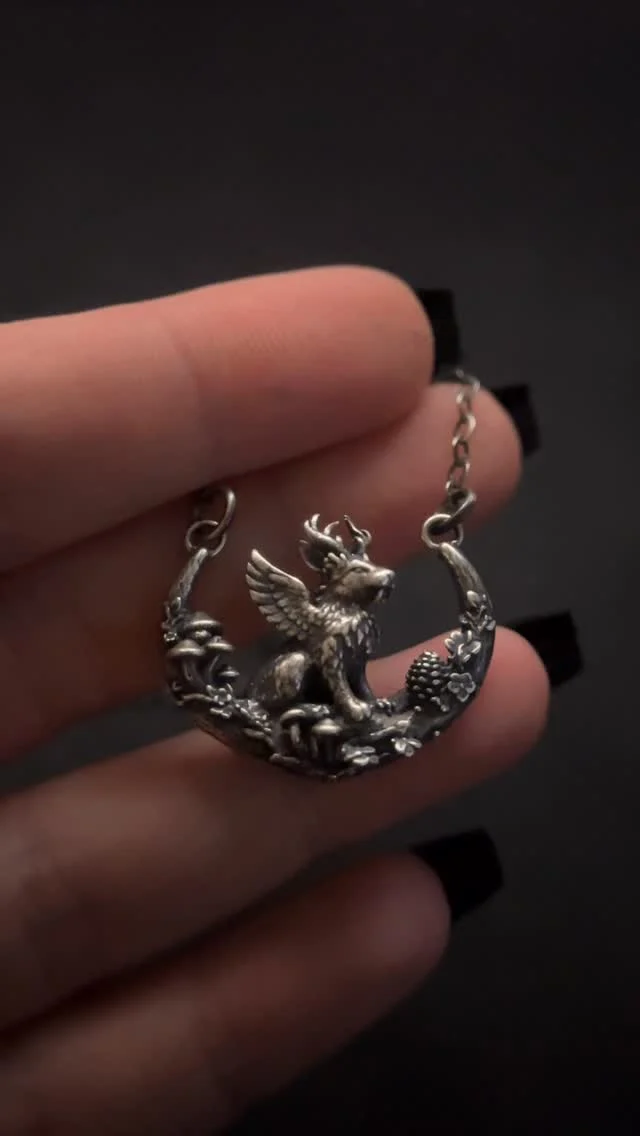
Bavarian Folklore says that you might just cross paths with a Wolpertinger in the alpine...

🐇🌲✨
He finally stepped out of the forest…
The Wolpertinger Pendant has arrived.
Inspired by...

I don’t often sell them, but love it when I do!
Vinca symbol bracelets ❤️...

Rooted in strength + guarded by ravens

The serpent waits 🖤
(Handcrafted Jörmungandr ring made to order in my shop)

Stay warm, everyone ❤️

😑😑😑🤮

I thought I had closed the book on the Alice in Wonderland rings…
But you...

Can this be over now, please?

In case you forgot 💜

Something I’ve been thinking about lately.
If there’s one thing I would’ve done differently early...

This year, we’re not buying things just to keep up.
If you need the reminder:...

My husband is from Bavaria (southern Germany) and I originally made this Krampus pendant for...

Some of the items I’m shipping out today ❤️
Please forgive my dirty nails 😂...

A few items shipping out today 🥰

This mornings rings shipping out ❤️

A few of the rjngs I’m shipping out this morning ❤️
How do you like...

Krampus is coming 🫶🏻

Getting ready to pack up these pretties and ship to their owners ❤️

Freya, cats and pentacles. Doesn’t get any better ❤️

You all got me going crazy making all these fairytale + storybook rings.
But I’ll...

Just launched these pretties ❤️
Size 9 amethyst ring + size 7.25 green kyanite

What would you trade to learn Baba Yaga’s secrets?

It *finally* looks, feels and smells like October!
And here are some items I’m packing...

This mornings pretties getting ready to ship :)

Getting ready to pack up these pretties and ship to their owners ❤️

You bet I’m hopping on this trend 😂
Thank you @shes_sinister for the prompt!

While I welcome the seasonal darkness…it sure is going to make my morning quick videos...

Finally finished the rings I’ve been working on in my stories ❤️
I think I...

Was going to post this update to my stories but it’s too long.

“How do you know I’m mad?” said Alice.
“You must be,” said the Cat, “or...

Some of this mornings orders getting ready to ship. Those little bats are so cute...

Here is the finished ring I was working on in my stories yesterday, along with...

A few of today’s orders shipping out this morning ❤️

The two silver raven rings I was working on in my stories yesterday.
…as well...

Eeeek! I’m so happy to add these to my shop ❤️
I’ve gotten so many...

I had 6 clamshells ready to ship this morning but I dropped and lost my...

Not the story you were told.
The girl didn’t run.
The wolf didn’t win.
This...

I love these raven rings so much 🖤
This mornings pretties shipping out.
All items...

Sleek + minimal Mjölnir ring ⚒️


About the author Jacqueline Fatica


