No products in the cart.
November 23, 2025 2:55 pm

Free USA shipping on orders $35+
November 23, 2025 2:55 pm
In the well-known fairy tales of the Slavic world, Father Frost (Morozko) is often remembered as an icy but oddly generous winter spirit.
It is a glittering figure cloaked in snow who tests a young maiden, rewards goodness, and punishes cruelty.
Readers treat it as a simple russian fairy tale about a wicked stepmother and a kind stepdaughter, another moral fable collected in the nineteenth century.
But beneath the frostbite and folktale charm, the figure of Father Frost belongs to a far older cosmology, perhaps one where winter is not just a season, but a sacred boundary between the world of the living and the ancestors.
When we examine the tale through the eyes of Slavic folklorists and ethnographers, Morozko begins to look less like a seasonal character and more like a mythic survival of an ancient chthonic power.
This article explores the deeper meaning behind Morozko’s test, his connection to underworld deities, and why this fairytale still echoes with ancient ritual memory.
At first glance, Father Frost appears as an old man of winter , indeed old, glittering, wrapped in fur, and carrying the chill of the deep forest.
The tale’s structure fits perfectly into the classic donor motif described by Vladimir Propp. The donor tests the hero, then brings gifts or punishment depending on the outcome.
Yet the kind of test Morozko administers, such as exposure to lethal winter cold, doesn’t simply measure politeness or bravery.
He tests the heroine at the threshold between life and death. This marks him not just as a winter spirit, but as a gatekeeper of an older cosmological frontier.
In Russian and Slavic narrative tradition, few beings are as starkly liminal as frost itself. Frost kills, preserves, strips color from the world, and marks the passage of seasonal time.
Morozko is the embodiment of that threshold.
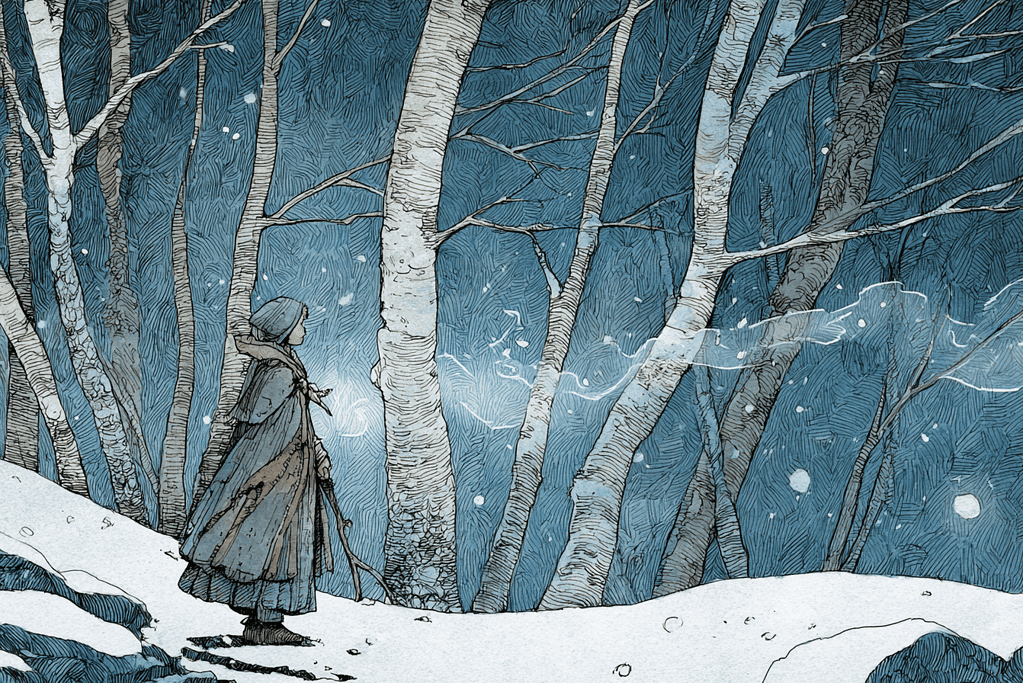
In the tale collected by Alexander Afanasyev, the young girl is sent into the forest by her abusive old womanstepmother and left to freeze.
When Morozko arrives, he tests her humility with increasingly bitter cold. She does not complain, and he rewards her.
This “trial by winter” carries echoes of older initiatory ordeals. Slavic ethnographers have documented winter rites where youths symbolically confronted cold as a way of testing character, endurance, and spiritual balance.
The idea of frost as a tester of humans, i.e. as not merely an environmental force, could be a remnant idea that originates in pre-christian cosmology.
According to the interpretation of Elena Zharnikova, Morozko is closely aligned with archaic underworld powers.
She compares him to Troyan, a lunar underworld deity, and to Veles, lord of the dead. Both are tied to winter’s stillness and the liminal boundary between worlds.
In this reading, Morozko is no harmless old father with a white beard. He is frost personified , a guardian of the thin border dividing the living from the ancestral realm.
His forest encounters echo the ancient theme of divine testing at the edge of life.
The freezing ordeal symbolizes ritual death. The maiden is not simply cold. Rather, she is symbolically close to the grave.
Only her humility and composure allow her to return with “gifts”: furs, jewels, and blessings associated with ancestral approval.
Zharnikova notes that the whiteness of frost mirrors the lunar, silver realm of the dead. Winter’s bleaching power becomes a metaphor for the stripping away of worldly identity.
Morozko’s “rewards” thus resemble the blessings of ancestors, not mere material wealth.
Matthias Freise interprets Father Frost within the broader symbolic order of paternal trial narratives.
He sees the tale as part of a gendered structure where young women must face hardship, endure symbolic frost, and return transformed.
The forest becomes a threshold zone where social, cosmic, and moral order converge.
Meanwhile, Zharnikova argues that Father Frost’s role is far older than its fairy-tale packaging.
His tests mirror underworld initiation trials, and his whiteness signals a lunar, ancestral force, not simply a winter figure in a russian culture holiday story.
Together, these readings position Morozko at the intersection of mythology, ritual memory, and narrative morality.
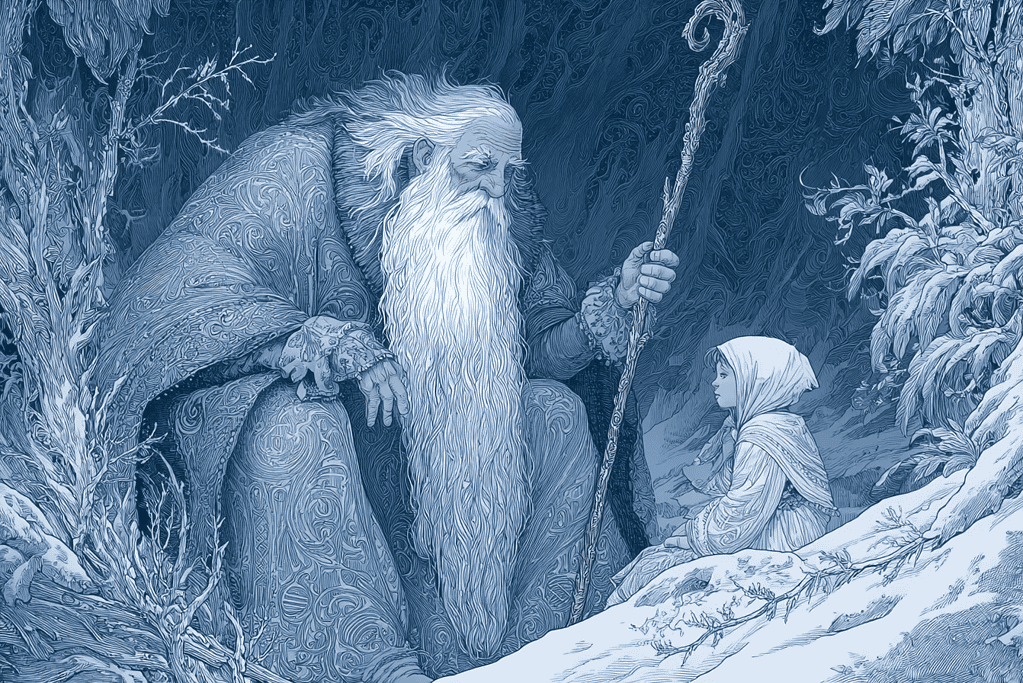
Frost’s whitening effect reflects lunar symbolism.
The moon governs time, cycles, old age, and death in many cultures.
In Slavic cosmology, silver and white often belong to the realm of ancestors. Morozko, with his silver shine and deadly cold, becomes a custodian of ancestral time.
This silver-lunar connection appears in many variants of the story, where Morozko offers beautiful jewels, silver and gold, or shining gifts.
These treasures are not random fairy-tale prizes, they symbolize blessings from the realm beyond life.

Afanasyev’s collection preserves some of the clearest windows into earlier Slavic folklore. In the Father Frost narrative, the forest becomes sacred ground.
This is a mythical idea where winter spirits dwell.
The stepmother archetype functions as a folkloric catalyst, forcing the maiden into an initiatory encounter.
The old woman embodies household cruelty, while Morozko embodies cosmic judgment.
Such tales often carry layered meanings: social didacticism on the surface, and deep mythic memory underneath.
Ethnographic records indicate that Slavic and Finno-Ugric peoples once honored frost as a living force.
Offerings were made at the first frost: porridge, or symbolic food placed outdoors to appease Morozko or his cognates.
These rituals treated frost as a being who “finds” or “takes,” one who must be approached carefully.
The russian fairy tale may preserve the logic of these rites, entering winter with humility, hoping for mercy.
Some villages even reported rites of “feeding the frost,” where families offered food at windows or tree stumps.
This behavior reinforces the idea of frost as a powerful, judging presence.
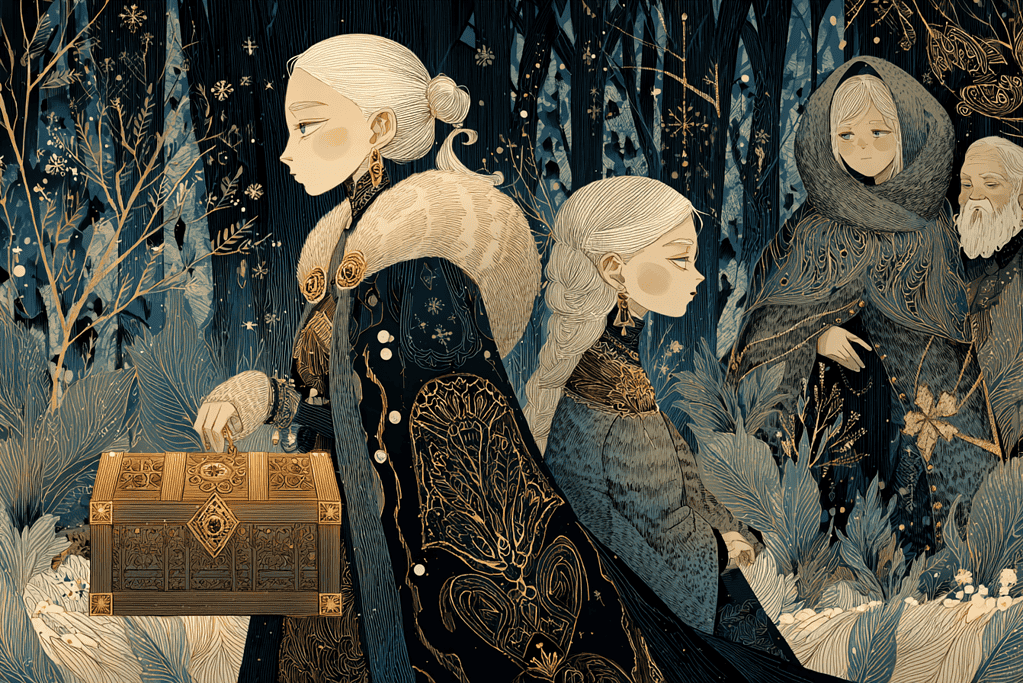
The old woman stepmother creates the central conflict: one daughter cast out, one favored. This motif recurs widely across Slavic lands.
The stepmother’s cruelty forces the heroine into a spiritual encounter otherwise inaccessible.
Her malice mirrors the harshness of winter itself. Winter punishes the unprepared, the proud, and the impatient, i.e., exactly the qualities displayed by the stepsister.
The stepmother-stepdaughter dynamic becomes a human reflection of cosmic balance.
Though modern grandfather frost, and New Year imagery paint Father Frost as a friendly holiday figure accompanied by his granddaughter the snow maiden (Snegurochka), the original Morozko is far older and far darker.
Modern depictions such as the red or blue coats, the fur coat, the long magic stick, the semi-round fur hat, the New Year fir-tree.
Even the association with christmas traditions, most likely come from Soviet reinterpretations that transformed a winter deity into a seasonal gift-bringer.
The original Morozko is not a version of Santa or father christmas.
He is closer to a frost-bound underworld figure who tests, judges, and occasionally blesses a being who embodies the ancient power of winter itself.
Freise, M. (2022). Slavistische Literaturwissenschaft (pp. 138–139).
Propp, V. (1976). Morphology of the Folktale (L. Scott, Trans.; 2nd ed.). University of Texas Press. (Original work published 1928)
Zharnikova, E. A. (2023). Сказка и обряд: Похоронный код в сюжете о Морозке. In Mythological Code of Traditional Culture. Collection of Articles (pp. 98–114).
Zharnikova, S. V. (2019). Archaic images of North Russian folklore and the origin of the Indo-Europeans (pp. 104–105).
Zharnikova, S. V. (2025). Secrets of the Ancient Aries. Digest of Articles (pp. 121–124).

ᛉ 100% handcrafted artisan pagan , viking, witchcraft and shamanic inspired jewelry.
ᛉ Runes, Symbolism & European Folklore
Get 20% off👇🏻

Five witches dance around a blazing bonfire beneath a citrine cabochon in this Walpurgisnacht pendant....
Happy washing day 🙃
A few rings I’ve worked on the last couple days…
Freya’s cats rule and dogs drool?
Or was that the other way around? 🙃

Garm barely shows up in the old Norse stories.
Still… he leaves a mark.
A...
Leave a comment with your result ❤️
Bavarian Folklore says that you might just cross paths with a Wolpertinger in the alpine...

🐇🌲✨
He finally stepped out of the forest…
The Wolpertinger Pendant has arrived.
Inspired by...

I don’t often sell them, but love it when I do!
Vinca symbol bracelets ❤️...

Rooted in strength + guarded by ravens

The serpent waits 🖤
(Handcrafted Jörmungandr ring made to order in my shop)

Stay warm, everyone ❤️

😑😑😑🤮

I thought I had closed the book on the Alice in Wonderland rings…
But you...

Can this be over now, please?

In case you forgot 💜

Something I’ve been thinking about lately.
If there’s one thing I would’ve done differently early...

This year, we’re not buying things just to keep up.
If you need the reminder:...

My husband is from Bavaria (southern Germany) and I originally made this Krampus pendant for...

Some of the items I’m shipping out today ❤️
Please forgive my dirty nails 😂...

A few items shipping out today 🥰

This mornings rings shipping out ❤️

A few of the rjngs I’m shipping out this morning ❤️
How do you like...

Krampus is coming 🫶🏻

Getting ready to pack up these pretties and ship to their owners ❤️

Freya, cats and pentacles. Doesn’t get any better ❤️

You all got me going crazy making all these fairytale + storybook rings.
But I’ll...

Just launched these pretties ❤️
Size 9 amethyst ring + size 7.25 green kyanite

What would you trade to learn Baba Yaga’s secrets?

It *finally* looks, feels and smells like October!
And here are some items I’m packing...

This mornings pretties getting ready to ship :)

Getting ready to pack up these pretties and ship to their owners ❤️

You bet I’m hopping on this trend 😂
Thank you @shes_sinister for the prompt!

While I welcome the seasonal darkness…it sure is going to make my morning quick videos...

Finally finished the rings I’ve been working on in my stories ❤️
I think I...

Was going to post this update to my stories but it’s too long.

“How do you know I’m mad?” said Alice.
“You must be,” said the Cat, “or...

Some of this mornings orders getting ready to ship. Those little bats are so cute...

Here is the finished ring I was working on in my stories yesterday, along with...

A few of today’s orders shipping out this morning ❤️

The two silver raven rings I was working on in my stories yesterday.
…as well...

Eeeek! I’m so happy to add these to my shop ❤️
I’ve gotten so many...

I had 6 clamshells ready to ship this morning but I dropped and lost my...

Not the story you were told.
The girl didn’t run.
The wolf didn’t win.
This...

I love these raven rings so much 🖤
This mornings pretties shipping out.
All items...

Sleek + minimal Mjölnir ring ⚒️


About the author Jacqueline Fatica


