No products in the cart.
November 1, 2024 8:28 am

Free USA shipping on orders $35+
November 1, 2024 8:28 am
In Norse mythology, dwarves are known as dvergar and are highly regarded as skilled craftsmen and creators. They play an important role in shaping the mythological world with their exceptional abilities in metalworking and crafting.
Dwarves are responsible for some of the most legendary artifacts in Norse lore, including Thor’s hammer, Mjölnir.
Their reputation is complex; while they are celebrated for their craftsmanship, they also exhibit morally ambiguous traits, blending creativity with cunning.
Understanding these complexities reveals the depth of dwarven characters within the rich stories of Norse folklore.
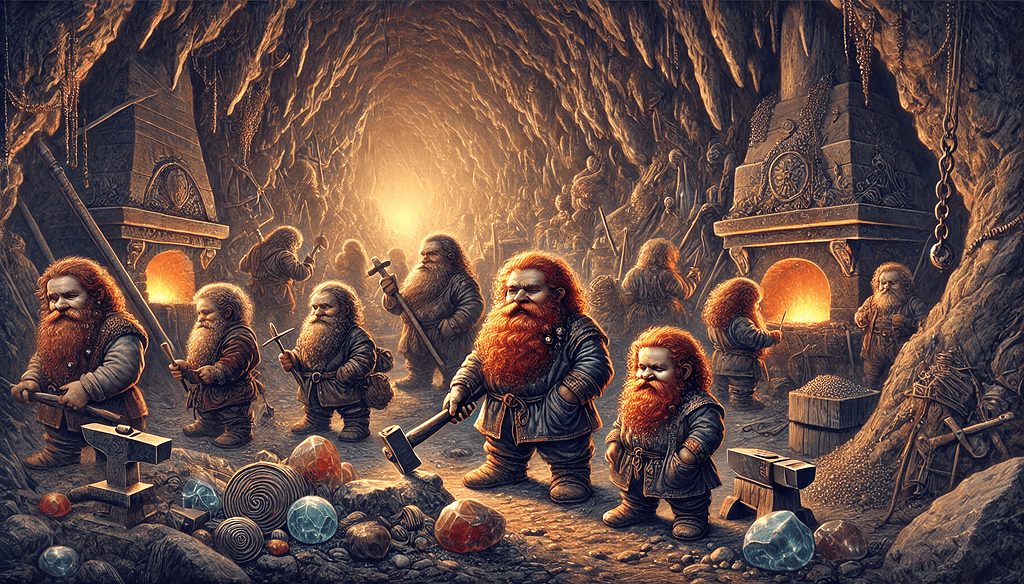
In Norse mythology, the term dvergr is significant, as it translates to “dwarves” in English.
It comes from the Old Norse word dvergr, which likely relates to the Proto-Germanic dwergaz, referring to beings with distinct traits that define them. The modern High German term ‘Zwerge’ stems from this Proto-Germanic root as well.
Dwarves are often linked to nature and the underworld. According to Snorri, the dwarves in Norse mythology may have been linked to black elves (Svartálfar) with whom they share locations and dwellings within the Norse Underworld. Several theories suggest their origins connect them to:
The portrayal of dwarves evolved within early sources such as the Poetic Edda and Prose Edda. These texts, written by Snorri Sturluson and other skáldskaparmál poets, present a multifaceted view of dwarven life.
For instance, the dwarves Fjalar and Galar carefully crafted the sacred mead of poetry out of the blood of Kvasir (John Lindow, 2001, p. 100).
Dwarves symbolize duality within Norse mythology. They represent not just skilled artisans but also embody the darker aspects of creation—those involving greed and conflict.
Their legacy stretches beyond mere craftsmanship; it’s interwoven with themes of power struggles, wealth accumulation, and divine favor.
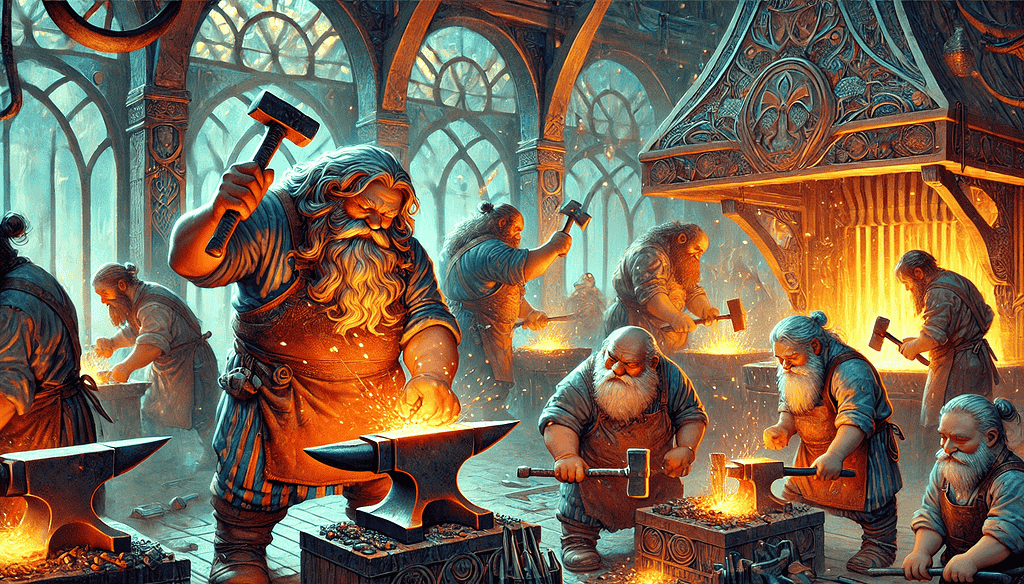
Dwarves, known as dvergr in Old Norse, are often depicted with distinct physical characteristics that set them apart from other beings in Norse mythology. Common attributes include:
Dwarves are typically represented as short and stocky, often no taller than a human child. Their diminutive size is complemented by robust builds, reflecting their strength and endurance.
Traditionally, they possess long beards, which symbolize wisdom and craftsmanship. Their skin is described as dark or swarthy, perhaps linking them to the depths of the earth where they reside.
Beyond their physical traits, dwarves are renowned for their magical abilities that enhance their reputation as master craftsmen. These abilities include:
Some dwarf legends suggest that they possess the power to change form, allowing them to adapt or conceal themselves in various situations. This skill may have been particularly useful during crafting endeavors or when engaging with other mythological beings.
Certain narratives mention dwarves’ ability to render themselves invisible at will. This trait has led to legends of them moving about undetected as they forge powerful weapons or artifacts.
Dwarves also played pivotal roles in significant myths involving gods and heroes. For example:
These magical capabilities not only highlight the dwarves’ exceptional skills but also contribute to their complex character within Norse mythology, where they embody both creation and cunning.
Dwarves in Norse literature are more than just mythical beings; while they are known to be skilled craftsmen, wise and possessing great amounts of wisdom (such as the dwarf Alvíss, literally meaning ‘all-wise; in the Alvíssmál” poem within the 12th century Poetic Edda) they are according to scholars not necessarily a driving force within the narratives of Norse Mythology (Neil Price, Stefan Brink, 2008, p. 236).
Their tales highlight their craftsmanship, cunning, and sometimes morally ambiguous traits. Among these dwarves, several stand out for their unique contributions to mythology.
One of the most intriguing dwarf figures is Andvari. He is best known for his cursed gold, which plays a significant role in the saga of Das Rheingold and the subsequent tales involving the hero Siegfried.
Andvari had amassed great wealth through his skill in crafting treasures. However, when he was captured by the god Loki, he was forced to surrender his hoard. In retaliation, Andvari placed a curse on his gold.
This curse brings misfortune to anyone who possesses it, illustrating a central theme in Norse mythology: the perilous nature of greed.
The story of Andvari serves as a cautionary tale about the dangers of avarice. Wealth acquired through deceit or misfortune often leads to ruin, reflecting the complex relationship between wealth and morality in Norse culture.
Another exemplary duo is Brokkr and Sindri, whose legendary craftsmanship culminates in the creation of Thor’s hammer, Mjölnir. Loki, on the other hand, shapeshifted into a fly and distracted them while creating the hammer (Claude Lecouteux, 2016).
The myth recounts how Loki boasted that no one could forge better gifts than those made by the dwarves. To prove him wrong, Brokkr and Sindri accepted a challenge from Loki to create three extraordinary items.
Using their exceptional skills, they forged Mjölnir, an iconic weapon capable of leveling mountains and returning to Thor’s hand after being thrown. This artifact symbolizes protection, power, and divine favor within the Norse pantheon.
Mjölnir’s importance extends beyond its physical capabilities; it represents Thor’s role as protector against chaos and evil forces.
According to the French historian and scholar Claude Lecouteux (2016) this mythological hammer also played a role in real-life rural customs and traditions in the Germanic-speaking areas of Europe.
For instance, to take ownership and possessions of a plot of land involved the throwing of a hammer. And to place a hammer on a woman’s lap meant to consecrate her marriage.
The hammer also embodies concepts of loyalty and sacrifice among dwarven craftsmen who risked much to create such powerful artifacts.
These notable figures enrich Norse mythology with their complex stories that intertwine themes of craftsmanship, greed, power dynamics, and morality.
Dwarves like Andvari remind us that wealth can be both a blessing and a curse while Brokkr and Sindri exemplify the pinnacle of artistry that defines dwarven culture.
Their narratives continue to resonate through time, underscoring the enduring fascination with these masters of the forge.
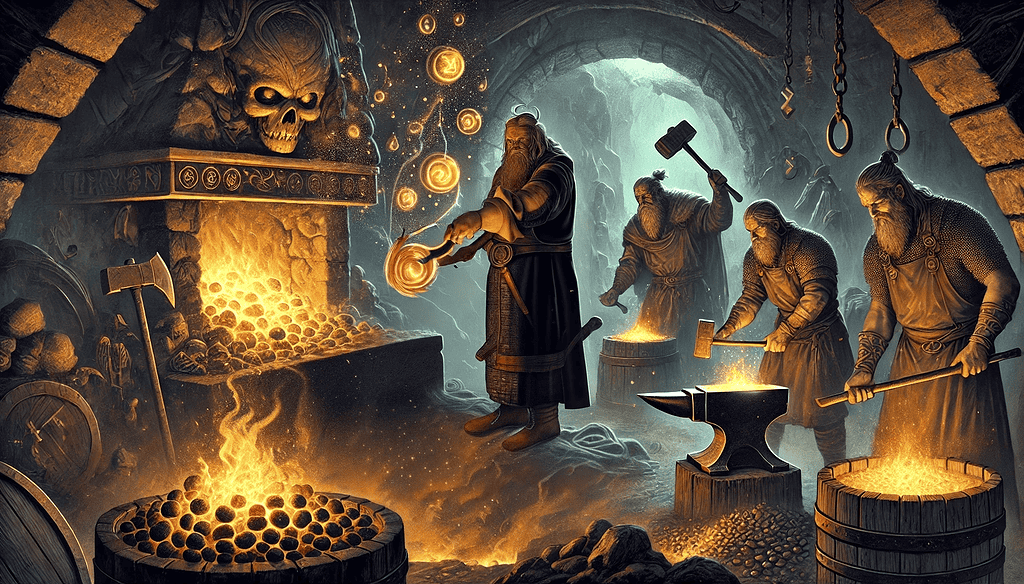
Dwarven craftsmanship holds a revered place in Norse mythology, exemplified by the creation of iconic artifacts such as Mjölnir and Gungnir. These legendary items not only showcase the unparalleled skill of the dwarves but also symbolize profound themes of power and protection.
The creation of Mjölnir, Thor’s mighty hammer, is a testament to dwarven ingenuity. Crafted by the brothers Brokkr and Sindri, this weapon was forged under challenging conditions.
According to legend, Loki’s mischief led to a wager that resulted in these skilled artisans producing items of extraordinary quality for the gods.
The hammer’s unique properties—its ability to return to Thor after being thrown—signify its divine purpose in protecting Asgard against giants and chaos.
Gungnir, Odin’s spear, is another remarkable artifact born from dwarven hands.
It was fashioned by the sons of Ivaldi, who were also responsible for creating Sif’s golden hair, a symbol of prosperity.
Embedded with magical properties, Gungnir never misses its target, representing Odin’s wisdom and authority over war.
These artifacts embody more than mere craftsmanship; they are interwoven into the very fabric of Norse belief systems:
Artifacts such as Mjölnir and Gungnir highlight the essential role that dwarven artisans played in shaping mythological narratives.
Their creations not only influenced battles between gods and giants but also reflected underlying themes within Norse culture, such as loyalty, honor, and the duality of creation and destruction.
Dwarves in Norse mythology are deeply rooted in family ties, which often define their social interactions and values.
Their stories frequently emphasize loyalty, showcasing protective relationships that exist between siblings and spouses. These bonds reflect a shared commitment to one another, evident in various tales where dwarven characters go to great lengths to safeguard their kin.
This protective nature is not just a trait but a central theme within dwarf lore.
Stories like Alvíssmál illustrate these dynamics, where the dwarf Alvíss seeks to marry the daughter of the god Thor, highlighting the lengths to which dwarves will go for familial honor and connection.
The social structure among dwarves is complex, characterized by:
The duality of dwarven existence intertwines craftsmanship with social dynamics.
In mythological narratives, these themes resonate through references to legendary beasts like Fenrir or golden-haired boars that appear alongside dwarves, symbolizing their interconnectedness with nature and the cosmos.
Dwarven stories remind us that behind every legendary artifact lies a network of relationships rooted in love, loyalty, and perhaps even rivalry—elements that make their society rich and engaging.
The legacy of these relationships continues to inspire narratives across cultures, echoing themes found in epic tales such as The Lord of the Rings.

Norse mythology introduces two fascinating groups often confused due to their overlapping traits: dark elves (Svartálfar) and dwarves (dvergar). Distinguishing between these entities requires delving into their definitions, characteristics, and societal roles (see, Hilda Davidson, 1993, p. 69).
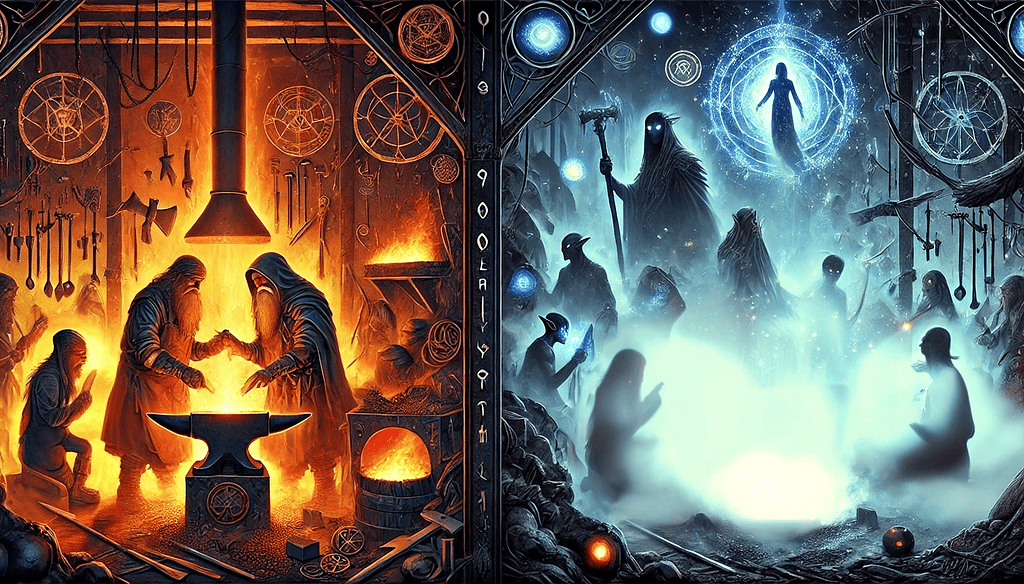
In recognizing the differences between dark elves and dwarves, we not only clarify these often-muddled figures but also deepen our understanding of the rich, complex world of Norse mythology.
Both beings play crucial roles, and their distinct characteristics contribute to the broader themes of power, creation, and magic that permeate the ancient stories. By examining these distinctions, we enrich our appreciation for the intricacies of Norse lore and its enduring legacy.
References:
Davidson, D. H. E., Davidson, H. E. (1993). The Lost Beliefs of Northern Europe. United Kingdom: Taylor & Francis.
Lecouteux, Claude. (2016). Encyclopedia of Norse and Germanic Folklore, Mythology, and Magic. United States: Inner Traditions/Bear.
Neil Price, Stefan Brink. The Viking World. (2008). United Kingdom: Taylor & Francis.
Lindow, J. (2002). Norse Mythology: A Guide to Gods, Heroes, Rituals, and Beliefs. United Kingdom: Oxford University Press.

ᛉ 100% handcrafted artisan pagan , viking, witchcraft and shamanic inspired jewelry.
ᛉ Runes, Symbolism & European Folklore
Get 20% off👇🏻
Leave a comment with your result ❤️
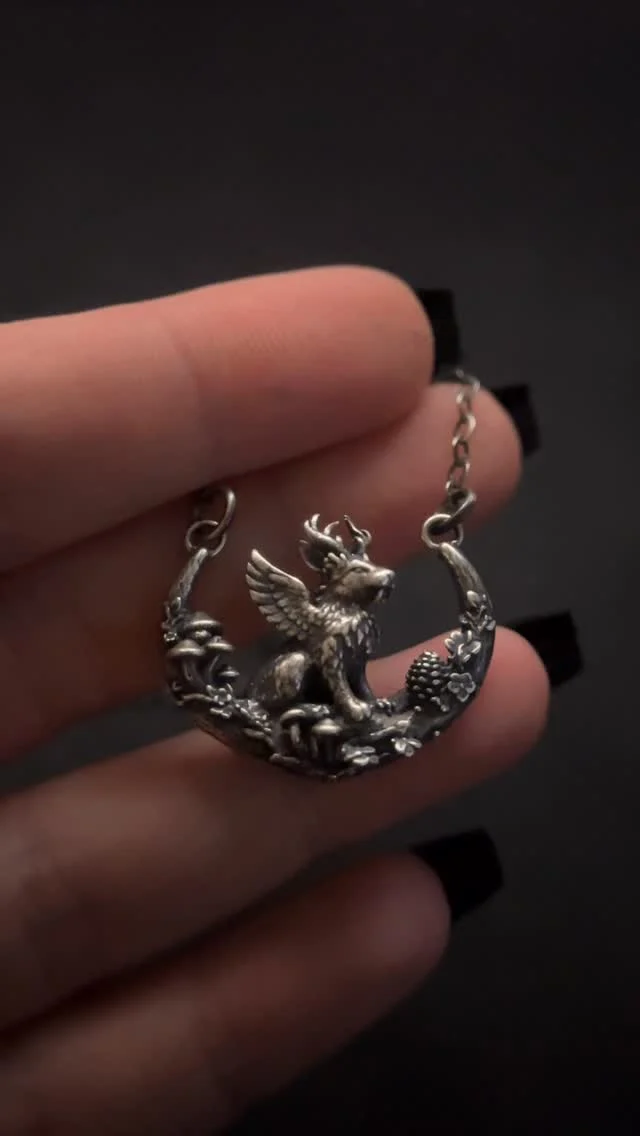
Bavarian Folklore says that you might just cross paths with a Wolpertinger in the alpine...

🐇🌲✨
He finally stepped out of the forest…
The Wolpertinger Pendant has arrived.
Inspired by...

I don’t often sell them, but love it when I do!
Vinca symbol bracelets ❤️...

Rooted in strength + guarded by ravens

The serpent waits 🖤
(Handcrafted Jörmungandr ring made to order in my shop)

Stay warm, everyone ❤️

😑😑😑🤮

I thought I had closed the book on the Alice in Wonderland rings…
But you...

Can this be over now, please?

In case you forgot 💜

Something I’ve been thinking about lately.
If there’s one thing I would’ve done differently early...

This year, we’re not buying things just to keep up.
If you need the reminder:...

My husband is from Bavaria (southern Germany) and I originally made this Krampus pendant for...

Some of the items I’m shipping out today ❤️
Please forgive my dirty nails 😂...

A few items shipping out today 🥰

This mornings rings shipping out ❤️

A few of the rjngs I’m shipping out this morning ❤️
How do you like...

Krampus is coming 🫶🏻

Getting ready to pack up these pretties and ship to their owners ❤️

Freya, cats and pentacles. Doesn’t get any better ❤️

You all got me going crazy making all these fairytale + storybook rings.
But I’ll...

Just launched these pretties ❤️
Size 9 amethyst ring + size 7.25 green kyanite

What would you trade to learn Baba Yaga’s secrets?

It *finally* looks, feels and smells like October!
And here are some items I’m packing...

This mornings pretties getting ready to ship :)

Getting ready to pack up these pretties and ship to their owners ❤️

You bet I’m hopping on this trend 😂
Thank you @shes_sinister for the prompt!

While I welcome the seasonal darkness…it sure is going to make my morning quick videos...

Finally finished the rings I’ve been working on in my stories ❤️
I think I...

Was going to post this update to my stories but it’s too long.

“How do you know I’m mad?” said Alice.
“You must be,” said the Cat, “or...

Some of this mornings orders getting ready to ship. Those little bats are so cute...

Here is the finished ring I was working on in my stories yesterday, along with...

A few of today’s orders shipping out this morning ❤️

The two silver raven rings I was working on in my stories yesterday.
…as well...

Eeeek! I’m so happy to add these to my shop ❤️
I’ve gotten so many...

I had 6 clamshells ready to ship this morning but I dropped and lost my...

Not the story you were told.
The girl didn’t run.
The wolf didn’t win.
This...

I love these raven rings so much 🖤
This mornings pretties shipping out.
All items...

Sleek + minimal Mjölnir ring ⚒️

Today’s orders getting ready to ship.
…And I finally got some time to work on...

That ant ring is so out of place 😂
Not that the mail is coming...

If you had this, which runes would you choose? Or would you accept the runes...

I love making these fun Halloween coffin pendants 🎃
All items you see are always...


About the author Jacqueline Fatica


