No products in the cart.
March 11, 2026 8:42 pm

Free USA shipping on orders $35+
March 11, 2026 8:42 pm
The domovoi occupies a fascinating place in Slavic folklore and mythology.
Known as a protective yet unpredictable spirit dwelling within the household, this mythical being bridges ancient ancestor worship, domestic ritual, and everyday life.
In Russian folklore and broader Slavic mythology, the domovoi who is sometimes called domovoy or domovoj represents the intimate connection between family, dwelling, and supernatural belief.
This article explores the origins, behaviour, and cultural significance of this house spirit, showing why the domovoi remains one of the most intriguing figures in Slavic spiritual tradition.
The domovoi was widely understood as a household spirit inhabiting the domestic sphere and interacting directly with the human family.
Folklorists note that the domovoi formed part of a structured supernatural system including beings such as the bannik of the bathhouse and courtyard spirits connected to agricultural life (Moyle, 1990, p. 127).
Within Russian folklore, the domovoi was seen not merely as a mythical curiosity but as an inhabitant of the home whose presence influenced daily behaviour and ritual practice.
In broader Slavic mythology, belief in such spirits reflected an animistic worldview in which the boundaries between spirit and matter were fluid.
Early religious traditions assumed that supernatural forces could inhabit everyday objects and spaces, making the house spirit an essential mediator between the human and unseen worlds (Dittrich, 1961, p. 485).
This conceptual framework helps explain why the domovoi remained central to domestic belief.
Scholars emphasize that Slavic religion evolved through layered historical processes rather than through a single unified mythology.
Household cult practices, including reverence for ancestral figures and sacred domestic corners, formed part of a deep religious stratum preserved through folklore traditions (Dittrich, 1961, p. 481–482).
In this context, the domovoi may be viewed as a household deity embodying continuity between generations.
Comparative linguistic studies reinforce this interpretation.
The domovoy has been compared with Roman domestic gods such as the lares and penates, suggesting that Indo-European cultures shared similar ideas about protective spirits within the dwelling (Cooper, 2005, p. 253).
This comparison demonstrates that the domovoi was not an isolated phenomenon but part of a wider religious heritage.
Many researchers argue that the domovoi originated in ancestor worship.
Early Slavic belief held that the spirits of the dead remained active in the world of the living and could influence fortune or misfortune within the household (Dittrich, 1961, p. 486).
From this perspective, the domovoi represents a domesticated ancestor whose protective behaviour ensured family prosperity.
At the same time, ethnographic evidence suggests that villagers perceived the house spirit as both guardian and potential source of danger.
Narratives describe the domovoi as capable of benevolent acts when honoured, yet able to cause distress if offended or neglected (Cooper, 2005, p. 254–255).
This dual nature highlights the ambivalence typical of supernatural beings in Slavic folklore.
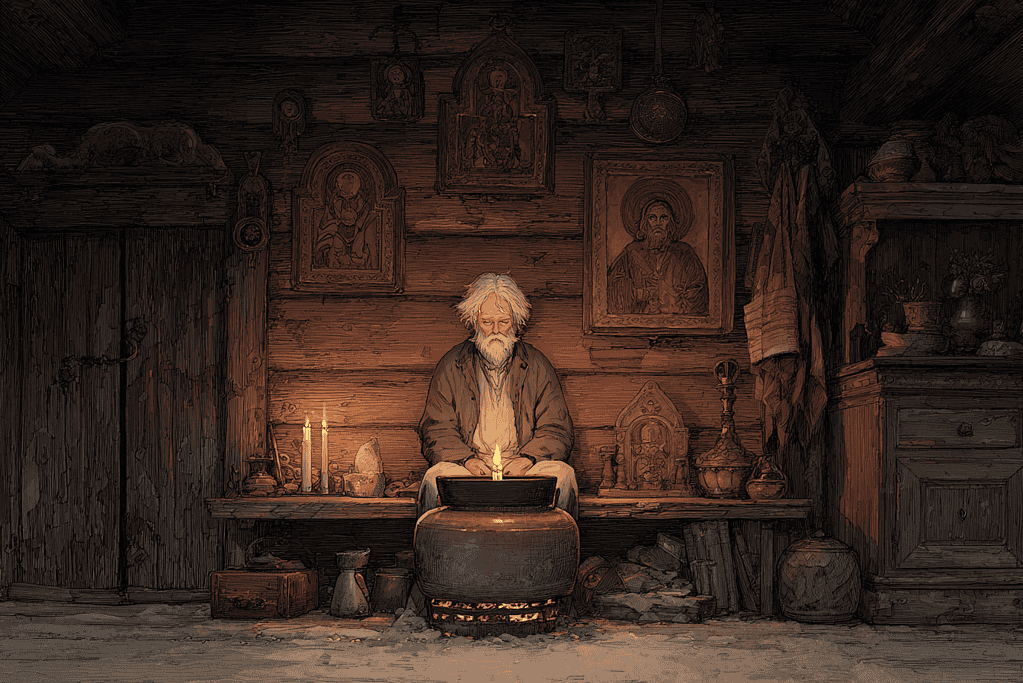
Traditional accounts place the domovoi behind the stove or near the hearth, locations considered spiritually significant within the home.
Domestic sacred space once associated with ancestral images later became integrated into Christian practice, demonstrating continuity of belief across religious transformations (Dittrich, 1961, p. 492).
Such spatial symbolism reinforced the idea that the house spirit protected both physical dwelling and spiritual identity.
Ethnographic studies of rural village life reveal that sacred areas such as the icon corner were also understood as places where communication with ancestors and household spirits could occur (Maeder, 2009, p. 314).
These beliefs illustrate how domestic ritual geography shaped everyday interaction with the domovoi.
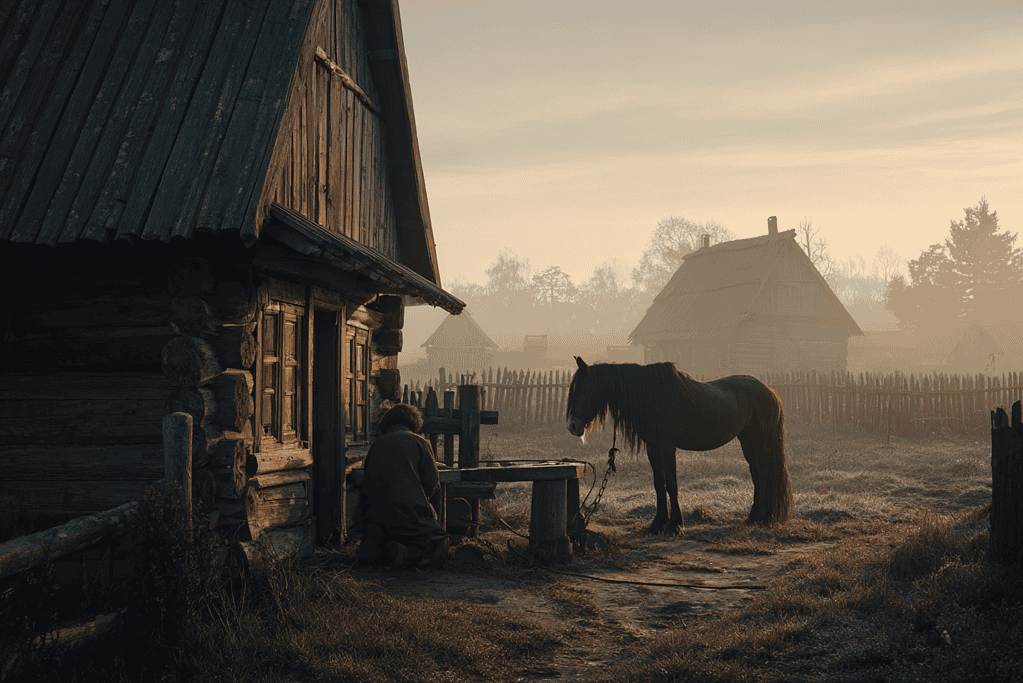
Folklore traditions attribute varied behaviour to the domovoi. In some regions, the spirit was believed to take care of the animals, braiding the manes of favoured horses or disturbing livestock when displeased (Fraenkel, 1951, p. 142).
Such stories reflect the agricultural importance of household prosperity and the perceived supernatural regulation of economic life.
Ritual offerings such as porridge or symbolic sacrifice were sometimes performed to appease the spirit and maintain good terms.
The domovoi could also foretell imminent events through signs such as knocking or appearing in dreams, demonstrating a role in divination practices within the household.
These customs illustrate the integration of supernatural belief into routine domestic activity.
Ethnographic research indicates that belief in the domovoi persisted well into modern times.
Rural communities described the spirit using narrative forms similar to those employed when recounting historical trauma, suggesting that supernatural stories helped structure collective memory and social cohesion (Maeder, 2009, p. 314).
In this sense, the domovoi functioned as both symbolic figure and living cultural presence.
The persistence of such traditions reflects the broader significance of folklore in shaping worldview.
Russian cultural identity was deeply influenced by rural spiritual practices, and the domovoi formed part of this enduring heritage (Moyle, 1990, p. 127).
Philological scholarship reveals striking parallels between Slavic domestic spirits and similar beings across Europe.
The domovoi has been compared to Germanic kobolds, Scottish brownie figures, and even Greek guardian serpents associated with household protection (Fraenkel, 1951, p. 142).
These analogies suggest a shared Indo-European pattern in which domestic supernatural beings embodied both economic fortune and moral order.
Such comparisons highlight the adaptability of mythological categories.
As cultural contact and scholarly classification developed, the domovoi became part of a broader discussion about mythical spirits inhabiting the home.
The ambivalent character of the domovoi reflects ancient beliefs about the impure or restless dead.
Slavic tradition distinguished between benevolent ancestral spirits and malevolent revenants whose presence threatened family well-being (Cooper, 2005, p. 262).
This distinction explains why the house spirit could be harmless or malicious depending on ritual respect.
Behaviour attributed to the domovoi often involved pranks or disturbances resembling poltergeist activity.
Folklore narratives emphasize that the spirit was easily offended, reinforcing moral lessons about household harmony and honouring tradition.
Domestic ritual formed a crucial framework for interacting with the domovoi. The threshold of the dwelling symbolized transition between worlds, while the hearth represented continuity of family lineage.
Scholars note that Slavic religious life revolved around agrarian cycles and ancestral memory, embedding the house spirit within everyday practice (Dittrich, 1961, p. 487–489).
Consulting the domovoi through ritual gestures or offerings was seen as a practical necessity rather than superstition.
Such actions were believed to prevent misfortune and maintain spiritual balance within the household.
Modern interest in Slavic folklore continues to draw on academic research into the domovoi.
Comparative studies and ethnographic accounts reveal how this mythical spirit encapsulates themes of belonging, memory, and continuity.
Even in contemporary discussions of Slavic mythology, the domovoi symbolizes the enduring power of traditional belief.
By examining historical sources and scholarly interpretation, readers can appreciate how this humble house spirit reflects complex religious and social processes.
The domovoi stands as a reminder that mythology is not merely a relic of the past but a living cultural narrative.
Cooper, B. (2005). The word “vampire”: Its Slavonic form and origin. Journal of Slavic Linguistics, 13(2), 251–270.
Dittrich, Z. R. (1961). Zur religiösen Ur- und Frühgeschichte der Slaven. Jahrbücher für Geschichte Osteuropas, 9(4), 481–510.
Fraenkel, E. (1951). Baltische Etymologien. Zeitschrift für Slavische Philologie, 21(1), 138–154.
Maeder, E. (2009). Review of Solovyovo: The Story of Memory in a Russian Village. Jahrbücher für Geschichte Osteuropas, 57(2), 313–315.
Moyle, N. K. (1990). Review of Russian Folk Belief. The Slavic and East European Journal, 34(1), 127–128.

ᛉ 100% handcrafted artisan pagan , viking, witchcraft and shamanic inspired jewelry.
ᛉ Runes, Symbolism & European Folklore
Get 20% off👇🏻
Leave a comment with your result ❤️
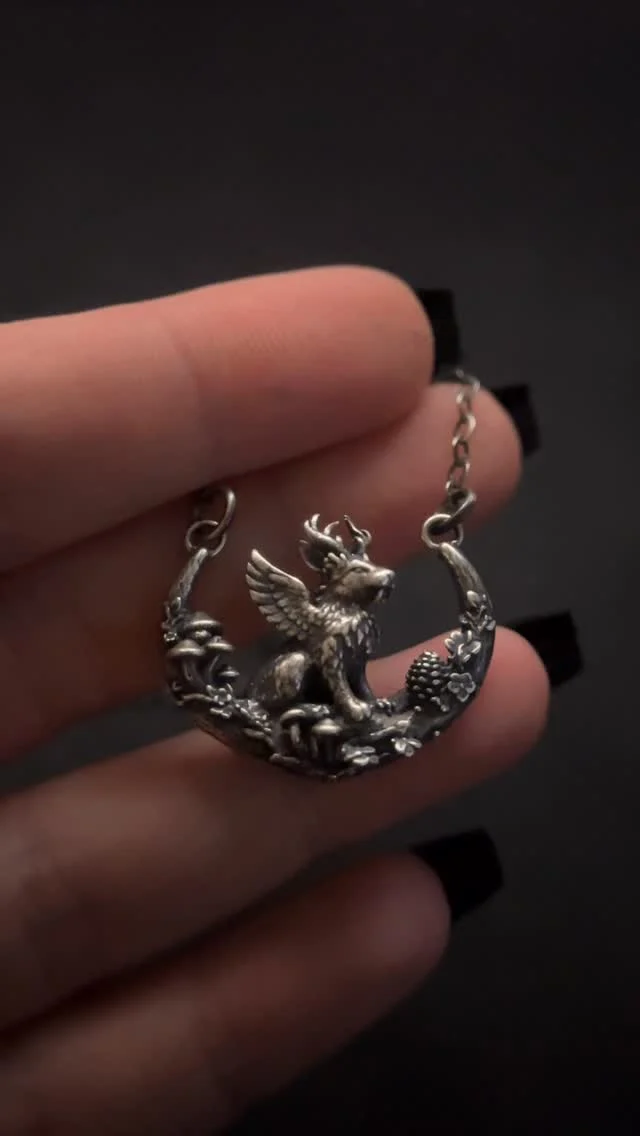
Bavarian Folklore says that you might just cross paths with a Wolpertinger in the alpine...

🐇🌲✨
He finally stepped out of the forest…
The Wolpertinger Pendant has arrived.
Inspired by...

I don’t often sell them, but love it when I do!
Vinca symbol bracelets ❤️...

Rooted in strength + guarded by ravens

The serpent waits 🖤
(Handcrafted Jörmungandr ring made to order in my shop)

Stay warm, everyone ❤️

😑😑😑🤮

I thought I had closed the book on the Alice in Wonderland rings…
But you...

Can this be over now, please?

In case you forgot 💜

Something I’ve been thinking about lately.
If there’s one thing I would’ve done differently early...

This year, we’re not buying things just to keep up.
If you need the reminder:...

My husband is from Bavaria (southern Germany) and I originally made this Krampus pendant for...

Some of the items I’m shipping out today ❤️
Please forgive my dirty nails 😂...

A few items shipping out today 🥰

This mornings rings shipping out ❤️

A few of the rjngs I’m shipping out this morning ❤️
How do you like...

Krampus is coming 🫶🏻

Getting ready to pack up these pretties and ship to their owners ❤️

Freya, cats and pentacles. Doesn’t get any better ❤️

You all got me going crazy making all these fairytale + storybook rings.
But I’ll...

Just launched these pretties ❤️
Size 9 amethyst ring + size 7.25 green kyanite

What would you trade to learn Baba Yaga’s secrets?

It *finally* looks, feels and smells like October!
And here are some items I’m packing...

This mornings pretties getting ready to ship :)

Getting ready to pack up these pretties and ship to their owners ❤️

You bet I’m hopping on this trend 😂
Thank you @shes_sinister for the prompt!

While I welcome the seasonal darkness…it sure is going to make my morning quick videos...

Finally finished the rings I’ve been working on in my stories ❤️
I think I...

Was going to post this update to my stories but it’s too long.

“How do you know I’m mad?” said Alice.
“You must be,” said the Cat, “or...

Some of this mornings orders getting ready to ship. Those little bats are so cute...

Here is the finished ring I was working on in my stories yesterday, along with...

A few of today’s orders shipping out this morning ❤️

The two silver raven rings I was working on in my stories yesterday.
…as well...

Eeeek! I’m so happy to add these to my shop ❤️
I’ve gotten so many...

I had 6 clamshells ready to ship this morning but I dropped and lost my...

Not the story you were told.
The girl didn’t run.
The wolf didn’t win.
This...

I love these raven rings so much 🖤
This mornings pretties shipping out.
All items...

Sleek + minimal Mjölnir ring ⚒️

Today’s orders getting ready to ship.
…And I finally got some time to work on...

That ant ring is so out of place 😂
Not that the mail is coming...

If you had this, which runes would you choose? Or would you accept the runes...

I love making these fun Halloween coffin pendants 🎃
All items you see are always...


About the author Jacqueline Fatica


