No products in the cart.
February 16, 2026 7:35 pm

Free USA shipping on orders $35+
February 16, 2026 7:35 pm
The meaning of viking is often misunderstood.
In modern imagination, the term brings to mind horned helmets, ships cutting through the mist, and fierce warriors from the north.
Yet the historical reality is much more nuanced, more interesting, and more deeply rooted in language and literature.
The viking definition did not originally refer to a people, ethnicity, or nation.
Instead, it described a specific activity and role within early medieval society.
This article explains the true definition of a viking using primary sources and academic research, carefully examining the word viking, its etymology, and its meaning in the viking world.
By examining Old English poetry, Old Norse texts, and runic inscriptions, we can understand exactly what made someone a viking and why the word still matters today.
The most accurate viking definition comes directly from primary sources written during or shortly after the early medieval period.
These sources show that a viking was not defined by ethnicity, nationality, or social class, but by activity.
Specifically, a viking was someone who participated in organized armed expeditions, often involving travel by sea and confrontation with foreign communities (Jesch, 2015, pp. 20–21).
This distinction is crucial.
A farmer living in Scandinavia was not automatically a viking. A merchant trading in Birka, a thriving market town in Sweden during the viking age, was not necessarily a viking either.
The term applied only when individuals joined expeditions involving warfare, raiding, or military ventures.
These ventures defined the viking world more than geography alone.
Academic work in Scandinavian studies emphasizes that the word described behavior rather than identity.
The term viking appears in contexts describing action, often group-based military activity, rather than referring to a permanent social category (Jesch, 2015, pp. 20–21).
This is why primary sources distinguish between Norse people generally and those specifically engaged in viking activity.
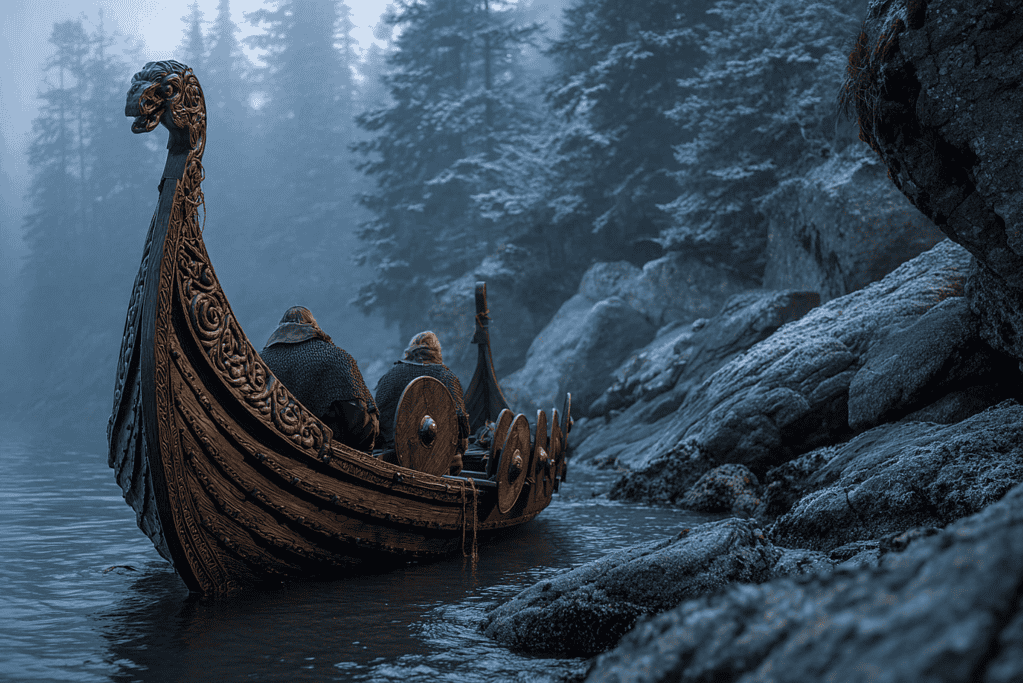
The etymology of the word viking has been debated for centuries.
The word originates in the Old Norse language, where the noun víkingr referred to a person participating in viking expeditions, while the related noun víking referred to the expedition itself.
Scholars have proposed several possible origins for the word viking.
One theory connects it to the Old Norse word vík, meaning a bay or inlet, suggesting that vikings were people who operated from coastal hiding places (Barnes & Page, 2011, p. xiii).
This interpretation fits well with the maritime nature of viking expeditions and their reliance on ships along the coasts of Europe.
Another theory connects the word viking to verbs meaning “to move aside” or “to depart,” reflecting the idea of leaving home on expeditions.
While these explanations remain debated, scholars emphasize that the original etymology cannot be known with absolute certainty (Jesch, 2015, pp. 19–20).
The grammatical gender of víkingr in Old Norse language is masculine, referring to the individual participant.
Meanwhile, víking, the expedition itself, is feminine in grammatical gender.
This linguistic distinction reinforces that the term originally described an activity rather than a permanent identity.
Old English literature provides some of the earliest written evidence for the word viking.
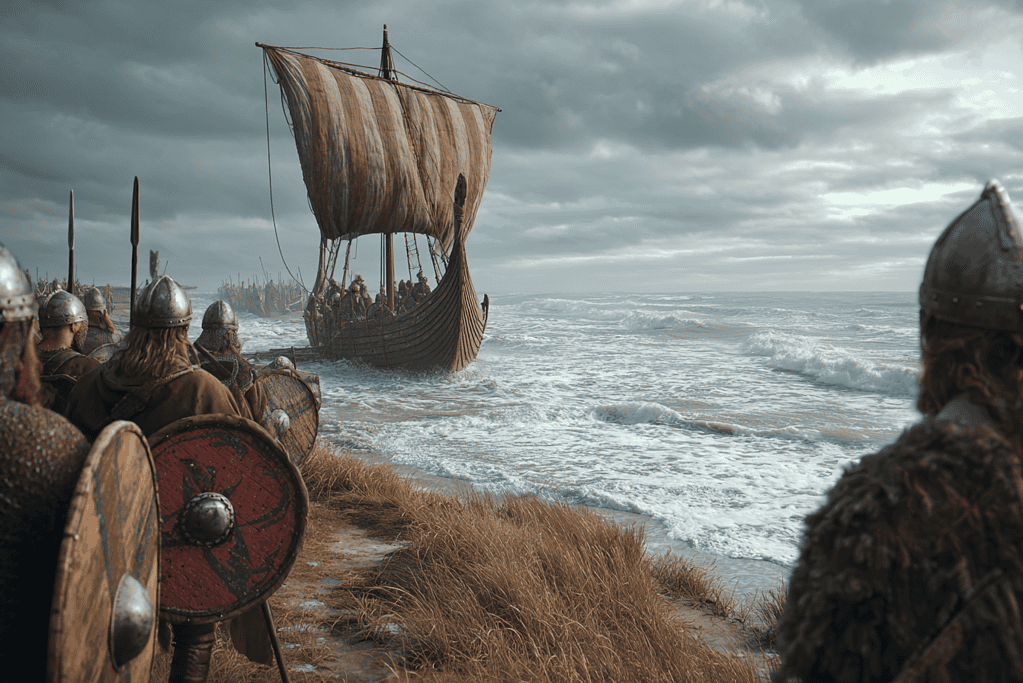
In the Anglo-Saxon poem The Battle of Maldon, written after a conflict in the 9th century, the term appears in the form wicing, referring to seaborne attackers.
The poem describes encounters between Anglo-Saxon defenders and invading forces, clearly framing the viking as an external raider arriving by ship.
This usage demonstrates that the word viking was understood in Old English as a functional description of an enemy engaged in military action rather than an ethnic label.
The Old English poem Widsith, another early medieval text, uses similar terminology to describe groups encountered in the early medieval period.
These literary references confirm that the meaning of viking was widely understood across northern Europe as describing a particular type of armed expedition participant rather than all Scandinavians.
Academic analysis of Old English sources concludes that the word functioned semantically as a description of a seafarer or maritime aggressor rather than a member of a specific nation or ethnic group (Fell, 1986, pp. 307–308).
The word víkingr in Old Norse sources refers specifically to someone participating in organized expeditions involving travel and conflict.
The meaning of viking in these texts often depends on context, sometimes describing heroic figures, and other times describing dangerous enemies.
Scholars emphasize that víkingr appears relatively rarely in surviving runic inscriptions and medieval Scandinavian texts.
When it does appear, it is used carefully, suggesting that not everyone was considered a viking (Jesch, 2015, pp. 19–21).
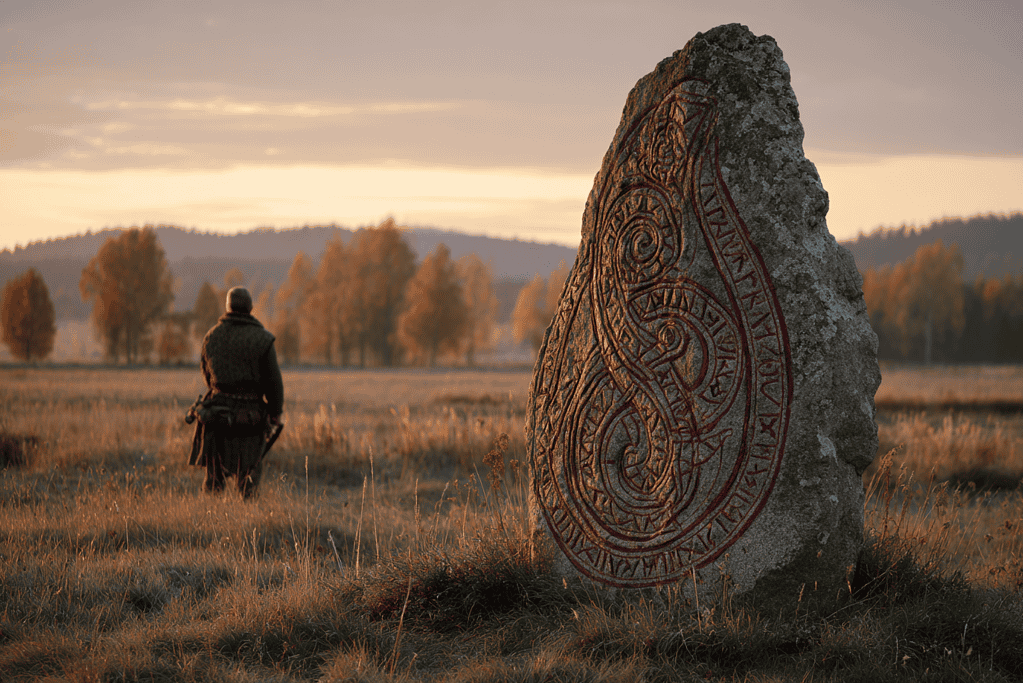
This distinction is visible in medieval Scandinavian societies such as Gotland and Uppland, where runestones commemorate individuals who traveled abroad, sometimes describing military expeditions.
These inscriptions demonstrate that participation in such expeditions was noteworthy enough to be memorialized in stone.
The use of the word víkingr reveals that the concept was recognized across the Norse world, but it remained tied to specific activities. Not every Scandinavian was a Viking!
The historical evidence shows that being a viking was not a formal profession or permanent rank within Norse society during what is called the Viking Age today.
Instead, it was often a temporary role undertaken by individuals, particularly younger men seeking wealth, prestige, or experience.
Old Norse literature and saga tradition, however, frequently depict young warriors embarking on expeditions as a rite of passage.
These stories emphasize that individuals could become vikings temporarily before settling into other roles such as farming or leadership (Barnes & Page, 2011, p. xiii).
This temporary nature explains why many individuals mentioned in saga literature, including figures in Egils saga, participated in expeditions during their youth before becoming landowners or leaders later in life.
This interpretation aligns with archaeological evidence from places like Birka and historical accounts of kings of Denmark such as Knut, whose careers involved military expeditions.
Several Runestones may further provide valuable primary sources for understanding the historical viking world.
These stones, carved with runic inscriptions, commemorate individuals who died abroad or participated in expeditions.
Runestones from regions such as Bohuslän and Uppland often mention individuals who traveled overseas, providing direct evidence of seafaring expeditions during the late iron age.
These inscriptions demonstrate that such expeditions were important enough to define personal legacy.
These runic inscriptions serve as primary sources documenting the existence of organized expeditions and confirming that participation in such activities defined what it meant to be a viking.
Medieval Scandinavian literature, including works attributed to Snorri Sturluson, preserves important traditions about the viking age.
These texts, written in Icelandic centuries later, describe individuals embarking on expeditions across northern Europe.
Saga literature presents a nuanced picture.
Some vikings are portrayed as honorable warriors, although this is certainly not always the case.
This diversity reflects the complex nature of viking culture and its social perception.
These texts demonstrate that the viking identity was tied to activity rather than birth, reinforcing conclusions drawn from linguistic and archaeological evidence.
One of the most important conclusions from academic research is that most Norse people were not vikings.
The majority of Scandinavians were farmers, craftsmen, traders, or settlers.
The viking age, spanning roughly the 8th to the 11th centuries, was defined by the presence of viking expeditions, not by universal participation in them.
The distinction between Norseman and viking is crucial.
A Norseman referred broadly to a person from Scandinavia, while a viking referred specifically to someone engaged in expeditionary trade, exploration or warfare.
The end of the viking age brought significant changes to the meaning of the word viking.
As Scandinavian societies transitioned into medieval kingdoms, the term became associated with historical memory rather than contemporary activity.
Later medieval texts preserved the concept of the viking as a figure of the past, while modern popular media transformed it into a generalized identity symbol.
Modern dictionaries such as Collins English Dictionary and Random House Unabridged Dictionary define viking broadly as Scandinavian raiders, reflecting later interpretations rather than original usage.
These definitions simplify a complex historical concept rooted in activity, language, and cultural context.
Academic research demonstrates that the historical viking was defined by action rather than ethnicity or nationality.
Barnes, M. P., & Page, R. I. (2011). A New Introduction to Old Norse. Cambridge University Press.
Fell, C. E. (1986). Old English wicing. Proceedings of the British Academy.
Jesch, J. (2015). The Viking Diaspora. Cambridge University Press.

ᛉ 100% handcrafted artisan pagan , viking, witchcraft and shamanic inspired jewelry.
ᛉ Runes, Symbolism & European Folklore
Get 20% off👇🏻
Happy washing day 🙃
A few rings I’ve worked on the last couple days…
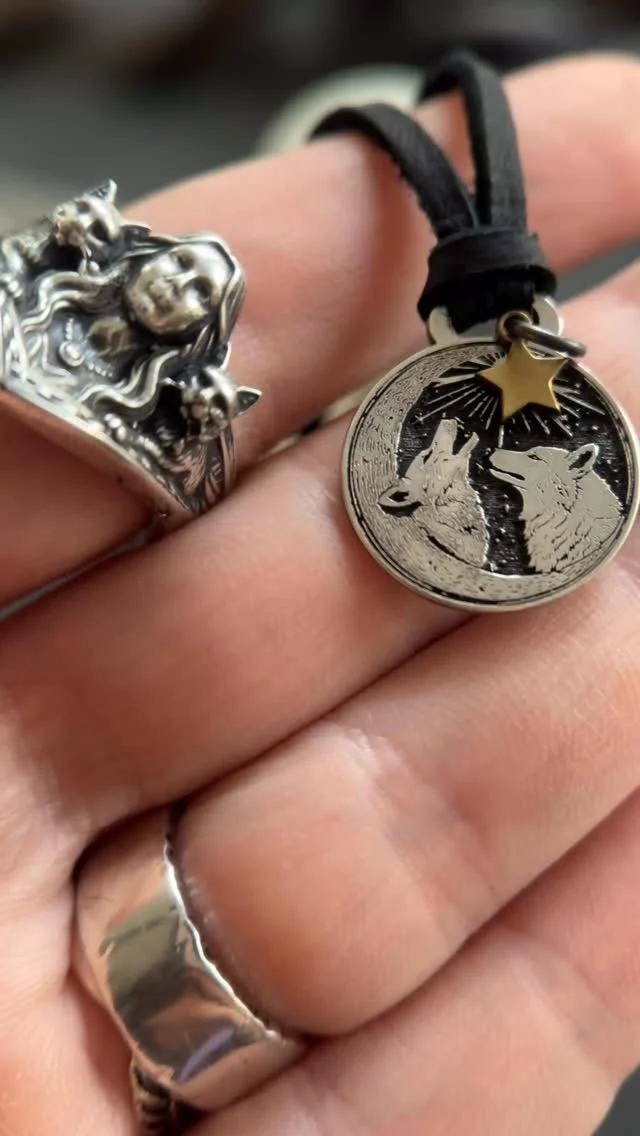
Freya’s cats rule and dogs drool?
Or was that the other way around? 🙃

Garm barely shows up in the old Norse stories.
Still… he leaves a mark.
A...
Leave a comment with your result ❤️
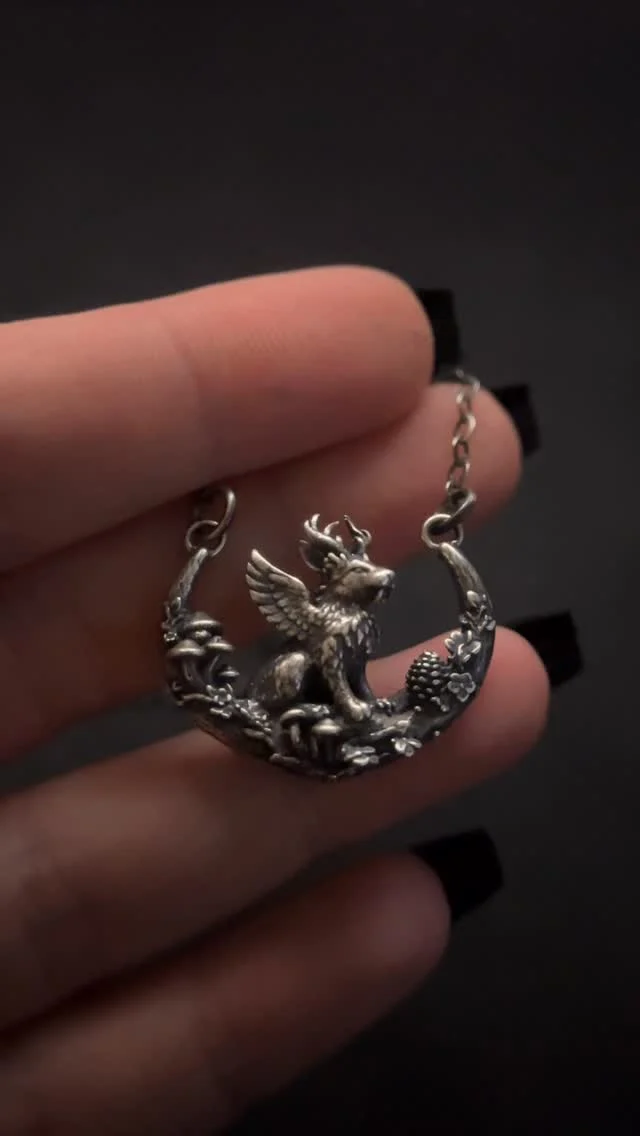
Bavarian Folklore says that you might just cross paths with a Wolpertinger in the alpine...

🐇🌲✨
He finally stepped out of the forest…
The Wolpertinger Pendant has arrived.
Inspired by...

I don’t often sell them, but love it when I do!
Vinca symbol bracelets ❤️...

Rooted in strength + guarded by ravens

The serpent waits 🖤
(Handcrafted Jörmungandr ring made to order in my shop)

Stay warm, everyone ❤️

😑😑😑🤮

I thought I had closed the book on the Alice in Wonderland rings…
But you...

Can this be over now, please?

In case you forgot 💜

Something I’ve been thinking about lately.
If there’s one thing I would’ve done differently early...

This year, we’re not buying things just to keep up.
If you need the reminder:...

My husband is from Bavaria (southern Germany) and I originally made this Krampus pendant for...

Some of the items I’m shipping out today ❤️
Please forgive my dirty nails 😂...

A few items shipping out today 🥰

This mornings rings shipping out ❤️

A few of the rjngs I’m shipping out this morning ❤️
How do you like...

Krampus is coming 🫶🏻

Getting ready to pack up these pretties and ship to their owners ❤️

Freya, cats and pentacles. Doesn’t get any better ❤️

You all got me going crazy making all these fairytale + storybook rings.
But I’ll...

Just launched these pretties ❤️
Size 9 amethyst ring + size 7.25 green kyanite

What would you trade to learn Baba Yaga’s secrets?

It *finally* looks, feels and smells like October!
And here are some items I’m packing...

This mornings pretties getting ready to ship :)

Getting ready to pack up these pretties and ship to their owners ❤️

You bet I’m hopping on this trend 😂
Thank you @shes_sinister for the prompt!

While I welcome the seasonal darkness…it sure is going to make my morning quick videos...

Finally finished the rings I’ve been working on in my stories ❤️
I think I...

Was going to post this update to my stories but it’s too long.

“How do you know I’m mad?” said Alice.
“You must be,” said the Cat, “or...

Some of this mornings orders getting ready to ship. Those little bats are so cute...

Here is the finished ring I was working on in my stories yesterday, along with...

A few of today’s orders shipping out this morning ❤️

The two silver raven rings I was working on in my stories yesterday.
…as well...

Eeeek! I’m so happy to add these to my shop ❤️
I’ve gotten so many...

I had 6 clamshells ready to ship this morning but I dropped and lost my...

Not the story you were told.
The girl didn’t run.
The wolf didn’t win.
This...

I love these raven rings so much 🖤
This mornings pretties shipping out.
All items...

Sleek + minimal Mjölnir ring ⚒️

Today’s orders getting ready to ship.
…And I finally got some time to work on...


About the author Jacqueline Fatica


