No products in the cart.
January 4, 2026 3:08 pm

Free USA shipping on orders $35+
January 4, 2026 3:08 pm
The dawn goddess appears across many ancient traditions as a poetic and carefully structured figure rather than a vague symbol of light.
This article focuses on what academic literature actually says about the goddess of dawn, with special attention to Eos, the Greek goddess of the dawn, her Roman counterpart Aurora, and their deeper Indo-European background.
Drawing strictly from philological, mythological, and historical sources, the discussion traces how dawn was understood as a divine presence tied to order, time, and renewal in ancient belief systems.
This article is worth reading if you want a grounded, literature-based understanding of the dawn goddess that stays close to ancient sources rather than modern reinterpretations.
In ancient religious systems, a dawn goddess is not an abstract metaphor but a clearly defined personification of the dawn, understood as a recurring cosmic event that demanded explanation and structure.
The goddess of dawn marks the transition from night to day, from disorder to visible order, and from rest to activity.
Philological evidence shows that dawn was treated as a divine presence long before written mythology emerged.
In Indo-European traditions, the dawn goddess appears as a youthful female deity associated with light, movement, and the opening of space between divine and mortal realms.
This figure is linguistically traceable through related names across cultures, indicating shared mythic inheritance rather than coincidence (West, 2007, p. 217).
The goddess of the dawn is not interchangeable with the sun god or moon goddess. Instead, she occupies the precise threshold between darkness and daylight.
This mythical position explains why ancient texts treat her with consistent imagery across cultures while assigning her a distinct role among gods and goddesses.
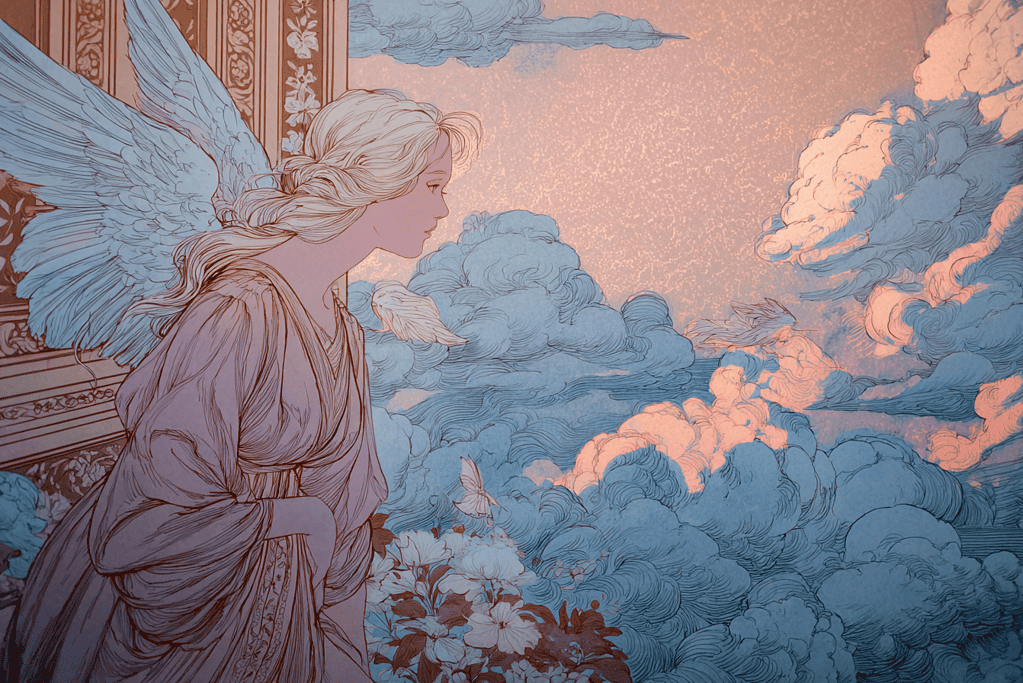
Eos, the Greek goddess of the dawn, is the most clearly attested dawn deity in Greek mythology.
According to Hesiod, she is the daughter of the Titan Hyperion and Theia, making her a second-generation Titan rather than an Olympian (Hesiod, Theogony, lines 371–374).
This lineage places her among the primordial forces that structure the cosmos rather than govern human institutions.
Eos in Greek mythology appears daily at the eastern edge of the world, riding a chariot drawn by winged horses.
Her role is to announce the arrival of the sun god and prepare the sky for daylight.
Ancient Greek sources consistently describe her as the bringer of light, acting as a herald rather than a ruler (West, 2007, p. 219).
The ancient Greeks did not treat Eos as a marginal poetic figure.
Her regular appearance in epic poetry shows that dawn in Greek mythology was understood as an active divine process rather than a passive natural event.
Ancient Greek poetry gives Eos a stable set of attributes that appear across centuries.
Homer repeatedly refers to her as rosy-fingered, an image that reflects both color and movement rather than decoration (Homer, Odyssey, 2.1).
This phrase captures the visual spreading of dawn across the morning sky.
Eos is described as having wings, emphasizing speed and transition rather than permanence.
Her chariot drawn by winged horses moves swiftly across the heavens, opening the gates of heaven for Helios to rise.
This imagery reinforces her function as a mythical deity who governs passage rather than dominance.
The consistency of these descriptions across Greek myths suggests that Eos functioned as a stable deity within Greek culture, not as a flexible literary symbol.
Her presence structures time itself, marking the beginning of the new day.
Eos belongs to a tightly organized family of light deities.
She is the sister of Helios, the god of the sun, and Selene, the goddess of the moon, forming a triad that governs the visible cycle of time (Hesiod, Theogony, 371–374).
This relationship is emphasized in Greek mythology rather than treated as incidental genealogy.
Helios and Selene represent stable celestial bodies, while Eos represents motion and change. She moves between them, signaling the handover from night to day.
The siblings Helios and Selene remain fixed in their paths, while Eos actively initiates transition.
This divine structure reflects how ancient Greek thought organized the cosmos.
Dawn was not absorbed into the sun god’s identity. Instead, it required its own goddess to account for the visible and experiential shift between night and day.

The phrase rosy-fingered goddess is not ornamental language but a technical poetic expression.
It describes the gradual extension of light across the sky, resembling fingers reaching outward.
Ancient Greek audiences understood this imagery as a precise observation of dawn rather than metaphorical excess.
The color rose appears repeatedly in descriptions of Eos, linking her to the morning dew and the first illumination of land and sea.
This image also reinforces her youthfulness and freshness, qualities repeatedly assigned to the goddess eos in Greek texts.
This visual language helped ancient Greek listeners recognize dawn as a divine act unfolding before their eyes.
The repeated use of the phrase across epic poetry suggests a shared cultural understanding of what the dawn goddess looked like and how she moved.
One of the most distinctive aspects of Eos in Greek mythology is her attraction to handsome young men who are mortal.
Her relationships with Tithonus and Cephalus appear in multiple sources and are treated as cautionary narratives about time and mortality.
In the myth of Eos and Tithonus, the goddess asks Zeus to grant her lover eternal life but forgets to ask for eternal youth.
As a result, Tithonus ages endlessly, illustrating the consequences of separating life from renewal (Homeric Hymn to Aphrodite, lines 218–238).
This episode demonstrates how even a goddess cannot fully overcome mortal limits.
The story of Cephalus reflects Eos’s insatiable desire and her inability to remain bound to a single realm.
These myths emphasize the tension between divine cycles and human lifespan rather than romantic fulfillment.
Eos appears directly in narratives connected to the Trojan War, particularly through the death of her son Memnon, a Trojan prince.
Memnon is killed by Achilles, and ancient sources describe Eos mourning his death with tears that become the morning dew (Quintus Smyrnaeus, Posthomerica, 2.530–550).
This association links the dawn goddess with grief, memory, and repetition. Each dawn recalls the death of her son, embedding loss into the daily cycle of the world.
The presence of Eos in Trojan War mythology reinforces her role as a figure who bridges cosmic rhythm and human suffering.
The dawn in Greek mythology is therefore not only hopeful. It carries remembrance and sorrow alongside rebirth.
In Roman mythology, Aurora functions as the roman goddess of dawn, directly inherited from Greek Eos.
Roman poets adopt Greek imagery almost unchanged, describing Aurora rising before the sun god and opening the sky for daylight (Virgil, Aeneid, 4.584).
Aurora retains the same essential role, chariot, and visual attributes.
Her name derives from the same Indo-European root as Eos, confirming shared origin rather than reinterpretation (West, 2007, p. 217).
Roman mythology does not substantially alter her character, indicating continuity rather than innovation.
The Roman goddess of dawn appears primarily in literature rather than cult practice, yet her presence demonstrates how Greek and Roman traditions preserved the same dawn goddess across linguistic boundaries.

Comparative linguistics identifies Eos and Aurora as descendants of a Proto-Indo-European dawn goddess, reconstructed through shared names and motifs across cultures (Mallory & Adams, 1997, p. 149).
This earlier goddess appears in Vedic, Greek, Roman, Baltic, and Germanic traditions.
The proto-indo-european dawn goddess is consistently female, youthful, and associated with motion, light, and renewal.
Her repeated role as a herald and opener of space appears across traditions, supporting the conclusion that these myths developed from a shared ancestral framework.
This does not suggest a single uniform goddess but rather a shared mythic grammar that shaped how dawn was understood across Indo-European cultures.

In ancient thought, the dawn goddess represents structured transition rather than vague hope.
She marks time, restores order, and separates divine and mortal realms without collapsing them. Her daily appearance reinforces cosmic stability through repetition.
The goddess of the dawn embodies rebirth not as personal transformation but as cyclical certainty.
Dawn happens regardless of human affairs, grief, or conflict. This reliability explains why ancient cultures invested dawn with divine identity rather than poetic abstraction.
By studying Eos, Aurora, and related figures through academic sources, we see a consistent ancient understanding of dawn as a divine process governed by a clearly defined goddess rather than symbolic language alone.
Bede. (1999). The Reckoning of Time (F. Wallis, Trans.). Liverpool University Press.
Hesiod. (2006). Theogony (G. W. Most, Trans.). Harvard University Press.
Homer. (1996). Odyssey (E. V. Rieu, Trans.). Penguin Classics.
Jamison, S., & Brereton, J. (2014). The Rigveda: A Guide. Oxford University Press.
Mallory, J. P., & Adams, D. Q. (1997). Encyclopedia of Indo-European Culture. Fitzroy Dearborn.
Quintus Smyrnaeus. (2007). The Fall of Troy (A. S. Way, Trans.). Harvard University Press.
Virgil. (1999). The Aeneid (R. Fitzgerald, Trans.). Vintage Classics.
West, M. L. (2007). Indo-European Poetry and Myth. Oxford University Press.

ᛉ 100% handcrafted artisan pagan , viking, witchcraft and shamanic inspired jewelry.
ᛉ Runes, Symbolism & European Folklore
Get 20% off👇🏻

Five witches dance around a blazing bonfire beneath a citrine cabochon in this Walpurgisnacht pendant....
Happy washing day 🙃
A few rings I’ve worked on the last couple days…
Freya’s cats rule and dogs drool?
Or was that the other way around? 🙃

Garm barely shows up in the old Norse stories.
Still… he leaves a mark.
A...
Leave a comment with your result ❤️
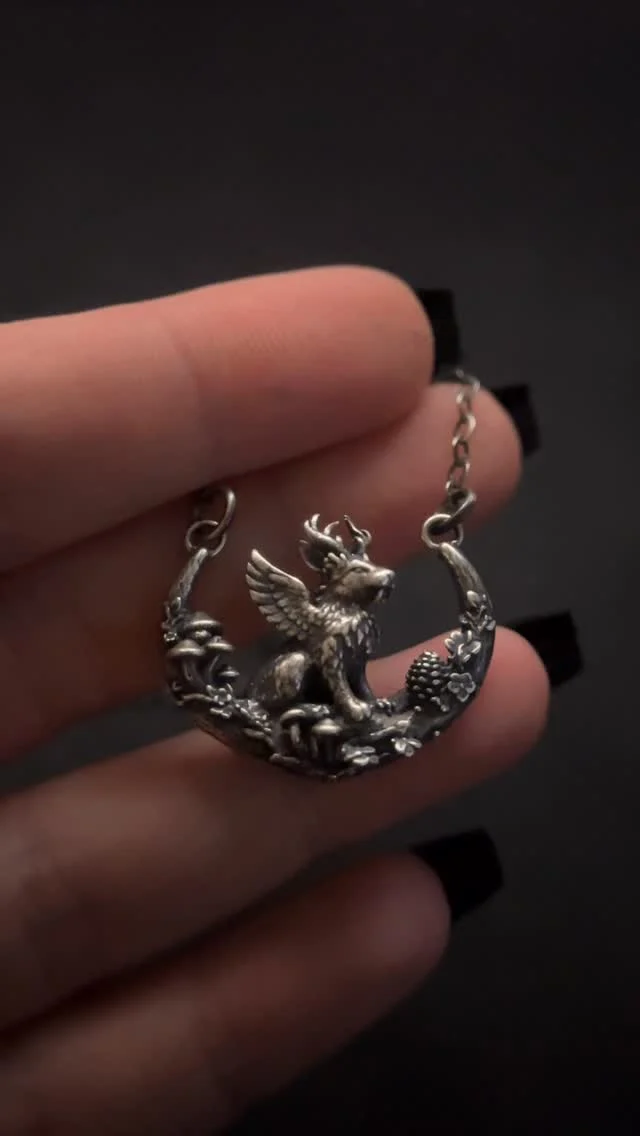
Bavarian Folklore says that you might just cross paths with a Wolpertinger in the alpine...

🐇🌲✨
He finally stepped out of the forest…
The Wolpertinger Pendant has arrived.
Inspired by...

I don’t often sell them, but love it when I do!
Vinca symbol bracelets ❤️...

Rooted in strength + guarded by ravens

The serpent waits 🖤
(Handcrafted Jörmungandr ring made to order in my shop)

Stay warm, everyone ❤️

😑😑😑🤮

I thought I had closed the book on the Alice in Wonderland rings…
But you...

Can this be over now, please?

In case you forgot 💜

Something I’ve been thinking about lately.
If there’s one thing I would’ve done differently early...

This year, we’re not buying things just to keep up.
If you need the reminder:...

My husband is from Bavaria (southern Germany) and I originally made this Krampus pendant for...

Some of the items I’m shipping out today ❤️
Please forgive my dirty nails 😂...

A few items shipping out today 🥰

This mornings rings shipping out ❤️

A few of the rjngs I’m shipping out this morning ❤️
How do you like...

Krampus is coming 🫶🏻

Getting ready to pack up these pretties and ship to their owners ❤️

Freya, cats and pentacles. Doesn’t get any better ❤️

You all got me going crazy making all these fairytale + storybook rings.
But I’ll...

Just launched these pretties ❤️
Size 9 amethyst ring + size 7.25 green kyanite

What would you trade to learn Baba Yaga’s secrets?

It *finally* looks, feels and smells like October!
And here are some items I’m packing...

This mornings pretties getting ready to ship :)

Getting ready to pack up these pretties and ship to their owners ❤️

You bet I’m hopping on this trend 😂
Thank you @shes_sinister for the prompt!

While I welcome the seasonal darkness…it sure is going to make my morning quick videos...

Finally finished the rings I’ve been working on in my stories ❤️
I think I...

Was going to post this update to my stories but it’s too long.

“How do you know I’m mad?” said Alice.
“You must be,” said the Cat, “or...

Some of this mornings orders getting ready to ship. Those little bats are so cute...

Here is the finished ring I was working on in my stories yesterday, along with...

A few of today’s orders shipping out this morning ❤️

The two silver raven rings I was working on in my stories yesterday.
…as well...

Eeeek! I’m so happy to add these to my shop ❤️
I’ve gotten so many...

I had 6 clamshells ready to ship this morning but I dropped and lost my...

Not the story you were told.
The girl didn’t run.
The wolf didn’t win.
This...

I love these raven rings so much 🖤
This mornings pretties shipping out.
All items...

Sleek + minimal Mjölnir ring ⚒️


About the author Jacqueline Fatica


