No products in the cart.
December 12, 2025 2:36 pm

Free USA shipping on orders $35+
December 12, 2025 2:36 pm
The Cinderella story has captivated imaginations for centuries.
This classic fairy tale is more than a bedtime story. Indeed, it’s a cultural touchstone that has shaped storytelling traditions across the globe.
In this post, we’ll explore the origins of Cinderella, trace how her story has evolved, and reveal why the fairy godmother, glass slipper, and magical transformations continue to enchant readers of all ages.
While many recognize Cinderella as a European fairy tale, her story dates back much further. The oldest known version comes from China.
The tale of Yeh-hsien appears in a 9th-century collection by Tuan Ch’eng-shih.
In this early version, the magical helper is a fish, not a fairy godmother, and the story involves a lost golden shoe (Dundes, 1982, p. 24).
In Europe, the most famous literary versions are Charles Perrault’s Cendrillon (1697) and the Grimm brothers’ Aschenputtel (1812).
Perrault’s version introduced the iconic fairy godmother and glass slipper, setting the tone for later adaptations (Zipes, 2000, p. 20).
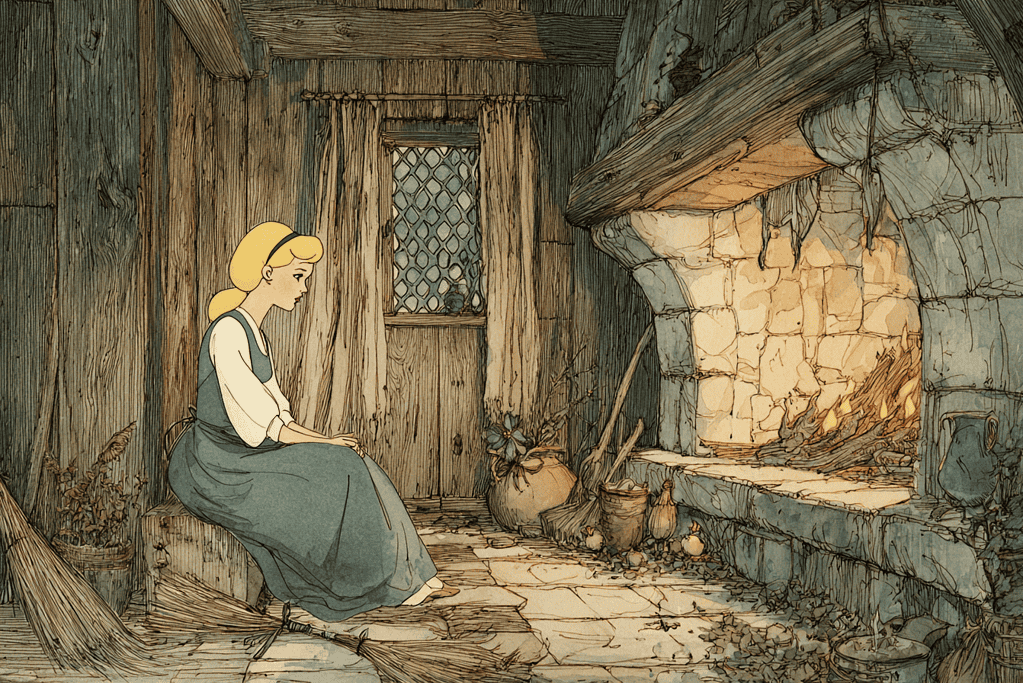
Cinderella is one of the most widely circulated fairy tales, with over 500 versions worldwide.
From the Italian La Gatta Cenerentola by Giambattista Basile (1634) to Native American retellings, the story has proven incredibly adaptable (Tatar, 2002, p. 37).
The motifs combine an oppressed heroine, magical assistance, and recognition through a lost object. These are nearly universal.
Each culture has added unique features while maintaining the heart of the Cinderella short story.
The fairy godmother is a relatively modern invention, appearing first in Perrault’s version.
She symbolizes hope, transformation, and divine intervention.
Her magical acts such as turning a pumpkin into a carriage, rags into a gown can help Cinderella go to the ball, making the impossible possible (Warner, 1994, p. 120).
The wand, the gown, and the carriage are icons of wish-fulfillment in fairy tales.
The fairy godmother also represents the importance of kindness and the belief that goodness will eventually be rewarded.
Cinderella’s stepmother and stepsisters have become symbols of cruelty and jealousy in fairy tales.
In both Perrault’s and Grimm’s tales, they exploit Cinderella, force her to work as a servant, and try to prevent her from attending the ball (Grimm & Grimm, 1812/2003, p. 215).
The wicked stepmother is not unique to Cinderella.
She appears in many bedtime stories and symbolizes obstacles to a young woman’s independence.
The contrast between Cinderella’s kindness and her stepfamily’s cruelty adds emotional depth to the story.

Perrault’s version introduced the glass slipper, which became the symbol of Cinderella’s identity and purity.
It’s through this slipper that the prince identifies her as the mysterious girl from the royal ball (Perrault, 1697/2010, p. 65).
Interestingly, there is a myth that “glass” was a mistranslation of “vair” (fur), but scholars agree the slipper was intended to be glass.
Its fragility and uniqueness highlight Cinderella’s delicate and irreplaceable character (Zipes, 2000, p. 28).
The royal ball is the climax of the Cinderella story. It’s the first time Cinderella is seen as an equal among the upper class.
With the help of the fairy godmother’s magic, she arrives in a beautiful gown and captivates everyone, including the prince, with her grace.
She must leave when the clock strikes midnight, as the magic will end.
In her rush, she leaves behind one glass slipper, which becomes the key to her future (Warner, 1994, p. 124).
The stepsisters represent vanity and arrogance.
In the Grimm version, they go to extreme lengths to win the prince (Grimm & Grimm, 1812/2003, p. 218).
Despite their cruelty, many modern versions soften their portrayal.
Some retellings show the stepsisters seeking redemption, aligning with more contemporary values in bedtime stories for kids.
The Cinderella short story teaches several values: kindness, patience, and resilience. Cinderella is kind despite her suffering.
She never seeks revenge but remains hopeful.
The story encourages young readers to believe that adversity can be overcome, and that goodness and inner beauty matter more than outward appearances.
These themes are why the tale endures in bedtime stories and fairy tales across generations.
From the violent realism of Aschenputtel to Disney’s sanitized animations, Cinderella has evolved with each cultural moment.
In earlier tales, birds peck out the stepsisters’ eyes; in newer versions, everyone lives happily ever after.
These shifts reflect changing attitudes toward justice, femininity, and social class.
Yet, the essence of the story remains: a girl named Cinderella, who overcomes hardship with the help of a magical fairy godmother.

Cinderella resonates because it speaks to universal human experiences: unfairness, hope, transformation.
Whether it’s a poor girl tending cinders or a princess Cinderella stepping into her destiny, the story connects with readers emotionally.
Children love its magic. Adults appreciate its symbolism. It’s more than just one of many stories for kids. More importantly, it’s a story that shapes how we view justice, love, and dreams.

Beyond Perrault and Grimm, there are versions like Tam Cam from Vietnam, Chinye from Africa, and the Native American tale of the Rough-Faced Girl.
These adaptations prove how widespread the story of Cinderella is (Tatar, 2002, p. 43).
Each version adds something new such as a different magical helper, a unique setting, but the structure remains: suffering, magic, recognition, and reward.
References
Dundes, A. (1982). Cinderella: A Casebook. University of Wisconsin Press.
Grimm, J., & Grimm, W. (2003). The Complete Fairy Tales of the Brothers Grimm (J. Zipes, Trans.). Bantam Classics. (Original work published 1812)
Perrault, C. (2010). The Fairy Tales of Charles Perrault (A. Carter, Trans.). Penguin Classics. (Original work published 1697) Tatar, M. (2002).
The Annotated Classic Fairy Tales. W. W. Norton & Company. Warner, M. (1994).
From the Beast to the Blonde: On Fairy Tales and Their Tellers. Farrar, Straus and Giroux. Zipes, J. (2000). The Oxford Companion to Fairy Tales. Oxford University Press.

ᛉ 100% handcrafted artisan pagan , viking, witchcraft and shamanic inspired jewelry.
ᛉ Runes, Symbolism & European Folklore
Get 20% off👇🏻

Five witches dance around a blazing bonfire beneath a citrine cabochon in this Walpurgisnacht pendant....
Happy washing day 🙃
A few rings I’ve worked on the last couple days…
Freya’s cats rule and dogs drool?
Or was that the other way around? 🙃

Garm barely shows up in the old Norse stories.
Still… he leaves a mark.
A...
Leave a comment with your result ❤️
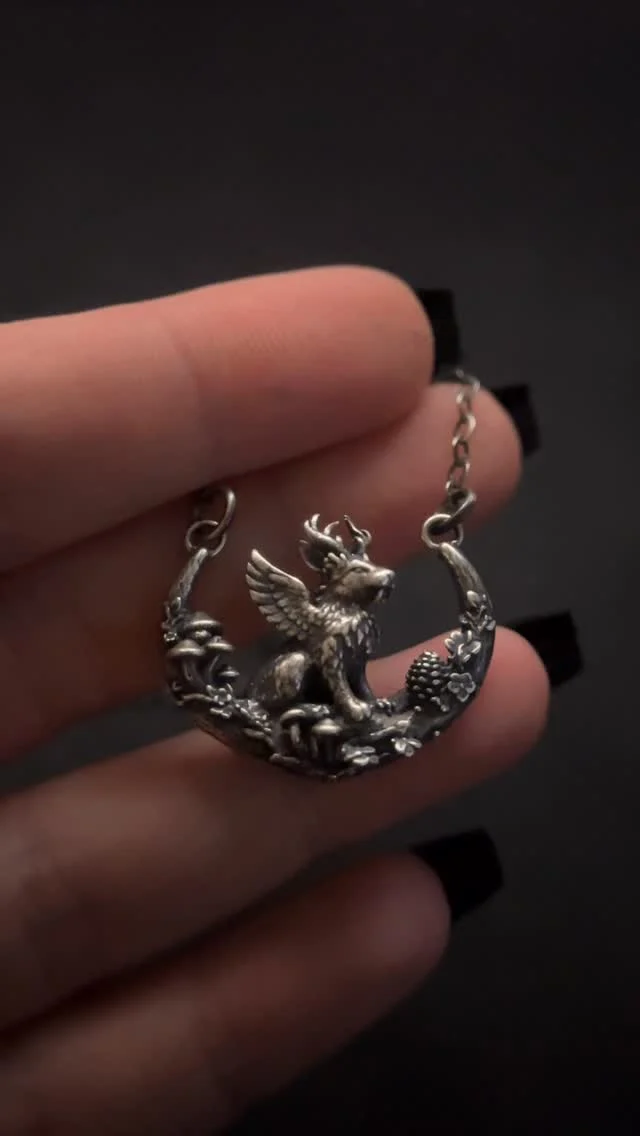
Bavarian Folklore says that you might just cross paths with a Wolpertinger in the alpine...

🐇🌲✨
He finally stepped out of the forest…
The Wolpertinger Pendant has arrived.
Inspired by...

I don’t often sell them, but love it when I do!
Vinca symbol bracelets ❤️...

Rooted in strength + guarded by ravens

The serpent waits 🖤
(Handcrafted Jörmungandr ring made to order in my shop)

Stay warm, everyone ❤️

😑😑😑🤮

I thought I had closed the book on the Alice in Wonderland rings…
But you...

Can this be over now, please?

In case you forgot 💜

Something I’ve been thinking about lately.
If there’s one thing I would’ve done differently early...

This year, we’re not buying things just to keep up.
If you need the reminder:...

My husband is from Bavaria (southern Germany) and I originally made this Krampus pendant for...

Some of the items I’m shipping out today ❤️
Please forgive my dirty nails 😂...

A few items shipping out today 🥰

This mornings rings shipping out ❤️

A few of the rjngs I’m shipping out this morning ❤️
How do you like...

Krampus is coming 🫶🏻

Getting ready to pack up these pretties and ship to their owners ❤️

Freya, cats and pentacles. Doesn’t get any better ❤️

You all got me going crazy making all these fairytale + storybook rings.
But I’ll...

Just launched these pretties ❤️
Size 9 amethyst ring + size 7.25 green kyanite

What would you trade to learn Baba Yaga’s secrets?

It *finally* looks, feels and smells like October!
And here are some items I’m packing...

This mornings pretties getting ready to ship :)

Getting ready to pack up these pretties and ship to their owners ❤️

You bet I’m hopping on this trend 😂
Thank you @shes_sinister for the prompt!

While I welcome the seasonal darkness…it sure is going to make my morning quick videos...

Finally finished the rings I’ve been working on in my stories ❤️
I think I...

Was going to post this update to my stories but it’s too long.

“How do you know I’m mad?” said Alice.
“You must be,” said the Cat, “or...

Some of this mornings orders getting ready to ship. Those little bats are so cute...

Here is the finished ring I was working on in my stories yesterday, along with...

A few of today’s orders shipping out this morning ❤️

The two silver raven rings I was working on in my stories yesterday.
…as well...

Eeeek! I’m so happy to add these to my shop ❤️
I’ve gotten so many...

I had 6 clamshells ready to ship this morning but I dropped and lost my...

Not the story you were told.
The girl didn’t run.
The wolf didn’t win.
This...

I love these raven rings so much 🖤
This mornings pretties shipping out.
All items...

Sleek + minimal Mjölnir ring ⚒️


About the author Jacqueline Fatica


