No products in the cart.
April 9, 2026 8:48 pm

Free USA shipping on orders $35+
April 9, 2026 8:48 pm
The word dragon evokes a powerful image: a giant winged creature with scaly skin and fiery breath. Yet the dragons found in early celtic mythology rarely look like that.
The evidence preserved in Welsh, Irish, and Scottish sources points instead to creatures closer to serpents, monstrous reptiles, or water beasts.
In other words, the dragon myth in the Celtic world belongs less to fantasy literature and more to the older landscape of local legend, political symbolism, and storytelling.
This article explores what a celtic dragon really meant in early tradition.
By looking closely at medieval texts and early folklore collections, we can see how these creatures appear in written records and how they differ from the dragons familiar from Greek mythology, Norse sagas, or later European romance literature.
Readers interested in dragons from Irish myth, Welsh legend, and Highland folklore will discover that the Celtic world preserved a fascinating variety of serpent-like beings.
Some dwell in lakes and rivers, some appear in prophetic visions, and some burn royal halls with supernatural fire. Together they form one of the most intriguing monster traditions in European myth.
When modern readers think about a dragon, they usually imagine a giant winged reptile that guards treasure and breathes fire.
Medieval Celtic texts present something different. In many cases the creature described is closer to a serpent, a monstrous snake, or a dangerous water beast.
The vocabulary of early sources makes this clear. Irish texts often use the term péist, which simply means worm, serpent, or monstrous creature.
A related expression, ollphéist, refers to a great monster or great worm. Welsh sources use the word draig, which can indicate a dragon-like creature but also functions symbolically in political prophecy.
These linguistic details show that the Celtic tradition never developed a single rigid category for dragons. Instead, the creatures appear as dangerous beings tied to particular landscapes and stories (MacKillop, 1998, p. 175).
Because of this flexibility, Celtic dragons are usually not the same as the giant winged dragons familiar from later medieval romance.
They are more often described as scaly serpent creatures or water monsters. This difference helps explain why modern readers sometimes struggle to identify a clear celtic dragon type.
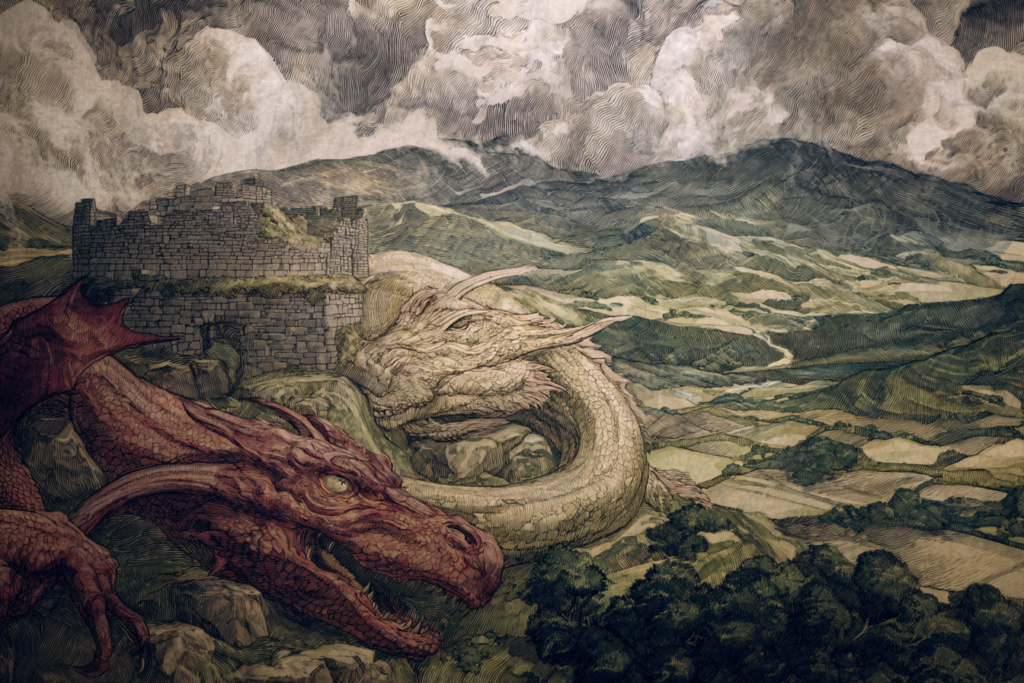
One of the most famous dragon stories connected with the Celtic world appears in the early medieval text known as the Historia Brittonum.
In this narrative the ruler Vortigern attempts to build a fortress at Dinas Emrys in Wales.
The construction repeatedly collapses, and the reason is eventually revealed to be a hidden struggle beneath the ground.
The text describes two snakes or serpents buried beneath the hill. One is red and one is white.
When the creatures are released they battle violently, and the red serpent ultimately drives the white one away.
The episode is interpreted as a prophetic vision in which the red creature represents the Britons and the white creature represents the Saxons (Historia Brittonum, ch. 40; Gunn, 1819).
Later tradition identified these creatures as the Red Dragon and White Dragon of Wales.
The episode involving Vortigern is not simply a dragon fight. It is also a story about kingship and prophecy.
The king cannot complete his fortress because the ground itself hides a conflict that has not yet been resolved.
The discovery of the buried serpents transforms the story into a political allegory.
The red creature symbolizes the survival of the Britons, while the white creature represents invading powers.
In this sense the dragon becomes a prophetic symbol rather than simply a monster that must be defeated.
Stories like this show how dragons are usually embedded in historical imagination. Instead of guarding treasure or kidnapping maidens, the dragon here reveals hidden truths about the land and the people who claim it.
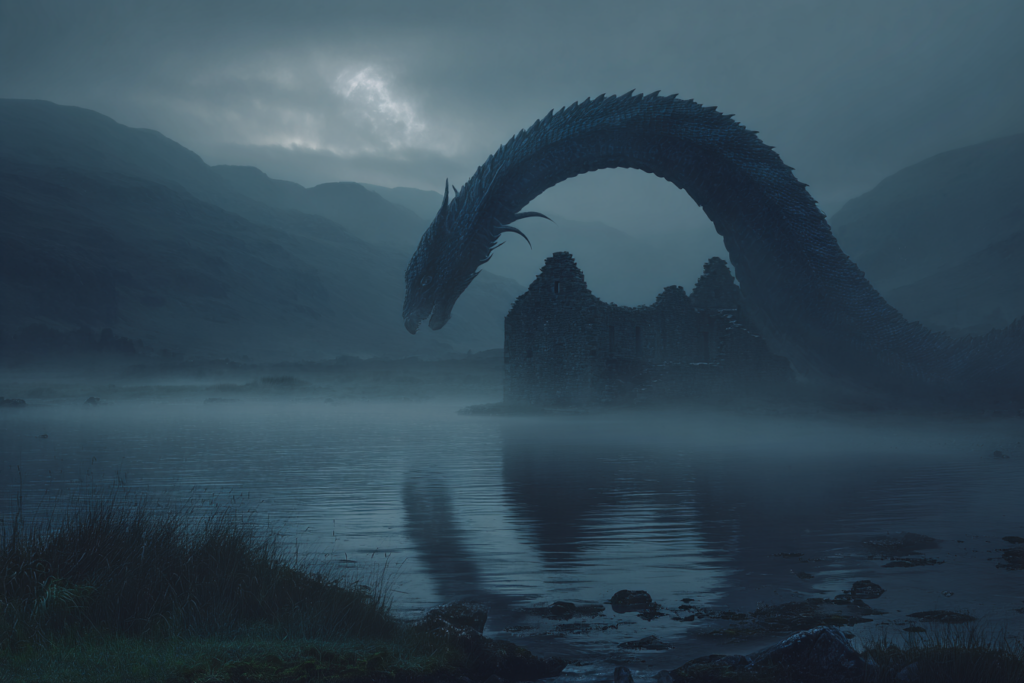
Another important source for Welsh dragon lore appears in the medieval tale Lludd and Llefelys, preserved in the Mabinogion manuscript tradition.
In this narrative Britain suffers from a series of supernatural plagues. One of these plagues comes from two dragons fighting across the island.
Their terrible screams devastate the land. The ruler Lludd ultimately learns how to defeat them by trapping them with enchanted mead and burying them beneath the earth.
The dragons are then placed in the region later known as Dinas Emrys.
This version of the story transforms the earlier prophetic episode into a fuller narrative. The dragons are no longer simply symbols of national struggle.
They become active destructive beings whose conflict threatens the entire land.
The Welsh afanc is sometimes described as a dragon, but the evidence suggests that it belongs more clearly to the category of water monsters.
In Welsh folklore, the afanc appears as a creature living in lakes or rivers that drags victims into the water.
John Rhys recorded several traditions about the afanc in his study Celtic Folklore: Welsh and Manx. In some accounts the creature resembles a giant beaver.
In others it appears as a crocodile-like beast or a mysterious lake monster (Rhys, 1901, pp. 128–131).
These descriptions show that the afanc does not fit neatly into the category of dragon.
It is better understood as a dangerous aquatic legendary creature that inhabits lakes and rivers. Only later writers sometimes describe it as a dragon.
When readers search for dragons from Irish myth, they often expect a single famous creature. Instead the sources reveal a broader category of monstrous beings.
The Irish term ollphéist describes a great monster or serpent-like beast.
It does not refer to one specific dragon but rather to any large dangerous creature that appears in irish myth and legend.
These beings may inhabit lakes, rivers, or the sea. In some traditions they resemble a massive sea serpent or monstrous reptile (MacKillop, 1998, p. 175).
Because the term functions as a category word, scholars sometimes refer to these creatures collectively as irish dragons, even though the original sources do not always treat them as dragons in the strict sense.
One figure sometimes discussed alongside the ollphéist is Caoránach.
Later Irish legend portrays Caoránach as a monstrous creature associated with the campaigns of St Patrick.
In some versions the creature appears as a female dragon or serpent that must be defeated or expelled from Ireland.
However, the sources do not consistently treat Caoránach as identical to the broader category of the ollphéist.
The safer conclusion is that Caoránach represents one example within the wider Irish tradition of monstrous serpents rather than a strict synonym for the term.
This distinction reflects the fluid nature of monster terminology in Irish literature. The language allows a wide range of dangerous creatures to be described with similar words.
Another dramatic creature from Irish tradition is Aillén, sometimes called Aillén the Burner.
In the narrative known as Macgnímartha Finn, Aillén appears every year at the festival of Samhain.
The creature plays magical music that causes everyone at Tara to fall asleep. Once the defenders are unconscious, Aillén burns the royal hall with supernatural fire.
The hero Fionn eventually defeats the monster by resisting the magical sleep and confronting the creature directly.
Although Aillén is not described as a serpent or dragon, the destructive role of the creature places it near the broader category of dragon-like adversaries in Irish storytelling (Meyer, 1901, pp. 184–186).
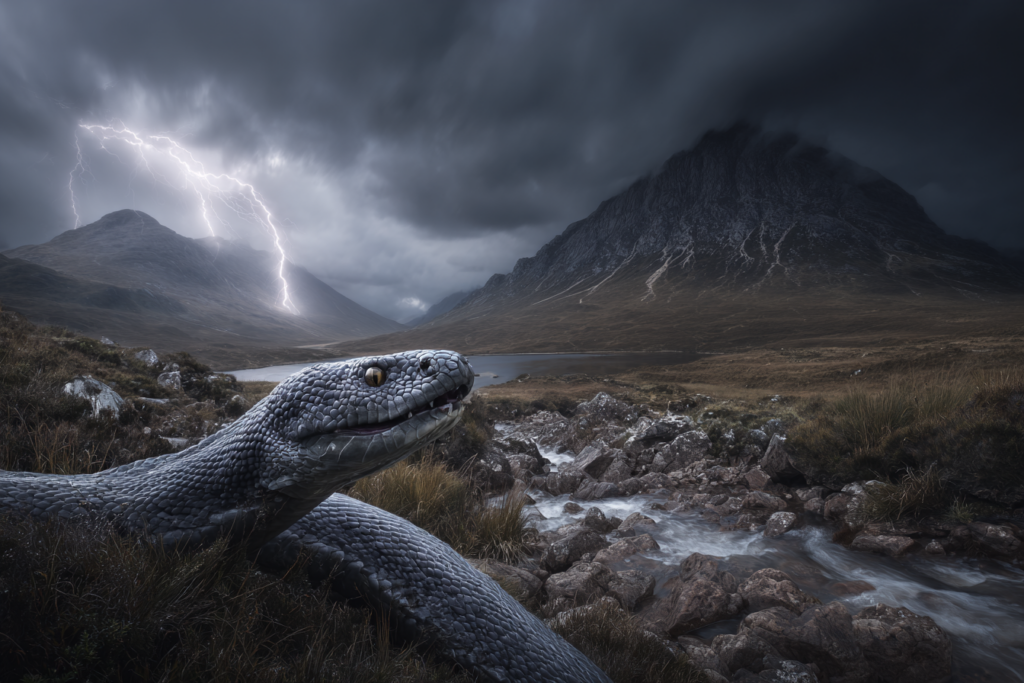
In Highland tradition the beithir appears as a deadly serpent creature.
The being is recorded in the folklore collection of J. Gregorson Campbell, who described it as a large and dangerous serpent whose bite could be fatal (Campbell, 1900, pp. 224–225).
The beithir inhabits remote hillsides and water sources, and stories describe it as extremely dangerous.
Unlike the dragons of later fantasy literature, this creature has no wings and no fiery breath. It is closer to a monstrous snake or giant serpent.
Such stories illustrate how Celtic serpent traditions often developed around specific landscapes.
A spring, hill, or cave might become associated with a particular monster, giving rise to local traditions that endured for generations.
Comparing Celtic monsters with creatures from other traditions helps clarify their unique characteristics.
In Greek mythology, the many-headed hydra represents one famous example of a monstrous serpent. Greek literature also uses the word drakōn to describe powerful guardian serpents.
Later northern European traditions produced their own dragon stories, including the English legend of the Lambton Worm.
Although this creature is not Celtic, it demonstrates how worm-like monsters could survive in regional storytelling.
When viewed alongside Norse dragon legends or classical dragon stories, Celtic creatures appear more localized.
They are rarely treasure guardians or cosmic monsters. Instead they are dangerous beings tied to particular lakes, hills, or royal sites.
Adomnán of Iona. (1995). Life of St Columba (R. Sharpe, Trans.). Penguin.
Campbell, J. G. (1900). Superstitions of the Highlands and Islands of Scotland. Glasgow: James MacLehose & Sons.
Guest, C. (Trans.). (1877). The Mabinogion. London: Bernard Quaritch.
MacKillop, J. (1998). Dictionary of Celtic mythology. Oxford: Oxford University Press.
Meyer, K. (1901). Macgnímartha Finn: The boyish exploits of Finn. Ériu, 1, 180–204.
Nennius. (1819). Historia Brittonum (W. Gunn, Trans.). London: J. & A. Arch.
Rhys, J. (1901). Celtic folklore: Welsh and Manx (Vol. 1). Oxford: Clarendon Press.

ᛉ 100% handcrafted artisan pagan , viking, witchcraft and shamanic inspired jewelry.
ᛉ Runes, Symbolism & European Folklore
Get 20% off👇🏻

Five witches dance around a blazing bonfire beneath a citrine cabochon in this Walpurgisnacht pendant....
Happy washing day 🙃
A few rings I’ve worked on the last couple days…
Freya’s cats rule and dogs drool?
Or was that the other way around? 🙃

Garm barely shows up in the old Norse stories.
Still… he leaves a mark.
A...
Leave a comment with your result ❤️
Bavarian Folklore says that you might just cross paths with a Wolpertinger in the alpine...

🐇🌲✨
He finally stepped out of the forest…
The Wolpertinger Pendant has arrived.
Inspired by...

I don’t often sell them, but love it when I do!
Vinca symbol bracelets ❤️...

Rooted in strength + guarded by ravens

The serpent waits 🖤
(Handcrafted Jörmungandr ring made to order in my shop)

Stay warm, everyone ❤️

😑😑😑🤮

I thought I had closed the book on the Alice in Wonderland rings…
But you...

Can this be over now, please?

In case you forgot 💜

Something I’ve been thinking about lately.
If there’s one thing I would’ve done differently early...

This year, we’re not buying things just to keep up.
If you need the reminder:...

My husband is from Bavaria (southern Germany) and I originally made this Krampus pendant for...

Some of the items I’m shipping out today ❤️
Please forgive my dirty nails 😂...

A few items shipping out today 🥰

This mornings rings shipping out ❤️

A few of the rjngs I’m shipping out this morning ❤️
How do you like...

Krampus is coming 🫶🏻

Getting ready to pack up these pretties and ship to their owners ❤️

Freya, cats and pentacles. Doesn’t get any better ❤️

You all got me going crazy making all these fairytale + storybook rings.
But I’ll...

Just launched these pretties ❤️
Size 9 amethyst ring + size 7.25 green kyanite

What would you trade to learn Baba Yaga’s secrets?

It *finally* looks, feels and smells like October!
And here are some items I’m packing...

This mornings pretties getting ready to ship :)

Getting ready to pack up these pretties and ship to their owners ❤️

You bet I’m hopping on this trend 😂
Thank you @shes_sinister for the prompt!

While I welcome the seasonal darkness…it sure is going to make my morning quick videos...

Finally finished the rings I’ve been working on in my stories ❤️
I think I...

Was going to post this update to my stories but it’s too long.

“How do you know I’m mad?” said Alice.
“You must be,” said the Cat, “or...

Some of this mornings orders getting ready to ship. Those little bats are so cute...

Here is the finished ring I was working on in my stories yesterday, along with...

A few of today’s orders shipping out this morning ❤️

The two silver raven rings I was working on in my stories yesterday.
…as well...

Eeeek! I’m so happy to add these to my shop ❤️
I’ve gotten so many...

I had 6 clamshells ready to ship this morning but I dropped and lost my...

Not the story you were told.
The girl didn’t run.
The wolf didn’t win.
This...

I love these raven rings so much 🖤
This mornings pretties shipping out.
All items...

Sleek + minimal Mjölnir ring ⚒️


About the author Jacqueline Fatica


