No products in the cart.
February 23, 2026 6:30 pm

Free USA shipping on orders $35+
February 23, 2026 6:30 pm
Celtic female names preserve an old continuous naming tradition in Europe.
These names appearin medieval Irish mythology, and in historical records that reach back more than 1,500 years.
Many Celtic female names indeed carry meaning rooted in language, mythology, social identity, and ancestry.
Understanding these names and their meanings reveals how ancient Celtic societies understood beauty, sovereignty, ancestry, and the natural world.
Let us have a closer look at Celtic naming origins, meaning, pronunciation, and cultural importance of Celtic female names using academically verified primary sources and scholarly research.
The origin and meaning of Celtic female names can be traced directly to early inscriptions, mythology, and early medieval manuscripts.
These names preserve linguistic structures belonging to the Celtic language family, especially the Gaelic branch spoken in Ireland and Scotland.
The meaning of each Celtic female name reflects social identity, ancestry, or spiritual symbolism and much more.
The earliest Celtic naming tradition appears in both Continental Celtic inscriptions and Insular Celtic sources.
These include for instance Gaulish inscriptions from Roman Gaul in Continental Europe and Ogham inscriptions in Ireland and western Britain.
Research shows that Celtic female names such as Brigantia and Cartimandua appear in Roman inscriptions and classical historical texts, demonstrating that Celtic naming traditions were firmly established long before the medieval period (Lambert, 1997, p. 34).
Many Irish girl names derive from ancient Celtic linguistic roots. These roots often describe brightness, nobility, fertility, and natural forces.
For example, the name Brigit comes from the Proto-Celtic root brigantī, meaning exalted or high-ranking (Delamarre, 2003, p. 88). This meaning reflects both social hierarchy and spiritual authority.

The Ogham inscriptions provide the oldest direct evidence of Celtic names in Ireland.
These inscriptions date from approximately the 4th to 6th centuries AD and were carved into standing stones to commemorate individuals and their ancestry (McManus, 1991, p. 9; Stifter, 2020, p. 856).
Each inscription typically records a personal name and genealogy or lineage.
These inscriptions demonstrate that Celtic naming traditions were strongly tied to family lineage and ancestry.
A typical inscription identifies a person as the daughter or son of a specific ancestor. Female names appear using the word inigena, meaning daughter in Primitive Irish (McManus, 1991, p. 38).
Its linguistic root stems from Proto-Celtic *enigenā, which is interpreted as meaning “born within”.
One example records the female name Avittoria in Wales.
This inscription proves that Celtic female names were formally recorded and used in historical contexts.
It also confirms that Celtic naming traditions applied equally to women, even though fewer female inscriptions survive (Sims-Williams, 2003, p. 25).
These inscriptions preserve some of the oldest Irish girl names and demonstrate that Celtic female names remained stable over centuries.
The meaning of these names often reflected ancestry or family identity rather than individual traits.
Genealogy was central to Celtic identity and Celtic societies preserved lineage through oral tradition, poetry, and inscriptions.
In other words, name giving wasn’t random or based on fashion or trends. Rather, names were essential markers of ancestry, linking individuals to their families and tribes.
Celtic inscriptions often record multiple generations of ancestry. This demonstrates that Celtic names served as historical records as a means to preserve social and cultural memory.
The meaning of a name could reflect tribal affiliation, social rank, or ancestry (McManus, 1991, p. 12).
Genealogical naming traditions continued into medieval Ireland. Early Irish manuscripts preserve extensive genealogies and naming patterns.
These records show that Celtic naming traditions survived the transition from pagan to Christian society without disruption (Ó Corráin & Maguire, 1981, p. 16).
Many Irish girl names preserved ancient Celtic linguistic structures, demonstrating continuity between prehistoric Celtic society and medieval Irish culture.
Irish mythology preserves some of the most important Celtic female names. These names appear in early Irish texts such as the Táin Bó Cúailnge and Tochmarc Étaíne.
Such highly important texts preserve names belonging to queens, goddesses, and legendary women.
One example is the name Medb, meaning intoxicating. Medb was the legendary queen of Connacht and appears in early Irish mythology.
Her name comes from the Proto-Celtic root medu, meaning mead or intoxication, symbolizing sovereignty and ritual authority (Ó Corráin & Maguire, 1981, p. 135; Delamarre, 2003, p. 224).
Another important Celtic female name is Brigit. In Irish mythology, Brigit was a goddess associated with poetry, prophecy, and fertility.
Her name comes from the Celtic root brigantī, meaning exalted or high (Delamarre, 2003, p. 88).
These mythological names demonstrate that Celtic female names often reflected spiritual and social authority. The meaning of these names conveyed symbolic power and social status.
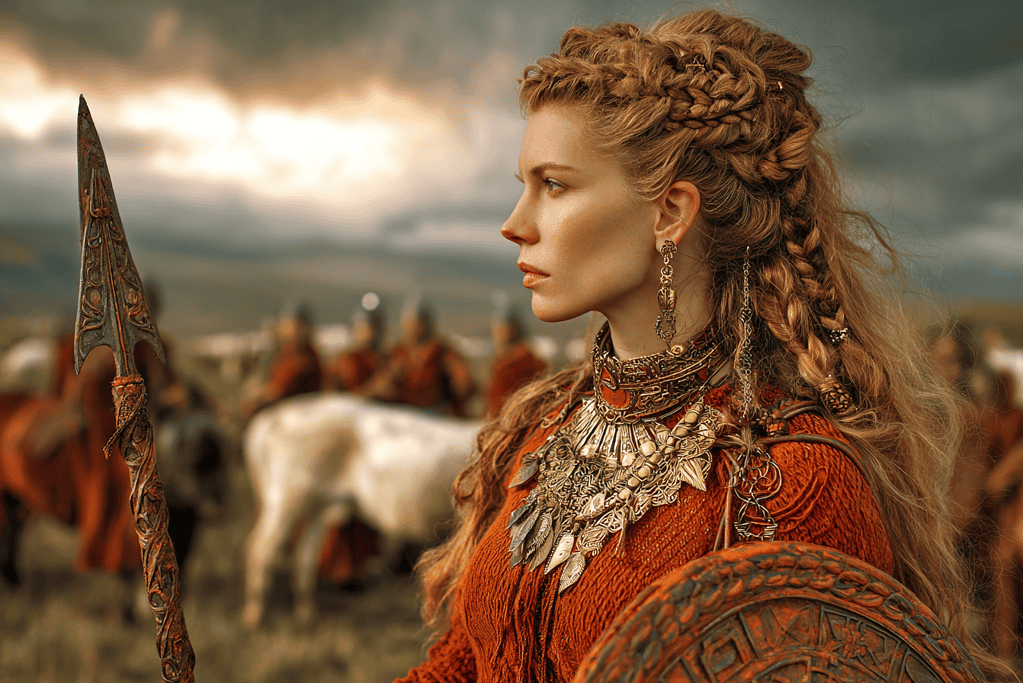
Celtic female names preserve linguistic structures belonging to Proto-Celtic and Old Irish.
These structures reveal how Celtic societies constructed personal names.
Many Celtic names derive from words describing brightness, strength, and sovereignty.
For example, names derived from the Celtic root brigantī reflect nobility and elevated status (Lambert, 1997, p. 42).
Other names derive from natural features such as rivers, animals, and landscapes.
These meanings reflect the close relationship between Celtic society and the natural world and the local environment that the culture resided in.
The Irish language preserves these naming structures in both ancient and modern forms. This continuity demonstrates the stability of Celtic naming traditions over more than 1,500 years.
Old Irish preserves the earliest recorded forms of Celtic names in Ireland. These names appear in manuscripts dating from the 7th century onward.
Many modern Irish girl names preserve their original Celtic structure.
And both linguistic and ethnographic research shows very clearly that the meaning and pronunciation of these names remain remarkably consistent over time (Ó Corráin & Maguire, 1981, p. 14).
This continuity demonstrates that Celtic naming traditions survived social and religious changes. Even after Christianization, many Celtic names remained in use.
Modern Irish names preserve linguistic structures dating back to Primitive Irish and Proto-Celtic.
The following Celtic female names appear in primary sources and academic scholarship:
Brigit — meaning exalted (Delamarre, 2003, p. 88)
Medb — meaning intoxicating (Ó Corráin & Maguire, 1981, p. 135)
Étaín — preserved in early Irish mythological texts (Ó Corráin & Maguire, 1981, p. 81)
Aoife — attested in Irish mythological literature (Ó Corráin & Maguire, 1981, p. 28)
Gráinne — recorded in medieval Irish manuscripts (Ó Corráin & Maguire, 1981, p. 102)
Avittoria — recorded in Ogham inscription (Sims-Williams, 2003, p. 25)
Cartimandua — historical Celtic queen recorded by Tacitus (Tacitus, Annals XII.36)
Each of these names preserves Celtic linguistic structures and cultural meaning.
Celtic naming traditions often emphasized qualities associated with leadership and spiritual authority.
Names derived from linguistic roots meaning brightness or nobility reflected social status.
The meaning of these names often symbolized sovereignty and legitimacy. This reflects the political structure of Celtic societies.
These names preserved cultural values associated with leadership and identity.

Irish spelling preserves ancient pronunciation patterns.
Many Celtic names appear unfamiliar to modern English speakers, but their pronunciation reflects ancient linguistic rules.
The Irish language preserves phonetic structures dating back to Proto-Celtic. This explains why many Celtic names appear different from English names.
These pronunciation patterns preserve linguistic continuity across centuries.
Celtic names remain popular in Ireland because they preserve cultural identity. Many Irish families continue to use traditional Celtic names.
These names connect modern individuals to their ancient heritage.
The meaning of these names preserves linguistic and cultural continuity as well as memory.
Aine — “Brightness,” “Radiance”
Irish goddess of summer, fertility, and sovereignty.
Aoife — “Beauty,” “Radiance,” “Pleasant”
Warrior woman and mother of Cú Chulainn’s son in the Ulster Cycle.
Arianrhod — “Silver wheel”
Welsh goddess associated with stars, fate, and cosmic order.
Badb — “Crow”
War goddess associated with battle and death; part of the Morrígan.
Banba — Possibly “Pig goddess” or “Sow”
One of the three goddesses who personified Ireland.
Bláthnat (Blathnat) — “Little flower”
Figure in the Ulster Cycle whose betrayal leads to tragedy.
Blodeuwedd — “Flower face”
Woman magically created from flowers in Welsh mythology.
Boann — “White cow” or “Bright cow”
Goddess of the River Boyne and mother of Aengus.
Brigid (Brighid) — “Exalted one,” “High one”
Major Irish goddess of poetry, healing, and smithcraft.
Branwen — “Blessed raven”
Welsh princess and tragic heroine in the Mabinogion.
Cerridwen — “Blessed poetry,” possibly “Bent white one”
Welsh goddess of wisdom, magic, and transformation.
Cliodhna (Clíodhna) — Possibly “Shapely” or “Beautiful one”
Goddess of the Otherworld in Irish mythology.
Creiddylad — “Jewel of the sea” or “Precious one”
Welsh maiden associated with seasonal cycles.
Danu — Possibly “Flowing one” or “River mother”
Mother goddess of the Tuatha Dé Danann.
Deirdre — Possibly “Woman,” or associated with sorrow
Heroine of a tragic love story in the Ulster Cycle.
Don — Possibly “Earth” or “Mother goddess”
Welsh mother goddess, equivalent to Irish Danu.
Ériu — Meaning uncertain; associated with fertility and land
Goddess who personifies Ireland; source of the name Éire.
Etain (Étaín) — Possibly “Shining one”
Beautiful woman transformed and reborn multiple times.
Enid — Possibly “Soul,” “Spirit,” or “Life”
Welsh noblewoman in Arthurian and Welsh myth.
Eithne — Meaning uncertain; possibly “Kernel,” “Grain”
Mother of the god Lugh in Irish mythology.
Fand — Possibly “Tear,” or “Pearl”
Sea goddess and fairy queen in Irish mythology.
Fedelm — Possibly “Beauty” or “Ever good”
Prophetess in the Ulster Cycle.
Flidais — Possibly “Doe,” or associated with deer
Goddess of wild animals and forests.
Gráinne — “Grain,” “Seed,” or “Sun”
Princess in the Fenian Cycle associated with fertility.
Macha — Possibly “Plain,” or “Field”
Sovereignty goddess associated with land and kingship.
Medb (Maeve) — Possibly “Intoxicating one”
Powerful queen of Connacht and sovereignty figure.
Mórrígan (Morrigan) — “Great queen” or “Phantom queen”
War and fate goddess associated with ravens.
Muirgen — “Born of the sea”
Woman transformed into a mermaid figure.
Nemain — Possibly “Frenzy,” “Panic”
War goddess associated with battlefield chaos.
Niamh — “Bright,” “Radiant”
Princess of the Otherworld and daughter of Manannán mac Lir.
Olwen — “White footprint”
Welsh maiden whose footsteps produced flowers.
Penarddun — “Chief maiden” or “High noblewoman”
Mother of Branwen and Bran.
Rhiannon — “Great queen,” from Proto-Celtic Rigantona
Welsh sovereignty goddess associated with horses.
Sadb (Sadhbh) — Possibly “Sweet,” “Good,” or “Noble”
Woman transformed into a deer; mother of Oisín.
Scáthach — “Shadowy one”
Legendary warrior woman who trained heroes.
Tailtiu — Meaning uncertain; associated with earth and land
Earth goddess and foster mother of Lugh.
These are historically authentic and still widely used today:
Delamarre, X. (2003). Dictionnaire de la langue gauloise. Paris: Errance.
Lambert, P.-Y. (1997). La langue gauloise. Paris: Errance.
McManus, D. (1991). A Guide to Ogham. Maynooth: An Sagart.
Ó Corráin, D., & Maguire, F. (1981). Irish Names. Dublin Institute for Advanced Studies.
Sims-Williams, P. (2003). The Celtic Inscriptions of Britain. Oxford: Blackwell.
Stifter, D. (2020). Insular Celtic: Ogham. Palaeohispanica, 20, 855–885.
Tacitus. Annals. Book XII.

ᛉ 100% handcrafted artisan pagan , viking, witchcraft and shamanic inspired jewelry.
ᛉ Runes, Symbolism & European Folklore
Get 20% off👇🏻
Leave a comment with your result ❤️
Bavarian Folklore says that you might just cross paths with a Wolpertinger in the alpine...

🐇🌲✨
He finally stepped out of the forest…
The Wolpertinger Pendant has arrived.
Inspired by...

I don’t often sell them, but love it when I do!
Vinca symbol bracelets ❤️...

Rooted in strength + guarded by ravens

The serpent waits 🖤
(Handcrafted Jörmungandr ring made to order in my shop)

Stay warm, everyone ❤️

😑😑😑🤮

I thought I had closed the book on the Alice in Wonderland rings…
But you...

Can this be over now, please?

In case you forgot 💜

Something I’ve been thinking about lately.
If there’s one thing I would’ve done differently early...

This year, we’re not buying things just to keep up.
If you need the reminder:...

My husband is from Bavaria (southern Germany) and I originally made this Krampus pendant for...

Some of the items I’m shipping out today ❤️
Please forgive my dirty nails 😂...

A few items shipping out today 🥰

This mornings rings shipping out ❤️

A few of the rjngs I’m shipping out this morning ❤️
How do you like...

Krampus is coming 🫶🏻

Getting ready to pack up these pretties and ship to their owners ❤️

Freya, cats and pentacles. Doesn’t get any better ❤️

You all got me going crazy making all these fairytale + storybook rings.
But I’ll...

Just launched these pretties ❤️
Size 9 amethyst ring + size 7.25 green kyanite

What would you trade to learn Baba Yaga’s secrets?

It *finally* looks, feels and smells like October!
And here are some items I’m packing...

This mornings pretties getting ready to ship :)

Getting ready to pack up these pretties and ship to their owners ❤️

You bet I’m hopping on this trend 😂
Thank you @shes_sinister for the prompt!

While I welcome the seasonal darkness…it sure is going to make my morning quick videos...

Finally finished the rings I’ve been working on in my stories ❤️
I think I...

Was going to post this update to my stories but it’s too long.

“How do you know I’m mad?” said Alice.
“You must be,” said the Cat, “or...

Some of this mornings orders getting ready to ship. Those little bats are so cute...

Here is the finished ring I was working on in my stories yesterday, along with...

A few of today’s orders shipping out this morning ❤️

The two silver raven rings I was working on in my stories yesterday.
…as well...

Eeeek! I’m so happy to add these to my shop ❤️
I’ve gotten so many...

I had 6 clamshells ready to ship this morning but I dropped and lost my...

Not the story you were told.
The girl didn’t run.
The wolf didn’t win.
This...

I love these raven rings so much 🖤
This mornings pretties shipping out.
All items...

Sleek + minimal Mjölnir ring ⚒️

Today’s orders getting ready to ship.
…And I finally got some time to work on...

That ant ring is so out of place 😂
Not that the mail is coming...

If you had this, which runes would you choose? Or would you accept the runes...

I love making these fun Halloween coffin pendants 🎃
All items you see are always...


About the author Jacqueline Fatica


