No products in the cart.
November 16, 2025 12:31 pm

Free USA shipping on orders $35+
November 16, 2025 12:31 pm
Baba Yaga is one of the most recognizable witches in all of Slavic folklore, and her strange hut on chicken legs is one of the most memorable dwellings in world mythology.
In this article, we’ll explore how writers and scholars describe her origins, personality, and role as both villain and guardian.
Drawing only from academic sources, we’ll look at what her hut represents, why the image persists, and how these stories became formative tales in the forests of Russia and Ukraine.
If you’re curious about the deeper layers behind the legendary baba yaga hut, this guide offers a thoughtful and human look at a figure who still inspires fantasy, imagination, and creative retellings perfect for Halloween and the following Winter months.
The hut is instantly recognizable: a little hut standing on chicken legs deep in the forest, turning at a command.
In the stories described by the sources, the hut on chicken legs symbolizes danger, magic, and the unpredictable nature of encounters with baba yaga.
It is unlike any house in European tradition and anchors her image in the supernatural.
This unusual wooden structure forms part of her identity as a mysterious witch whose home has a life of its own.
For many readers, it’s the baba yaga hut that first sparks fascination.
Baba Yaga’s hut also suggests a boundary between the mundane world and a mythic realm where normal rules collapse.
It becomes the threshold to the strange worlds of Slavic tales, a place where a traveler must rely on cleverness, bravery, or simple luck.
This home is one of the most legendary elements in East Slavic storytelling, and studying it helps us understand why baba yaga is both fearsome and unforgettable, something that her name itself suggests.
Cooper’s linguistic study offers the clearest academic insight into Baba Yaga’s name, which is the oldest and most stable part of her tradition.
Cooper explains that Baba means an old woman and often carries connotations of a grandmother or “old crone” (Cooper, 1997, pp. 82–83).
The second part, Yaga, is more complex. Cooper traces the root to forms meaning “horror,” “shudder,” or something frightening.
This suggests that the name itself likely marked her as a fearsome female supernatural from the beginning (Cooper, 1997, p. 83).
Cooper also notes that Baba Yaga appears across Slavic languages in forms that remain remarkably consistent, which indicates a widespread and deeply rooted tradition (Cooper, 1997, pp. 84–86).
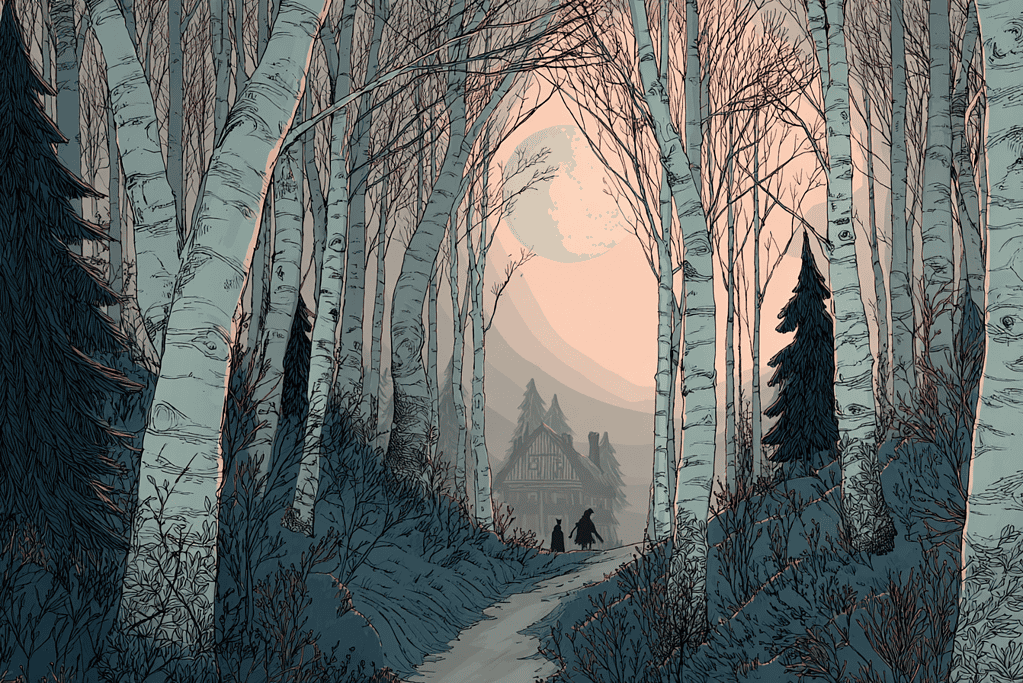
Povsic notes that the witch “roams the woods in her hut on chicken legs in search of bad children” (Povsic, 1981, p. 334).
While this is a children’s adaptation, Povsic is clear that the author blended “many variants” of the traditional tale, meaning these elements were drawn from genuine folk sources.
Most sources provide little direct explanation for why the hut has chicken legs, but the detail seems rooted in local storytelling from Russia and Ukraine.
Tales recorded in the nineteenth and twentieth centuries frequently describe the hut standing above the forest floor, avoiding contact with the ground.
Scholars who analyze Slavic folklore tend to interpret the legs symbolically rather than literally.
Across multiple stories, the hut functions as both a shelter and a trap. It can rotate, hide, or reveal itself.
This animated structure underscores the fluid nature of Slavic tales, where buildings and landscapes behave with intent.
The chicken-legged house is part of the magical imagery that continues to inspire fantasy writers and modern artists, giving baba yaga a place of power that reflects her unpredictable nature.
Worobec shows that pre-revolutionary villagers believed witches were responsible for illness, harm, and misfortune, and they were often imagined as living on the margins of communities (Worobec, 1995, pp. 166–170).
These beliefs created a social context in which a figure like Baba Yaga, a dangerous old woman living away from society which felt credible and familiar.
Worobec also illustrates how villagers saw witches as almost supernatural beings connected to nature, livestock, and the wellbeing of children (Worobec, 1995, pp. 173–176).
The scholarly writings make it clear: baba yaga is a complex character in Ukrainian and Russian stories.
Sometimes she is cruel; other times she is helpful, though never warm or gentle.
In these tales from Russia and Ukraine, she is an unpredictable old woman who tests heroes, bargains with them, or threatens them depending on her mood.
Her house plays a role in these encounters, serving as a gateway to adventures that shape the story.
These depictions rarely treat her as a simple villain. Instead, she is a figure of shifting morality. The Slavic imagination gives her layers, some rooted in fear, others in respect.
Scholars show that in east Slavic tradition, she can even take on a teaching role, forcing characters to confront challenges that build inner strength.
This makes her one of the most enduring figures in the region’s fairy tales.
All three roles appear in the research. One source highlights her frightening qualities. Indeed, she can be a fierce witch, associated with danger and darkness.
Another shows her as a guardian, someone who protects thresholds or tests visitors.
In some legendary narratives, she becomes almost a mythic grandmother, a figure who embodies old knowledge and the power of the forest.
In many tales, she acts as a villain, but even then, she does not behave predictably. Rather than pure malice, she displays an ancient, ritualistic personality.
She may offer guidance or oppose the hero depending on the myth or tale.
The ambiguity is part of her enduring charm, especially in fantasy retellings that use her unpredictability as inspiration.
The forest in Slavic stories functions as a mythical place and realm, a border between human settlements and magical realms.
Baba Yaga lives in this wilderness, far from the order of villages. Her hut stands amid deep woods where paths shift, animals speak, and travelers face tests of character.
This location mirrors the structure of many fairy tales, where heroes must leave safety behind and confront forces older than the community.
Baba Yaga’s home emphasizes that crossing into the unknown is essential for transformation.
The sources reveal how deeply the forest setting shapes the mood and purpose of these traditional stories.
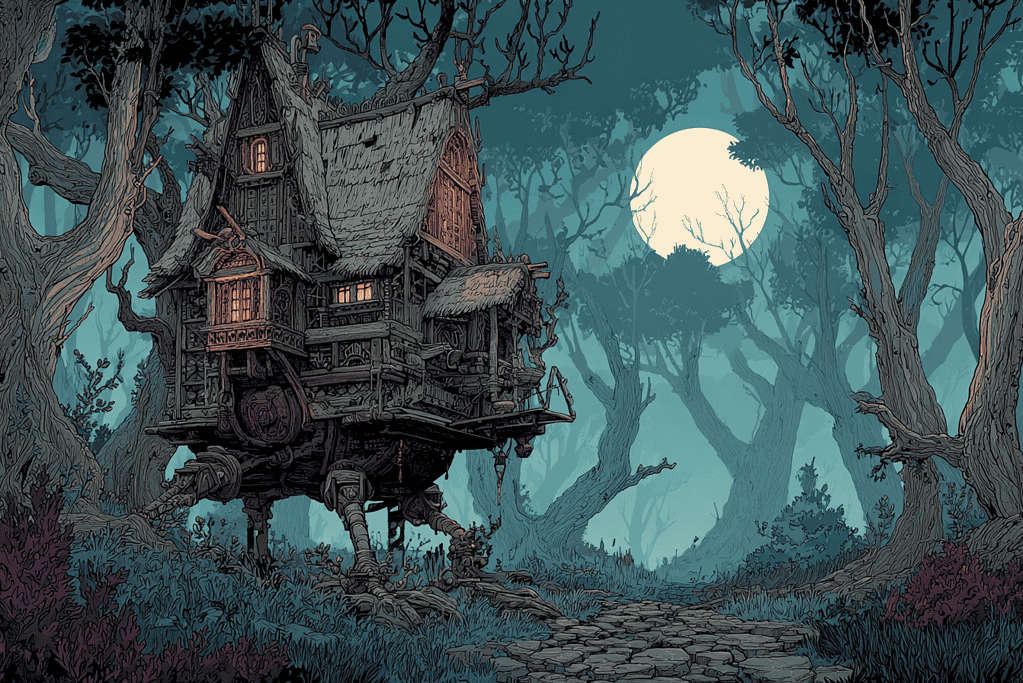
The baba yaga’s hut is both a character and a setting. It stands on chicken legs, turns at spoken commands, and watches over the surrounding wilderness.
In many tales, simply approaching it requires bravery. Its movement and unpredictability reflect the unsettling power of baba yaga herself.
Inside the hut, the visitor often finds tests, threats, or strange hospitality. Scholars note that encounters within this house rarely follow predictable patterns.
While sometimes terrifying, the dwelling can also offer refuge or answers to those who show wit and respect.
The hut becomes a physical expression of Yaga’s personality, shifting, animated, and full of contradiction.
Brian Cooper analyzes the meaning of baba and baba yaga, exploring linguistic and cultural explanations.
The word baba appears widely across Slavic languages and can refer to a grandmother, an elderly woman, or in some contexts, a supernatural crone.
The second part of her name yaga is much harder to pin down.
Cooper’s discussion shows that scholars have not reached agreement, but many theories link it to words for illness, fright, or harmful female spirits.
This ongoing scholarly debate emphasizes how old the tradition truly is.
The name is not a recent invention; it reflects layers of older Slavic belief.
Even without certainty, the debate enriches the legend surrounding her.

The texts often describe objects she carries: a mortar, pestle, and broom. These are key markers of her identity.
In some tales, she flies around in a mortar, using the pestle to steer and the broom to erase her tracks. This unusual form of movement is one of her most memorable traits.
Her hut, of course, is another symbol, sometimes adorned with a fence of skull lanterns.
These details appear in children’s literature retellings as well as scholarly summaries.
Each object deepens her connection to old Slavic beliefs and imagery.
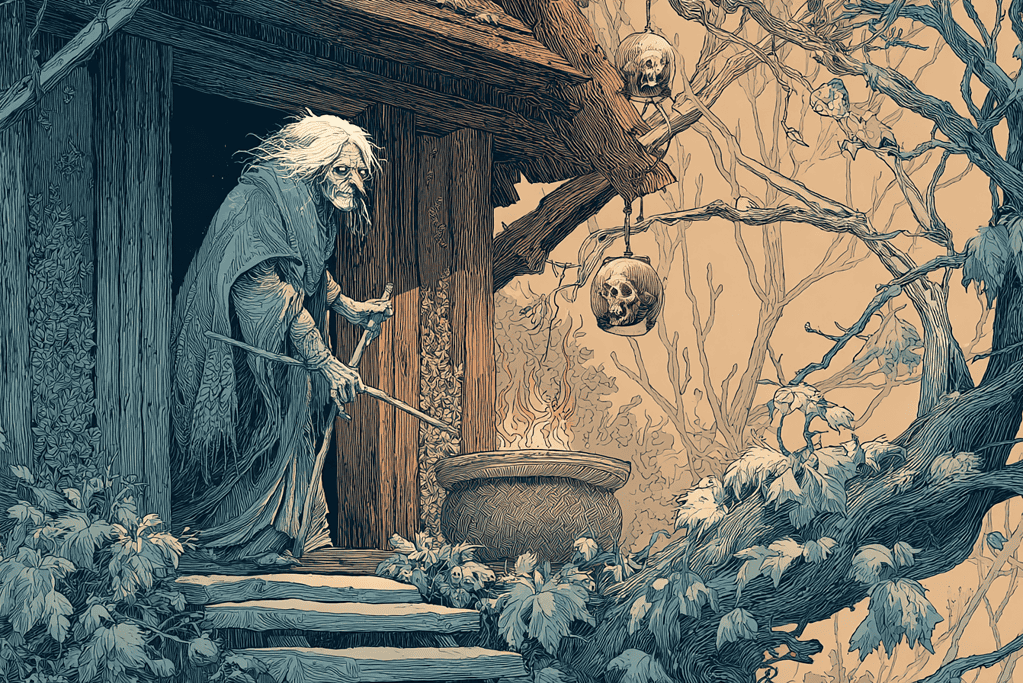
Many Slavic fairy tales about Yaga involve young heroes. This doesn’t mean she is exclusively a threat; rather, she is a kind of perfect protagonist for stories centered on fear, bravery, and cleverness.
Scholars of Russian storytelling highlight how these tales teach moral lessons: caution, independence, and resilience.
Baba Yaga often challenges protagonists to confront their fears. When they succeed, they earn magical items, knowledge, or safe passage.
When they fail, they suffer the consequences of dealing with an unpredictable supernatural force.
The presence of a grandmother figure, yet twisted into something both wise and dangerous, certainly adds emotional depth to these narratives.
Writers, artists, and creators continue to return to baba yaga’s hut because the imagery is so distinctive.
The combination of the little hut, chicken legs, dense woods, and an ancient witch fuels endless reinterpretations.
Modern fantasy novels, animations, and artwork often portray her as a powerful figure between worlds.
This makes the baba yaga hut perfect for Halloween themes, dark-retelling aesthetics, and folklore-inspired storytelling.
Her ambiguous morality also plays a role. She can be frightening or wise, monstrous or mysterious.
That flexibility keeps her timeless, a figure who continually adapts to new generations and remains central in discussions of Slavic folklore.
Cooper, B. (1997). Baba-Yaga, the Bony-Legged: A short note on the witch and her name. New Zealand Slavonic Journal, 82–88.
Povsic, F. F. (1981). Russian folk and animal tales. The Reading Teacher, 35(3), 329–343.
Worobec, C. D. (1995). Witchcraft beliefs and practices in prerevolutionary Russian and Ukrainian villages. The Russian Review, 54(2), 165–187.

ᛉ 100% handcrafted artisan pagan , viking, witchcraft and shamanic inspired jewelry.
ᛉ Runes, Symbolism & European Folklore
Get 20% off👇🏻

Five witches dance around a blazing bonfire beneath a citrine cabochon in this Walpurgisnacht pendant....
Happy washing day 🙃
A few rings I’ve worked on the last couple days…
Freya’s cats rule and dogs drool?
Or was that the other way around? 🙃

Garm barely shows up in the old Norse stories.
Still… he leaves a mark.
A...
Leave a comment with your result ❤️
Bavarian Folklore says that you might just cross paths with a Wolpertinger in the alpine...

🐇🌲✨
He finally stepped out of the forest…
The Wolpertinger Pendant has arrived.
Inspired by...

I don’t often sell them, but love it when I do!
Vinca symbol bracelets ❤️...

Rooted in strength + guarded by ravens

The serpent waits 🖤
(Handcrafted Jörmungandr ring made to order in my shop)

Stay warm, everyone ❤️

😑😑😑🤮

I thought I had closed the book on the Alice in Wonderland rings…
But you...

Can this be over now, please?

In case you forgot 💜

Something I’ve been thinking about lately.
If there’s one thing I would’ve done differently early...

This year, we’re not buying things just to keep up.
If you need the reminder:...

My husband is from Bavaria (southern Germany) and I originally made this Krampus pendant for...

Some of the items I’m shipping out today ❤️
Please forgive my dirty nails 😂...

A few items shipping out today 🥰

This mornings rings shipping out ❤️

A few of the rjngs I’m shipping out this morning ❤️
How do you like...

Krampus is coming 🫶🏻

Getting ready to pack up these pretties and ship to their owners ❤️

Freya, cats and pentacles. Doesn’t get any better ❤️

You all got me going crazy making all these fairytale + storybook rings.
But I’ll...

Just launched these pretties ❤️
Size 9 amethyst ring + size 7.25 green kyanite

What would you trade to learn Baba Yaga’s secrets?

It *finally* looks, feels and smells like October!
And here are some items I’m packing...

This mornings pretties getting ready to ship :)

Getting ready to pack up these pretties and ship to their owners ❤️

You bet I’m hopping on this trend 😂
Thank you @shes_sinister for the prompt!

While I welcome the seasonal darkness…it sure is going to make my morning quick videos...

Finally finished the rings I’ve been working on in my stories ❤️
I think I...

Was going to post this update to my stories but it’s too long.

“How do you know I’m mad?” said Alice.
“You must be,” said the Cat, “or...

Some of this mornings orders getting ready to ship. Those little bats are so cute...

Here is the finished ring I was working on in my stories yesterday, along with...

A few of today’s orders shipping out this morning ❤️

The two silver raven rings I was working on in my stories yesterday.
…as well...

Eeeek! I’m so happy to add these to my shop ❤️
I’ve gotten so many...

I had 6 clamshells ready to ship this morning but I dropped and lost my...

Not the story you were told.
The girl didn’t run.
The wolf didn’t win.
This...

I love these raven rings so much 🖤
This mornings pretties shipping out.
All items...

Sleek + minimal Mjölnir ring ⚒️


About the author Jacqueline Fatica


